
Machine Learning Course in Pune with Placement: Training, Projects & Career Support
Quick Answer
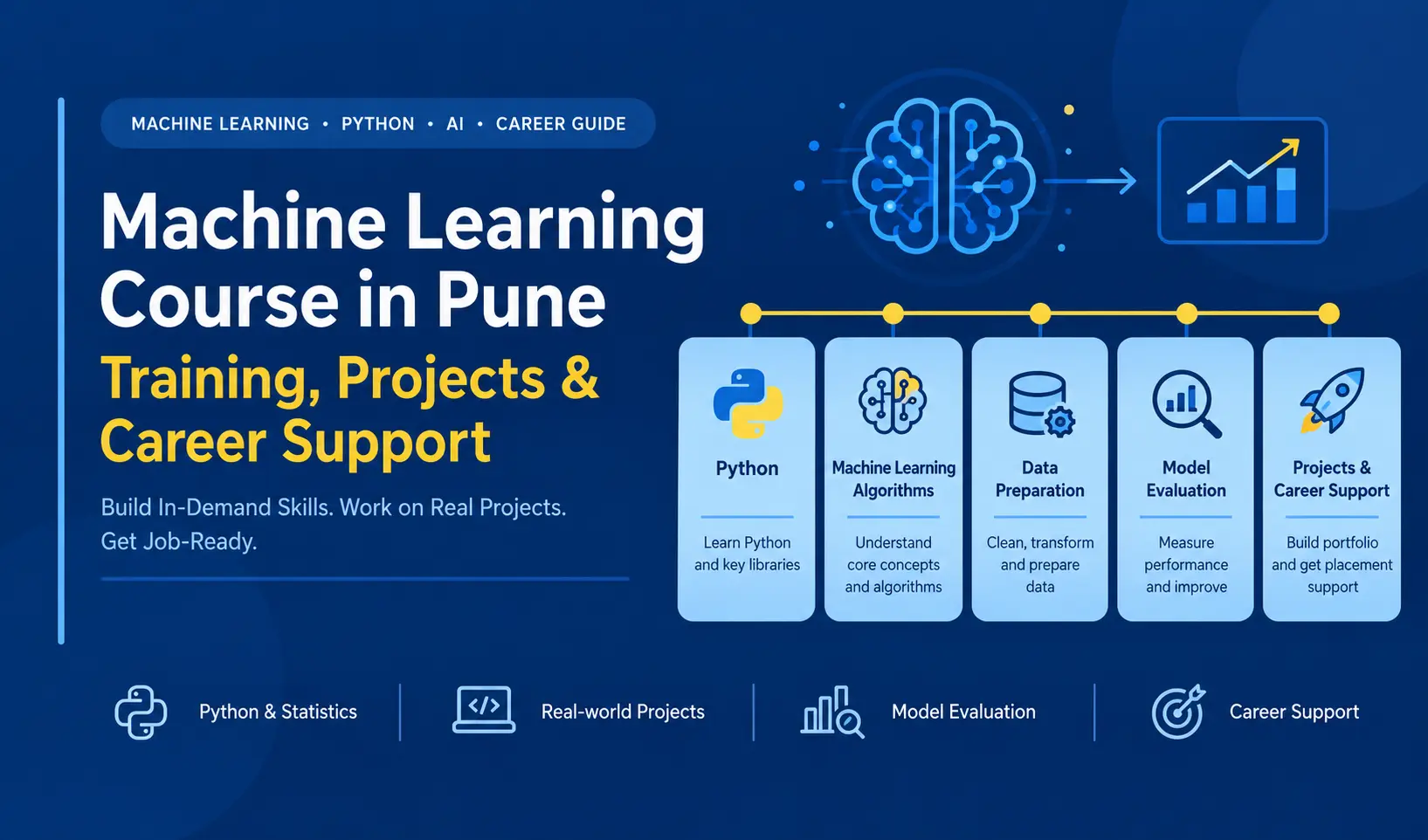
A Machine Learning Course in Pune typically covers Python, statistics, data preparation, supervised and unsupervised learning, feature engineering, model evaluation, advanced ML, and practical projects. A career-focused program may also provide certification, mentorship, resume guidance, interview preparation, and placement assistance. The best choice depends on curriculum depth, hands-on learning, project quality, career support, and the learner’s goals.
Machine Learning Course in Pune with Placement: Training, Projects & Career Support
Machine Learning has become one of the most important technologies shaping modern businesses. From recommendation engines and fraud detection to predictive analytics, automation, customer personalization, and intelligent applications, organizations are increasingly using machine learning to make better decisions and automate complex tasks.
For students and professionals planning a career in AI and data, learning machine learning is no longer limited to understanding algorithms. Employers increasingly look for candidates who can work with data, build models, evaluate results, solve practical problems, and explain their solutions clearly.
This is where a structured Machine Learning Course in Pune can make a difference. A well-designed program should combine programming fundamentals, machine learning concepts, hands-on projects, model evaluation, practical tools, and career guidance.
At IntelliBI Innovations Technologies, the focus is on helping learners connect theoretical knowledge with practical implementation. The objective is to help students develop skills they can apply to real-world machine learning problems while preparing for the expectations of technology-driven careers.
What Is Machine Learning?
Machine Learning is a branch of artificial intelligence that enables computer systems to identify patterns in data and use those patterns to make predictions or decisions.
Traditional software generally follows explicitly programmed rules. Machine learning systems, in contrast, can learn patterns from examples and use those patterns when processing new data.
For example, a machine learning model can be trained to:
- Predict customer churn
- Identify fraudulent transactions
- Recommend products
- Forecast sales
- Classify emails
- Predict house prices
- Analyze customer sentiment
- Detect unusual activity
- Categorize documents
The quality of a machine learning solution depends on more than the algorithm. Data preparation, feature selection, model evaluation, validation, deployment, and monitoring are all important parts of the process.
Why Learn Machine Learning in Pune?
Pune has a strong technology and education ecosystem, creating interest in areas such as artificial intelligence, data science, cloud computing, analytics, and software development.
Learners searching for Machine Learning Classes in Pune often come from different backgrounds. Some are fresh graduates, while others are software developers, data analysts, engineers, or working professionals looking to expand their technical skills.
A structured learning program can help learners follow a progressive path instead of studying individual algorithms without understanding how they fit into a complete machine learning workflow.
The right training should help learners move through the journey from understanding a business problem to preparing data, developing a model, evaluating its performance, and communicating the outcome.
What Will You Learn in Machine Learning Training?
A comprehensive Machine Learning Training in Pune should cover both fundamental concepts and practical implementation.
Python for Machine Learning
Python is widely used in machine learning because of its extensive ecosystem and accessibility.
Learners should become comfortable with:
- Variables and data types
- Conditional statements
- Loops
- Functions
- Data structures
- Object-oriented programming
- File handling
- Exception handling
- Modules and packages
- Virtual environments
Python libraries such as NumPy and Pandas can then be introduced for numerical computing and data manipulation.
The objective is not simply to learn Python syntax. Learners should understand how to use Python to clean data, analyze datasets, implement workflows, and build machine learning applications.
Statistics and Mathematics
A machine learning program should also introduce the mathematical and statistical concepts required to understand model behavior.
Important areas can include:
- Mean, median, and variance
- Probability
- Distributions
- Correlation
- Sampling
- Hypothesis testing
- Linear algebra fundamentals
- Optimization concepts
Learners do not necessarily need advanced mathematics before starting machine learning. However, understanding the relevant fundamentals can make model interpretation and algorithm selection easier.
Understanding the Machine Learning Lifecycle
One of the most important skills is understanding the complete machine learning lifecycle.
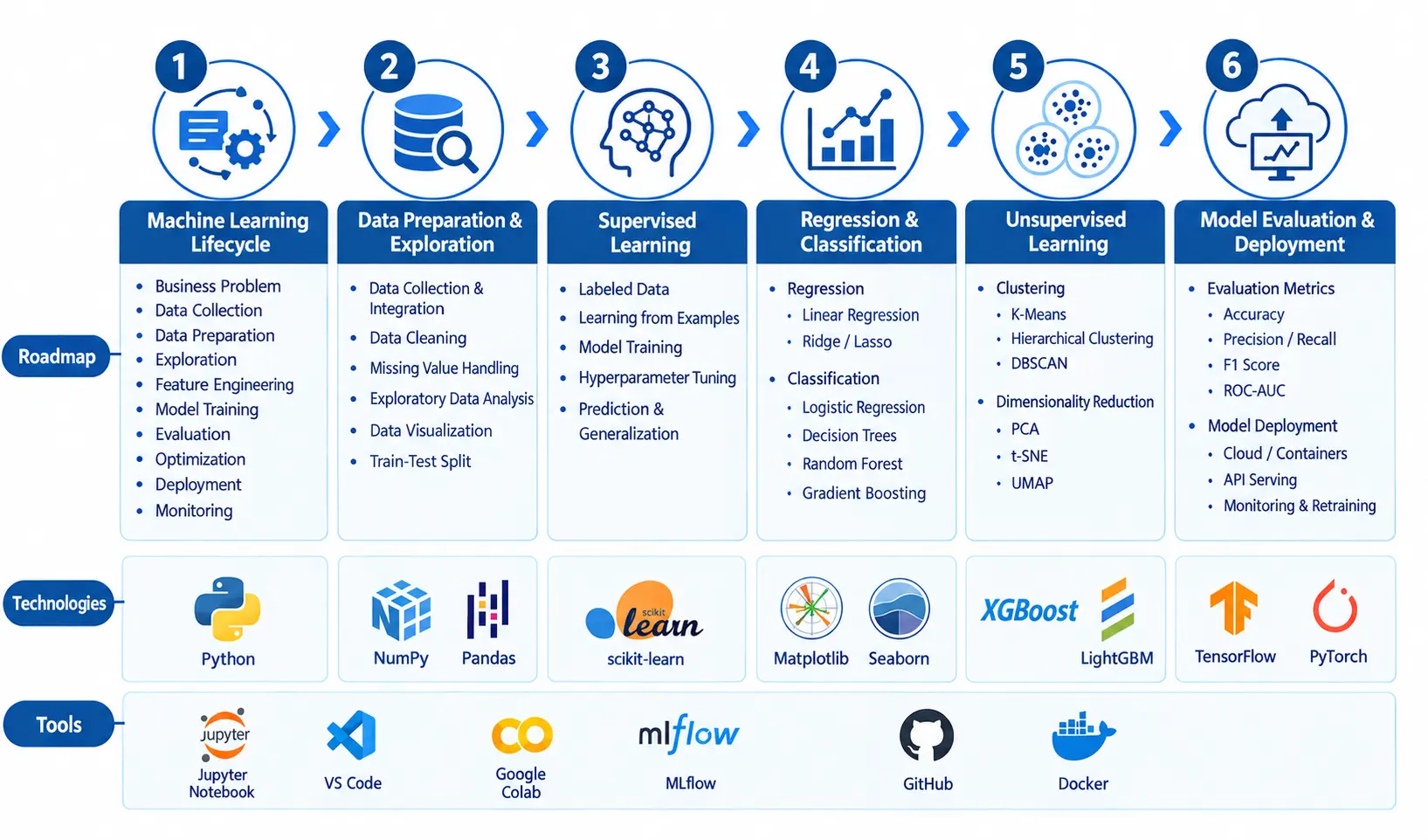
A typical workflow includes:
Business Problem → Data Collection → Data Preparation → Exploration → Feature Engineering → Model Training → Evaluation → Optimization → Deployment → Monitoring
This process demonstrates why machine learning is more than simply selecting an algorithm.
For example, if a company wants to predict customer churn, an AI professional first needs to understand what “churn” means for the business. The data must then be collected and cleaned, relevant variables identified, a model trained, and its predictions evaluated.
A technically sophisticated algorithm cannot compensate for a poorly defined problem or unreliable data.
Supervised Learning
Supervised learning involves training a model using data where the desired outcome is known.
Two major supervised learning categories are regression and classification.
Regression
Regression models are used when the target is a numerical value.
Examples include:
- Sales forecasting
- House price prediction
- Demand estimation
- Revenue prediction
Learners may explore algorithms such as linear regression, decision tree regression, random forests, and gradient boosting.
Classification
Classification models predict categories or classes.
Applications include:
- Spam detection
- Customer churn prediction
- Fraud detection
- Sentiment classification
- Loan risk classification
Common algorithms include logistic regression, decision trees, random forests, support vector machines, and ensemble methods.
Understanding why and when to use each algorithm is more valuable than simply memorizing algorithm names.
Unsupervised Learning
Not every dataset contains predefined target labels.
Unsupervised learning techniques can help identify patterns or groups within data.
Important techniques include:
- K-Means clustering
- Hierarchical clustering
- Principal Component Analysis
- Dimensionality reduction
For example, a business might use clustering to divide customers into groups based on purchasing behavior. Marketing teams can then develop different strategies for different customer segments.
Feature Engineering and Data Preparation
Data preparation often determines how effectively a machine learning model performs.
Real-world datasets may contain missing values, duplicate records, inconsistent formats, outliers, and irrelevant variables.
Learners should understand techniques such as:
- Missing-value treatment
- Data transformation
- Encoding categorical variables
- Feature scaling
- Outlier analysis
- Feature selection
- Feature creation
Feature engineering is particularly valuable because domain knowledge can help transform raw data into more meaningful inputs for a model.
Model Evaluation and Validation
A machine learning model should not be judged solely by whether it produces predictions.
Learners need to understand how to evaluate performance using appropriate metrics.
For classification, metrics can include:
- Accuracy
- Precision
- Recall
- F1-score
- ROC-AUC
- Confusion matrix
For regression, common measures include:
- Mean Absolute Error
- Mean Squared Error
- Root Mean Squared Error
- R-squared
The appropriate metric depends on the business problem.
For example, in certain fraud detection scenarios, identifying fraudulent transactions may be more important than maximizing overall accuracy. Understanding such trade-offs helps learners approach machine learning from a practical perspective.
Advanced Machine Learning Concepts
Once the fundamentals are established, learners can move toward advanced topics.
An advanced machine learning course in Pune may explore areas such as:
- Ensemble learning
- Random forests
- Gradient boosting
- Hyperparameter tuning
- Cross-validation
- Feature selection
- Model interpretability
- Handling imbalanced datasets
- Model optimization
- Pipeline development
Learners can also explore how machine learning models are integrated into applications.
The objective of advanced training should be to improve problem-solving ability rather than simply increasing the number of algorithms covered.
Machine Learning Projects: From Theory to Practice
Projects are an essential component of effective machine learning education.
A project gives learners an opportunity to work through the complete development lifecycle.
Customer Churn Prediction
A churn prediction project can involve:
- Understanding customer behavior
- Cleaning the dataset
- Performing exploratory analysis
- Engineering useful features
- Training classification models
- Comparing model performance
- Identifying important predictors
- Presenting business recommendations
House Price Prediction
A regression project can demonstrate:
- Data cleaning
- Exploratory data analysis
- Feature engineering
- Regression modeling
- Model evaluation
- Prediction
Fraud Detection
Fraud detection can introduce important concepts such as imbalanced datasets, precision, recall, threshold selection, and model evaluation.
Recommendation System
A recommendation project can demonstrate how machine learning can personalize content or products based on user behavior.
Projects like these can help learners build a portfolio that demonstrates practical skills.
Why Projects Matter for Career Preparation
Completing a project is different from simply downloading a dataset and training a model.
A strong project should explain:
- What problem is being solved?
- Why does the problem matter?
- What data was used?
- How was the data prepared?
- Why was a particular model selected?
- How was performance measured?
- What limitations exist?
- How could the solution be improved?
These questions also become useful during technical interviews.
When evaluating the best machine learning course in Pune for their goals, learners should therefore look at the depth and relevance of project work rather than focusing only on the number of topics listed in the syllabus.
Machine Learning Course in Pune with Placement: What Should Career Support Include?
Placement support can be an important consideration when selecting a training program. However, learners should understand what the support actually includes.
A machine learning course in Pune with placement may provide career-oriented assistance such as:
- Resume guidance
- Interview preparation
- Technical interview practice
- Project presentation guidance
- Portfolio development
- Communication preparation
- Job-readiness sessions
- Guidance on relevant career paths
- Placement assistance
Career support works best when it is combined with practical technical skills.
A learner who understands machine learning concepts, can explain projects, and can demonstrate practical problem-solving skills is better prepared to participate in technical hiring processes.
Who Should Join a Machine Learning Course?
Machine learning is relevant to learners from several backgrounds.
Fresh Graduates
Graduates from computer science, IT, engineering, mathematics, statistics, and related disciplines can build machine learning skills as part of their career preparation.
Software Developers
Developers can combine their programming experience with machine learning knowledge to build intelligent applications.
Data Analysts
Data analysts can expand their existing analytical skills into predictive modeling and machine learning.
Working Professionals
Professionals can use machine learning training to strengthen their technical profile or explore opportunities in AI and data-driven roles.
Career Switchers
Professionals planning a transition into AI or data careers can use structured training and practical projects to build relevant skills.
Machine Learning Classes in Pimpri Chinchwad
Learners based around the broader Pune technology region may also search for machine learning classes in Pimpri Chinchwad.
When comparing programs, location is only one factor. Learners should also consider curriculum depth, hands-on projects, instructor guidance, practical tools, learning format, career support, and opportunities to apply concepts.
A strong learning experience should make it possible for students to progress from fundamentals to practical machine learning implementation.
Online Machine Learning Learning Options
For professionals or learners who cannot attend classroom sessions regularly, an online machine learning course with placement can offer greater flexibility.
Online learning can be effective when it includes:
- Live or structured instruction
- Practical assignments
- Project guidance
- Doubt resolution
- Mentorship
- Assessments
- Career support
The key consideration should be the quality of learning and practical engagement rather than whether the program is online or classroom-based.
Machine Learning Certification: Is It Enough?
A machine learning certification course in Pune can help demonstrate structured learning and provide a formal credential.
However, certification alone does not demonstrate every practical skill required for a machine learning role.
Learners should aim to combine certification with:
- Strong Python skills
- Machine learning fundamentals
- Practical projects
- Model evaluation knowledge
- Data preparation skills
- Portfolio development
- Interview preparation
A certificate can complement a portfolio, but practical capability should remain a central part of career preparation.
How to Choose the Right Machine Learning Course in Pune
Before enrolling in a program, learners can evaluate the following areas.
1. Curriculum
Does the course cover Python, statistics, machine learning algorithms, data preparation, evaluation, and advanced concepts?
2. Practical Training
Are learners actually building models and applications?
3. Projects
Are the projects based on realistic business problems?
4. Mentorship
Can learners receive guidance when they encounter implementation challenges?
5. Career Support
Does the program include resume, interview, and placement-oriented assistance?
6. Learning Format
Does the course format fit the learner's schedule and learning style?
7. Portfolio Development
Does the training help learners document and present their projects professionally?
These factors can provide a more meaningful basis for comparing different programs than course duration or promotional claims alone.
Why Choose IntelliBI Innovations Technologies?
IntelliBI Innovations Technologies focuses on practical, career-oriented technology learning. The objective is to help learners develop skills that can be applied to real-world technology problems.
The Machine Learning Course in Pune provides a structured learning path for understanding machine learning concepts and applying them through practical work.
Learners interested in an advanced machine learning course in Pune can explore how advanced concepts build upon fundamental machine learning knowledge.
Professionals looking for Machine Learning Training in Pune can also consider how structured training, practical projects, mentorship, and career guidance can support their learning journey.
Career Opportunities After Machine Learning Training
Machine learning knowledge can contribute to several technology career paths, depending on a learner's background and level of expertise.
Potential roles include:
- Machine Learning Engineer
- AI Engineer
- Data Scientist
- Junior Data Scientist
- ML Developer
- Data Analyst with ML skills
- AI Application Developer
- NLP Engineer
- Computer Vision Engineer
- Machine Learning Consultant
The responsibilities and requirements for these roles vary between organizations.
Learners should therefore review job descriptions and identify the technical skills commonly requested for their target roles.
From Learning Algorithms to Solving Problems
Machine learning education should ultimately be about problem-solving.
Knowing how a decision tree works is useful. Knowing when to use it, how to prepare the data, how to evaluate its performance, and how to explain its limitations is more valuable.
Similarly, understanding Python syntax is important, but using Python to build a reliable machine learning workflow is the practical objective.
This is why project-based Machine Learning Classes in Pune can provide an important bridge between theoretical concepts and practical application.
Build Your Machine Learning Career Step by Step
Machine learning is a broad field, and learners do not need to master everything simultaneously.
A practical progression can look like this:
Step 1: Learn Python fundamentals.
Step 2: Build basic statistics and data analysis knowledge.
Step 3: Learn supervised and unsupervised machine learning.
Step 4: Practice data preparation and feature engineering.
Step 5: Learn model evaluation and optimization.
Step 6: Build multiple practical projects.
Step 7: Explore advanced machine learning concepts.
Step 8: Develop a professional portfolio.
Step 9: Prepare for technical interviews.
Step 10: Continue learning through real-world applications.
This approach creates a stronger foundation than attempting to learn advanced topics without understanding the basics.
Conclusion
A Machine Learning Course in Pune can provide a structured pathway for learners who want to develop skills in Python, data preparation, machine learning algorithms, model evaluation, advanced techniques, and practical application development.
For students, freshers, working professionals, and career switchers, the combination of training and project experience can help build a more complete technical profile.
When evaluating a machine learning course in Pune with placement, learners should consider the complete experience: curriculum, practical training, projects, mentorship, certification, career guidance, interview preparation, and placement assistance.
At IntelliBI Innovations Technologies, the focus remains on helping learners move beyond theory and develop practical, career-oriented machine learning skills.
The goal is simple: learn the fundamentals, practice consistently, build meaningful projects, understand how machine learning solves business problems, and continue developing the skills required for an evolving AI and data ecosystem.