
Generative AI Course in Pune: Complete Roadmap to LLMs, RAG & AI Agents
Quick Answer
A Generative AI Course in Pune can prepare learners to build modern AI applications using Python, prompt engineering, Large Language Models (LLMs), RAG, vector databases, LangChain, and AI agents. A career-focused program should combine concepts with hands-on projects, deployment practices, and interview preparation. IntelliBI Innovations Technologies offers practical, industry-oriented AI learning designed for students, professionals, and career switchers.
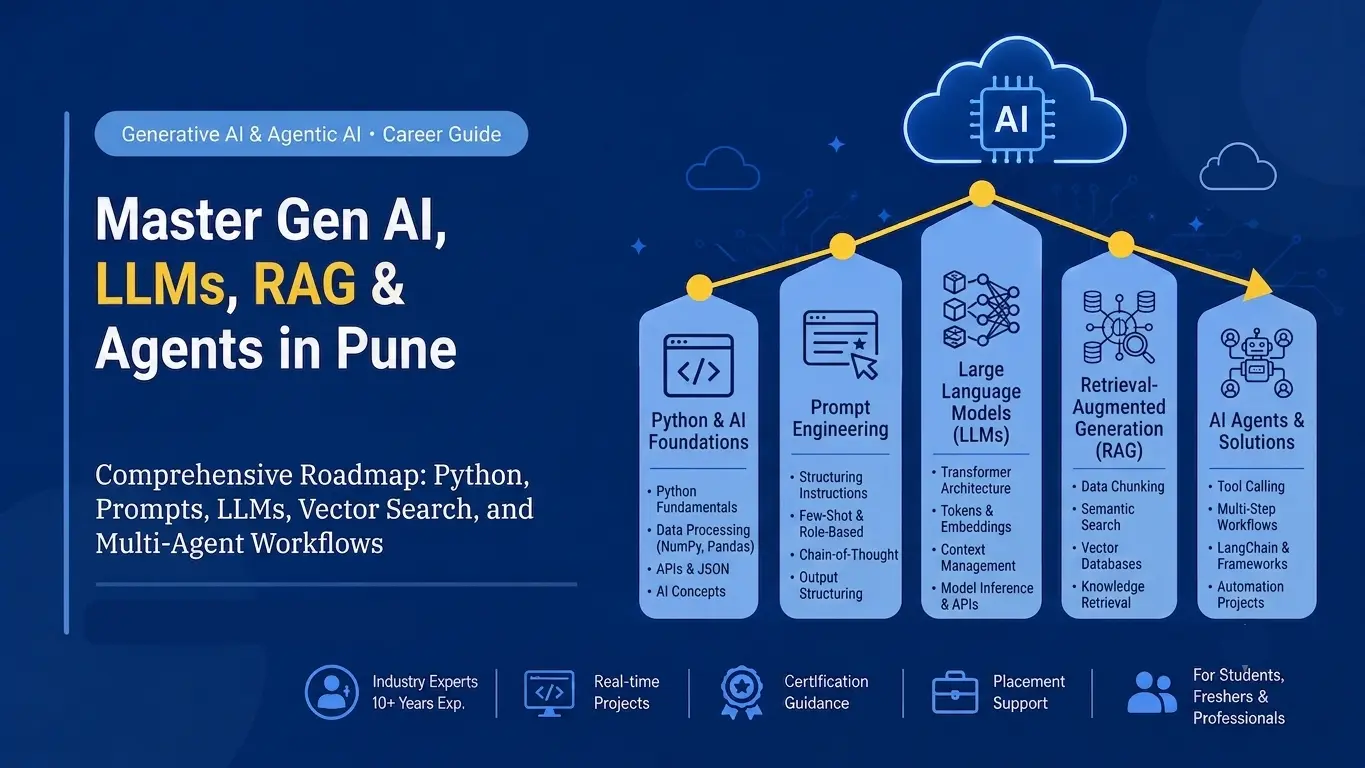
Artificial Intelligence has moved beyond traditional machine learning. Today, Generative AI can create text, images, code, summaries, recommendations, and intelligent responses within seconds. Businesses are increasingly exploring Large Language Models, Retrieval-Augmented Generation, AI assistants, and autonomous AI agents to improve productivity and automate complex workflows.
For students, technology professionals, and career switchers, this transformation creates an important opportunity: learning how modern Generative AI systems are actually built.
A structured Generative AI Course in Pune can help learners progress from fundamental concepts to advanced technologies such as LLMs, RAG, vector databases, prompt engineering, and AI agents.
But learning Generative AI is not simply about using ChatGPT or writing prompts. A professional learning path should explain what happens behind the interface and teach learners how to develop practical AI applications.
Why Learn Generative AI in 2026?
Generative AI is becoming part of software development, marketing, finance, healthcare, education, customer service, analytics, and many other industries.
Organizations are experimenting with AI-powered:
- Customer support assistants
- Document analysis systems
- Enterprise chatbots
- Code generation tools
- Knowledge management platforms
- Content automation
- Business intelligence assistants
- Workflow automation
- Personalized recommendation systems
This growing adoption means professionals need more than basic AI awareness. They need practical skills to understand models, data, prompts, retrieval systems, APIs, and AI application architecture.
This is why Generative AI Training in Pune is becoming relevant for both technology professionals and learners entering the AI ecosystem.
What Does a Generative AI Course in Pune Cover?
A good program should provide a structured progression rather than immediately jumping into advanced AI frameworks.
The learning journey can be divided into several stages.
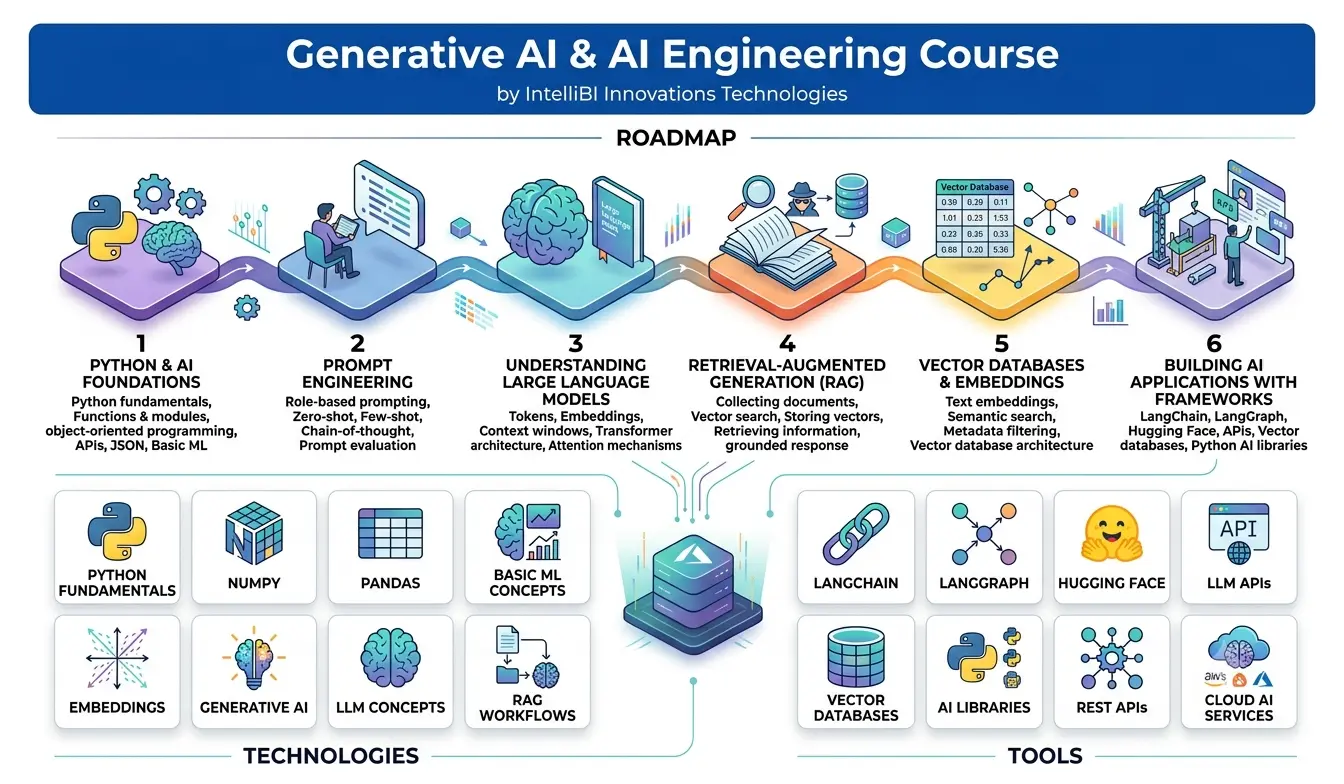
Stage 1: Python and AI Foundations
Python is one of the most important programming languages for modern AI development.
Learners should understand:
- Python fundamentals
- Functions and modules
- Object-oriented programming
- NumPy
- Pandas
- APIs
- JSON
- Data processing
- Basic machine learning concepts
These fundamentals make it easier to work with AI models and development frameworks.
For beginners, Generative AI Classes in Pune should therefore begin with the programming and AI concepts required to understand what happens behind an AI application.
Stage 2: Prompt Engineering
Prompt engineering is an important skill for working effectively with Generative AI models.
Instead of simply asking a model a question, professionals learn how to structure instructions, provide context, define expected outputs, and improve response quality.
A Prompt Engineering Course in Pune may cover concepts such as:
- Role-based prompting
- Zero-shot prompting
- Few-shot prompting
- Chain-of-thought-style task decomposition
- Structured outputs
- Context management
- Prompt evaluation
- System instructions
- AI workflow design
However, prompt engineering should be considered one component of Generative AI development rather than the entire skill set.
Stage 3: Understanding Large Language Models
Large Language Models, commonly called LLMs, are at the center of many Generative AI applications.
A learner searching for an LLM Course in Pune should understand how language models process information and generate responses.
Important concepts include:
- Tokens
- Embeddings
- Context windows
- Transformer architecture
- Attention mechanisms
- Model inference
- Fine-tuning concepts
- Model evaluation
- APIs
- Open-source and commercial models
Understanding these concepts helps learners move from simply using AI tools to building applications around them.
Stage 4: Retrieval-Augmented Generation (RAG)
One of the most important concepts in enterprise Generative AI is Retrieval-Augmented Generation.
LLMs have limitations. A model may not know private organizational information, internal documents, or recently updated data. RAG helps address this challenge by retrieving relevant information from an external knowledge source before generating an answer.
A typical RAG workflow includes:
- Collecting documents
- Cleaning and processing data
- Splitting documents into chunks
- Creating embeddings
- Storing vectors
- Performing similarity searches
- Retrieving relevant information
- Providing retrieved context to the LLM
- Generating a grounded response
This approach can be used to create applications such as internal knowledge assistants, document question-answering systems, and intelligent support tools.
For this reason, RAG should be an important component of advanced Generative AI Training in Pune.
Stage 5: Vector Databases and Embeddings
RAG applications depend heavily on embeddings and vector search.
Embeddings represent information as numerical vectors that capture semantic relationships. These vectors can then be stored in vector databases and searched based on similarity.
Learners should become familiar with:
- Text embeddings
- Semantic search
- Vector indexing
- Similarity search
- Metadata filtering
- Document retrieval
- Vector database architecture
These concepts provide the technical foundation for building knowledge-based AI applications.
Stage 6: Building AI Applications with Frameworks
Once learners understand LLMs and RAG, the next step is application development.
Modern AI frameworks can simplify the process of connecting models with tools, databases, documents, APIs, and business workflows.
Depending on the program, learners may explore technologies such as:
- LangChain
- LangGraph
- Hugging Face
- LLM APIs
- Vector databases
- Python AI libraries
- REST APIs
- Cloud AI services
The objective should not be to memorize frameworks. Instead, learners should understand how these components work together to create useful AI applications.
Generative AI and Agentic AI Course in Pune
The next evolution beyond basic AI assistants is agentic AI.
Traditional Generative AI applications generally respond to user instructions. AI agents can go further by planning tasks, using tools, accessing information, making decisions within defined boundaries, and completing multi-step workflows.
A Generative AI and Agentic AI Course in Pune can introduce learners to concepts such as:
- AI agents
- Tool calling
- Function calling
- Agent workflows
- Memory
- Planning
- Multi-step reasoning
- API integration
- Workflow automation
- Human-in-the-loop systems
For example, an AI agent could receive a business request, retrieve relevant information, call an external service, process the result, and generate a final response.
This makes agentic AI an important skill for professionals preparing for the next generation of AI applications.
Projects to Build During Generative AI Training
Practical projects are one of the best ways to demonstrate AI skills.
A career-focused program should encourage learners to build projects such as:
1. Document Question-Answering Assistant
Build a RAG application that allows users to upload documents and ask questions about their content.
2. Customer Support AI Assistant
Create an intelligent assistant that uses a knowledge base to answer customer queries.
3. AI Resume Analyzer
Develop an application that analyzes resumes against job descriptions and provides structured feedback.
4. AI Data Assistant
Build an assistant capable of interacting with structured datasets and answering business questions.
5. AI Agent Workflow
Create an agent that can use multiple tools to perform a predefined business workflow.
These projects can strengthen a learner's portfolio and provide useful discussion points during interviews.
Online Generative AI Course for Working Professionals
Working professionals often want to learn AI without leaving their current jobs.
An Online Generative AI Course can provide flexibility through live sessions, practical assignments, recorded learning resources, and project-based practice.
Professionals from software development, analytics, marketing, testing, data engineering, business analysis, and other technology-related backgrounds can use Generative AI skills to improve productivity or transition into emerging AI roles.
However, online learning should still include practical implementation, mentor guidance, assignments, and project evaluation.
How to Choose the Best Generative AI Course in Pune
Choosing a program only because it contains the words "Generative AI" may not be enough.
Before enrolling, evaluate whether the program includes:
- Python foundations
- Machine learning basics
- Prompt engineering
- LLM concepts
- Embeddings
- RAG
- Vector databases
- AI frameworks
- API integration
- AI agents
- Real-world projects
- Deployment concepts
- Interview preparation
- Career guidance
The Best Generative AI Course in Pune should balance theory, coding, application development, and practical problem-solving.
Why Choose an AI Training Institute in Pune?
A professional AI Training Institute in Pune can provide a structured learning environment that is difficult to achieve through random online tutorials.
IntelliBI Innovations Technologies focuses on practical, industry-oriented technology education. Learners can develop skills through structured training, hands-on assignments, real-world projects, mentorship, and career preparation.
The objective is to help learners understand not only what a technology does, but also how it can be applied to real business problems.
Career Opportunities After Learning Generative AI
Generative AI skills can complement several existing technology roles.
Depending on experience and specialization, learners can explore paths such as:
- Generative AI Developer
- AI Engineer
- Machine Learning Engineer
- LLM Application Developer
- AI Solutions Developer
- Prompt Engineer
- AI Automation Developer
- Data Scientist
- AI Consultant
Career outcomes depend on prior experience, technical depth, project quality, interview performance, and the ability to apply AI to practical problems.
A Practical Roadmap to Become Generative AI Ready
A simple learning roadmap can look like this:
Step 1: Learn Python and programming fundamentals.
Step 2: Understand machine learning and data concepts.
Step 3: Master prompt engineering and LLM fundamentals.
Step 4: Learn embeddings, vector databases, and semantic search.
Step 5: Build RAG applications.
Step 6: Learn AI application frameworks and APIs.
Step 7: Explore AI agents and tool-based workflows.
Step 8: Build multiple portfolio projects.
Step 9: Learn deployment and production considerations.
Step 10: Prepare for technical interviews and demonstrate projects professionally.
This progressive approach is more effective than trying to learn every AI tool simultaneously.
Frequently Asked Questions
Is a Generative AI Course in Pune suitable for beginners?
Yes. Beginners can start with Python and AI fundamentals before progressing toward prompt engineering, LLMs, RAG, and AI agents. A structured learning path makes advanced concepts easier to understand.
What is the difference between Generative AI and Agentic AI?
Generative AI focuses primarily on producing content or responses, while agentic AI applications can use models together with tools, workflows, data sources, and actions to complete multi-step tasks.
Do I need Python to learn Generative AI?
Python is highly recommended for anyone who wants to develop AI applications. While users can explore AI tools without programming, development-oriented careers generally require programming knowledge.
Is an LLM Course in Pune useful for working professionals?
Yes. Professionals can use LLM knowledge to build AI assistants, automate workflows, develop intelligent applications, and enhance existing technical skills.
What should I look for in Generative AI Classes in Pune?
Look for practical training covering LLMs, prompt engineering, RAG, embeddings, vector databases, AI frameworks, agents, APIs, and real-world projects rather than only theoretical demonstrations.
Conclusion
Generative AI is creating a new generation of intelligent applications, and the technology is evolving rapidly. Learning how to use AI tools is only the beginning. Professionals who understand LLMs, prompt engineering, RAG, vector databases, APIs, and AI agents can move toward building practical AI solutions.
A well-designed Generative AI Course in Pune should therefore provide a complete journey from programming fundamentals to advanced AI application development.
At IntelliBI Innovations Technologies, the focus is on practical, industry-oriented learning that helps students, professionals, and career switchers develop relevant technology skills through structured training and projects.
Whether you are beginning your AI journey, upgrading your existing technical skills, or exploring a career in Generative AI and Agentic AI, the right roadmap can help you progress with greater clarity and confidence.
Start with the fundamentals, build real projects, understand how LLM-powered systems work, and gradually move toward RAG and AI agents. The future of AI belongs not only to people who use intelligent tools, but also to professionals who understand how to build and apply them.