
Artificial Intelligence vs Machine Learning vs Deep Learning: Complete Comparison
Quick Answer
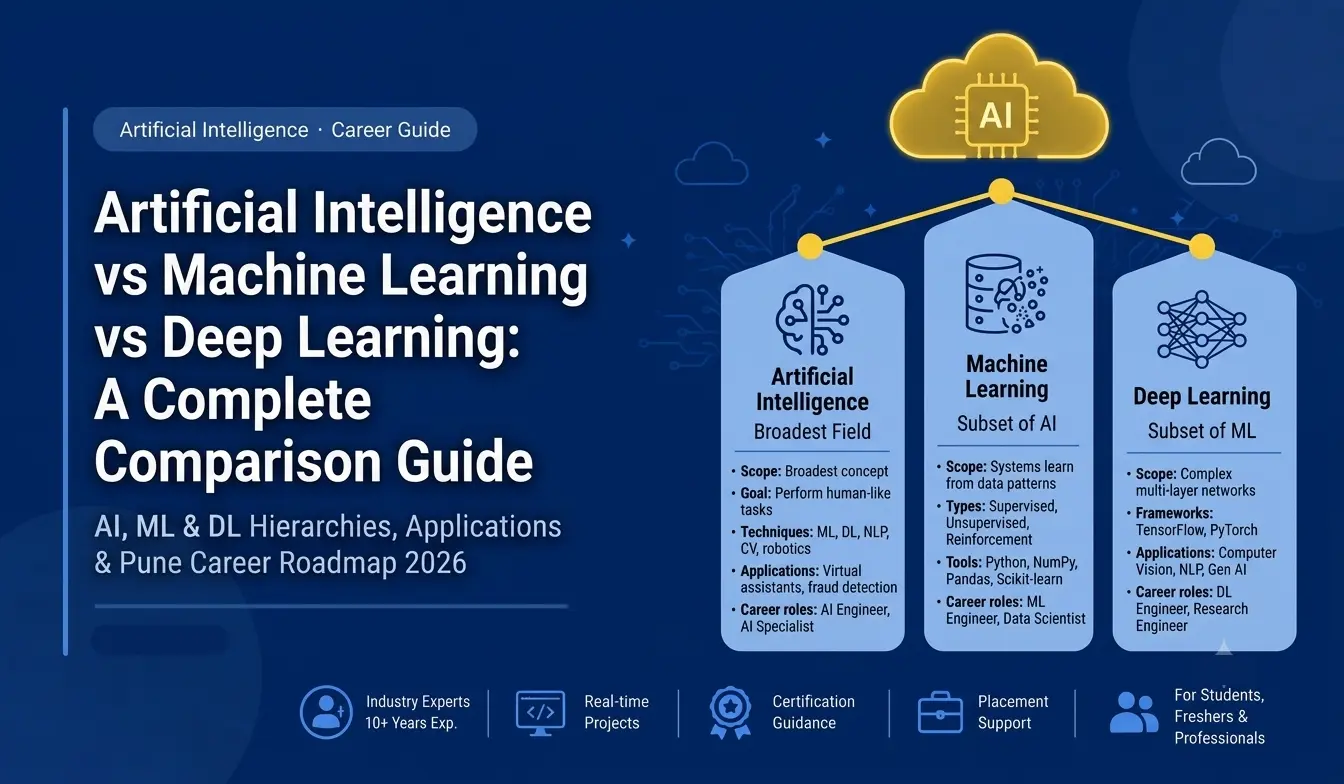
Artificial Intelligence (AI) is the broad field of creating machines that perform tasks requiring human-like intelligence. Machine Learning (ML) is a subset of AI that enables systems to learn patterns from data, while Deep Learning (DL) is a subset of ML that uses multi-layer neural networks to solve complex problems. In simple terms: AI is the broader concept, ML is a learning approach within AI, and Deep Learning is a specialized ML technique.
Artificial Intelligence is no longer a futuristic concept limited to research laboratories. From intelligent chatbots and recommendation engines to autonomous systems, fraud detection, healthcare applications, and Generative AI, intelligent technologies are becoming part of everyday business.
But as you explore this rapidly growing field, you will frequently encounter three terms: Artificial Intelligence, Machine Learning, and Deep Learning.
Are they the same thing?
Not exactly.
Although these technologies are closely connected, they represent different levels and approaches within the broader field of intelligent computing. Understanding their differences is important if you are planning to start an AI career, choose an AI Course Pune program, or transition into a Machine Learning or AI Engineer role.
This guide explains AI vs Machine Learning vs Deep Learning in simple terms, compares their technologies and applications, and provides a practical career roadmap for aspiring professionals.
What Is Artificial Intelligence?
Artificial Intelligence, commonly known as AI, is the broadest concept among the three.
AI refers to the development of computer systems capable of performing tasks that normally require human intelligence. These tasks can include understanding language, recognising images, making decisions, solving problems, predicting outcomes, and learning from information.
AI systems can be designed to reason, plan, perceive their environment, communicate with people, and automate complex processes.
Examples of AI include:
- Virtual assistants
- AI chatbots
- Recommendation systems
- Fraud detection
- Autonomous vehicles
- Intelligent search
- AI-powered customer support
- Generative AI applications
For someone considering Artificial Intelligence Training in Pune, it is important to understand that AI is not one single technology. It is an ecosystem that includes Machine Learning, Deep Learning, Natural Language Processing, Computer Vision, Generative AI, robotics, and other intelligent computing techniques.
What Is Machine Learning?
Machine Learning is a subset of Artificial Intelligence.
Instead of explicitly programming a computer with rules for every possible situation, Machine Learning enables systems to learn patterns from data and use those patterns to make predictions or decisions.
For example, imagine a company wants to identify fraudulent transactions.
A traditional program might use manually defined rules. A Machine Learning model, on the other hand, can analyse historical transaction data and learn patterns associated with fraudulent behaviour.
Machine Learning is commonly divided into:
Supervised Learning
The model learns from labelled data.
Examples include:
- Sales prediction
- Customer churn prediction
- Credit risk assessment
- Spam detection
- House price prediction
Unsupervised Learning
The model identifies patterns or groups within data without predefined labels.
Examples include:
- Customer segmentation
- Market basket analysis
- Anomaly detection
- Clustering
Reinforcement Learning
The system learns through interaction with an environment, receiving rewards or penalties based on its actions.
Reinforcement Learning is used in areas such as robotics, recommendation systems, gaming, and autonomous decision-making.
A Machine Learning Course in Pune should therefore go beyond theoretical algorithms and introduce learners to Python, statistics, data preparation, model development, evaluation, and real-world projects.
What Is Deep Learning?
Deep Learning is a specialized subset of Machine Learning.
It uses artificial neural networks containing multiple layers to learn increasingly complex patterns from large amounts of data.
Deep Learning has become particularly powerful for tasks involving unstructured information such as images, audio, and natural language.
Applications include:
- Facial recognition
- Speech recognition
- Medical image analysis
- Autonomous vehicles
- Language translation
- Generative AI
- Large Language Models
- Image generation
- Voice assistants
Deep Learning models often require significant amounts of training data and computational resources.
Popular Deep Learning frameworks include TensorFlow and PyTorch.
For professionals planning an advanced machine learning course in Pune, Deep Learning is an important specialization to consider after developing strong foundations in Python, mathematics, statistics, and Machine Learning.
AI vs Machine Learning vs Deep Learning: The Key Difference
The easiest way to understand the relationship is:
Artificial Intelligence → Machine Learning → Deep Learning
Think of them as nested concepts.
Artificial Intelligence is the larger field.
Machine Learning is one approach used to build AI systems.
Deep Learning is one specialized approach within Machine Learning.
For example, an AI-powered healthcare platform could use Machine Learning to predict patient risks and Deep Learning to analyse medical images.
Understanding this hierarchy makes it easier to decide whether you should begin with an AI Course in Pune, a Machine Learning Course in Pune, or a more specialized Deep Learning pathway.
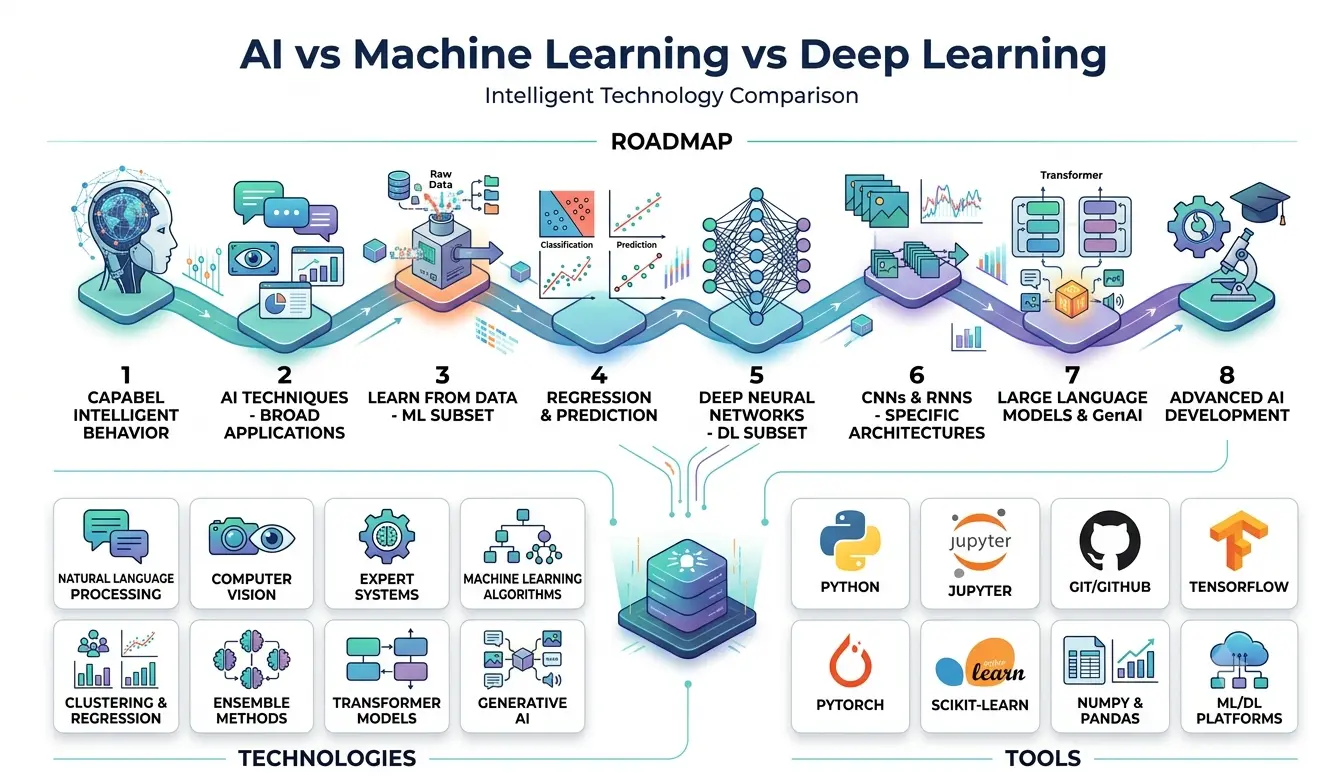
AI vs ML vs Deep Learning: Comparison
Artificial Intelligence
Scope: Broadest field
Goal: Build systems capable of intelligent behaviour
Techniques: Machine Learning, Deep Learning, NLP, Computer Vision, Expert Systems and more
Applications: Automation, robotics, intelligent assistants, decision systems
Career roles: AI Engineer, AI Specialist, AI Consultant
Machine Learning
Scope: Subset of AI
Goal: Enable systems to learn from data
Techniques: Regression, classification, clustering, decision trees, ensemble methods and more
Applications: Forecasting, recommendations, fraud detection, prediction
Career roles: Machine Learning Engineer, ML Specialist, Data Scientist
Deep Learning
Scope: Subset of Machine Learning
Goal: Learn complex representations using neural networks
Techniques: CNNs, RNNs, Transformers and other neural architectures
Applications: Computer Vision, NLP, speech, Generative AI
Career roles: Deep Learning Engineer, AI Engineer, Research Engineer
Which Is Easier to Learn: AI, ML, or Deep Learning?
The difficulty depends on your existing technical background.
For beginners, starting with the fundamentals of Artificial Intelligence can provide a useful overview. However, practical Machine Learning requires programming, mathematics, statistics, and data-handling skills.
Deep Learning generally comes later because learners need a strong understanding of Machine Learning and neural networks.
A practical learning sequence is:
Python → SQL → Mathematics & Statistics → Machine Learning → Deep Learning → Generative AI → Advanced AI
This structured approach can be especially useful for learners joining AI Classes in Pune for Working Professionals who need a clear roadmap rather than trying to learn everything simultaneously.
Skills Required for an AI Career
If you are considering an AI Engineer Course in Pune, developing the right foundation is essential.
Python Programming
Python is one of the most widely used programming languages in AI and Machine Learning.
You should understand:
- Variables
- Functions
- Object-oriented programming
- Data structures
- Libraries
- APIs
- File handling
SQL and Data Handling
AI models depend on data. SQL helps professionals retrieve, filter, join, and analyse structured data.
Mathematics and Statistics
Important foundations include:
- Probability
- Statistics
- Linear algebra
- Calculus fundamentals
- Data distributions
- Hypothesis testing
Machine Learning
You should understand model development, training, evaluation, feature engineering, and optimisation.
Deep Learning
Advanced learners can explore:
- Neural networks
- CNNs
- RNNs
- Transformers
- Model training
- Transfer learning
Generative AI
Modern AI professionals should also understand:
- Large Language Models
- Prompt Engineering
- Retrieval-Augmented Generation
- Vector databases
- AI agents
- Model APIs
Choosing an AI and Machine Learning Course in Pune
The right course should not focus only on theoretical concepts.
When comparing Artificial Intelligence Classes in Pune, look for a program that includes:
- Python programming
- SQL
- Machine Learning
- Deep Learning
- Generative AI
- Real-world projects
- Model deployment
- Industry tools
- Interview preparation
- Career mentoring
A strong AI and Machine Learning Course in Pune should help you move from understanding concepts to actually building solutions.
AI Course in Pune with Placement: What Should You Check?
Placement support can be valuable, particularly for freshers and professionals changing careers.
However, do not select a course solely because it advertises placement assistance.
Before enrolling in an AI Course in Pune with Placement, evaluate:
- Course curriculum
- Trainer experience
- Project quality
- Practical training
- Interview preparation
- Resume support
- Portfolio development
- Placement assistance
- Alumni outcomes
- Learning schedule
A career-focused Artificial Intelligence Certification Course in Pune should combine certification with practical knowledge rather than treating the certificate as the final objective.
Machine Learning Course in Pune: What Should You Learn?
If your primary interest is Machine Learning, look for a curriculum that covers the complete ML lifecycle.
A quality Machine Learning Training in Pune should include:
- Python fundamentals
- NumPy and Pandas
- Data visualisation
- Statistics
- Data preprocessing
- Feature engineering
- Supervised learning
- Unsupervised learning
- Model evaluation
- Hyperparameter tuning
- Machine Learning projects
- Model deployment
Learners should also understand how Machine Learning models are applied to real business problems.
Machine Learning Course in Pune with Placement for Career Switchers
Career switchers often need more than technical lectures.
A Machine Learning Course in Pune with Placement should ideally provide practical projects and interview preparation alongside technical training.
Projects could include:
- Customer churn prediction
- Sales forecasting
- Fraud detection
- Recommendation systems
- Customer segmentation
- Sentiment analysis
These projects can demonstrate practical problem-solving ability during interviews.
For professionals in PCMC, machine learning classes in Pimpri Chinchwad can also provide a convenient way to build technical skills while maintaining their existing careers.
Online Machine Learning Course with Placement: Is It Worth It?
Online learning can be a practical option for working professionals who cannot attend classroom sessions regularly.
An online machine learning course with placement can work well when it provides:
- Live instructor-led sessions
- Practical assignments
- Project-based learning
- Doubt-solving support
- Recorded learning resources
- Mock interviews
- Resume guidance
- Career support
The quality of mentorship and hands-on practice matters more than whether the learning format is online or classroom-based.
How to Choose the Best Artificial Intelligence Institute in Pune
There are many technology training providers, so choosing the right institute requires research.
When evaluating the Best Artificial Intelligence Institute in Pune, consider these factors:
Industry-Relevant Curriculum
AI changes quickly. The curriculum should cover both foundational concepts and modern technologies.
Practical Projects
Projects allow learners to apply knowledge and create a portfolio.
Experienced Mentors
Good trainers should be able to connect theoretical concepts with practical industry scenarios.
Career Support
Look for resume development, interview preparation, mock interviews, and career guidance.
Flexible Learning
Working professionals may need weekend, evening, or online options.
IntelliBI Innovations Technologies focuses on practical, industry-oriented technology learning designed to help learners develop relevant skills for evolving technology careers.
Career Opportunities After AI and Machine Learning Training
AI and Machine Learning skills can lead to several career paths.
Potential roles include:
- AI Engineer
- Machine Learning Engineer
- Data Scientist
- Deep Learning Engineer
- Generative AI Engineer
- NLP Engineer
- Computer Vision Engineer
- AI Solutions Developer
- Data Analyst with AI skills
Your ideal path depends on your background and interests.
For example, someone interested in analytics may combine SQL, Power BI, Python, and AI. A software developer may move toward AI engineering, while a data professional may specialise in Machine Learning or Deep Learning.
AI Career Roadmap for Beginners
If you are starting from scratch, avoid trying to learn every AI technology simultaneously.
Follow a structured roadmap.
Step 1: Learn Programming
Start with Python and basic programming concepts.
Step 2: Understand Data
Learn SQL, Pandas, data cleaning, visualisation, and statistics.
Step 3: Learn Machine Learning
Study algorithms, model training, evaluation, and practical projects.
Step 4: Learn Deep Learning
Move into neural networks, computer vision, NLP, and advanced models.
Step 5: Explore Generative AI
Learn LLMs, prompt engineering, RAG, AI APIs, and AI agents.
Step 6: Build Real Projects
Create projects that demonstrate your ability to solve practical problems.
Step 7: Prepare for Interviews
Develop your resume, LinkedIn profile, portfolio, project explanations, and technical interview skills.
This roadmap can help learners progress from an introductory AI Course Pune program toward advanced AI engineering roles.
Why Practical Learning Matters
Technology careers are becoming increasingly skills-driven.
Knowing the definition of Machine Learning is not enough. Employers want professionals who can understand a problem, prepare data, select an appropriate approach, build a solution, evaluate results, and communicate their findings.
That is why practical training matters.
Whether you choose Artificial Intelligence Training in Pune or Machine Learning Training in Pune, focus on programs where learning is connected to real projects and business scenarios.
Why Learn AI and Machine Learning with IntelliBI?
IntelliBI Innovations Technologies focuses on industry-oriented technology education across Artificial Intelligence, Machine Learning, Data Analytics, Data Engineering, Cloud Computing, Power BI, Generative AI, and related technologies.
For learners exploring Artificial Intelligence Classes in Pune or Machine Learning Classes in Pimpri Chinchwad, a structured learning environment can help make the transition from theory to practical application easier.
The goal should not simply be to complete a course.
The goal should be to develop skills, build projects, strengthen your professional profile, and become confident enough to solve real-world technology problems.
Frequently Asked Questions
Is Machine Learning part of Artificial Intelligence?
Yes. Machine Learning is a subset of Artificial Intelligence. AI is the broader field, while Machine Learning focuses on systems that learn patterns from data.
Is Deep Learning part of Machine Learning?
Yes. Deep Learning is a specialized branch of Machine Learning that uses multi-layer neural networks to learn complex patterns.
Should I learn AI or Machine Learning first?
Beginners should understand AI fundamentals and then develop strong foundations in Python, statistics, data handling, and Machine Learning before progressing into Deep Learning.
Which course is best for an AI career?
A good program should cover Python, SQL, Machine Learning, Deep Learning, Generative AI, projects, and practical implementation. Your choice should depend on your career goal and existing technical background.
Can working professionals learn AI?
Yes. Working professionals can learn AI through flexible evening, weekend, or online programs. A structured AI learning path can make it easier to balance professional responsibilities with skill development.
Is an AI certification enough to get a job?
A certification can demonstrate learning, but practical skills, projects, problem-solving ability, communication, and interview performance are also important for building an AI career.
Final Thoughts
Artificial Intelligence, Machine Learning, and Deep Learning are closely connected, but they are not interchangeable terms.
AI is the broad field of building intelligent systems.
Machine Learning is a method that enables systems to learn from data.
Deep Learning is a specialized Machine Learning approach based on neural networks.
Understanding this relationship is the first step toward choosing the right career direction.
If you are considering an AI Course in Pune, Machine Learning Course in Pune, or an AI and Machine Learning Course in Pune, focus on practical learning, industry-relevant technologies, real projects, and career preparation.
The AI industry will continue evolving, and professionals who continuously upgrade their skills will be better positioned to take advantage of emerging opportunities.
Your journey can begin with Python and Machine Learning fundamentals and gradually progress toward Deep Learning, Generative AI, LLMs, and advanced AI engineering.
At IntelliBI Innovations Technologies, the focus is on helping learners build practical, career-oriented technology skills for an AI-driven future.