

How to Build a Predictive Analytics Project Using Python and Machine Learning
Quick Answer
To build a predictive analytics project, start by defining a clear business problem and identifying the data needed to solve it. Clean and explore the data, prepare features, divide the dataset for training and evaluation, select an appropriate machine learning algorithm, train and evaluate the model, improve its performance, interpret predictions, and develop a practical application. Finally, document the complete workflow so the project can demonstrate your machine learning skills.
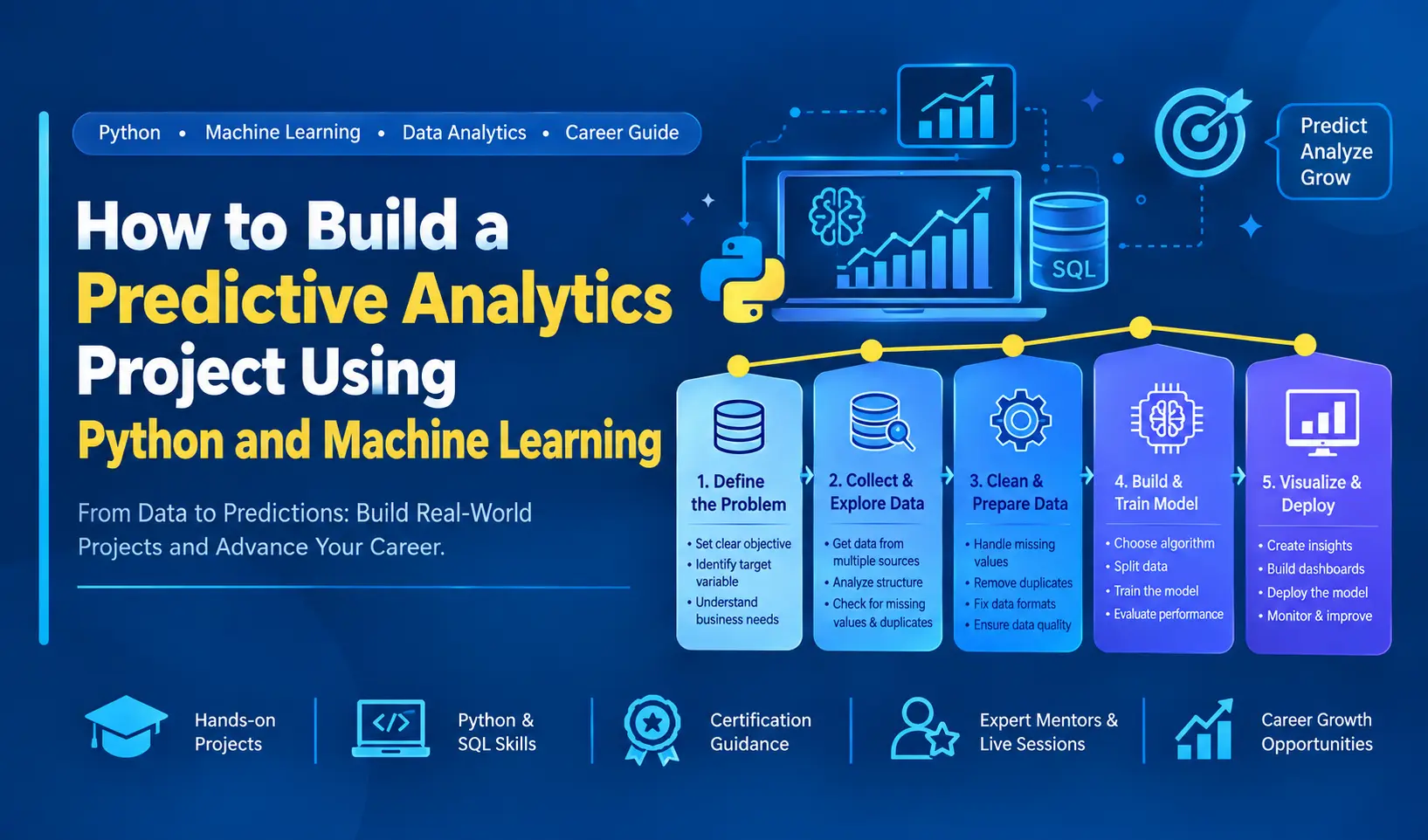
How to Build a Predictive Analytics Project Using Python and Machine Learning
Predictive analytics has become an important part of modern business decision-making. Organizations use historical data to identify patterns, estimate future outcomes, understand customer behavior, manage risks, and improve operational planning. Behind many of these applications are Python-based data workflows and machine learning models.
For learners, building a predictive analytics project is an excellent way to move beyond theoretical concepts. Instead of learning algorithms individually, you get to understand how data, statistics, Python, machine learning, and business requirements come together in a practical solution.
Whether you are considering a Machine Learning Course in Pune or learning through self-study, understanding the complete project lifecycle can help you approach machine learning projects with greater confidence.
What Is Predictive Analytics?
Predictive analytics focuses on using existing data to estimate future outcomes. Machine learning is one of the key technologies used to develop predictive models.
Consider a subscription-based business that wants to identify customers who may cancel their subscriptions. Historical information such as customer tenure, purchase behavior, subscription type, spending patterns, support interactions, and product usage can be analyzed to identify patterns associated with customer churn.
A machine learning model can learn from previous customer records and use those patterns to predict the likelihood of churn among current customers.
Similar approaches are used for sales forecasting, fraud detection, demand prediction, employee attrition, credit-risk assessment, customer segmentation, and many other applications.
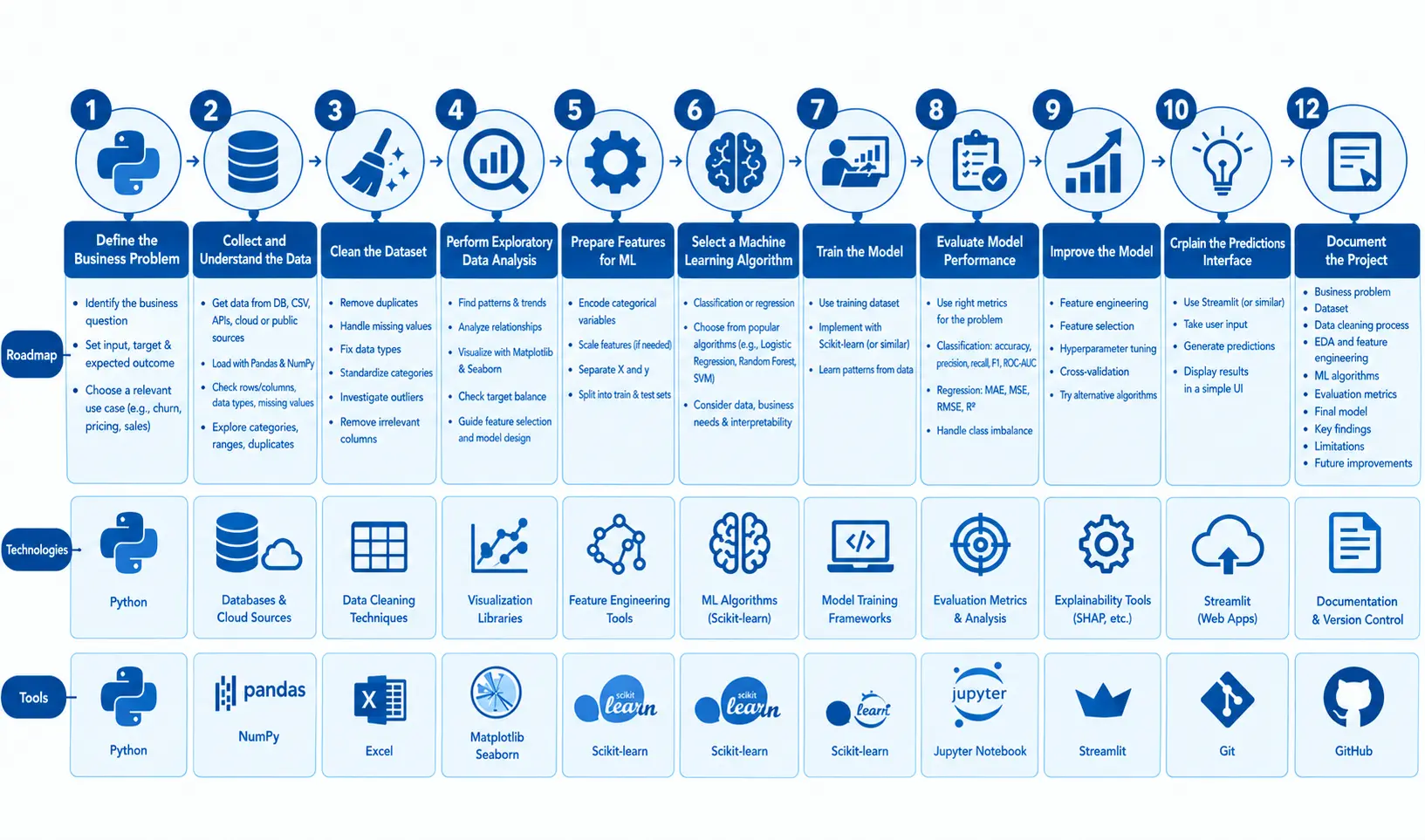
Step 1: Define the Business Problem
Every successful predictive analytics project should begin with a clearly defined problem.
Instead of starting with a machine learning algorithm, first identify what the organization actually wants to predict.
For example:
"Which customers are likely to leave the company within the next 30 days?"
This question provides direction for the entire project. It helps determine what data is required, what the target variable should be, what type of machine learning problem you are solving, and how model performance should eventually be evaluated.
A well-defined problem should have a clear objective, measurable outcome, and practical business purpose.
For beginners, customer churn prediction, house-price prediction, sales forecasting, loan-risk prediction, employee attrition, and demand forecasting are useful project ideas.
Step 2: Collect and Understand the Data
After defining the problem, the next step is to identify the data required to answer it.
Data may come from databases, CSV files, APIs, cloud storage, business applications, or publicly available datasets.
Python is particularly useful for working with structured data. Libraries commonly used in data science make it possible to load, inspect, transform, and analyze large datasets efficiently.
Before building a model, examine the available data carefully.
Important questions include:
- How many records are available?
- Which columns are present?
- What does each column represent?
- Which columns contain missing values?
- Are duplicate records present?
- Which variables are numerical?
- Which variables are categorical?
- What is the distribution of the target variable?
Understanding the dataset at this stage can prevent many problems later in the project.
Step 3: Clean the Data
Data collected from real-world systems is rarely perfect.
It may contain missing values, duplicate records, inconsistent formats, incorrect data types, unusual values, or irrelevant information.
Data cleaning involves preparing the dataset so that it can be reliably used for analysis and machine learning.
Depending on the dataset, this may include:
- Removing duplicate records
- Handling missing values
- Correcting inconsistent categories
- Converting data into appropriate formats
- Identifying unusual observations
- Removing irrelevant fields
- Checking for data-quality issues
The appropriate treatment depends on the meaning of each variable.
For example, simply deleting every record containing a missing value may result in losing valuable information. In some situations, missing values can be handled through appropriate statistical or domain-based methods.
The goal is not to make the dataset artificially perfect. The goal is to make it reliable enough for meaningful analysis.
Step 4: Perform Exploratory Data Analysis
Exploratory Data Analysis, commonly known as EDA, helps you understand the relationships and patterns within the dataset.
This is an important stage because it allows you to investigate the data before making assumptions about which machine learning algorithm should be used.
You might explore questions such as:
- Which customer groups show higher churn?
- Does customer tenure influence the outcome?
- Is spending related to the target?
- Are certain product categories associated with higher risk?
- Is the target variable balanced?
- Are there unusual patterns or outliers?
Python provides several libraries for statistical analysis and visualization, making it possible to examine distributions, relationships, trends, and patterns.
EDA should not be treated simply as a chart-creation exercise. The objective is to develop an understanding of the data that can guide subsequent modeling decisions.
Step 5: Select and Prepare Features
Features are the variables that a machine learning model uses to learn patterns.
For a customer churn project, features could include customer tenure, monthly spending, number of transactions, subscription type, customer support interactions, and product usage.
Not every available column should automatically be used.
Some fields may be irrelevant, while others may introduce leakage or unnecessary complexity.
Categorical information may also need to be transformed into a format that machine learning algorithms can process.
Numerical variables may sometimes require scaling depending on the selected algorithm.
Feature preparation should therefore consider the characteristics of both the data and the machine learning method.
Good feature engineering can make a significant difference because carefully designed features can represent business behavior more effectively than raw variables alone.
Step 6: Split the Dataset
A predictive model should be evaluated using information it did not see during training.
For this reason, datasets are commonly divided into training and testing portions. In some workflows, a separate validation set or cross-validation approach is also used.
The training data is used to learn patterns, while the testing data is used to assess how well the trained model performs on unseen observations.
This distinction is important because a model can appear highly accurate on the data it has already seen while performing poorly on new data.
A reliable predictive analytics project should therefore evaluate generalization rather than simply measuring training performance.
Step 7: Choose a Suitable Machine Learning Algorithm
The choice of algorithm depends on the problem.
If the goal is to predict a category, such as whether a customer will churn or not, the problem is generally treated as classification.
Common classification approaches include Logistic Regression, Decision Trees, Random Forest, Gradient Boosting, Support Vector Machines, and other machine learning techniques.
If the objective is to predict a numerical value, such as house price or future sales, the problem may be treated as regression.
Possible approaches include Linear Regression, Decision Tree Regression, Random Forest Regression, and Gradient Boosting Regression.
There is no universal algorithm that works best for every dataset.
Model selection should consider the data, business requirements, interpretability, computational requirements, and evaluation results.
For beginners, starting with a simple baseline model is often more useful than immediately selecting a highly complex algorithm.
Step 8: Train the Machine Learning Model
After selecting the features and algorithm, the model can be trained using the prepared training data.
During training, the algorithm identifies patterns and relationships between the input variables and the target outcome.
This is where concepts learned through machine learning training become practical.
However, training a model does not mean the project is complete.
A model must be evaluated carefully to determine whether it has learned useful patterns or simply memorized characteristics of the training dataset.
This is also where concepts such as underfitting and overfitting become important.
Step 9: Evaluate Model Performance
Model evaluation is one of the most important stages of predictive analytics.
The appropriate evaluation metric depends on the problem.
For classification, commonly considered metrics include accuracy, precision, recall, F1-score, ROC-AUC, and the confusion matrix.
Accuracy alone may not always provide a reliable picture.
For example, imagine a dataset where only a small percentage of customers actually churn. A model could predict that almost everyone will remain a customer and still achieve high accuracy. However, such a model may not be useful for identifying the customers the business actually wants to reach.
For regression problems, metrics such as Mean Absolute Error, Mean Squared Error, Root Mean Squared Error, and R-squared can be considered.
The important principle is to select metrics that reflect the real objective of the project.
Step 10: Improve the Model
Once a baseline model has been evaluated, you can explore ways to improve it.
Possible approaches include:
- Better feature engineering
- Feature selection
- Hyperparameter tuning
- Cross-validation
- Handling class imbalance
- Comparing different algorithms
- Removing noisy or irrelevant variables
- Improving data quality
Feature engineering can be especially valuable.
For example, instead of using only a customer's total number of purchases, you might derive purchase frequency, average transaction value, or recent activity. Such features can provide the model with additional information about customer behavior.
The goal should not simply be to achieve the highest possible score. The objective is to build a model that performs reliably and makes sense for the intended business application.
Step 11: Interpret the Predictions
Predictive analytics should not end with a model score.
Business stakeholders often want to understand why a model produced a particular prediction.
For example, if a customer is identified as having a high likelihood of churn, the business may want to know which factors contributed to that prediction.
Techniques such as feature importance and explainable AI methods can help professionals understand model behavior.
Interpretability is especially valuable when predictions influence important business decisions.
A model that performs well but cannot be reasonably understood may be difficult for stakeholders to trust or implement.
Step 12: Create a Practical Application
A project becomes more meaningful when people can actually interact with the prediction system.
For example, a predictive analytics application could allow a user to enter customer information and receive a predicted churn category.
Python-based frameworks can be used to create simple interfaces around machine learning models.
This creates a complete workflow:
Business problem → Data → Analysis → Machine learning model → Prediction → User-facing application
For learners considering an advanced machine learning course in Pune, building such an end-to-end project can provide a stronger understanding of how machine learning moves from experimentation toward practical use.
How to Organize a Predictive Analytics Project
A well-organized project is easier to understand, maintain, and present.
A typical project can contain separate areas for:
- Raw and processed data
- Exploratory analysis
- Machine learning workflows
- Trained models
- Reports and visualizations
- Application components
- Documentation
Keeping these components organized is particularly useful when working with Git or collaborating with other developers and data professionals.
Good organization also helps when the project becomes part of a professional portfolio.
Skills You Develop Through a Predictive Analytics Project
A complete project can help develop several skills simultaneously.
Python helps with programming, data manipulation, automation, and analytical workflows.
Statistics helps you understand distributions, relationships, probability, sampling, and evaluation.
Machine learning helps you build predictive models and compare their performance.
Data visualization helps communicate patterns and findings.
Business understanding helps you connect technical results with real-world objectives.
Communication skills help you explain your approach and findings to people who may not have a technical background.
This combination is valuable for learners preparing through a Machine Learning Certification Course in Pune or developing their skills through independent projects.
How Machine Learning Training in Pune Can Support Project-Based Learning
For learners considering Machine Learning Training in Pune, it is useful to look beyond the number of algorithms covered in a program.
A practical learning journey should connect Python programming, statistics, data preparation, exploratory analysis, machine learning, model evaluation, and real-world project development.
Learners exploring machine learning classes in Pimpri Chinchwad can also evaluate whether the learning environment provides opportunities to work with realistic datasets and solve complete business problems.
The same principle applies when choosing an online machine learning course with placement. Flexibility can be valuable, but practical project work remains important for developing confidence and demonstrating skills.
How to Make the Project Portfolio-Ready
A predictive analytics project becomes much more valuable as a portfolio piece when you present the complete problem-solving journey.
Instead of simply mentioning that you trained a machine learning model, explain:
- What business problem you addressed
- Where the data came from
- How you cleaned the data
- What patterns you discovered
- How you engineered features
- Which models you evaluated
- Why you selected the final approach
- Which evaluation metrics you used
- What the predictions mean
- What limitations remain
- How the solution could be improved
This demonstrates that you understand the complete machine learning workflow rather than only the algorithm.
For someone preparing through a best machine learning course in Pune, this approach can also help turn classroom learning into a practical portfolio project.
Common Mistakes to Avoid
Beginners often make several mistakes while developing predictive analytics projects.
Starting with the algorithm: The business problem should come before the algorithm.
Ignoring data quality: Poor-quality data can undermine even a sophisticated model.
Using accuracy as the only metric: Choose evaluation measures that reflect the actual problem.
Ignoring data leakage: Information that would not be available at prediction time should not accidentally influence the model.
Overfitting: A model should perform well on new data, not just training data.
Skipping interpretation: Stakeholders often need to understand the reasons behind predictions.
Stopping at the notebook: Whenever practical, demonstrate how the model could be used in a real application.
Where to Go After Your First Project
Once you complete your first predictive analytics project, increase the complexity gradually.
You could explore time-series forecasting, anomaly detection, recommendation systems, natural language processing, computer vision, or advanced ensemble techniques.
You can also learn about model deployment, monitoring, data pipelines, cloud platforms, and responsible AI.
This progression can help you move from understanding individual machine learning algorithms to understanding how complete machine learning solutions are designed and operated.
For learners pursuing an advanced machine learning course in Pune, these areas can provide a natural progression after mastering the fundamentals.
Conclusion
Building a predictive analytics project using Python and machine learning is an effective way to transform theoretical knowledge into practical skills. The value of the project comes from understanding the entire journey, not simply from selecting an algorithm.
Start with a meaningful business problem. Understand and clean the data. Explore patterns, prepare useful features, select an appropriate model, evaluate it with relevant metrics, improve the approach, interpret the predictions, and consider how the solution could be used in practice.
Whether you are exploring a machine learning course in Pune, machine learning course in Pune with placement, ai ml course in Pune, or an online machine learning course with placement, focus on developing the ability to solve problems end to end.
A strong predictive analytics project does not need to be unnecessarily complicated. It needs a clear objective, reliable data, thoughtful analysis, appropriate machine learning techniques, meaningful evaluation, and a practical outcome.
That approach can help you build stronger machine learning fundamentals while creating projects that demonstrate how Python and machine learning can be applied to real-world problems.