
Data Analyst vs Data Engineer vs Data Scientist: Which Career Is Right for You?
Quick Answer
A Data Analyst turns data into business insights using SQL, Excel, Power BI, Tableau, and statistics. A Data Engineer builds the pipelines, platforms, and cloud infrastructure that make reliable data available. A Data Scientist uses statistics, Python, machine learning, and advanced analytics to build predictive models. The right career depends on whether you prefer business insights, data infrastructure, or advanced modelling and AI.
Data Analyst vs Data Engineer vs Data Scientist: Which Career Is Right for You?
Data is no longer just a reporting resource. It has become one of the most important assets behind business decisions, artificial intelligence, automation, customer experiences, and digital transformation.
As companies increasingly depend on data, three career paths attract significant attention: Data Analyst, Data Engineer, and Data Scientist.
Although these roles work closely together, they solve different problems.
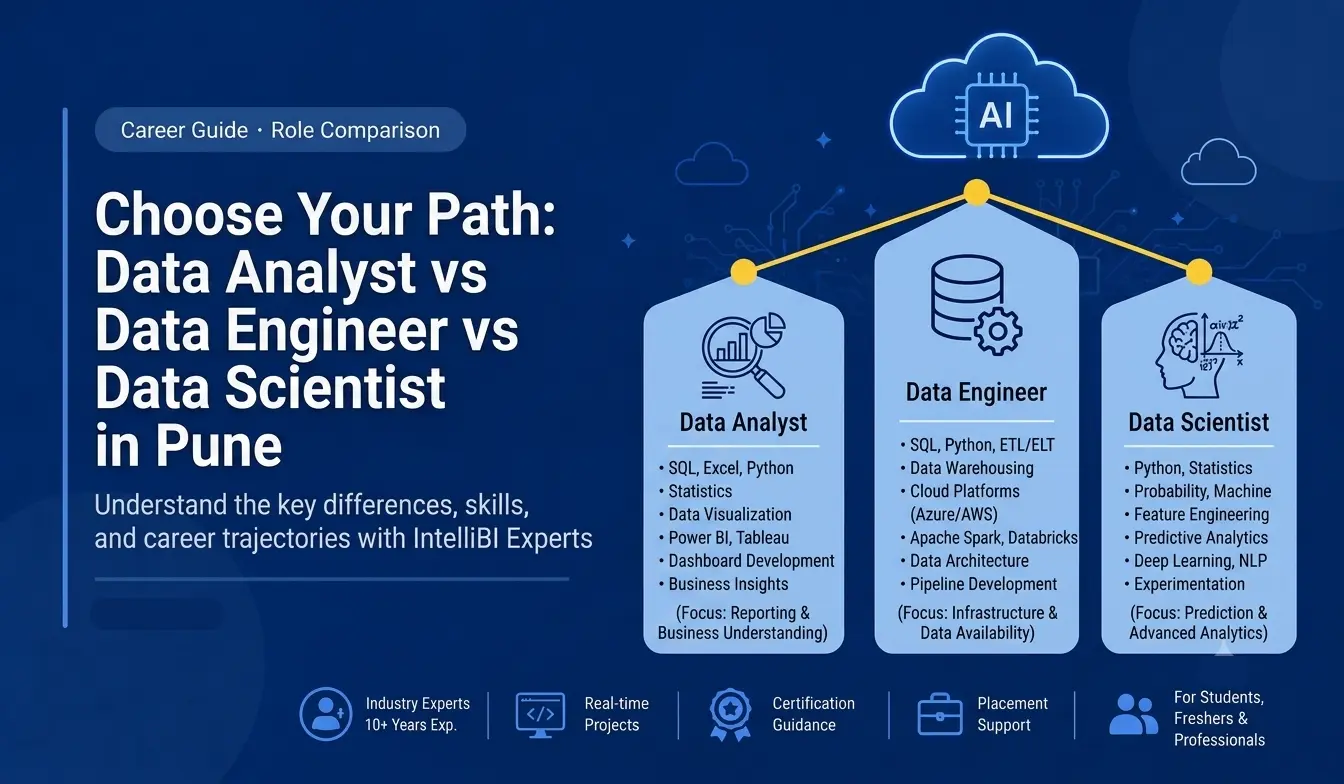
A Data Analyst focuses on understanding what happened and why it happened. A Data Engineer builds the systems and pipelines that make reliable data available. A Data Scientist goes deeper into statistics, machine learning, and predictive modelling to determine what may happen next.
Understanding these differences is important before selecting a Data Analyst Course in Pune, a Data Engineering Course in Pune, or an AI and Machine Learning Course in Pune.
At IntelliBI Innovations Technologies, career-oriented programs connect data analytics, data engineering, artificial intelligence, cloud technologies, and real-world projects, helping learners understand how these roles work together in modern organizations.
Data Analyst vs Data Engineer vs Data Scientist at a Glance
The easiest way to understand the difference is to look at the primary objective of each role.
Data Analyst: Converts raw data into reports, dashboards, trends, and actionable business insights.
Data Engineer: Designs and maintains the infrastructure, databases, pipelines, and data platforms required for analytics and AI.
Data Scientist: Uses statistics, programming, machine learning, and advanced analytics to solve complex problems and make predictions.
Think of a modern data organization as a production system.
The Data Engineer builds the roads through which data travels. The Data Analyst studies the information arriving through those roads. The Data Scientist uses advanced techniques to discover patterns and predict future outcomes.
What Does a Data Analyst Do?
A Data Analyst works primarily with structured data to answer business questions.
For example, a company may want to know:
- Which products generate the highest revenue?
- Why did sales decline last quarter?
- Which customer segment has the highest retention?
- Which marketing campaign generates the best return?
- Which region is growing fastest?
The analyst collects, cleans, examines, visualizes, and interprets data to answer these questions.
A strong Data Analyst Course in Pune should therefore go beyond basic reporting and teach learners how to connect technical analysis with business decision-making.
Key Skills for a Data Analyst
Important Data Analyst skills include:
- SQL
- Excel
- Python
- Statistics
- Data Cleaning
- Data Visualization
- Power BI
- Tableau
- Business Communication
- Dashboard Development
- Critical Thinking
Power BI is particularly valuable for professionals working in business intelligence and reporting environments. A Power BI Course in Pune can help learners develop practical knowledge of data modelling, Power Query, DAX, dashboards, and business reporting.
IntelliBI's current Power BI program emphasizes Power Query, DAX, data modelling, executive dashboards, and enterprise reporting scenarios.
Data Analyst Career Path
A typical Data Analyst career can progress from:
Junior Data Analyst → Data Analyst → Senior Data Analyst → Analytics Lead → Analytics Manager.
Professionals can also move toward Business Analyst, BI Developer, Product Analyst, Marketing Analyst, or Data Scientist roles after gaining additional skills.
For learners comparing a Data Analyst Course in Pune with a Business Analyst Course in Pune, the key difference is that Data Analysts tend to focus more heavily on data, analytics, visualization, and technical tools, while Business Analysts often focus more on business requirements, processes, stakeholders, and solution definition.
What Does a Data Engineer Do?
Data Engineers work behind the scenes to make data usable.
Imagine a company receives millions of records from websites, mobile applications, CRM systems, payment platforms, IoT devices, and business applications. Someone must collect that information, move it through reliable pipelines, transform it, store it, and make it accessible to analysts and data scientists.
That is the job of a Data Engineer.
A Data Engineering Course in Pune should therefore introduce learners to databases, programming, ETL/ELT, cloud platforms, data warehouses, data lakes, distributed processing, and pipeline architecture.
Key Skills for a Data Engineer
A modern Data Engineer commonly works with:
- SQL
- Python
- ETL and ELT
- Data Warehousing
- Data Lakes
- Apache Spark
- PySpark
- Databricks
- Azure
- AWS
- Data Modelling
- Workflow Orchestration
- Cloud Architecture
The demand for cloud-based data skills has also made an Azure Data Engineer Course in Pune a relevant option for professionals targeting enterprise data roles.
IntelliBI's Azure-focused program covers Azure Data Factory, Synapse Analytics, Azure Databricks, ADLS Gen2, production ETL pipelines, lakehouse architecture, Delta Lake, Spark, and CI/CD.
Data Engineering Career Path
A typical career progression can look like:
Junior Data Engineer → Data Engineer → Senior Data Engineer → Lead Data Engineer → Data Architect.
Professionals may also specialize in cloud data engineering, Big Data, platform engineering, analytics engineering, or AI-ready data infrastructure.
For professionals looking for advanced specialization, an Advanced Data Engineer Course in Pune can be useful after building a strong foundation in SQL, Python, databases, and data pipelines.
What Does a Data Scientist Do?
Data Scientists work on problems where advanced statistics, experimentation, machine learning, and predictive modelling are required.
For example, a Data Scientist may develop a model to:
- Predict customer churn
- Detect fraudulent transactions
- Forecast demand
- Recommend products
- Predict equipment failures
- Classify documents
- Identify customer segments
This role generally requires stronger mathematical, statistical, and machine learning knowledge than a traditional analyst position.
Key Skills for a Data Scientist
Important skills include:
- Python
- SQL
- Statistics
- Probability
- Machine Learning
- Feature Engineering
- Model Evaluation
- Predictive Analytics
- Deep Learning
- Natural Language Processing
- Data Visualization
- Experimentation
Professionals who want to enter this area may explore an AI and Machine Learning Course in Pune or an AI Course Pune program that combines programming, statistics, machine learning, and modern AI applications.
Data Analyst vs Data Engineer vs Data Scientist: Skills Comparison
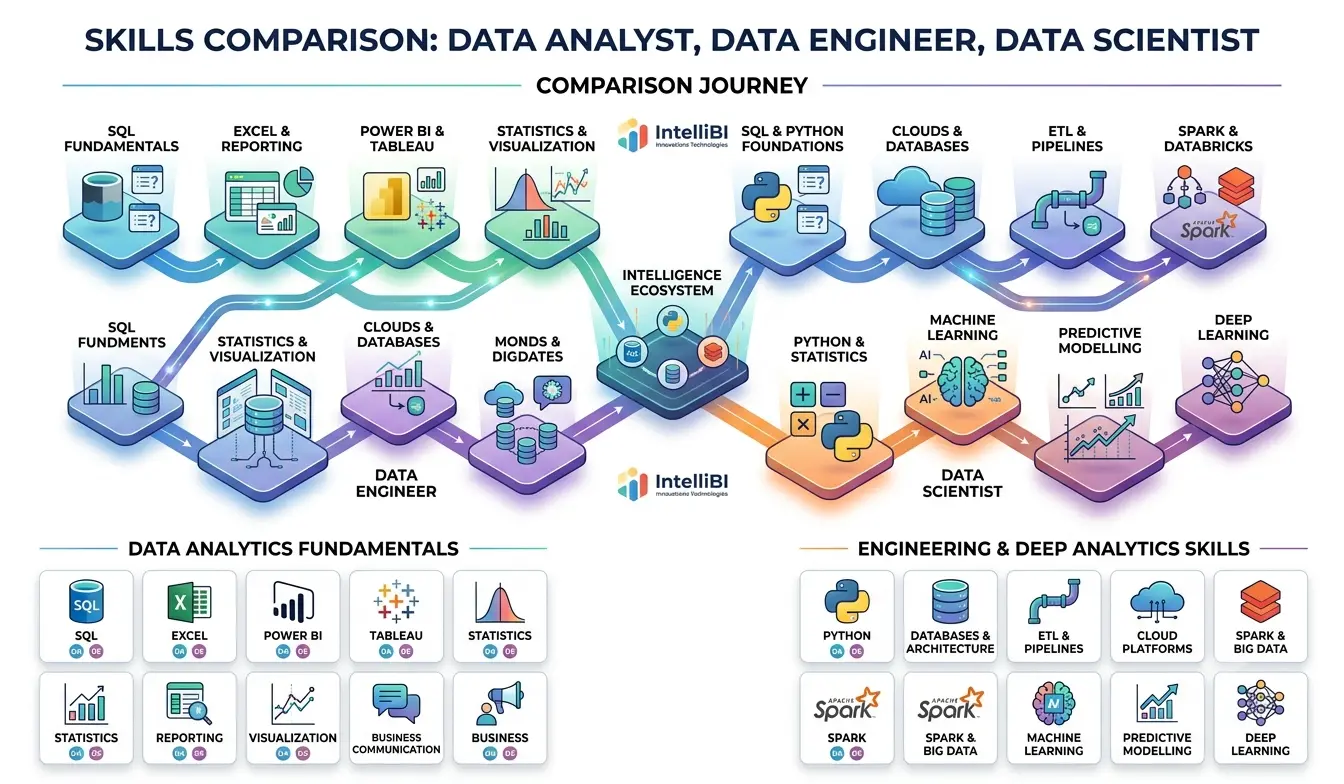
The three roles overlap, but their depth of specialization is different.
Data Analyst: SQL, Excel, Power BI, Tableau, statistics, reporting, visualization, and business communication.
Data Engineer: SQL, Python, databases, ETL, cloud platforms, Spark, Databricks, data architecture, and pipeline development.
Data Scientist: Python, statistics, machine learning, experimentation, predictive modelling, deep learning, and advanced analytics.
This does not mean that one role is "better" than another. They are different career directions.
How AI Is Changing These Three Careers
Artificial Intelligence is changing the way data professionals work.
Analysts can use AI to accelerate reporting, generate insights, query datasets using natural language, and automate repetitive analytical tasks.
Data Engineers increasingly build data platforms capable of supporting AI applications, machine learning workloads, vector databases, and retrieval systems.
Data Scientists use AI and machine learning techniques to build predictive and intelligent systems.
This is why modern training increasingly combines data skills with AI.
For example, IntelliBI's Data Analytics with Gen AI program combines SQL, Python, Power BI, Tableau, and Generative AI, including AI-powered reporting and natural-language data interaction.
A Data Analytics with Gen AI Course in Pune can therefore be particularly relevant for analysts who want to remain competitive as AI becomes integrated into analytics workflows.
Which Career Is Easier to Start?
For many beginners, Data Analytics can provide a more accessible starting point because the initial learning curve can be more focused on SQL, Excel, visualization, statistics, and business understanding.
A learner can gradually add Python, Power BI, Tableau, and AI capabilities.
Data Engineering generally requires stronger programming, database, cloud, and system-oriented knowledge.
Data Science often requires deeper statistics, mathematics, programming, and machine learning knowledge.
However, "easier" depends on your background.
Someone with software development experience may find Data Engineering more natural, while someone from finance, marketing, operations, or reporting may find Data Analytics more intuitive.
Which Career Is Best for Working Professionals?
Working professionals should choose based on their existing experience rather than simply following the most popular technology trend.
If you enjoy dashboards, business questions, reporting, and presenting insights, consider Data Analytics.
If you enjoy databases, programming, cloud platforms, pipelines, and infrastructure, consider Data Engineering.
If you enjoy mathematics, experimentation, algorithms, and predictive models, consider Data Science.
For professionals with limited time, AI Classes in Pune for Working Professionals or specialized Data Analytics Classes in Pune can provide a structured way to upgrade skills while continuing a career.
IntelliBI currently offers flexible online, offline, and hybrid programs designed specifically for working professionals.
How to Choose Between Data Analytics and Data Engineering
Ask yourself three questions.
Do you enjoy business problems?
If yes, Data Analytics may be a strong fit.
Do you enjoy building technical systems?
If yes, Data Engineering could be the better direction.
Do you enjoy mathematics and predictive modelling?
If yes, Data Science may be more suitable.
You can also transition between these roles.
For example:
Data Analyst → Data Scientist
Data Analyst → Analytics Engineer
Data Analyst → BI Developer
Data Engineer → Data Architect
Data Engineer → ML Engineer
Data Scientist → ML Engineer
The key is to build transferable foundations such as SQL, Python, statistics, data structures, cloud concepts, and problem-solving.
Choosing the Right Course in Pune
If you're comparing the Best Data Analyst Course in Pune or the Best Data Engineering Course in Pune, don't select a program only because it has a long syllabus.
Evaluate the learning experience.
Look for:
- Real-world projects
- Industry-relevant tools
- Experienced mentors
- Practical assignments
- Interview preparation
- Portfolio development
- Certification guidance
- Career support
- Flexible schedules
A Data Analyst Training in Pune should give you opportunities to work with realistic datasets and build dashboards.
Similarly, Data Engineering Training in Pune should include practical pipelines, cloud services, databases, distributed processing, and deployment concepts.
IntelliBI emphasizes project-based learning, industry guidance, career support, and flexible learning options across its technology programs.
Why Cloud and Databricks Matter for Data Engineers
Modern data platforms increasingly operate in cloud environments.
That makes Cloud Computing Classes in Pune relevant for learners who want to understand how data systems operate at scale.
Azure, AWS, Databricks, Spark, data lakes, warehouses, and orchestration tools are increasingly part of modern data engineering ecosystems.
Databricks Training in Pune can be particularly useful for professionals interested in large-scale data processing, lakehouse architectures, Spark, and AI-ready data platforms.
The important point is not to learn tools individually. Learn how those tools work together to solve business problems.
Can a Data Analyst Move Into AI?
Absolutely.
A Data Analyst already works with data, business questions, statistics, and visualization. By adding Python, machine learning, and AI concepts, the professional can gradually move toward advanced analytics, machine learning, or AI engineering.
An AI Course in Pune with Placement can be considered by professionals who want structured guidance while transitioning into AI-oriented roles.
For learners seeking a broader technical pathway, Artificial Intelligence Classes in Pune can introduce concepts ranging from Python and machine learning to Generative AI and modern AI applications.
Those targeting deeper specialization can explore an Artificial Intelligence Certification Course in Pune after developing the necessary technical foundation.
Final Career Decision: Analyst, Engineer or Scientist?
There is no universally "best" career among Data Analyst, Data Engineer, and Data Scientist.
The best choice is the one aligned with your strengths and interests.
Choose Data Analytics if you enjoy business insights, dashboards, reporting, and communication.
Choose Data Engineering if you enjoy programming, databases, cloud technologies, pipelines, and scalable systems.
Choose Data Science if you enjoy statistics, machine learning, experimentation, and predictive modelling.
And if your long-term goal is AI, you can build progressively from data foundations toward machine learning and advanced AI.
The important thing is to avoid learning disconnected tools. Build a career roadmap where each skill supports the next one.
Build Your Data and AI Career with IntelliBI
Choosing the right learning environment can make the transition into technology more structured and practical.
IntelliBI Innovations Technologies offers career-focused programs spanning Data Analytics, Data Engineering, Artificial Intelligence, Machine Learning, Generative AI, Azure, AWS, Databricks, Power BI, and related technologies. Its current programs emphasize hands-on projects, industry mentorship, certifications, and career support.
Whether you are searching for a Data Analyst Institute in Pune, a Best Data Engineering Institute in Pune, or an AI-focused training pathway, begin by identifying the role you want to build toward.
Your first course does not have to define your entire career.
It should give you the foundation to take the next step.
FAQs
Is Data Analyst better than Data Engineer?
Neither role is universally better. Data Analysts focus on insights and reporting, while Data Engineers build the infrastructure and pipelines that support analytics. Your choice should depend on your interests and technical strengths.
Which course should I choose as a beginner?
Beginners interested in dashboards and business insights can start with data analytics. Those interested in programming, cloud, and data infrastructure can consider data engineering. Learners interested in machine learning can progress toward data science or AI.
Is a Data Analyst Course in Pune with Placement suitable for working professionals?
It can be, especially when the program provides flexible schedules, practical projects, interview preparation, and career support. Always evaluate the curriculum and project depth before enrolling.
Is Azure useful for Data Engineers?
Yes. Azure provides services for data storage, processing, orchestration, analytics, and cloud-based data architectures. Learning services such as Azure Data Factory, Azure Databricks, Synapse Analytics, and ADLS can strengthen a data engineering profile.
Should Data Analysts learn AI?
Yes. AI can improve productivity in analytics through automated reporting, natural-language querying, insight generation, and advanced predictive capabilities. Learning AI alongside analytics can help professionals remain adaptable.
Can a Data Engineer become a Data Scientist?
Yes. A Data Engineer can transition into Data Science by developing stronger skills in statistics, machine learning, experimentation, and predictive modelling. Python and SQL provide a useful foundation for the transition.
Can working professionals learn Data Engineering or AI?
Yes. Structured programs with weekend, evening, online, or hybrid options can make upskilling more manageable. The important factor is maintaining consistent hands-on practice alongside the course.
Conclusion
Data Analyst, Data Engineer, and Data Scientist are three different roles within the same broader data ecosystem.
The Data Analyst transforms information into business insights. The Data Engineer creates the infrastructure that makes reliable data available. The Data Scientist applies advanced statistics and machine learning to discover patterns and build predictive solutions.
As AI continues to reshape the technology industry, the boundaries between these careers will increasingly overlap. Professionals who combine strong fundamentals with practical AI, cloud, and data skills will be better positioned to adapt.
If you are planning your next career move, start with the role—not the tool.
Understand what the role requires, build the right foundation, work on realistic projects, and continuously develop skills that solve real business problems.
That is the difference between simply completing a course and becoming truly industry-ready.