
Generative AI Course in Pune: LLMs, Prompt Engineering, RAG & AI Applications
Quick Answer
A Generative AI Course in Pune typically covers LLMs, prompt engineering, embeddings, RAG, vector databases, APIs, AI applications, and AI agents. A practical course should combine concepts with hands-on projects so learners can build and evaluate real AI solutions. It can be suitable for fresh graduates, software developers, data professionals, and working professionals seeking skills in modern AI application development.
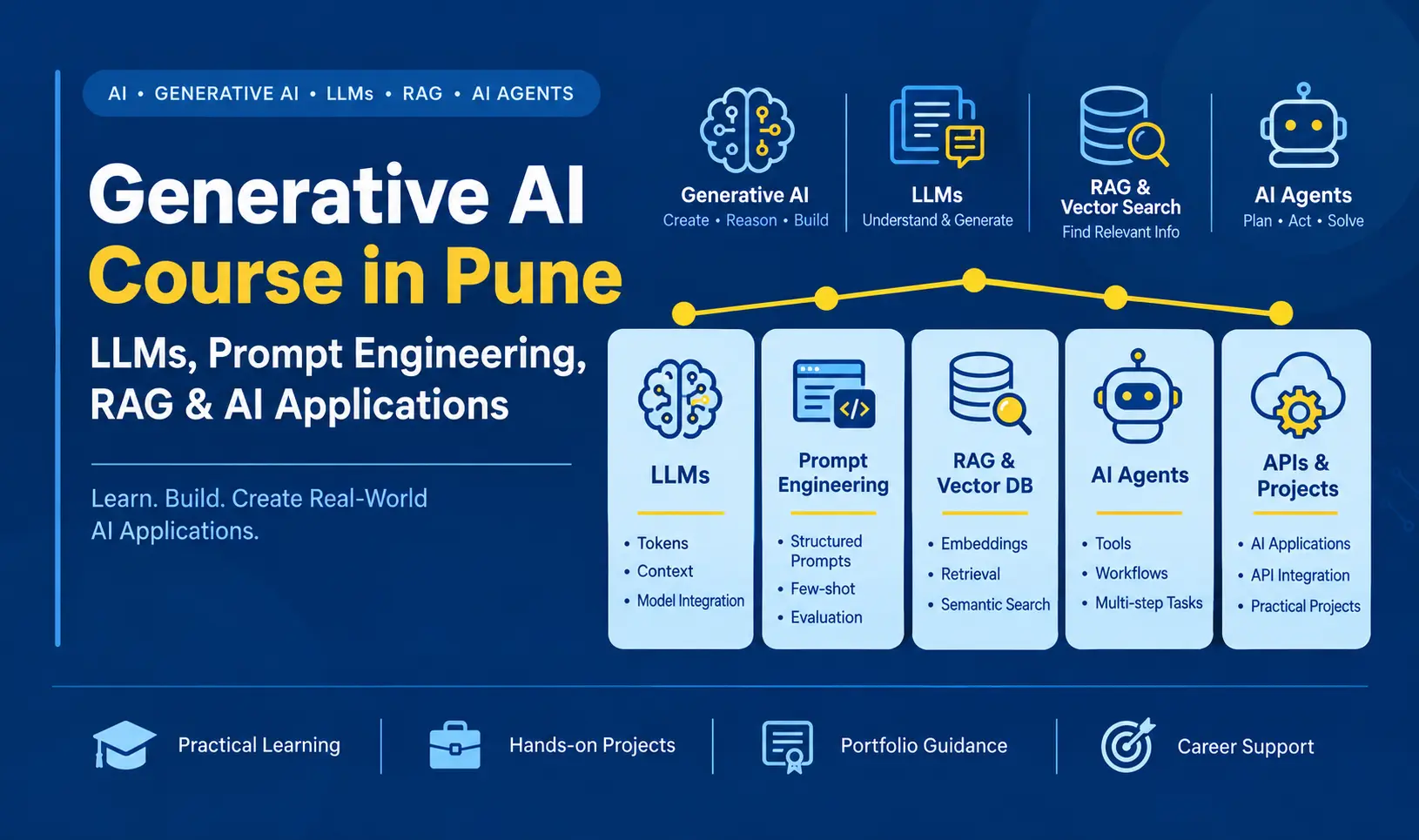
Generative AI Course in Pune: LLMs, Prompt Engineering, RAG & AI Applications
Generative AI has rapidly changed the way businesses create content, process information, automate workflows, and interact with technology. From intelligent chatbots and document assistants to AI-powered coding tools and business automation, Generative AI is becoming part of everyday technology.
For students and professionals planning to build a career in artificial intelligence, understanding Generative AI requires more than learning how to write prompts. Modern AI applications combine Large Language Models (LLMs), prompt engineering, embeddings, Retrieval-Augmented Generation (RAG), APIs, vector databases, AI agents, application frameworks, and evaluation techniques.
A structured Generative AI Course in Pune can help learners build these skills progressively. Instead of approaching each technology separately, learners can understand how different components work together to create practical AI applications.
At IntelliBI Innovations Technologies, the learning approach focuses on connecting concepts with hands-on implementation. The objective is to help learners understand how Generative AI systems are designed, developed, tested, and applied to real-world business requirements.
What Is Generative AI?
Generative AI refers to artificial intelligence systems capable of creating new content based on learned patterns and user-provided instructions.
Depending on the model and application, Generative AI can generate:
- Text
- Code
- Images
- Summaries
- Business reports
- Marketing content
- Conversational responses
- Structured information
- Question-and-answer responses
Unlike traditional analytical systems that primarily classify or predict outcomes, Generative AI can produce new content based on context and instructions.
For example, an organization could use Generative AI to summarize lengthy documents, create an internal knowledge assistant, generate product descriptions, support software developers, or automate repetitive communication tasks.
This wide range of applications has created demand for professionals who understand both AI concepts and application development.
Why Learn Generative AI in Pune?
Pune has a strong technology, education, and business ecosystem, making it an active location for learners interested in artificial intelligence and emerging technologies.
People exploring Generative AI Classes in Pune come from diverse backgrounds. Some are fresh graduates looking for AI career opportunities, while others are developers, data professionals, analysts, managers, or working professionals who want to understand how Generative AI can be applied in their domains.
A structured learning program can provide a clear progression:
Python and AI Fundamentals → LLM Concepts → Prompt Engineering → Embeddings → RAG → AI Applications → AI Agents → Deployment and Evaluation
This progression can help learners understand the technology as an interconnected ecosystem rather than a collection of unrelated tools.
What Does a Generative AI Course Cover?
A practical Generative AI program should cover both foundational concepts and application development.
Important areas may include:
- Generative AI fundamentals
- Python programming
- Natural Language Processing fundamentals
- Large Language Models
- Prompt engineering
- Tokens and context windows
- Embeddings
- Vector databases
- Retrieval-Augmented Generation
- LLM APIs
- AI application frameworks
- AI agents
- Model evaluation
- Responsible AI
- Practical projects
The exact curriculum may vary between programs, but learners should look for a balance between conceptual understanding and implementation.
Large Language Models: The Foundation of Modern GenAI
Large Language Models, commonly known as LLMs, are central to many Generative AI applications.
LLMs are trained on large volumes of language data and can process prompts to generate responses based on learned patterns and the context provided to them.
A learner taking an LLM Course in Pune should understand concepts such as:
- Tokens
- Context windows
- Model parameters
- Inference
- Embeddings
- Prompt construction
- Structured outputs
- Model selection
- Temperature
- API-based integration
- Model limitations
Understanding these concepts helps learners move beyond simply using an AI chatbot.
For example, an AI Engineer may need to select an appropriate model, construct a prompt, provide relevant context, process the model response, validate the output, and integrate the result into an application.
That requires a broader understanding of the LLM application lifecycle.
Understanding Tokens and Context
Tokens are fundamental to how language models process text.
A sentence is divided into smaller units that a language model can process. Depending on the tokenizer and language, a token may represent a complete word, part of a word, punctuation, or another text unit.
Context is equally important.
An LLM does not simply process a prompt in isolation. Applications can provide additional instructions, conversation history, retrieved documents, examples, and other information as context.
Understanding token usage and context limitations helps developers design efficient AI applications.
It can also influence decisions about prompt length, document retrieval, conversation memory, and model selection.
Prompt Engineering: Communicating Effectively With AI
Prompt engineering is the process of designing instructions that help an AI model produce useful and consistent results.
A Prompt Engineering Course in Pune should go beyond basic prompts and demonstrate how prompts can be structured for different application requirements.
Important techniques include:
- Clear task instructions
- Role and context definition
- Few-shot examples
- Structured outputs
- Constraint-based prompting
- Step-by-step task decomposition
- Output formatting
- Context injection
- Prompt testing
- Prompt evaluation
For example, instead of asking an LLM to “analyze this document,” an application can provide a clearly defined task, specify the information to extract, establish the desired output format, and identify constraints.
Better prompts can improve consistency and make AI applications easier to integrate into business workflows.
Prompt Engineering Is More Than Writing Good Questions
A common misconception is that prompt engineering is simply about asking an AI tool clever questions.
In professional AI development, prompt engineering can be part of a larger application design process.
Developers may need to test different prompts, compare outputs, identify failure cases, establish formatting requirements, and evaluate responses against predefined criteria.
For production applications, prompts may also need to work reliably across different user inputs.
This makes experimentation and evaluation important parts of prompt engineering.
Retrieval-Augmented Generation: Connecting LLMs With Knowledge
One of the most important concepts in modern Generative AI application development is Retrieval-Augmented Generation, or RAG.
An LLM may have broad general knowledge, but an organization often needs an AI system that can answer questions using its own documents or knowledge sources.
RAG provides a way to retrieve relevant information and use it as context for generating a response.
A simplified RAG workflow looks like:
Documents → Chunking → Embeddings → Vector Database → Retrieval → Context → LLM → Response
For example, a company could build an internal AI assistant that answers employee questions using HR policies, company documents, training material, or internal technical documentation.
Instead of expecting the model to know the organization's private information, the application retrieves relevant information and provides it to the model during the request.
What Are Embeddings?
Embeddings convert information such as text into numerical representations that capture semantic relationships.
This allows applications to compare pieces of information based on meaning rather than simply matching exact words.
For example, a search for “leave policy” could potentially retrieve a document containing a heading such as “employee time-off guidelines,” even though the exact words differ.
Embeddings are therefore an important component of semantic search and RAG systems.
Learners should understand how embeddings are generated, stored, retrieved, and used as part of an AI application.
Vector Databases and Semantic Search
RAG applications commonly use vector databases or vector search technologies to store and retrieve embeddings.
A typical process involves:
- Collecting documents
- Splitting documents into manageable chunks
- Generating embeddings
- Storing embeddings with associated information
- Converting a user query into an embedding
- Searching for relevant content
- Sending retrieved information to the LLM
- Generating the final response
Understanding this workflow helps learners develop AI applications that can work with domain-specific information.
Building Real-World AI Applications
The practical value of Generative AI becomes clearer when learners build applications.
Potential projects can include:
AI Document Assistant
A document assistant can allow users to upload documents and ask questions about their contents.
The application can combine document processing, embeddings, vector search, RAG, and an LLM.
Customer Support Assistant
A customer support application can retrieve information from product documentation and generate context-aware responses.
Resume Analysis Application
An AI application can extract information from resumes, organize candidate details, identify relevant skills, and generate structured summaries.
Meeting Summary Assistant
A Generative AI application can process meeting transcripts and produce summaries, action items, decisions, and follow-up tasks.
AI Content Assistant
An AI-powered content application can help generate drafts, summarize information, rewrite text, or create structured content based on predefined instructions.
These projects provide learners with opportunities to understand the complete AI application workflow.
AI Agents: The Next Step in Generative AI
Generative AI applications are increasingly moving beyond simple question-and-answer interfaces.
AI agents are designed to perform tasks through multi-step workflows. Depending on their architecture, agents can use tools, retrieve information, call APIs, make decisions based on intermediate results, and continue working toward a defined objective.
A simplified agent workflow can be represented as:
User Goal → Planning → Tool Selection → Action → Observation → Next Step → Final Result
For example, an AI agent could receive a business request, retrieve relevant information, call an external service, process the result, and prepare a response.
This is different from a basic chatbot that simply generates a response to a single prompt.
Generative AI and Agentic AI Course in Pune
Learners interested in advanced AI development may look for a Generative AI and Agentic AI Course in Pune that combines LLM application development with agent-based workflows.
Agentic AI introduces concepts such as:
- Tool calling
- Function calling
- Workflow orchestration
- Memory
- Planning
- Retrieval
- Multi-step execution
- Agent evaluation
- Human-in-the-loop processes
The purpose is not to make every application autonomous. Instead, learners should understand where agentic workflows are useful and how they can be designed with appropriate controls.
APIs: Connecting LLMs to Applications
An AI model becomes significantly more useful when it can be integrated into software applications.
APIs allow developers to send requests to AI models and receive responses programmatically.
Learners can use APIs to build applications such as:
- AI chat interfaces
- Document processing systems
- Content generation tools
- Customer assistants
- Data extraction applications
- AI-powered workflow automation
This is an important transition from experimenting with AI tools to developing AI-powered software.
Python and Generative AI
Python remains an important skill for learners interested in Generative AI development.
Python can be used for:
- Calling LLM APIs
- Processing documents
- Cleaning data
- Creating RAG pipelines
- Working with embeddings
- Building application logic
- Connecting databases
- Developing AI workflows
- Testing AI applications
Learners do not need to become advanced software engineers before beginning Generative AI. However, a practical understanding of Python can significantly expand what they can build.
Who Should Join Generative AI Training?
Generative AI has applications across multiple professional backgrounds.
Fresh Graduates
Students and graduates can build foundational AI skills and develop projects for their portfolios.
Software Developers
Developers can learn how to integrate LLMs and Generative AI capabilities into existing applications.
Data Professionals
Data analysts and data professionals can explore AI-powered analytics, document processing, and intelligent assistants.
Business Professionals
Professionals from marketing, finance, HR, operations, customer service, and other functions can learn how Generative AI can support business workflows.
Working Professionals
An AI Training Institute in Pune can provide structured learning opportunities for professionals who want to develop AI skills while continuing their careers.
Online Generative AI Course: Is It Effective?
An Online Generative AI Course can be useful for learners who require flexibility.
However, online learning should not mean passive learning.
A good online program can include:
- Live instruction
- Practical demonstrations
- Assignments
- Hands-on projects
- Mentorship
- Doubt-solving sessions
- Assessments
- Portfolio guidance
- Career support
Learners should evaluate the quality of practical engagement rather than choosing a course only because it is online.
How to Choose the Best Generative AI Course in Pune
When comparing programs, learners should consider several factors.
1. LLM Coverage
Does the curriculum explain how LLMs work and how they are integrated into applications?
2. Prompt Engineering
Does the program cover structured prompting, testing, and output control?
3. RAG
Does the course provide practical experience with embeddings, retrieval, vector databases, and context management?
4. AI Agents
Does the curriculum introduce tool use, function calling, workflows, and agent architecture?
5. Hands-On Projects
Can learners build applications rather than only watch demonstrations?
6. Industry-Relevant Tools
Does the program provide exposure to practical technologies used for AI application development?
7. Career Guidance
Does the program help learners prepare projects, resumes, portfolios, and interviews?
These considerations can help learners make an informed comparison when looking for the Best Generative AI Course in Pune.
Generative AI Certification and Career Development
Certification can demonstrate that a learner has completed a structured learning program.
However, certification should ideally be supported by practical skills.
A strong Generative AI portfolio can demonstrate:
- LLM integration
- Prompt engineering
- RAG implementation
- AI application development
- API integration
- AI agent workflows
- Evaluation techniques
During interviews, candidates may be asked to explain how their applications work, why they selected particular approaches, and how they handled limitations.
Therefore, project understanding is an important complement to certification.
Career Opportunities in Generative AI
Generative AI is creating opportunities across software development, data, automation, and AI application engineering.
Potential career paths include:
- Generative AI Developer
- AI Engineer
- LLM Application Developer
- AI Application Developer
- Prompt Engineer
- Machine Learning Engineer
- NLP Engineer
- AI Automation Developer
- RAG Application Developer
- AI Solutions Developer
The specific responsibilities vary by organization and role.
Learners should review current job requirements and continuously update their technical knowledge because Generative AI technologies evolve rapidly.
Why Practical Projects Matter
Generative AI is highly practical. Watching demonstrations can introduce concepts, but building an application helps learners understand implementation challenges.
A project can teach learners how to handle:
- Unexpected model responses
- Poor retrieval results
- Long documents
- Context limitations
- API errors
- Prompt inconsistencies
- Hallucination risks
- Data privacy considerations
- Output validation
These challenges provide valuable experience that cannot be gained from theoretical learning alone.
Responsible AI and Application Evaluation
Building an AI application also requires attention to responsible AI practices.
Learners should understand issues such as:
- Hallucinations
- Bias
- Privacy
- Security
- Sensitive information
- Copyright considerations
- Incorrect outputs
- Prompt injection
- Data leakage
Applications should also be evaluated systematically.
Evaluation can involve checking whether responses are relevant, accurate, grounded in retrieved information, appropriately formatted, and useful for the intended task.
This is particularly important when AI applications are used in professional environments.
Why Choose IntelliBI Innovations Technologies?
IntelliBI Innovations Technologies focuses on practical, career-oriented technology education.
The Generative AI Course in Pune provides learners with an opportunity to explore modern Generative AI concepts and application development.
Learners interested in Generative AI Training in Pune can benefit from a structured approach that connects LLM concepts, prompt engineering, RAG, AI applications, and practical project work.
Professionals looking for Generative AI Classes in Pune can also consider how hands-on learning and project development can help connect AI concepts with their existing technical or business experience.
A Practical Learning Roadmap for Generative AI
Learners can approach Generative AI progressively.
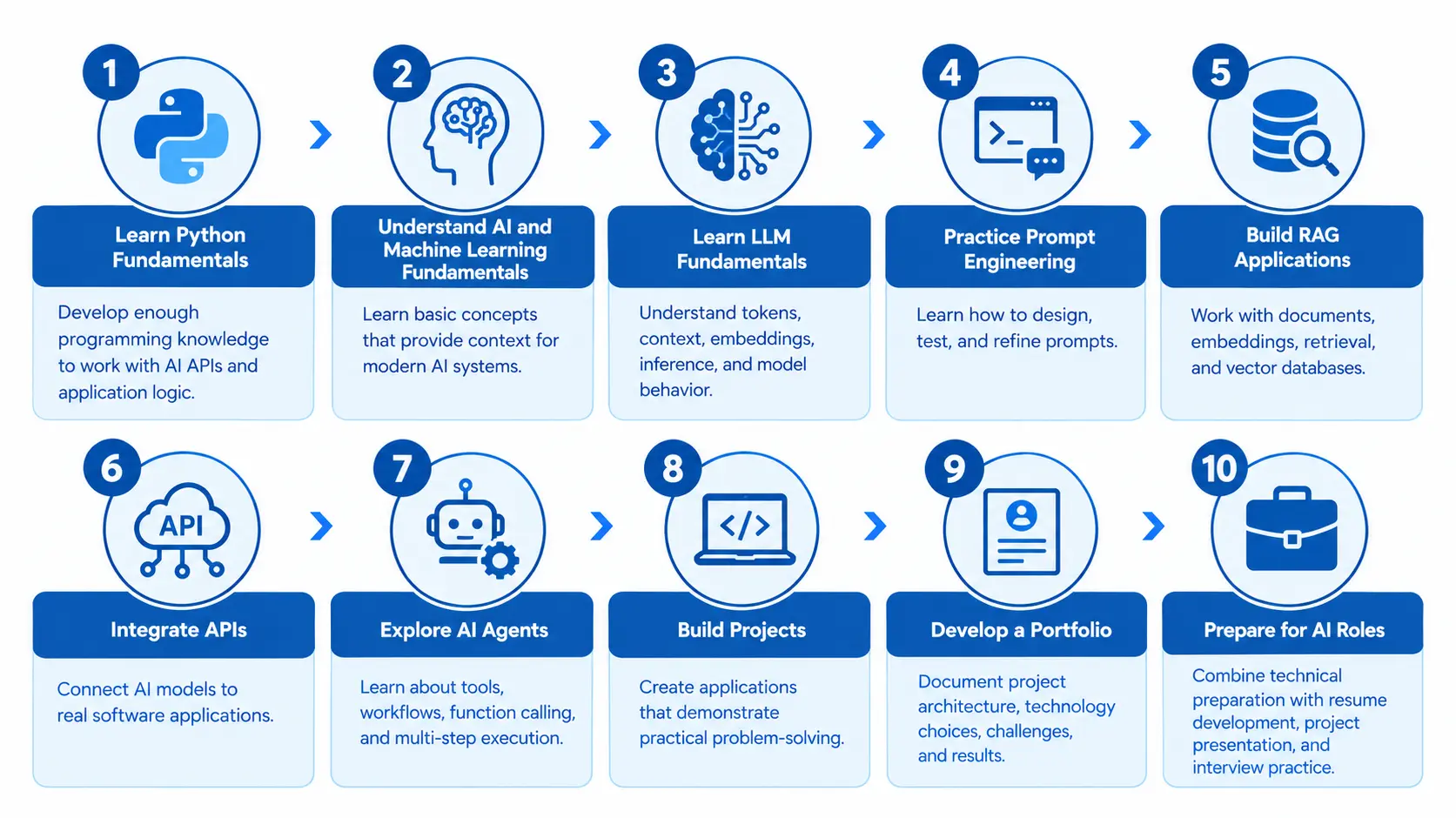
Step 1: Learn Python fundamentals.
Develop enough programming knowledge to work with AI APIs and application logic.
Step 2: Understand AI and machine learning fundamentals.
Learn basic concepts that provide context for modern AI systems.
Step 3: Learn LLM fundamentals.
Understand tokens, context, embeddings, inference, and model behavior.
Step 4: Practice prompt engineering.
Learn how to design, test, and refine prompts.
Step 5: Build RAG applications.
Work with documents, embeddings, retrieval, and vector databases.
Step 6: Integrate APIs.
Connect AI models to real software applications.
Step 7: Explore AI agents.
Learn about tools, workflows, function calling, and multi-step execution.
Step 8: Build projects.
Create applications that demonstrate practical problem-solving.
Step 9: Develop a portfolio.
Document project architecture, technology choices, challenges, and results.
Step 10: Prepare for AI roles.
Combine technical preparation with resume development, project presentation, and interview practice.
Build the Skills Behind the AI Applications
Generative AI is more than a trend or a collection of chatbot tools. It represents a new approach to building software applications that can understand language, retrieve information, generate content, and support complex workflows.
For learners, the opportunity lies in understanding the technology behind these applications.
LLMs provide the language capabilities. Prompt engineering helps guide model behavior. Embeddings and vector search enable semantic retrieval. RAG connects models with external knowledge. APIs connect AI capabilities with software. AI agents introduce multi-step workflows.
Together, these technologies form a practical foundation for modern AI application development.
Conclusion
A Generative AI Course in Pune can help learners develop practical skills in LLMs, prompt engineering, RAG, AI applications, APIs, embeddings, vector databases, and AI agents.
For fresh graduates, developers, data professionals, working professionals, and career switchers, structured learning can provide a clear path from AI fundamentals to practical application development.
When evaluating Generative AI Classes in Pune or an Online Generative AI Course, learners should look beyond course titles and promotional claims. Curriculum depth, practical projects, mentorship, industry relevance, application development, and career guidance are important considerations.
At IntelliBI Innovations Technologies, the emphasis is on connecting learning with practical implementation. The goal is to help learners understand how modern Generative AI systems work and develop the confidence to build meaningful AI applications.
The future of AI will not be limited to using AI tools. It will increasingly involve people who can understand, build, integrate, evaluate, and improve AI-powered solutions. Developing these skills today can provide a strong foundation for participating in the rapidly evolving Generative AI ecosystem.