

What Is MCP? An Enterprise AI Project Explanation for Data Analysts
Quick Answer
Model Context Protocol (MCP) is an open protocol that enables AI applications to connect with external data sources, tools and enterprise systems through a standardized interface. It uses hosts, clients and servers to support capabilities such as database queries, business reporting, document retrieval and AI-powered workflow automation.
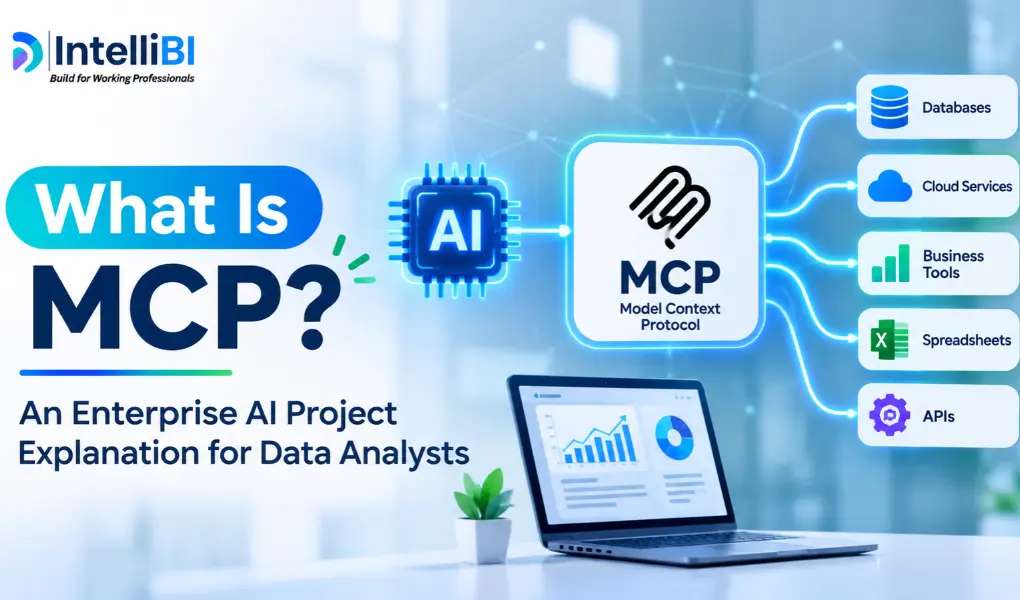
What Is MCP? An Enterprise AI Project Explanation for Data Analysts
Artificial Intelligence is changing how businesses interact with their data. Traditionally, employees depended on dashboards, SQL queries, reports and multiple business applications to find information. Today, Generative AI allows users to ask questions in natural language and receive meaningful answers. However, a major challenge remains: how can an AI application securely connect with enterprise databases, business applications, reporting platforms and internal tools?
This is where Model Context Protocol (MCP) becomes important.
MCP is an open protocol that standardizes how AI applications connect with external data sources and tools. Instead of developing separate integrations for every AI application and business system, developers can use a common communication framework to make information and functionality accessible to AI models.
For example, imagine a sales manager asking an AI assistant, "Which region generated the highest revenue last quarter, and what caused the decline in the western region?" The AI application could use MCP-connected tools to retrieve approved sales data, query a database, examine business reports and generate an explanation.
This makes MCP particularly relevant to modern data analytics, business intelligence and enterprise AI development. Understanding it can also help professionals exploring a Data Analyst Course in Pune develop a broader understanding of how traditional analytics connects with Generative AI.
Let's understand MCP through a practical enterprise project.
1. What Is MCP (Model Context Protocol)?
Model Context Protocol is an open standard that enables AI applications to communicate with external systems through a structured interface.
Think of MCP as a common connector between an AI application and business tools.
Without a standardized protocol, developers may need to build individual integrations between an AI application and every database, reporting platform or enterprise application. MCP simplifies this integration process by providing a consistent communication approach.
For example, an organization may use:
- SQL Server or PostgreSQL for storing business information.
- Power BI for business reporting.
- Salesforce for customer relationship management.
- SharePoint for internal documentation.
- Python applications for data processing.
- Cloud platforms for enterprise data storage.
An MCP-enabled AI application can communicate with compatible MCP servers to access approved information and functionality from these systems.
Important: MCP does not replace databases, APIs, AI models, data pipelines or business intelligence platforms. It provides a standardized way for AI applications to interact with external capabilities.
2. Why Do Enterprises Need MCP?
Enterprise organizations manage information across multiple platforms. Although these systems store valuable information, employees often need to switch between applications to complete a single business task.
Consider a business analyst preparing a monthly performance report.
The analyst might need to:
- Retrieve sales information from a database.
- Check customer details in a CRM.
- Review historical performance in Power BI.
- Read operational explanations from internal documents.
- Combine the information into a management report.
This process requires time and knowledge of multiple applications.
An MCP-enabled AI assistant can simplify the interaction by providing a common interface through which approved tools and data sources become accessible.
Major enterprise benefits
1. Standardized integrations
MCP provides a common protocol for connecting compatible AI applications with different tools and information sources.
2. Reduced integration complexity
Developers can build reusable MCP servers instead of creating an entirely separate integration for every AI client.
3. Better access to business context
AI applications can retrieve relevant information from approved databases, documents and enterprise services.
4. Workflow automation
AI agents can use exposed tools to perform permitted operations, such as retrieving reports, checking pipeline status or creating a business summary.
5. Flexible architecture
Organizations can connect additional MCP servers as their technology requirements change, subject to compatibility and security controls.
3. Understanding MCP Architecture
To understand how MCP works, it is important to know its three main components: Host, Client and Server.
A. MCP Host
The host is the AI application that coordinates the overall interaction.
Examples include an AI assistant or another application that uses a language model and supports MCP connections.
The host manages the AI experience, client connections, user permissions and interactions.
B. MCP Client
The MCP client is the component inside the host that communicates with an MCP server.
A host can create multiple clients to connect to different MCP servers. Each client maintains a dedicated connection with its corresponding server.
C. MCP Server
The MCP server exposes specific data and functionality to an AI application.
For example, a database MCP server could provide access to approved database operations, while a reporting MCP server could expose selected business reports.
How the components work together
Component
Responsibility
Enterprise example
MCP Host
Coordinates AI interactions
Enterprise AI assistant
MCP Client
Communicates with an MCP server
Database MCP client
MCP Server
Exposes tools and information
SQL database server
Enterprise system
Stores or processes business data
SQL Server, CRM, Power BI
The basic interaction looks like this:
- A user asks a question through an AI application.
- The AI host identifies the relevant capability.
- The MCP client communicates with the appropriate server.
- The server provides available tools or resources.
- The AI application requests the necessary information or action.
- The server returns the result.
- The AI model uses the returned information to formulate an answer.
MCP uses JSON-RPC-based communication. Depending on the deployment, connections can use local standard input/output (STDIO) or remote Streamable HTTP transport.
4. Three Important MCP Capabilities
MCP provides three important server-side primitives: Tools, Resources and Prompts.
Understanding these capabilities is essential when designing an enterprise AI project.
1. Tools
Tools allow an AI application to request an operation from an MCP server.
Examples include:
- Execute an approved SQL query.
- Retrieve customer information.
- Check sales performance.
- Generate a report.
- Retrieve pipeline execution status.
For example, a business user asks:
"Show the total sales generated by each region."
The AI application can select an appropriate database tool and request the relevant operation.
The server executes the approved operation and returns the result.
2. Resources
Resources provide contextual information to AI applications.
Examples include:
- Database schemas.
- Business documentation.
- Product catalogues.
- Internal reports.
- Data dictionaries.
- Company policies.
For example, before answering a question about revenue, an AI assistant may need to understand how the organization defines revenue.
An MCP resource could provide the relevant business definitions and database schema.
3. Prompts
Prompts are reusable templates exposed by an MCP server to help structure interactions.
For example, an organization could provide a reusable template for generating:
- Monthly sales summaries.
- Customer performance reports.
- Financial analysis.
- Operational performance reviews.
These templates help establish consistent instructions for recurring business tasks.
5. Enterprise MCP Project: Building an AI-Powered Business Analytics Assistant
Let's understand MCP through an end-to-end enterprise project.
Project objective: Develop an AI-powered business analytics assistant that allows employees to ask questions about company sales, customers, products and regional performance using natural language.
Business problem
Imagine a retail organization operating across multiple cities in India.
The company stores information across different systems:
- SQL Server contains sales transactions.
- Salesforce contains customer information.
- Power BI contains business dashboards.
- SharePoint contains internal business documentation.
- Python applications perform data processing.
Management wants a single AI assistant that can answer business questions without requiring employees to manually access every application.
The proposed solution uses MCP to connect the AI application with approved enterprise capabilities.
Step 1: Identify enterprise data sources
The first step is understanding where business information is stored.
For this project, consider the following datasets:
Data source
Information available
SQL Server
Sales transactions
Salesforce
Customer details
Power BI
Revenue and KPI reports
SharePoint
Business policies and reports
Python services
Data processing operations
Before building the application, developers must identify the relevant tables, APIs, business definitions and access requirements.
Step 2: Design the MCP architecture
The next step is designing the communication architecture.
The architecture includes:
- An AI application acting as the MCP host.
- MCP clients connecting to individual servers.
- A SQL MCP server exposing approved database tools.
- A CRM MCP server exposing customer-related operations.
- A reporting MCP server exposing selected reporting capabilities.
- A document MCP server providing relevant business documentation.
Each server has a clearly defined responsibility.
This modular approach allows developers to maintain and extend integrations independently.
Step 3: Build the SQL MCP server
The SQL MCP server connects the AI application with approved database operations.
For example, the server can expose tools such as:
- get_sales_by_region
- get_monthly_revenue
- get_product_performance
- get_customer_summary
When an employee asks a question about sales, the AI application can identify the relevant tool and request the required information.
The server validates the request, applies authorization and executes the permitted database operation.
An important enterprise practice is to use parameterized queries, read-only access wherever possible, query limits and controlled database permissions.
The AI model should not receive unrestricted database access.
Step 4: Connect business intelligence tools
The next stage is connecting the reporting environment.
Suppose the organization uses Power BI to monitor:
- Total revenue.
- Monthly sales growth.
- Customer acquisition.
- Product profitability.
- Regional performance.
An MCP server can expose approved reporting or semantic-model operations through the relevant supported interfaces.
The AI assistant can retrieve business information and explain the results in natural language.
For example:
"Revenue increased by 12% in the southern region, while the western region recorded a decline of 5% compared with the previous quarter."
The assistant should provide the underlying reporting period and source context so that users can verify the result.
Step 5: Connect CRM and enterprise documents
The assistant can also retrieve customer information from an approved CRM integration and relevant business definitions from enterprise documents.
For example, a manager asks:
"Why did customer retention decrease last month?"
The AI assistant may retrieve approved retention metrics, examine relevant customer segments and access internal reports explaining recent operational changes.
It can then generate a contextual summary.
However, the system must distinguish between verified data and possible explanations. A correlation in the data does not automatically establish the cause of a business problem.
Step 6: Integrate the LLM and develop the AI workflow
The next step is connecting the MCP-enabled application with a Large Language Model (LLM).
The LLM interprets the user's question and helps determine which available tools or resources are relevant.
A typical interaction could be:
User question: "Which product category generated the highest revenue in Pune during the previous quarter?"
AI application workflow:
- Understand the question and identify the required business metrics.
- Discover the relevant MCP tool.
- Request the sales data using the MCP client.
- Retrieve the database result through the MCP server.
- Interpret the result using the LLM.
- Present the answer with the reporting period and supporting figures.
The AI model handles language understanding and response generation, while the MCP server provides access to the underlying business capabilities.
Step 7: Test, secure and deploy the application
Before deployment, the organization must test the complete workflow.
Important testing areas include:
- Accuracy of database queries.
- Correctness of business calculations.
- User authentication.
- Role-based access control.
- API authorization.
- Protection of confidential information.
- Tool execution permissions.
- Error handling and monitoring.
- Response quality and audit logging.
The system should also be tested against prompt injection and malicious instructions contained in retrieved documents or tool responses.
For sensitive operations, human approval should be required before the assistant performs actions such as modifying customer records or triggering financial transactions.
6. Practical Example: How an Employee Uses an MCP Assistant
Consider a sales manager who wants to understand the company's quarterly performance.
Instead of manually opening multiple applications, the manager asks:
"Compare this quarter's sales with the previous quarter and identify the three regions with the largest decline."
The assistant follows a structured workflow:
Stage
Activity
User input
Manager submits a natural-language question
AI interpretation
LLM identifies the required metrics
Tool discovery
MCP client identifies the available reporting tool
Data retrieval
MCP server retrieves approved sales information
Analysis
AI application compares the results
Response
Assistant presents regional performance
Verification
User can review the underlying report or source data
The final response might look like:
- Region A: Revenue declined by 11%.
- Region B: Revenue declined by 8%.
- Region C: Revenue declined by 6%.
These are illustrative figures, not actual company results.
The manager can then ask follow-up questions such as:
- Which products contributed most to the decline?
- Did customer acquisition decrease?
- How did the performance compare with the annual target?
- Can you prepare an executive summary?
The assistant can use additional approved tools to retrieve the relevant information.
This is an example of how MCP can connect enterprise analytics with conversational AI.
7. MCP vs Traditional API Integration
MCP and APIs serve related but different purposes.
APIs provide application-to-application communication interfaces. MCP establishes a standardized protocol through which compatible AI applications can discover and interact with exposed capabilities.
Feature
Traditional API integration
MCP
Primary purpose
Application communication
AI application context and capability exchange
Interface
API-specific contracts
Standardized MCP protocol
Tool discovery
Depends on API implementation
Supports capability and tool discovery
Data access
Through API endpoints
Through exposed resources and tools
AI integration
Requires application-specific integration
Designed for compatible AI clients
Reusability
Depends on API design
Common protocol across compatible clients and servers
MCP does not eliminate APIs. An MCP server may use existing APIs internally to communicate with enterprise applications.
The two technologies can work together.
8. Enterprise Security Challenges and Best Practices
Connecting AI applications to enterprise systems introduces important security considerations.
MCP provides a communication standard, but implementing MCP does not automatically make an application secure.
Organizations should consider the following practices.
Authentication and authorization: Verify the identity of clients and users. Use appropriate OAuth-based authorization for remote deployments where applicable.
Least-privilege access: Give each MCP server only the permissions needed for its intended operations.
Database security: Prefer read-only database access for analytics use cases. Restrict tables, columns, query execution and returned records.
Human approval: Require explicit confirmation for sensitive or irreversible operations.
Input validation: Validate tool arguments and reject unauthorized or unexpected requests.
Prompt injection protection: Treat retrieved documents, database content and external tool responses as untrusted data.
Audit logging: Record relevant tool calls, user identity, authorization decisions and execution outcomes.
Monitoring: Monitor unusual activity, failed requests, excessive queries and unexpected data access.
For enterprise deployments, security should be designed into the architecture rather than added after development. The NSA's May 2026 MCP security guidance is also a useful reference for understanding risks in AI-driven automation.
9. Where Is MCP Used in Data Analytics and Business Intelligence?
MCP has applications across several enterprise workflows.
A. AI-powered business intelligence
Business users can ask natural-language questions and retrieve approved information from reporting systems.
B. Automated data analysis
AI applications can access approved analytical tools to retrieve datasets, calculate metrics and summarize findings.
C. Enterprise knowledge assistants
Employees can interact with company documentation, policies, reports and structured business information.
D. Data engineering automation
AI agents can use approved tools to inspect pipeline status, retrieve execution logs and assist with troubleshooting.
E. Customer analytics
MCP-connected applications can retrieve approved CRM information and help teams understand customer trends and segments.
These applications demonstrate why MCP is becoming relevant to professionals working across data analytics, data engineering and Generative AI.
10. Skills Required to Work on an Enterprise MCP Project
MCP development involves more than understanding a protocol. Developers need knowledge of the technologies used to build and operate enterprise applications.
Some important skills include:
Skill
Why it matters
SQL
Retrieving and analyzing enterprise data
Python
Building MCP servers and backend integrations
APIs
Connecting external business applications
JSON and JSON-RPC
Understanding structured communication
LLMs
Natural-language understanding and response generation
Prompt engineering
Designing effective AI interactions
RAG
Retrieving relevant enterprise knowledge
Power BI
Understanding business metrics and reporting
Authentication
Securing enterprise integrations
Testing and monitoring
Ensuring reliable application behaviour
For professionals exploring a Data Analytics Course in Pune, these technologies represent an extension of traditional analytics skills.
A strong foundation in SQL, Python, data visualization and business analysis makes it easier to understand how MCP-enabled analytics applications work.
Similarly, learners pursuing a Power BI Course in Pune can benefit from understanding how AI assistants interact with reporting systems and business metrics.
Professionals interested in combining conventional reporting with Generative AI can also explore a Data Analytics with Gen AI Course in Pune to understand the broader technology landscape.
11. How MCP Is Changing the Future of Enterprise Analytics
Traditional business intelligence primarily focuses on dashboards, reports and predefined analytical queries.
Generative AI introduces a more conversational approach, allowing users to interact with business information using natural language.
MCP helps connect these AI applications with the systems where enterprise information and operations actually exist.
In the future, enterprise analytics workflows may increasingly combine:
- Traditional BI dashboards.
- Conversational analytics.
- AI-powered data retrieval.
- Automated business reporting.
- RAG-based enterprise knowledge systems.
- AI agents connected to approved business tools.
However, successful implementation will depend on data quality, security, governance and reliable business definitions.
MCP is an important integration layer in this development, not a replacement for the underlying data architecture.
Frequently Asked Questions (FAQs)
1. What does MCP stand for in Artificial Intelligence?
MCP stands for Model Context Protocol. It is an open protocol that standardizes communication between AI applications and external data sources, tools and services.
2. Is MCP an AI model?
No. MCP is not an AI model or a Large Language Model. It is a communication protocol that enables compatible AI applications to interact with external systems.
3. What is an MCP server?
An MCP server is a program that exposes capabilities such as tools, resources and prompts to an MCP client. It can connect AI applications with databases, APIs, documents and other enterprise systems.
4. What is the difference between MCP and an API?
An API provides an interface for software applications to communicate. MCP provides a standardized protocol designed to help AI applications discover and interact with tools and contextual information. MCP servers can also use APIs internally.
5. Can MCP connect with SQL databases?
Yes. An MCP server can expose approved database operations, schema information and query capabilities to compatible AI applications. Appropriate authentication, authorization and query restrictions are essential.
6. Is MCP useful for data analysts?
Yes. MCP is relevant to data analysts because it can connect AI applications with databases, business intelligence platforms and enterprise information. It can support conversational reporting, automated analysis and business intelligence workflows.
7. Does MCP replace Power BI?
No. Power BI remains a business intelligence and reporting platform. MCP can provide an integration layer through which an AI application accesses supported reporting capabilities.
8. Is MCP secure for enterprise applications?
MCP can be used in enterprise environments, but security depends on implementation. Organizations must establish authentication, authorization, least-privilege access, input validation, monitoring and appropriate human approval controls.
9. Which programming language is used to develop MCP servers?
MCP servers can be developed using supported SDKs and programming languages, including Python and TypeScript. The appropriate choice depends on the existing application architecture and development requirements.
10. What should I learn before working on an MCP project?
Start with Python, SQL, APIs, JSON, databases and basic Generative AI concepts. Knowledge of LLMs, RAG, authentication and business intelligence will also help when developing enterprise applications.
Conclusion
Model Context Protocol is an important development in the way AI applications interact with enterprise systems. By standardizing communication between AI clients and external tools, MCP makes it easier to connect databases, reporting platforms, APIs and business applications through reusable integrations.
The enterprise analytics project discussed in this article demonstrates how MCP can support natural-language reporting, business data retrieval and AI-assisted decision-making.
For aspiring data analysts and working professionals, understanding SQL, Python, Power BI, APIs and Generative AI provides a strong foundation for exploring these emerging workflows.
As organizations continue adopting AI-powered business applications, the ability to understand both traditional analytics and modern AI integration technologies will become increasingly valuable.
Explore Data Analytics and Generative AI Training at IntelliBI
IntelliBI Innovations Technologies focuses on practical learning across SQL, Python, Power BI, Tableau and Generative AI. Learners interested in understanding modern analytics workflows and AI-powered business applications can explore the Data Analytics Course in Pune and its industry-oriented curriculum.