
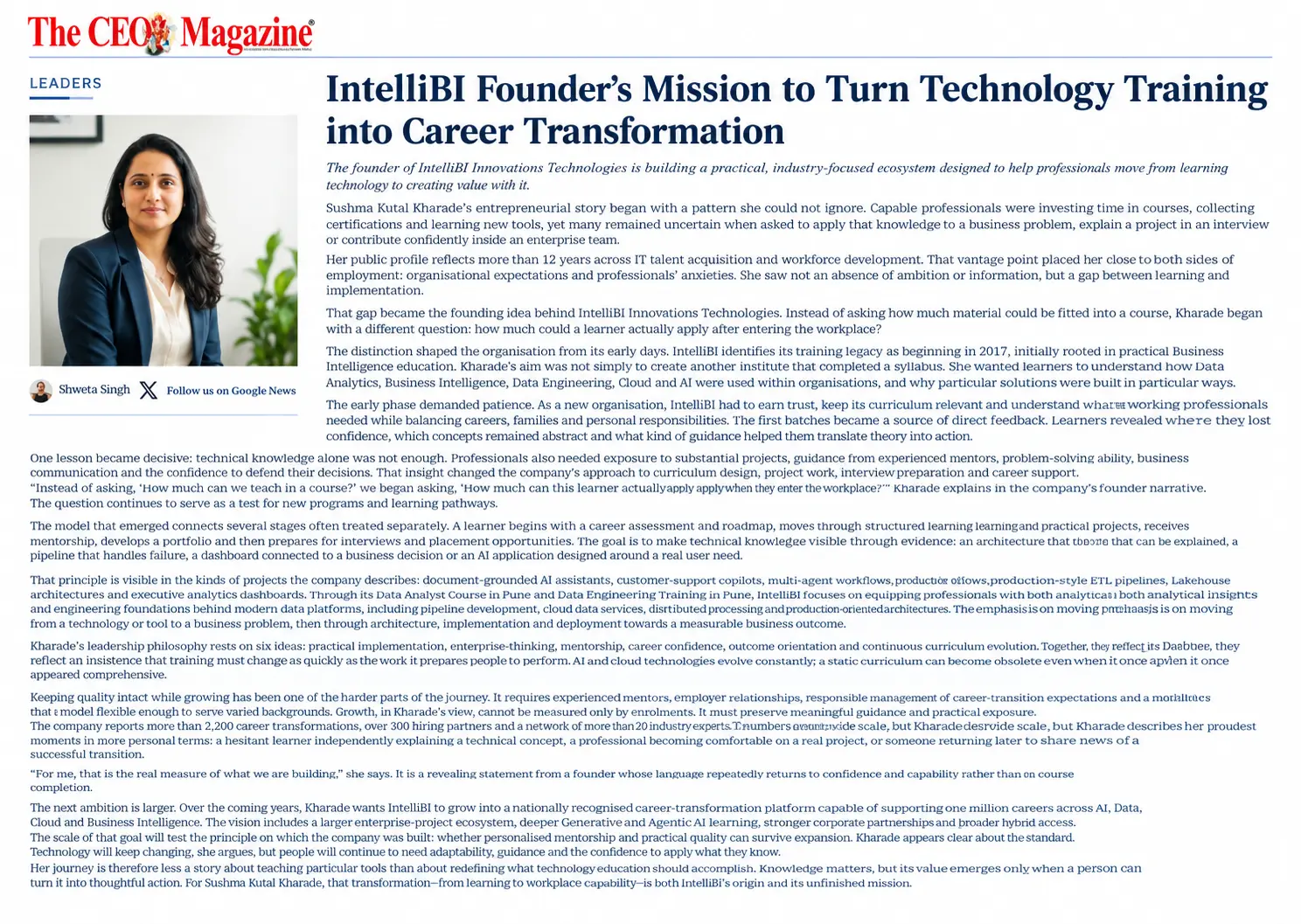
IntelliBI Founder’s Mission to Turn Technology Training into Career Transformation
Quick Answer
IntelliBI Founder Sushma Kutal Kharade’s mission is to bridge the gap between technology learning and workplace performance. IntelliBI focuses on practical projects, mentorship, career roadmaps, portfolio development, interview preparation, and industry-oriented learning across AI, data, cloud, and business intelligence. The goal is to help learners move beyond certificates and demonstrate the ability to apply technology to real business problems.
Technology education has changed significantly in recent years. Learning platforms, certifications, online courses, bootcamps, and specialised training programmes have made technical knowledge more accessible than ever. Yet one important question continues to matter: Can a learner actually apply what they have learned when they enter the workplace?
For Sushma Kutal Kharade, Founder of IntelliBI Innovations Technologies, this question became the foundation for a different approach to technology training.
Her mission is centred on a simple distinction: learning technology and becoming capable of using technology professionally are not always the same thing.
That distinction has shaped IntelliBI’s approach to training, projects, mentorship, career guidance, interview preparation, and professional development. Rather than treating course completion as the final destination, the organisation focuses on helping learners build evidence of what they can actually do.
From Technology Training to Career Transformation
The story behind IntelliBI begins with an observation from the professional world.
According to the founder’s profile, Kharade has more than 12 years of experience across IT talent acquisition and workforce development. This experience provided visibility into both sides of the employment equation: what professionals expect from their careers and what organisations expect from potential employees.
A recurring challenge became clear. Professionals could spend significant time learning new technologies, completing certifications, and adding tools to their resumes, yet still feel uncertain when asked to explain a project, solve a practical problem, or demonstrate how their knowledge could contribute to an organisation.
This gap between learning and implementation became an important part of IntelliBI’s philosophy.
For someone exploring an Artificial Intelligence Course in Pune, for example, the objective should not stop at understanding AI concepts. Learners increasingly need to understand how models, data, programming, automation, and AI applications come together to solve practical problems.
The same principle applies to an AI Course Pune learner, a professional exploring Artificial Intelligence Classes in Pune, or someone considering Artificial Intelligence Training in Pune as part of a career transition.
The question is not simply, “What did you learn?”
It is also, “What can you build, explain, improve, and implement with that knowledge?”
Why Practical Learning Matters
Technology changes quickly.
Artificial intelligence, machine learning, cloud platforms, data engineering, generative AI, and business intelligence continue to evolve. A curriculum that remains static can become disconnected from the realities of modern workplaces.
This is one reason IntelliBI places emphasis on practical implementation.
An Artificial Intelligence Course in Pune can introduce learners to algorithms, machine learning concepts, programming, and AI frameworks. However, practical exposure gives those concepts context. Projects can demonstrate how an AI system is designed. A portfolio can provide evidence of implementation. Mentorship can help learners understand why one technical approach may be more appropriate than another.
For professionals attending Artificial Intelligence Classes in Pune, practical exposure can also help connect classroom learning with existing workplace experience.
This becomes particularly important for working professionals who cannot simply start their careers again from the beginning. Their learning journey needs to connect with the skills, experience, and responsibilities they already possess.
That is where AI Classes in Pune for Working Professionals can become more relevant when they are structured around practical outcomes rather than theory alone.
A Career-Focused Learning Journey
IntelliBI’s approach connects multiple stages that are often treated separately by traditional training models.
The journey begins with understanding the learner’s career direction. From there, a roadmap can help establish what skills need to be developed. Structured learning introduces technical concepts, while practical projects provide opportunities to apply them.
The next stages involve mentorship, portfolio development, interview preparation, and placement-oriented career support.
This approach creates a more connected learning journey.
Someone pursuing an AI Course in Pune with Placement may not only want classroom instruction. They may also need guidance on portfolio development, interview communication, project explanation, resume positioning, and understanding the expectations associated with a target role.
Similarly, someone searching for an AI Engineer Course in Pune may need exposure to the broader engineering lifecycle rather than isolated AI concepts.
The emphasis is therefore on capability backed by evidence.
A learner should be able to explain an architecture, discuss technical decisions, demonstrate a project, and connect technology with a business requirement.
Building Confidence Through Projects
Projects play an important role in this philosophy.
The founder’s profile highlights examples such as document-grounded AI assistants, customer-support copilots, multi-agent workflows, production-style ETL pipelines, lakehouse architectures, and executive analytics dashboards.
These examples reflect a practical orientation toward technology.
For learners undertaking an Artificial Intelligence Training in Pune programme, a project can turn an abstract concept into something tangible. Instead of simply learning what retrieval-augmented generation means, for example, learners can understand how information is collected, processed, retrieved, and presented within an application.
The same principle applies across an AI and Machine Learning Course in Pune.
Machine learning concepts become more meaningful when learners understand how they fit into a real workflow: preparing data, selecting an approach, evaluating results, deploying a solution, and monitoring its performance.
Projects also provide something that certificates alone cannot always demonstrate: visible evidence of practical work.
That evidence can become part of a professional portfolio and a talking point during interviews.
Supporting Working Professionals Through Change
Career transitions can be complex.
A working professional moving into AI may already have experience in software development, testing, analytics, infrastructure, operations, finance, sales, or another domain. The challenge is not necessarily starting from zero. It is identifying transferable skills and building the technical capabilities required for the next role.
This is particularly relevant to people considering AI Classes in Pune for Working Professionals.
A career-focused programme can help connect previous experience with emerging technology instead of treating the learner’s previous career as irrelevant.
For example, a professional with business knowledge may bring valuable domain understanding to an AI project. A software professional may already understand application development and need to strengthen their AI capabilities. A data professional may need to expand into machine learning or generative AI.
The transformation therefore involves more than acquiring another certificate. It involves understanding how existing experience can work together with new technical skills.
Beyond Certificates: Demonstrating Capability
The growing popularity of Artificial Intelligence Certification Course in Pune programmes reflects the demand for structured learning and recognised credentials. Certifications can provide evidence that someone has completed a learning path, but professional capability often requires additional evidence.
A strong candidate may need to explain:
- What problem did the project solve?
- Why was a particular technology selected?
- How was the solution designed?
- What challenges appeared during implementation?
- How was performance evaluated?
- What would be changed in a production environment?
- How does the solution create business value?
These questions require understanding rather than memorisation.
This is why IntelliBI’s philosophy places projects, mentorship, portfolio development, and interview preparation alongside structured technology learning.
The objective is to make knowledge visible through practical evidence.
Creating Industry-Oriented AI Learning
The demand for AI professionals is creating new opportunities across industries, but the definition of an AI professional is also becoming broader.
Modern roles may involve machine learning, generative AI, large language models, data engineering, cloud platforms, AI applications, automation, or a combination of several technologies.
An Artificial Intelligence Course in Pune therefore needs to reflect the changing nature of the technology ecosystem.
Likewise, an Artificial Intelligence Institute in Pune needs to consider more than classroom delivery. Learners need access to relevant tools, practical environments, experienced guidance, and opportunities to understand how technologies work together.
IntelliBI’s broader learning ecosystem brings together AI, data, cloud, and business intelligence with the objective of preparing professionals for changing workplace requirements.
The emphasis remains on adaptability.
The Role of Mentorship in Career Transformation
Technology can be learned independently, but career development often benefits from guidance.
A mentor can help a learner identify gaps, review project decisions, understand technical trade-offs, prepare for interviews, and build confidence in explaining their work.
This becomes particularly valuable when someone is transitioning into a new role.
For an AI Engineer Course in Pune, mentorship can help learners understand the difference between building a demonstration project and thinking about how an application could operate in a production environment.
For an Artificial Intelligence Training in Pune programme, mentorship can also provide context around where a particular skill fits within an organisation.
The objective is not to provide every answer. It is to help learners develop the ability to find, evaluate, and apply answers independently.
A Larger Vision for Career Transformation
The founder’s stated ambition extends beyond individual courses.
The long-term vision described in the profile is to build IntelliBI into a nationally recognised career-transformation platform supporting up to one million careers across AI, data, cloud, and business intelligence.
The proposed direction includes a broader enterprise project ecosystem, deeper generative and agentic AI learning, stronger corporate partnerships, and wider hybrid access.
At the centre of this vision is a consistent principle: technology education should remain connected to workplace capability.
As tools change, learners will need to keep adapting. An AI Course Pune learner today may need a different combination of skills tomorrow. A professional completing an AI and Machine Learning Course in Pune may later need to understand generative AI, agentic systems, cloud infrastructure, or data architecture.
Continuous curriculum evolution therefore becomes essential.
What Career Transformation Really Means
Career transformation is not simply changing a job title.
It can mean gaining the confidence to explain a technical concept, successfully completing a real project, moving into a new technology role, returning to the workforce after a career break, or applying newly acquired skills to an existing professional responsibility.
This perspective changes how success is measured.
For someone comparing the Best Artificial Intelligence Institute in Pune options, the decision can involve looking beyond course names and promotional claims. Learners can examine curriculum depth, project exposure, mentor involvement, portfolio opportunities, interview preparation, industry relevance, and the connection between training and workplace requirements.
The same evaluation applies when considering Artificial Intelligence Classes in Pune, Artificial Intelligence Training in Pune, or an Artificial Intelligence Certification Course in Pune.
The important question is how effectively the learning experience helps someone progress from knowledge to application.
The Mission Continues
Technology will continue to evolve. New AI models, cloud services, development frameworks, data platforms, and automation tools will reshape professional roles.
But one requirement is likely to remain consistent: professionals need to know how to use technology to solve meaningful problems.
That is the foundation behind IntelliBI Founder Sushma Kutal Kharade’s mission.
The organisation’s story is not simply about delivering technology courses. It is about creating a pathway that connects learning with projects, projects with portfolios, portfolios with interviews, and technical knowledge with workplace confidence.
Whether a learner is beginning with an Artificial Intelligence Course in Pune, exploring an AI Course in Pune with Placement, developing skills through Artificial Intelligence Classes in Pune, or preparing for an AI Engineer Course in Pune, the larger objective remains the same: turn learning into capability, and capability into career opportunity.
For IntelliBI, that transformation is not presented as a finished destination. It is an ongoing mission—one that evolves alongside technology, industry expectations, and the people who choose to build their careers around them.