
How to Build an ETL Data Pipeline Using Python and SQL
Quick Answer
An ETL pipeline using Python and SQL extracts data from sources such as CSV files, APIs, or databases, cleans and transforms it using Python and SQL, validates the results, and loads the processed data into a target database or warehouse. Beginners can then extend the pipeline with automation, incremental loading, cloud storage, Spark, and orchestration.
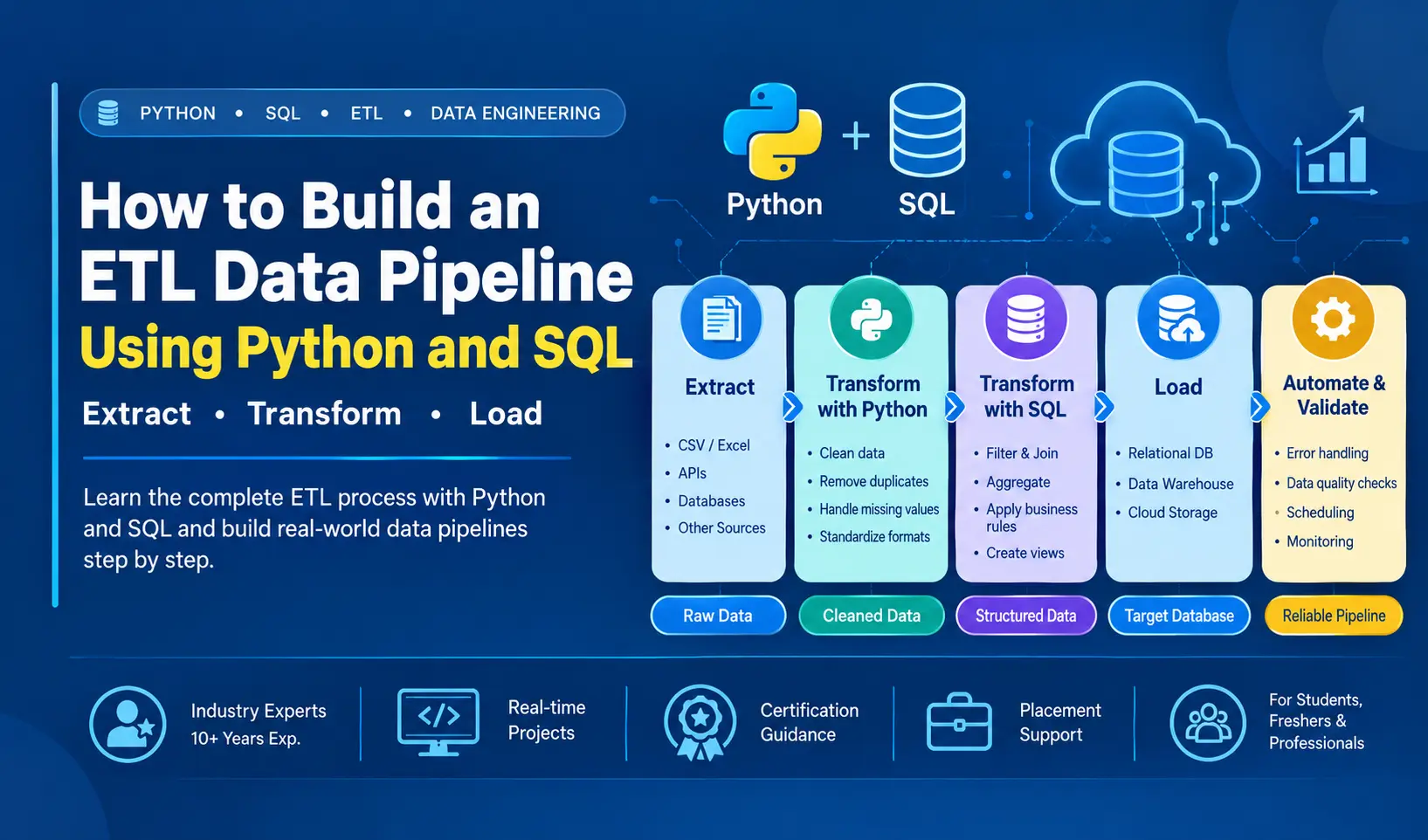
How to Build an ETL Data Pipeline Using Python and SQL
Data is at the center of almost every modern business decision. From customer transactions and sales records to application logs and operational data, organizations continuously generate information from multiple sources. But raw data is rarely ready for reporting or analytics. It needs to be collected, cleaned, transformed, validated, and stored in a usable format.
This is where ETL—Extract, Transform, Load—becomes important.
Learning to build an ETL pipeline using Python and SQL is one of the most practical skills for aspiring data engineers. It helps you understand how real-world data moves from source systems to analytical databases.
For learners exploring a Data Engineering Course in Pune, this is also an excellent project concept because it combines programming, databases, data transformation, and automation in one workflow.
What Is an ETL Data Pipeline?
ETL stands for Extract, Transform, and Load.
The process begins by extracting data from one or more sources. The data may come from CSV files, Excel sheets, APIs, operational databases, or other applications.
The next step is transformation. During this stage, data engineers clean the information, remove duplicates, handle missing values, standardize formats, and apply business rules.
Finally, the transformed data is loaded into a target system such as a relational database, data warehouse, or cloud storage platform.
A simple ETL workflow looks like this:
Source Data → Python Extraction → Data Cleaning → SQL Transformation → Target Database → Analytics
Understanding this workflow is an important part of Data Engineering Training in Pune because it introduces learners to the basic architecture behind many production data pipelines.
Why Use Python and SQL Together?
Python and SQL serve different but complementary purposes.
Python is useful for automation, file processing, API integration, data manipulation, validation, and pipeline orchestration. Libraries such as Pandas, NumPy, Requests, and database connectors make Python particularly useful for ETL development.
SQL is essential for interacting with relational databases. It helps engineers filter records, join tables, aggregate information, identify duplicates, and transform datasets.
For someone pursuing a Data Engineer Course in Pune, learning both technologies provides a strong foundation. Python handles the pipeline logic, while SQL provides powerful tools for working with structured data.
This combination is also commonly emphasized in practical Data Engineering Classes in Pune because it allows beginners to move from simple scripts toward realistic data workflows.
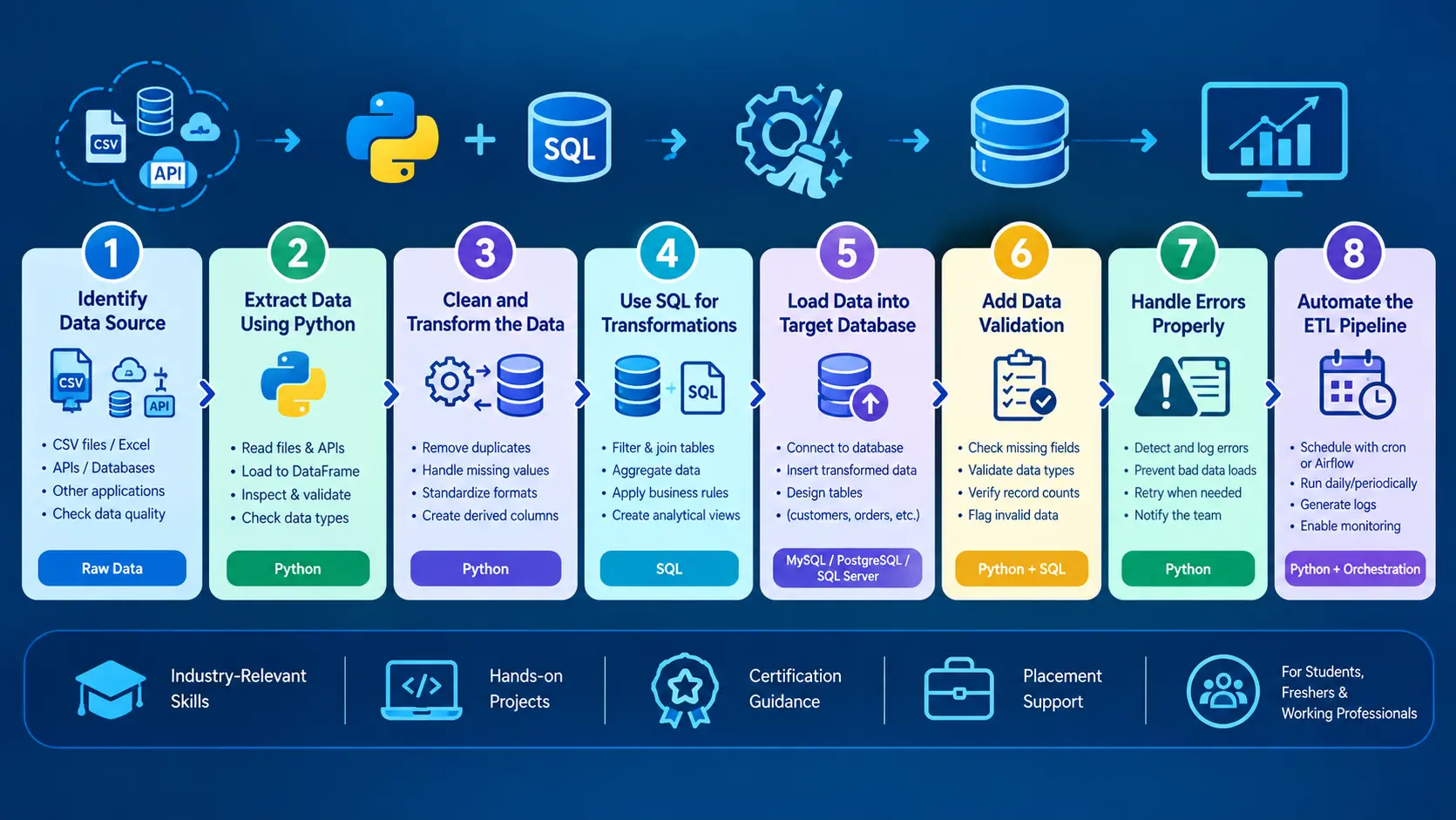
Step 1: Identify the Data Source
Before writing code, understand where your data comes from.
For a beginner project, a CSV file is a simple starting point. For example, imagine an online business has a file containing:
- Customer ID
- Customer Name
- Product
- Order Date
- Quantity
- Price
- City
The data may contain missing customer names, inconsistent city names, duplicate orders, or incorrect values.
A real ETL pipeline should not assume that incoming data is always clean.
If you are following a Best Data Engineering Course in Pune, this is an important mindset to develop: data engineering is not simply about moving data. It is about moving reliable and usable data.
Step 2: Extract Data Using Python
Python can be used to read data from files, APIs, and databases.
For example, Pandas can load a CSV file into a DataFrame. Once the data is available in memory, Python can inspect columns, identify missing values, check data types, and perform initial validation.
The extraction stage should answer questions such as:
Where did the data come from?
How frequently does new data arrive?
What format does the source use?
How many records are expected?
What happens if the source is unavailable?
These questions become increasingly important as you progress from beginner exercises to professional projects.
A practical Data Engineering Course in Pune should ideally explain not only how to extract data, but also how to deal with common extraction problems.
Step 3: Clean and Transform the Data
Raw data often requires significant preparation before it can be loaded into a database.
Python can be used to:
- Remove duplicate records
- Handle missing values
- Convert data types
- Standardize text
- Format dates
- Validate numerical fields
- Create derived columns
- Filter invalid records
Suppose the city column contains "Pune", "pune", and "PUNE". These values may represent the same location but appear differently.
A transformation step can standardize them into one consistent format.
Similarly, an order date may arrive in different formats. Converting dates into a consistent database-friendly format makes downstream analysis easier.
These practical exercises are particularly valuable in Data Engineering Training in Pune because they teach learners how to think about data quality rather than simply execute commands.
Step 4: Use SQL for Database Transformations
Once data has been prepared, SQL can take over many transformation tasks.
Suppose your database contains an orders table. SQL can calculate total revenue using:
Quantity × Price
You can then use SQL queries to calculate total sales by city, product, customer, or month.
Common SQL operations used in ETL include:
- SELECT
- WHERE
- JOIN
- GROUP BY
- HAVING
- CASE
- Window functions
- INSERT
- UPDATE
- MERGE
SQL is especially important because data engineers frequently work with multiple tables.
For example, customer information may exist in one table while orders are stored in another. A JOIN can combine the datasets to create a more meaningful analytical view.
Anyone considering a Data Engineer Course in Pune should therefore spend significant time practicing SQL rather than treating it as a secondary skill.
Step 5: Load the Data Into a Target Database
After extraction and transformation, the cleaned data needs to reach its destination.
For a beginner project, you could load the results into MySQL, PostgreSQL, SQL Server, or another relational database.
A simple target design might include:
Customers
Orders
Products
Sales Summary
Python can connect to the database using an appropriate connector or SQLAlchemy-based workflow and insert the transformed records.
At this point, the ETL process becomes a complete pipeline:
CSV → Python → Cleaning → SQL → Database
This type of project can be an excellent practical assignment for a Best Data Engineering Institute in Pune because it demonstrates the complete movement of data from source to destination.
Step 6: Add Data Validation
A pipeline should not blindly load everything it receives.
Validation helps identify problems before they reach the target database.
For example, you can check:
- Are required fields missing?
- Are customer IDs unique?
- Are quantities positive?
- Are dates valid?
- Are prices within reasonable ranges?
- Did the expected number of records arrive?
- Were any records rejected?
Suppose 10,000 records were expected but only 7,500 were received. The pipeline should flag the difference rather than silently continuing.
Data validation is an important topic in an Advanced Data Engineer Course in Pune because production pipelines need reliability as well as functionality.
Step 7: Handle Errors Properly
Errors are unavoidable in real data pipelines.
A source file might be unavailable. A database connection might fail. An API may return an unexpected response. A record may contain an invalid value.
Python provides exception-handling mechanisms that can help manage these situations.
A good pipeline should:
- Detect the error.
- Record useful information in logs.
- Prevent corrupted data from being loaded.
- Retry where appropriate.
- Notify the responsible team when necessary.
Learning error handling makes an ETL project much closer to a real engineering workflow.
This is one reason practical Data Engineering Classes in Pune can be more valuable than learning ETL concepts only through theoretical examples.
Step 8: Automate the ETL Pipeline
Running a Python script manually every day is not an efficient production solution.
The next step is automation.
You could schedule a Python pipeline using operating-system scheduling tools for a beginner project. As your skills develop, you can explore workflow orchestration tools such as Apache Airflow or cloud-native scheduling services.
For example:
Every morning at 6:00 AM → Extract new data → Validate → Transform → Load → Generate logs
This approach turns a collection of Python and SQL commands into an automated data pipeline.
Automation is an important part of modern Data Engineering Training in Pune and becomes especially relevant when working with large-scale cloud data platforms.
Incremental Loading vs Full Loading
One of the next concepts to learn is incremental loading.
A full load processes all available records every time the pipeline runs.
An incremental load processes only newly added or changed records.
For example, if a database contains 10 million orders and only 20,000 new orders arrive today, processing all 10 million records may be inefficient.
Instead, the pipeline can use an order timestamp or another high-watermark column to identify new records.
This concept becomes extremely important when progressing from a beginner project to an Advanced Data Engineer Course in Pune, where efficiency and scalability become major considerations.
How Cloud Platforms Extend ETL Pipelines
Once you understand Python and SQL-based ETL, the next step is learning how these concepts work in cloud environments.
An Azure Data Engineer Course in Pune can introduce services for cloud storage, data integration, databases, analytics, and orchestration.
Similarly, learners interested in Databricks Training in Pune can explore Spark, PySpark, Delta Lake, and lakehouse architectures for large-scale data processing.
Cloud Computing Classes in Pune can provide the broader foundation required to understand compute, storage, networking, security, databases, and monitoring.
The important point is that cloud technologies do not replace ETL fundamentals. They extend them.
You still need to understand where data comes from, how it should be transformed, how quality should be maintained, and where the final data should be stored.
A Practical ETL Project for Beginners
If you want to turn this topic into a portfolio project, consider building a sales ETL pipeline.
The project could work like this:
Source: Daily sales CSV files
Extraction: Python and Pandas
Cleaning: Python
Transformation: Python and SQL
Storage: PostgreSQL or MySQL
Validation: Python and SQL checks
Automation: Scheduled Python workflow
Reporting: SQL queries or a BI dashboard
You could then document the architecture, transformation rules, database schema, validation checks, and challenges you encountered.
This type of project can strengthen your portfolio when applying after completing Data Engineering Classes in Pune.
Skills to Learn Alongside ETL
ETL is only one part of the data engineering skill set.
After becoming comfortable with Python and SQL, consider learning:
- Git and version control
- Linux fundamentals
- Database design
- APIs
- Data warehouses
- Cloud storage
- Spark and PySpark
- Data orchestration
- Data quality
- Monitoring and logging
- CI/CD basics
Databricks Training in Pune can be useful for learners moving toward distributed processing, while an Azure Data Engineer Course in Pune can help those targeting Microsoft Azure-based data roles.
Cloud Computing Classes in Pune can also help beginners understand the infrastructure behind modern data platforms.
How to Make Your ETL Project Interview-Ready
Simply saying "I built an ETL pipeline" is not enough during an interview.
Be prepared to explain why you selected Python, why SQL was used, how duplicates were handled, how failures were managed, and how the pipeline could scale.
Interviewers may ask:
What happens when the source file contains bad data?
How would you implement incremental loading?
How would you prevent duplicate records?
What happens if the database is unavailable?
How would you optimize a slow SQL query?
How would you monitor the pipeline?
What would you change if the dataset grew from thousands to millions of records?
Being able to answer these questions demonstrates engineering thinking.
A Data Engineering Course in Pune should therefore ideally include project discussions and interview-oriented problem solving alongside technical lessons.
Career Path After Learning Python and SQL ETL
Python and SQL can provide a strong starting point for a data engineering career.
Beginners can progress from basic ETL scripts to cloud pipelines, distributed processing, orchestration, data warehouses, and lakehouse architectures.
A possible progression is:
Python + SQL → ETL Fundamentals → Database Design → Cloud Fundamentals → Cloud Data Engineering → Spark/PySpark → Databricks → Orchestration → Advanced Projects
For learners comparing a Best Data Engineering Course in Pune with an Advanced Data Engineer Course in Pune, the right choice depends on their existing skills and career goals.
Professionals who already understand programming and databases may be ready for more advanced topics, while beginners may benefit from building their fundamentals first.
The Best Data Engineering Institute in Pune is not necessarily the one with the longest list of technologies. Look for a learning approach that helps you understand concepts, practise them, build projects, and explain your work confidently.
Conclusion
Building an ETL data pipeline using Python and SQL is one of the best ways for beginners to understand the practical side of data engineering.
Python provides flexibility for extraction, automation, validation, and data processing, while SQL provides powerful capabilities for querying, transforming, and managing structured data.
Once you understand the fundamentals, you can progress toward cloud platforms, Spark, PySpark, Databricks, orchestration, data warehouses, and modern lakehouse architectures.
Whether you begin with a Data Engineering Course in Pune, explore an Azure Data Engineer Course in Pune, or move toward Databricks Training in Pune, focus on understanding how the complete data journey works.
The goal is not simply to write Python scripts or SQL queries. The real skill is learning how to build data pipelines that are reliable, maintainable, scalable, and useful for business decisions.