
Generative AI vs Traditional AI: Differences, Applications & Career Opportunities
Quick Answer
Traditional AI is mainly used for prediction, classification, recommendation, forecasting, and decision support, while Generative AI creates new content such as text, images, code, and audio. Generative AI relies heavily on technologies such as LLMs, prompting, embeddings, and RAG. Both areas offer career opportunities, with skills in Python, machine learning, LLMs, AI applications, and agentic workflows becoming increasingly relevant.
Generative AI vs Traditional AI: Differences, Applications & Career Opportunities
Artificial Intelligence has moved from research labs into everyday business and technology. AI is now used in customer support, fraud detection, healthcare, finance, marketing, manufacturing, software development, and many other areas.
But not all AI systems work in the same way.
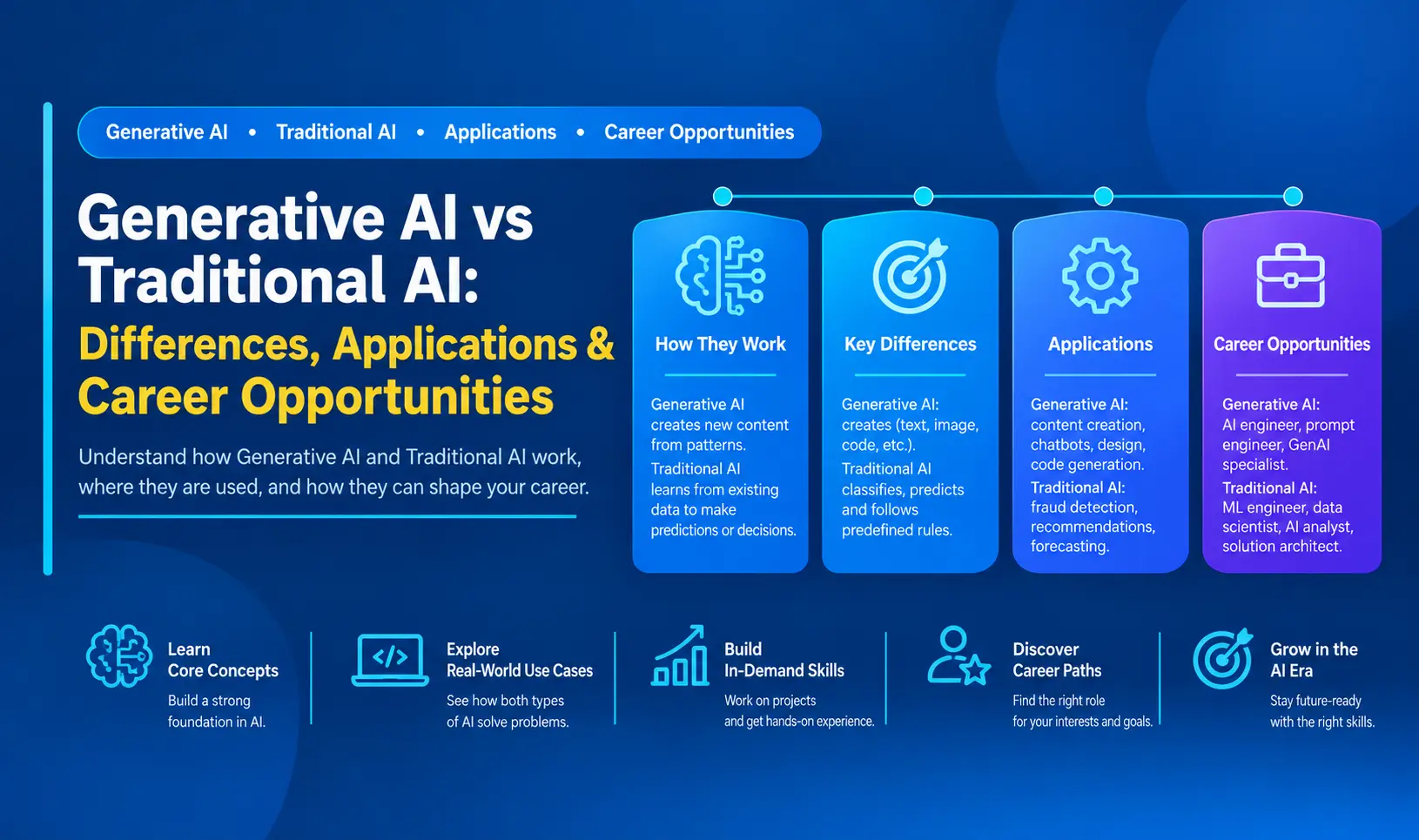
Traditional AI is generally designed to analyze data, identify patterns, classify information, make predictions, or support decisions. Generative AI takes a different approach. It can create new content such as text, images, code, audio, and other forms of digital content based on learned patterns and user instructions.
This difference has created new opportunities for learners and professionals. Skills such as large language models, prompt engineering, Retrieval-Augmented Generation, AI applications, and AI agents are becoming part of modern technology roles.
For anyone planning a career in this field, understanding the difference between traditional AI and Generative AI is an important first step.
At IntelliBI Innovations Technologies, we focus on practical, career-oriented learning that helps students understand not only AI concepts but also how those concepts can be applied to real-world problems.
What Is Traditional AI?
Traditional AI refers to AI systems designed primarily to perform specific tasks based on rules, statistical methods, machine learning models, or trained algorithms.
These systems generally take information as input and produce an output such as a classification, prediction, recommendation, or decision.
For example, a traditional AI system may analyze a customer's transaction history and determine whether a transaction appears suspicious.
Another system may examine historical sales data and predict future demand.
Traditional AI is commonly associated with tasks such as:
- Classification
- Prediction
- Recommendation
- Forecasting
- Fraud detection
- Image recognition
- Customer segmentation
- Anomaly detection
- Search and ranking
- Decision support
The system is usually designed around a specific business or technical objective.
What Is Generative AI?
Generative AI focuses on creating new content from patterns learned during training.
It can generate:
- Text
- Images
- Code
- Audio
- Video
- Summaries
- Product descriptions
- Reports
- Conversational responses
Large language models, or LLMs, are an important part of modern Generative AI.
An LLM can process natural language prompts and generate responses based on the information and patterns learned during training and the context provided at the time of use.
For example, a user can ask an AI system to summarize a document, explain a programming concept, generate a draft email, or create a Python function.
This ability to generate content is one of the main differences between Generative AI and many traditional AI systems.
Generative AI vs Traditional AI: Key Differences
The easiest way to understand the difference is to compare their typical goals.
Area
Traditional AI
Generative AI
Main purpose
Analyze, classify, predict, or recommend
Generate new content
Typical input
Structured or unstructured data
Natural language, images, files, or other prompts
Typical output
Prediction, classification, score, recommendation
Text, images, code, audio, or other generated content
Common models
Regression, decision trees, neural networks, classifiers
LLMs, diffusion models, multimodal models
User interaction
Often task-specific
Often conversational
Example
Fraud detection
AI-generated business summary
Business use
Prediction and decision support
Content generation and intelligent assistance
These categories can overlap. Generative models can also perform analytical tasks, while traditional machine learning can be used inside larger Generative AI systems.
The important difference is the primary function the system is designed to perform.
How Traditional AI Works
A traditional machine learning workflow generally begins with a clearly defined problem.
For example:
Business Problem → Data Collection → Data Preparation → Model Training → Evaluation → Prediction
Suppose a company wants to predict whether a customer may leave its service.
The organization can collect historical customer information, prepare the data, train a model, evaluate its performance, and use the model to generate predictions for new customers.
The model may consider factors such as:
- Customer tenure
- Purchase history
- Usage patterns
- Customer service interactions
- Subscription type
- Previous cancellations
The result could be a probability or classification indicating the likelihood of churn.
The system is focused on solving a defined prediction problem.
How Generative AI Works
Generative AI systems use models trained on very large datasets to learn patterns and relationships.
In the case of language models, the system learns relationships between words, tokens, concepts, and context.
A simplified workflow can be represented as:
Prompt → Context Processing → Model Inference → Generated Output → Human Review
For example, a user might provide:
“Explain cloud computing to a beginner using a simple example.”
The model generates a response based on the prompt and the patterns it has learned.
Modern Generative AI applications can also use additional information supplied through documents, databases, APIs, or other systems.
This allows organizations to build AI applications that are more connected to their own data.
Applications of Traditional AI
Traditional AI remains highly valuable across industries.
Fraud Detection
Banks and financial institutions can use machine learning models to identify unusual transaction patterns.
Recommendation Systems
E-commerce and entertainment platforms can use recommendation algorithms to suggest products, movies, music, or other content.
Demand Forecasting
Businesses can use historical data to estimate future demand and improve inventory planning.
Predictive Maintenance
Manufacturing organizations can analyze equipment data to identify signs that a machine may require maintenance.
Customer Segmentation
Companies can group customers based on behavior, purchasing patterns, or other characteristics.
Medical and Image Analysis
AI-based image analysis can support professionals in reviewing certain types of medical or industrial images, subject to appropriate validation and professional oversight.
These applications show that traditional AI continues to play an important role even as Generative AI grows.
Applications of Generative AI
Generative AI has introduced a broader range of human-computer interactions.
Content Creation
Marketing teams can use AI to create initial drafts for:
- Blog posts
- Product descriptions
- Social media content
- Email campaigns
- Advertisements
Human review remains important for accuracy, brand consistency, and originality.
Software Development
Developers can use Generative AI to:
- Generate code drafts
- Explain code
- Suggest test cases
- Identify potential issues
- Create documentation
The generated code should still be reviewed and tested.
Customer Support
Generative AI can power conversational assistants that understand natural language and provide responses based on available information.
Document Summarization
Businesses can use AI to summarize long documents, meeting notes, reports, and other text-heavy material.
Knowledge Assistants
Organizations can build AI assistants that answer questions using internal documents and approved information sources.
Creative Applications
Generative models can support the creation of images, audio, presentations, designs, and other creative assets.
Generative AI Classes in Pune: What Should You Learn?
Learners considering Generative AI Classes in Pune should look beyond basic chatbot usage.
A strong learning path should cover the foundations behind modern AI systems.
Important topics include:
- AI and machine learning fundamentals
- Generative AI concepts
- Large language models
- Tokens
- Context windows
- Embeddings
- Vector databases
- Prompt engineering
- Retrieval-Augmented Generation
- AI APIs
- Model evaluation
- AI application development
- Responsible AI
- AI agents
Understanding these concepts makes it easier to move from simply using AI tools to building AI-powered applications.
Why Prompt Engineering Matters
Prompt engineering is the practice of creating clear instructions for AI models to produce useful results.
A basic prompt might ask:
“Explain machine learning.”
A more useful prompt could provide:
- The target audience
- The desired level of detail
- The context
- The output format
- Specific constraints
- Examples where appropriate
This can improve the usefulness and consistency of the response.
A Prompt Engineering Course in Pune can help learners understand techniques such as:
- Role-based instructions
- Few-shot examples
- Structured prompts
- Context management
- Output constraints
- Prompt evaluation
- Task decomposition
Prompt engineering is useful, but it is only one part of a broader Generative AI skill set.
LLM Course in Pune: Understanding Large Language Models
Large language models are central to many Generative AI applications.
An LLM Course in Pune can introduce learners to concepts such as:
- Tokens
- Embeddings
- Transformers
- Attention
- Context
- Inference
- Model parameters
- Fine-tuning
- Retrieval-Augmented Generation
- Model limitations
The goal is not necessarily to train a large model from scratch.
For many application developers, the more practical focus is understanding how to work with existing models and build useful applications around them.
What Is Retrieval-Augmented Generation?
Retrieval-Augmented Generation, commonly called RAG, combines information retrieval with Generative AI.
Instead of relying only on what a model learned during training, a RAG application can retrieve relevant information from an approved knowledge source and provide that information to the model as context.
A simplified flow is:
User Question → Search Knowledge Base → Retrieve Relevant Information → Provide Context to LLM → Generate Response
This approach can be useful for:
- Company knowledge assistants
- Document question-answering
- Policy assistants
- Technical support systems
- Research tools
- Internal information portals
RAG has become an important concept for learners who want to build practical AI applications.
Generative AI Training in Pune: Skills Beyond Prompting
Generative AI Training in Pune should ideally cover more than prompts and chatbot interactions.
Learners can build skills across several layers.
AI Fundamentals
Understand machine learning, neural networks, and the basic concepts behind modern AI.
LLM Fundamentals
Learn how language models process tokens, context, embeddings, and prompts.
Application Development
Understand how APIs and software components can be connected to AI models.
RAG
Learn how external information can be retrieved and supplied to an AI model.
Evaluation
Understand how to test AI outputs for relevance, accuracy, consistency, and other requirements.
AI Agents
Explore applications where AI systems can plan tasks, use tools, access information, and complete multi-step workflows under appropriate controls.
Generative AI and Agentic AI Course in Pune
Generative AI and agentic AI are related but not identical.
Generative AI primarily focuses on generating content or responses.
Agentic AI applications can go further by coordinating multiple steps to achieve a goal.
For example, a basic Generative AI application may answer:
“What are the key points from this report?”
An agentic application might be designed to:
- Find the relevant report.
- Read the required information.
- Extract important details.
- Compare them with another source.
- Create a structured summary.
- Return the result for review.
The exact level of autonomy depends on the system design and safeguards.
This is why a Generative AI and Agentic AI Course in Pune can be useful for learners who want to understand the next stage of AI application development.
Online Generative AI Course: Is It Suitable for Career Development?
An Online Generative AI Course can provide flexibility for students and working professionals.
Online learning can be useful when it includes:
- Live instruction or structured lessons
- Hands-on exercises
- Practical assignments
- Project work
- Tool demonstrations
- Doubt support
- Assessment
- Career guidance
The format matters less than the quality of learning and the amount of practical work.
Learners should aim to build projects rather than only complete video lessons.
Career Opportunities in Traditional AI
Traditional AI and machine learning continue to support many technology roles.
Possible career paths include:
- Machine Learning Engineer
- Data Scientist
- AI Engineer
- Data Analyst
- Computer Vision Engineer
- NLP Engineer
- ML Operations Engineer
- AI Research roles
The required skills vary by role.
A learner interested in traditional machine learning may need stronger knowledge of statistics, algorithms, feature engineering, model evaluation, and machine learning frameworks.
Career Opportunities in Generative AI
Generative AI is creating and changing several technology roles.
Potential career directions include:
- Generative AI Engineer
- AI Engineer
- LLM Application Developer
- AI Application Developer
- Prompt Engineer
- Machine Learning Engineer
- RAG Developer
- AI Solutions Developer
- AI Automation Developer
Job titles can differ between organizations. In many cases, Generative AI skills are combined with existing software engineering, data, cloud, or machine learning responsibilities.
Generative AI Course in Pune: Who Should Consider It?
A Generative AI Course in Pune can be relevant to several learner groups.
IT Professionals
Software developers and technology professionals can learn how to integrate AI into applications.
Data Professionals
Data analysts and data scientists can explore LLM-based tools, AI-assisted analysis, and intelligent data applications.
Fresh Graduates
Students can build foundational AI knowledge and create portfolio projects.
Career Switchers
Professionals from related technical backgrounds can use structured learning to explore new AI roles.
Business Professionals
Professionals in marketing, operations, HR, finance, and other functions can learn how Generative AI can support workplace tasks.
How to Choose the Best Generative AI Course in Pune
When comparing training programs, learners should evaluate the complete syllabus instead of focusing only on the course title.
Consider whether the program covers:
- AI fundamentals
- LLM concepts
- Prompt engineering
- RAG
- Vector databases
- AI APIs
- Python
- AI application development
- Agents
- Projects
- Evaluation
- Responsible AI
Practical project work is especially important.
A learner should ideally finish the program with projects that demonstrate the ability to solve real problems using Generative AI.
AI Training Institute in Pune: What Should Learners Expect?
An AI Training Institute in Pune can support learners by providing a structured environment for learning and practice.
A useful learning experience should connect concepts with applications.
For example:
Concept → Demonstration → Hands-On Exercise → Project → Review
This approach helps learners understand not only how a tool works but also why and when it should be used.
Generative AI vs Traditional AI: Which Skills Should You Learn?
Learners do not necessarily have to choose one area and ignore the other.
Traditional AI provides a strong foundation in:
- Machine learning
- Statistics
- Data preparation
- Model evaluation
- Prediction
- Classification
Generative AI adds skills such as:
- LLMs
- Prompt engineering
- Embeddings
- RAG
- AI APIs
- Generative applications
- AI agents
A professional who understands both areas can better recognize which technology is appropriate for a particular problem.
For example, a business may need a traditional machine learning model for fraud prediction while using a Generative AI assistant to help employees search internal documentation.
The right solution depends on the problem.
A Practical Roadmap for Learning Generative AI
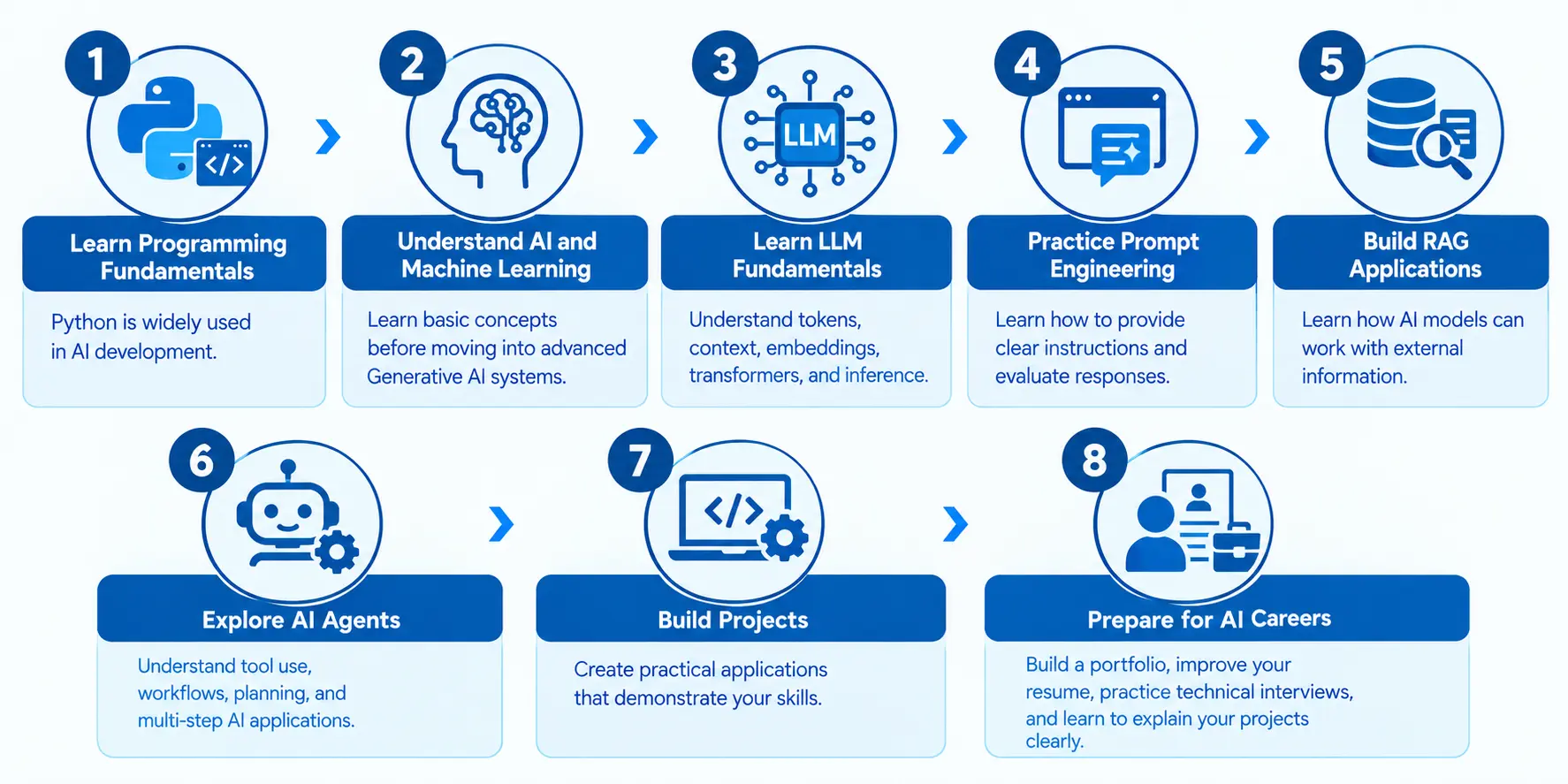
Learners can follow a step-by-step approach.
Step 1: Learn Programming Fundamentals
Python is widely used in AI development.
Step 2: Understand AI and Machine Learning
Learn basic concepts before moving into advanced Generative AI systems.
Step 3: Learn LLM Fundamentals
Understand tokens, context, embeddings, transformers, and inference.
Step 4: Practice Prompt Engineering
Learn how to provide clear instructions and evaluate responses.
Step 5: Build RAG Applications
Learn how AI models can work with external information.
Step 6: Explore AI Agents
Understand tool use, workflows, planning, and multi-step AI applications.
Step 7: Build Projects
Create practical applications that demonstrate your skills.
Step 8: Prepare for AI Careers
Build a portfolio, improve your resume, practice technical interviews, and learn to explain your projects clearly.
Why Practical Projects Matter in Generative AI
Generative AI changes quickly. Tools and models evolve, but problem-solving skills remain valuable.
A practical project can demonstrate that a learner understands how to:
- Define a problem
- Select an AI approach
- Prepare information
- Choose an appropriate model
- Design prompts
- Connect APIs
- Build a user workflow
- Evaluate outputs
- Handle limitations
Project ideas can include:
- Document Q&A assistant
- Resume analysis assistant
- Customer support chatbot
- AI-powered knowledge base
- Meeting summarization tool
- Marketing content assistant
- Code explanation assistant
- RAG-based company information assistant
The quality of the problem and implementation matters more than simply using the newest AI model.
Why Learn Generative AI at IntelliBI Innovations Technologies?
IntelliBI Innovations Technologies focuses on practical learning across Artificial Intelligence, Generative AI, data, analytics, and related technologies.
Our Generative AI Course in Pune is designed to help learners understand modern Generative AI concepts and explore their practical use in AI applications.
Learners searching for Generative AI Training in Pune can focus on developing skills that go beyond basic chatbot usage, including LLM concepts, prompting, RAG, AI application development, and practical projects.
For learners exploring a GenAI Course in Pune, a project-focused learning approach can help connect theory with practical implementation.
Conclusion
Traditional AI and Generative AI solve different types of problems, but both are important parts of the modern AI ecosystem.
Traditional AI is widely used for prediction, classification, recommendation, forecasting, and decision support. Generative AI focuses on creating new content and enabling natural-language interactions with AI systems.
For learners, the opportunity is not simply to choose between the two. Understanding their differences can help you select the right learning path and recognize where each technology fits.
Building skills in Python, machine learning, LLMs, prompt engineering, RAG, AI APIs, and agentic workflows can create a strong foundation for modern AI careers.
At IntelliBI Innovations Technologies, we believe practical learning is the bridge between understanding AI concepts and applying them to real-world problems. With the right combination of fundamentals, projects, and continuous learning, aspiring professionals can prepare themselves for an AI-driven technology landscape.