
DEA-C01 Syllabus Explained: 4 Domains, Weightage and Study Plan
Quick Answer
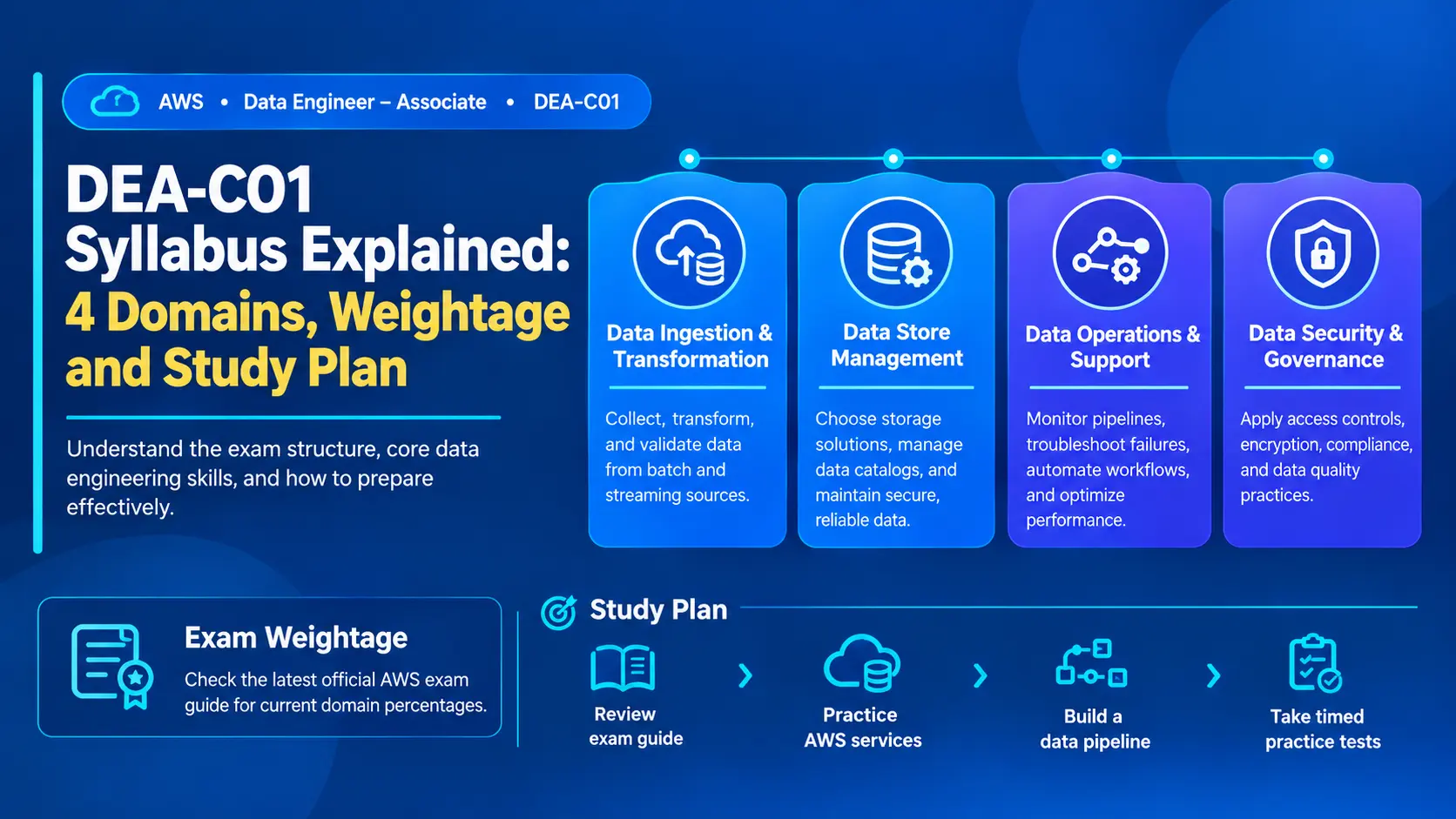
DEA-C01 is the AWS Certified Data Engineer – Associate exam: 65 questions, 130 minutes, USD 150, passing score 720/1000. It has four domains: Data Ingestion & Transformation (34%), Data Store Management (26%), Data Operations & Support (22%) and Data Security & Governance (18%). Focus on S3, Glue, Redshift, Athena, EMR, Lambda, Kinesis, IAM and KMS. Most learners need 8 weeks of hands-on practice; an AWS Data Engineer Course in Pune with real projects shortens that curve.
DEA-C01 Syllabus Explained: 4 Domains, Weightage and Study Plan
If you have typed "AWS Classes Near Me" into Google in the last few months, you have probably noticed that almost every result talks about the same certification: AWS Certified Data Engineer – Associate, exam code DEA-C01. It is the credential hiring managers in Hinjewadi, Kharadi and Magarpatta now mention in job descriptions alongside Databricks and PySpark, and it is the exam our learners in the AWS Data Engineer Course in Pune target by the end of their fourth month.
This guide does one job: explain the DEA-C01 syllabus the way a mentor would on a whiteboard. You will see the four domains, their exact weightage, the AWS services each domain hides behind, the traps that cost people marks, and an 8-week study plan you can start this weekend. Whether you are comparing an AWS Course in Pune or studying on your own, this is the map.
What Is DEA-C01 and Why Does It Matter in 2026?
DEA-C01 is AWS's associate-level data engineering exam. It replaced the retired Big Data Specialty as the certification for people who build pipelines, not just people who administer cloud accounts. Here are the facts that matter:
- Questions: 65 (multiple choice and multiple response)
- Duration: 130 minutes
- Cost: USD 150 (roughly ₹12,800 plus GST in India)
- Passing score: 720 out of 1,000 (scaled)
- Languages: English, Japanese, Korean, Simplified Chinese
- Recommended experience: 2–3 years in data engineering and 1–2 years hands-on with AWS
That last line scares freshers, but do not let it. "Equivalent experience" is exactly what project-based AWS Training in Pune is designed to give you. At IntelliBI, learners finish ten production-grade projects before they book the exam, which is more hands-on hours than many two-year roles provide.
The 4 DEA-C01 Domains and Their Weightage
The exam guide splits the syllabus into four domains. Memorise the percentages because they tell you where to spend your study hours:
- Data Ingestion and Transformation – 34%
- Data Store Management – 26%
- Data Operations and Support – 22%
- Data Security and Governance – 18%
Put simply, 60% of your marks come from getting data in and storing it well. That is the same ratio we use when we design the syllabus for the AWS Data Engineering Course at IntelliBI, because the exam mirrors what employers actually ask for.
Domain 1: Data Ingestion and Transformation (34%)
This is the heart of the DEA-C01 syllabus and the reason any serious AWS Cloud Course in Pune spends weeks on it. The domain has four task statements.
1.1 Perform data ingestion
You must know the difference between batch and streaming ingestion and when to use each. Expect scenario questions on Amazon Kinesis Data Streams, Kinesis Data Firehose, Amazon MSK (managed Kafka), AWS DMS for database migration, AWS Glue crawlers and jobs, Amazon AppFlow for SaaS sources, and AWS DataSync for file transfers. The exam loves questions where a company wants "near real-time" data and you must choose between Firehose (simple, buffered delivery) and Kinesis Data Streams (custom consumers, replay).
1.2 Transform and process data
Here the syllabus leans on AWS Glue ETL, Amazon EMR with Spark, AWS Lambda for lightweight transforms, and Glue DataBrew for low-code cleaning. You should understand file formats cold: why Parquet beats CSV for analytics, when to use Avro for streaming schemas, and how compression (Snappy, GZIP, ZSTD) affects Athena cost. In our AWS Classes in Pune we run a lab where the same 10 GB dataset is queried in CSV and in partitioned Parquet; the cost difference usually makes the point better than any slide.
1.3 Orchestrate data pipelines
AWS Step Functions, Amazon Managed Workflows for Apache Airflow (MWAA), Glue Workflows and EventBridge are the orchestration tools you must compare. Typical question: a pipeline needs branching logic, retries and human approval – which service? (Step Functions.) Another: an existing team already writes Airflow DAGs – which service? (MWAA.)
1.4 Apply programming concepts
This task statement surprises people. The exam expects you to read Python and SQL snippets, understand CI/CD for data code (CodeCommit, CodeBuild, CodePipeline), infrastructure as code (CloudFormation, CDK), and basic optimisation such as pushing filters down to the source. If you have ever wondered why the Best AWS Course in Pune should still teach SQL and Python before touching the console, this domain is the answer.
Domain 2: Data Store Management (26%)
The second-largest domain is about choosing and operating the right storage.
2.1 Choose a data store
Amazon S3 for data lakes, Amazon Redshift for warehousing, DynamoDB for key-value workloads, RDS and Aurora for transactional data, OpenSearch for log search, and Lake Formation to govern the lake. The exam gives a business requirement and asks for the cheapest service that meets it. Learn the Redshift architecture (leader node, compute nodes, RA3 with managed storage, Redshift Serverless) and when Redshift Spectrum lets you query S3 directly.
2.2 Understand data cataloguing systems
The AWS Glue Data Catalog is the metadata backbone, and Lake Formation sits on top of it for permissions. Expect questions on crawlers, schema versioning, and the Hive-compatible metastore used by Athena and EMR.
2.3 Manage the lifecycle of data
S3 storage classes (Standard, Intelligent-Tiering, Glacier Instant/Flexible/Deep Archive), lifecycle rules, versioning, and Redshift data-sharing and vacuum behaviour all appear. A classic question: logs must be queryable for 30 days and retained for 7 years at the lowest cost – design the lifecycle policy.
2.4 Design data models and schema evolution
Star and snowflake schemas, slowly changing dimensions, Redshift distribution and sort keys, and handling schema drift in Glue. This is where the data-warehousing module of our AWS Data Engineer Course in Pune pays off directly, because SCD Type 2 and dimensional modelling are examined, not just mentioned.
Domain 3: Data Operations and Support (22%)
This domain checks whether you can keep pipelines running once they exist, which is most of a real data engineer's week.
3.1 Automate data processing with AWS services
Scheduling with EventBridge, Lambda triggers on S3 events, Glue job bookmarks for incremental loads, and Redshift scheduled queries. Know what "idempotent" means and how to make a re-run safe.
3.2 Analyse data using AWS services
Amazon Athena (serverless SQL on S3), Amazon QuickSight for dashboards, Redshift query editor, and Glue DataBrew profiling. The exam tests cost awareness: Athena charges per data scanned, so partitioning and columnar formats are the answer to half the questions here.
3.3 Maintain and monitor data pipelines
Amazon CloudWatch metrics, logs and alarms, AWS CloudTrail for API auditing, Glue job metrics, and Step Functions execution history. Learn how to troubleshoot a failing Glue job from its CloudWatch logs; our AWS Cloud Training in Pune includes a deliberately broken pipeline that learners must diagnose.
3.4 Ensure data quality
Glue Data Quality rules, DataBrew profiling, and validation patterns such as row counts and null checks between stages. Observability and quality are the fastest-growing topics in 2026 job descriptions, so treat this task statement as career insurance, not just exam prep.
Domain 4: Data Security and Governance (18%)
Smallest domain, but the easiest to lose marks on because the questions are precise.
4.1 Apply authentication mechanisms
IAM users versus roles, instance profiles, cross-account access, and Secrets Manager versus Parameter Store for credentials. Never hard-code keys – the exam will offer that as a wrong option every time.
4.2 Apply authorisation mechanisms
IAM policies, S3 bucket policies, Lake Formation fine-grained permissions (column and row level), and Redshift GRANT statements. Know the principle of least privilege and how resource-based and identity-based policies combine.
4.3 Ensure data encryption and masking
AWS KMS (customer-managed versus AWS-managed keys), S3 SSE-S3 versus SSE-KMS, encryption in transit with TLS, Redshift encryption, and masking PII with Glue DataBrew or Lake Formation data filters.
4.4 Prepare logs for audit
CloudTrail, CloudWatch Logs, S3 access logs and Redshift audit logging. Questions here usually ask which log proves "who accessed this table on this date".
4.5 Understand data privacy and governance
Amazon Macie for discovering sensitive data, data residency and regional considerations, and DataZone for cataloguing and sharing. Expect one or two questions on compliance concepts such as GDPR-style retention and deletion.
How DEA-C01 Questions Are Actually Written
Most questions follow a pattern: a two-paragraph scenario, a constraint word such as "least operational overhead", "most cost-effective", or "lowest latency", and four plausible answers. The constraint word decides the answer. "Least operational overhead" almost always points to serverless or managed services (Glue, Athena, Firehose, Redshift Serverless). "Most cost-effective" points to S3 lifecycle policies, Spot instances on EMR, or partitioned Parquet. Learners from our AWS Certification Course in Pune are trained to underline the constraint before reading the options – a small habit that typically adds 50–80 scaled points.
Unscored questions are mixed in (AWS uses them to test future items), so do not panic if a question seems far outside the syllabus. Answer, flag, move on.
An 8-Week DEA-C01 Study Plan
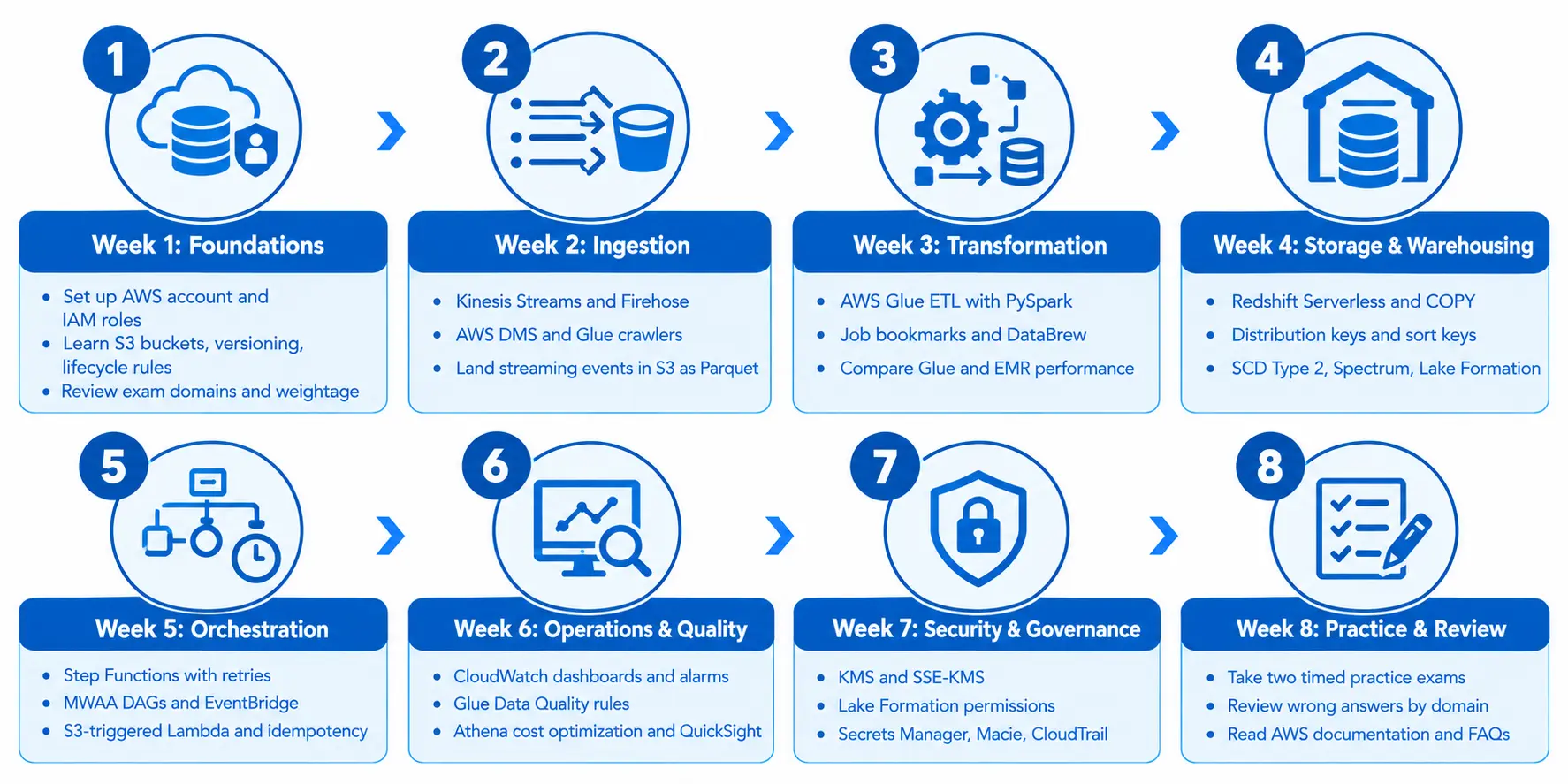
This is the plan we hand to every learner in the AWS Data Engineer Course in Pune when they enter the certification phase. It assumes 8–10 hours a week, which fits a working professional on the 7–9 PM batch or the weekend batch.
Week 1 – Foundations and account setup Create a free-tier account, set up IAM users and roles properly, and learn S3 end to end: buckets, prefixes, storage classes, versioning, lifecycle rules. Read the official exam guide and write the four domains with weightage on a sticky note.
Week 2 – Ingestion Hands-on with Kinesis Data Streams and Firehose, AWS DMS from an RDS source, and a Glue crawler over raw JSON. Build a small streaming pipeline that lands events in S3 as Parquet.
Week 3 – Transformation AWS Glue ETL jobs with PySpark, job bookmarks, Glue DataBrew recipes, and an EMR cluster running Spark. Compare runtime and cost for the same job on Glue and EMR.
Week 4 – Storage and warehousing Redshift Serverless: load from S3 with COPY, design distribution and sort keys, implement an SCD Type 2 dimension, and query S3 through Redshift Spectrum. Register the lake in Lake Formation.
Week 5 – Orchestration and automation Step Functions state machine with retries and error handling, an MWAA DAG, EventBridge schedules and S3-triggered Lambda. Make every step idempotent and prove it by re-running.
Week 6 – Operations and quality CloudWatch dashboards and alarms for the pipeline, Glue Data Quality rules, Athena cost optimisation through partition projection, and a QuickSight dashboard on the gold layer.
Week 7 – Security and governance KMS keys, SSE-KMS buckets, Lake Formation column-level permissions, Secrets Manager rotation, Macie scan on a PII sample, CloudTrail queries. This is the week most self-learners skip; it is also the week that separates a 690 from a 760.
Week 8 – Practice exams and review Two full-length timed practice tests. Review every wrong answer by domain, re-read the relevant AWS documentation and FAQs (the exam is heavily derived from service FAQs), and book the exam for the following week while the material is fresh.
If you are following this plan inside structured AWS Training in Pune, your mentor will map each week to a capstone deliverable, which is why our learners usually finish with a GitHub portfolio and a certificate at the same time.
Common Mistakes DEA-C01 Candidates Make
- Studying services instead of scenarios. The exam never asks "what is Glue?"; it asks which service fits a constraint.
- Ignoring the 18% security domain because it feels "non-technical". Those are the most deterministic marks on the paper.
- Memorising Redshift node types but never running a COPY command. Hands-on memory lasts; slide memory fades in the exam room.
- Skipping file formats and partitioning. These underpin questions in three of the four domains.
- Booking the exam before a timed practice test. 130 minutes for 65 scenario questions is tighter than it sounds.
Is DEA-C01 Enough to Get a Data Engineering Job in Pune?
On its own, no certification is. Paired with real projects, it is one of the strongest signals an associate-level candidate can show. Recruiters in Pune's IT services, finance and manufacturing sectors shortlist on three things: a cloud certification, a portfolio of end-to-end pipelines, and the ability to explain design trade-offs in an interview. A good AWS Course in Pune should deliver all three, not just exam dumps. At IntelliBI, the DEA-C01 preparation sits inside a 4–5 month AWS Data Engineering Course that also covers SQL, Python, PySpark, Databricks, Apache Airflow, data-warehouse modelling and a GenAI module for data engineers, because that combination is what the job market in 2026 is asking for.
Typical outcomes we see after the course and certification: career switchers from testing, support and SQL development moving into data engineering roles, and existing engineers negotiating meaningful hikes with the certification on their profile.
How IntelliBI Prepares You for DEA-C01
Learners searching for the Best AWS Course in Pune usually want three assurances: that the syllabus matches the exam, that the projects are real, and that someone will help them get placed. Here is how our programme handles each:
- Syllabus mapping: every DEA-C01 task statement is tied to a module and a lab, from Glue ETL to Lake Formation permissions.
- Real projects: a Medallion data lake on S3 with Glue and Athena, a retail sales warehouse on Redshift with SCD Type 2, a healthcare data-processing pipeline on EMR, and an insurance claims analytics platform orchestrated with Airflow and Lambda.
- Mentors with 10–15 years at enterprise MNCs who have sat the exam themselves.
- Mock exams, technology-wise interview question banks, HackerRank-style challenges and system-design rounds.
- Placement support until you are placed, with ATS resume and LinkedIn optimisation.
- Classroom at Thergaon (ten minutes from Hinjewadi Phase 1) plus live online with recordings, so whether you searched for AWS Classes Near Me from Wakad or Nashik, the batch fits.
Final Word
The DEA-C01 syllabus is not mysterious: 34% ingestion and transformation, 26% storage, 22% operations, 18% security. Spend your hours in that ratio, practise in a real account, learn to read the constraint word, and sit a timed mock before you book. Do that for eight focused weeks and the certificate is well within reach.
If you would rather do it with a mentor, real projects and a cohort that keeps you accountable, explore the AWS Certification Course in Pune at IntelliBI, join a free demo class, and start your AWS Cloud Training in Pune with the October 2026 batch. Your pipelines – and your next role – are waiting.