
50 AWS Data Engineer Interview Questions and Answers (2026-2027)
Quick Answer
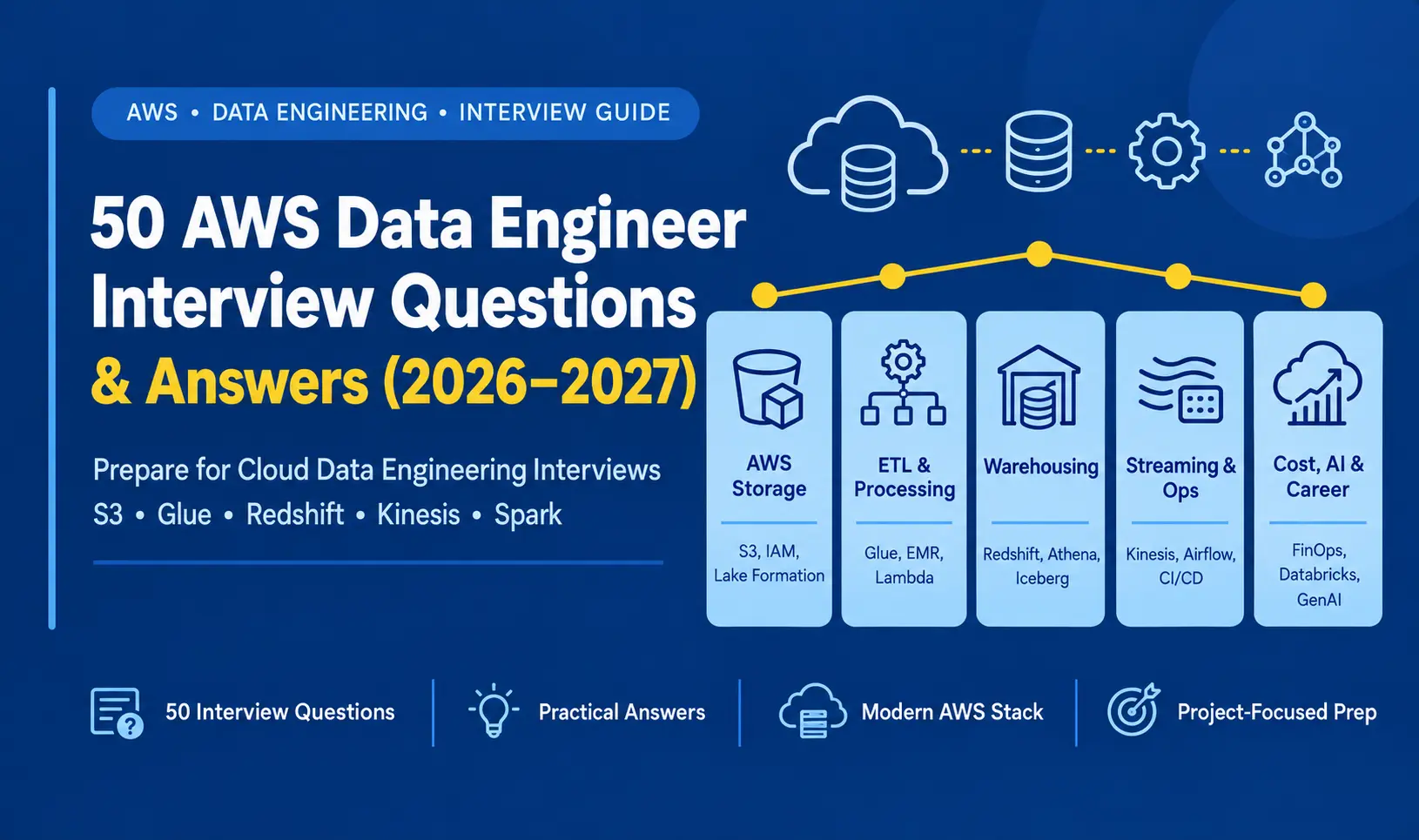
AWS Data Engineer interviews in 2026–2027 focus on S3, Lake Formation, Glue, EMR, Redshift, Athena, Kinesis, MSK, Step Functions, MWAA, CI/CD, IAM, and cost optimisation. Expect scenario-based questions on CDC pipelines, partitioning, file formats, and Spark performance tuning. Hands-on projects and preparation for the AWS Certified Data Engineer – Associate (DEA-C01) exam can help you build practical knowledge and answer confidently.
50 AWS Data Engineer Interview Questions and Answers (2026-2027)
Hiring for AWS data engineers in Pune has changed. Interviewers at Hinjewadi, Kharadi and Magarpatta companies no longer ask “what is S3?” and stop there. They ask how you would design a lakehouse on S3, why your Glue job cost ₹40,000 last month, and what happens to your pipeline when a Kinesis shard gets hot. At IntelliBI Innovations Technologies, our mentors conduct mock interviews every week for learners of the AWS Data Engineer Course in Pune, and these are the 50 questions that come up again and again. Read the answers, practise them aloud, and then build the projects that make them yours.
Section 1: AWS Fundamentals and Storage (Questions 1–10)
Every AWS Course in Pune starts with the basics, and so does every interview. Interviewers use these to check whether your foundations are real or copied from a cheat sheet.
1. What makes Amazon S3 the default data lake storage on AWS?
S3 offers 11 nines of durability, virtually unlimited scale, pay-per-GB pricing and native integration with Glue, Athena, EMR, Redshift Spectrum and Lake Formation. Compute and storage stay decoupled, which is the core lakehouse principle.
2. Explain S3 storage classes and when a data engineer uses each.
Standard for hot data, Intelligent-Tiering for unpredictable access, Standard-IA and One Zone-IA for infrequent reads, Glacier Instant/Flexible/Deep Archive for compliance archives. Lifecycle rules move raw landing data to cheaper tiers automatically.
3. How do you organise S3 prefixes for a lakehouse?
Use a medallion layout: bronze/raw, silver/cleansed, gold/curated, each partitioned by domain, table and date (year=/month=/day=). Keep partition cardinality sensible so Athena and Glue crawlers stay fast.
4. What is S3 eventual consistency today?
Since December 2020, S3 provides strong read-after-write consistency for PUTs and DELETEs, so pipelines no longer need retry logic for “object not found” immediately after a write.
5. Difference between IAM users, roles and policies for data pipelines?
Users are long-lived identities; roles are assumable with temporary credentials; policies define permissions. Pipelines should always run under roles with least-privilege policies, never access keys.
6. What is Lake Formation and why does it matter in 2026?
Lake Formation centralises fine-grained permissions (table, column, row and cell level) over S3 data and the Glue Data Catalog, so Athena, Redshift Spectrum and EMR all enforce one governance model.
7. How do you secure data at rest and in transit on AWS?
SSE-S3, SSE-KMS or client-side encryption for rest; TLS for transit; KMS key policies plus bucket policies for access; VPC endpoints so traffic never leaves the AWS network.
8. What are VPC endpoints and why do data engineers care?
Gateway endpoints (S3, DynamoDB) and interface endpoints (Glue, Kinesis) keep traffic private and remove NAT gateway charges, which is a common hidden cost in ETL workloads.
9. Parquet vs ORC vs Avro vs CSV: when do you choose which?
Parquet for columnar analytics (Athena, Redshift Spectrum, Spark); ORC in Hive-heavy EMR stacks; Avro for row-oriented streaming and schema evolution; CSV only for landing zones.
10. What is Apache Iceberg and why are AWS teams adopting it?
Iceberg is an open table format offering ACID transactions, schema and partition evolution, time travel and hidden partitioning on S3. Athena, Glue, EMR and Redshift now support it natively, making it the 2026 lakehouse standard.
Section 2: ETL with AWS Glue, EMR and Lambda (Questions 11–22)
Hands-on ETL is where candidates from a project-driven AWS Training in Pune stand out from tutorial watchers. Expect follow-ups on every answer here.
11. What are the components of AWS Glue?
Data Catalog (metadata), Crawlers (schema discovery), ETL Jobs (Spark or Python shell), Glue Studio (visual ETL), Triggers and Workflows (orchestration), and DataBrew for no-code preparation.
12. Glue DynamicFrame vs Spark DataFrame?
DynamicFrames handle schema inconsistencies (choice types) and integrate with the catalog and job bookmarks; DataFrames give full Spark SQL performance. Convert between them with toDF() and fromDF().
13. What are Glue job bookmarks?
Bookmarks track processed data between runs so incremental loads skip already-ingested files or rows. Pause or reset them when backfilling.
14. How do you tune a slow Glue job?
Right-size DPUs and worker type (G.1X, G.2X, G.4X), enable auto scaling, use pushdown predicates and partition projection, avoid small files, broadcast small dimensions, and check the Spark UI for skewed stages.
15. When do you choose EMR over Glue?
EMR when you need custom cluster control, Hadoop ecosystem tools (Hive, HBase, Presto/Trino), long-running or very large Spark jobs, or Spot-instance cost optimisation. Glue when you want serverless, catalog-integrated ETL.
16. What is EMR Serverless?
A serverless runtime for Spark and Hive that scales workers automatically and bills per vCPU-second, removing cluster management while keeping full Spark features.
17. Explain Spark data skew and how to fix it on EMR.
Skew means a few partitions hold most of the keys. Fix with salting, broadcast joins, Adaptive Query Execution (AQE) skew join handling, or repartitioning on a better key.
18. Where does AWS Lambda fit in data pipelines?
Event-driven micro-tasks: validating files on S3 PUT, triggering Glue jobs, light transformations under 15 minutes, and writing metadata. Not for heavy batch processing.
19. How do you handle schema evolution in a Glue pipeline?
Enable crawler schema change policies, use Iceberg or Delta tables for safe evolution, version schemas in the Glue Schema Registry for streaming, and apply explicit casting in jobs.
20. What is the small-files problem and how do you solve it on S3?
Thousands of tiny Parquet files slow Athena and Spark. Compact with Glue or EMR jobs, use Iceberg’s rewrite_data_files, and target 128–512 MB files.
21. How do you implement CDC from an RDS database to the lake?
AWS DMS captures change logs to S3 or Kinesis; Glue or Spark applies merges into Iceberg/Delta tables; SCD Type 2 logic preserves history where required.
22. What is idempotency and why do interviewers love it?
An idempotent pipeline produces the same result when re-run. Achieve it with merge/upsert semantics, deterministic file naming, bookmarks and partition overwrites, so retries never duplicate data.
Section 3: Warehousing and Analytics – Redshift and Athena (Questions 23–32)
A good AWS Data Engineering Course teaches warehousing alongside the lake, because most Pune JDs ask for both.
23. Redshift architecture in one minute?
A leader node plans queries; compute nodes with slices execute in parallel; columnar storage with zone maps; Redshift Managed Storage separates compute and storage in RA3 nodes.
24. Distribution styles in Redshift?
KEY (co-locate join keys), EVEN (round-robin), ALL (replicate small dimensions), AUTO (Redshift decides). Wrong distribution causes data redistribution during joins.
25. What are sort keys and when do you use compound vs interleaved?
Sort keys order data on disk to prune blocks. Compound for predictable filter order (date first); interleaved when queries filter on several columns equally.
26. What is Redshift Spectrum?
Querying S3 data directly from Redshift through the Glue Data Catalog, so hot data stays in Redshift and cold history stays on S3 without loading.**
27. Redshift Serverless vs provisioned?
Serverless auto-scales RPUs and bills per second of use, ideal for variable workloads; provisioned RA3 clusters suit steady, predictable loads with reserved-instance savings.
28. How do you load data into Redshift efficiently?
COPY from S3 in parallel (multiple files, gzip or Parquet), use a manifest, avoid single-row INSERTs, run ANALYZE and VACUUM, and use staging tables for upserts.
29. What is Amazon Athena and how is it priced?
Serverless SQL over S3 using Trino, priced per TB scanned. Partitioning, columnar formats and compression directly reduce cost.
30. Athena vs Redshift Spectrum vs Redshift?
Athena for ad hoc lake queries; Spectrum when Redshift users need lake data joined with warehouse tables; Redshift for high-concurrency BI dashboards with strict SLAs.
31. How do you implement SCD Type 2 in a cloud warehouse?
Add effective_from, effective_to and is_current columns; on change, close the old row and insert a new one; use MERGE in Redshift or Iceberg for atomic updates.
32. Star schema vs One Big Table in 2026?
Star schema remains the default for BI and governance; OBT (denormalised wide tables) is used for specific high-performance dashboards. Interviewers want to hear trade-offs, not a single answer.
Section 4: Streaming, Orchestration and CI/CD (Questions 33–42)
Real-time and automation questions separate junior from senior candidates. Learners in our AWS Classes in Pune build a Kinesis-to-Redshift streaming project precisely because this section decides offers.
33. Kinesis Data Streams vs Kinesis Data Firehose vs MSK?
Data Streams for custom consumers and replay; Firehose for managed delivery to S3, Redshift or OpenSearch with buffering; MSK when the team already runs Kafka.
34. What is a hot shard and how do you fix it?
A shard receiving disproportionate records due to a poor partition key. Fix by choosing a high-cardinality key, adding a random suffix, or splitting the shard.
35. How does Spark Structured Streaming achieve exactly-once?
Checkpointing offsets plus idempotent sinks (Delta/Iceberg merges or deterministic file names) gives end-to-end exactly-once semantics.
36. Step Functions vs Glue Workflows vs Airflow (MWAA)?
Step Functions for serverless state machines across AWS services; Glue Workflows for Glue-only chains; MWAA (managed Airflow) for complex DAGs, backfills and cross-platform orchestration.
37. Explain Airflow DAG best practices. I
dempotent tasks, no heavy logic in DAG files, use XComs sparingly, parameterise with Variables and Connections, set retries and SLAs, and test DAGs in CI.
38. How do you do CI/CD for data pipelines on AWS?
Code in Git, unit tests with pytest and chispa, infrastructure with CloudFormation/CDK/Terraform, CodePipeline or GitHub Actions deploying Glue scripts and DAGs to dev, test and prod with approvals.
39. How do you monitor pipelines?
CloudWatch metrics and alarms, Glue job run insights, Spark UI, SNS alerts, data quality checks with Glue Data Quality or Great Expectations, and lineage in the Data Catalog.
40. What is data observability?
Continuous monitoring of freshness, volume, schema, distribution and lineage so issues are detected before dashboards break. It is now a standard interview theme.
41. How do you backfill a pipeline safely?
Pause scheduled runs, reset bookmarks or checkpoints for the range, run partition-scoped reprocessing with overwrite semantics, validate counts, then resume.
42. Describe a pipeline you would build end-to-end on AWS.
Files land in S3 bronze; Lambda validates and triggers Glue; Glue writes Iceberg silver tables; a second job builds gold star-schema tables; Redshift Spectrum or COPY serves BI; Airflow orchestrates; CloudWatch alerts; everything deployed via CI/CD.
Section 5: Cost, Databricks, AI and Career Questions (Questions 43–50)
The final round at most Pune companies mixes FinOps, modern platforms and “why you”. Candidates from a Best AWS Course in Pune should be ready for all three.
43. Name five ways to cut AWS data-platform costs.
artition and compress to reduce Athena scans, Spot instances on EMR, Glue auto scaling and right-sized workers, S3 lifecycle tiers, Redshift Serverless or reserved RA3 for steady loads.
44. How do you estimate the cost of a Glue job before running it?
DPU-hours × price: worker count × worker DPU rating × runtime hours. Test on a sample, extrapolate, and compare against EMR Serverless for large jobs.
45. Databricks on AWS vs native Glue/EMR?
Databricks adds Delta Lake, Unity Catalog governance, Workflows, DLT and AI/BI tools on top of S3; native services are cheaper for simple pipelines. Many Pune enterprises run both.
46. What is a medallion architecture?
Bronze (raw, append-only), Silver (cleansed, deduplicated, conformed), Gold (aggregated, business-ready). It gives replayability and clear ownership per layer.
47. How is GenAI changing data engineering roles in 2026?
Engineers now build RAG pipelines (vector embeddings over lake data with OpenSearch or Bedrock Knowledge Bases), use LLMs for pipeline monitoring and triage, and expose data to agents via MCP-style tool interfaces.
48. Which certification should an AWS data engineer hold?
AWS Certified Data Engineer – Associate (DEA-C01) is the direct match; Databricks Certified Data Engineer Associate adds lakehouse credibility. An AWS Certification Course in Pune that maps modules to exam domains shortens preparation.
49. How do you explain a project in an interview?
Use the STAR structure: business problem, your design decisions (and rejected alternatives), tools, measurable outcome (runtime, cost, data quality) and what you would improve next.
50. Why should we hire you as an AWS Data Engineer?
Show the portfolio: a GitHub repo with an end-to-end AWS project, cost figures, test coverage and documentation. Interviewers hire evidence, not adjectives.
How to Prepare for These Questions in Pune
Reading 50 answers is a start; owning them takes practice. Here is the approach our mentors recommend to every learner searching for AWS Classes Near Me or comparing AWS Cloud Training in Pune options:
- Build, do not just watch. One complete S3-Glue-Redshift-Airflow project teaches more than ten videos. Our AWS Data Engineer Course in Pune includes 10+ production-style projects across retail, healthcare and insurance.
- Practise aloud with a senior. Mock interviews with engineers who have 10–15 years in MNCs are part of every batch of our AWS Training in Pune.
- Map answers to DEA-C01 domains: ingestion and transformation, data store management, operations and support, security and governance. The AWS Cloud Course in Pune at IntelliBI follows this mapping module by module.
- Keep a “decisions log” for every project; interviewers probe the “why”, not the “what”.
- Revise SQL window functions, PySpark optimisation and IAM policies the night before; these three areas produce the most rejections.
Final Word from IntelliBI
AWS data engineering remains one of the most future-proof careers in the AI era, and Pune’s hiring market reflects it, with typical post-upskilling packages of ₹15–40 LPA for experienced professionals. Whether you are a fresher, a manual tester planning a switch, or an on-premise ETL developer moving to the cloud, the questions above are your checklist. When you are ready to turn answers into offers, explore the AWS Course in Pune at IntelliBI Innovations Technologies, Thergaon, PCMC, with weekend and evening batches, lifetime LMS access and placement support until you are placed.