
Databricks vs Snowflake: Architecture, Features, Use Cases & Career Scope
Quick Answer
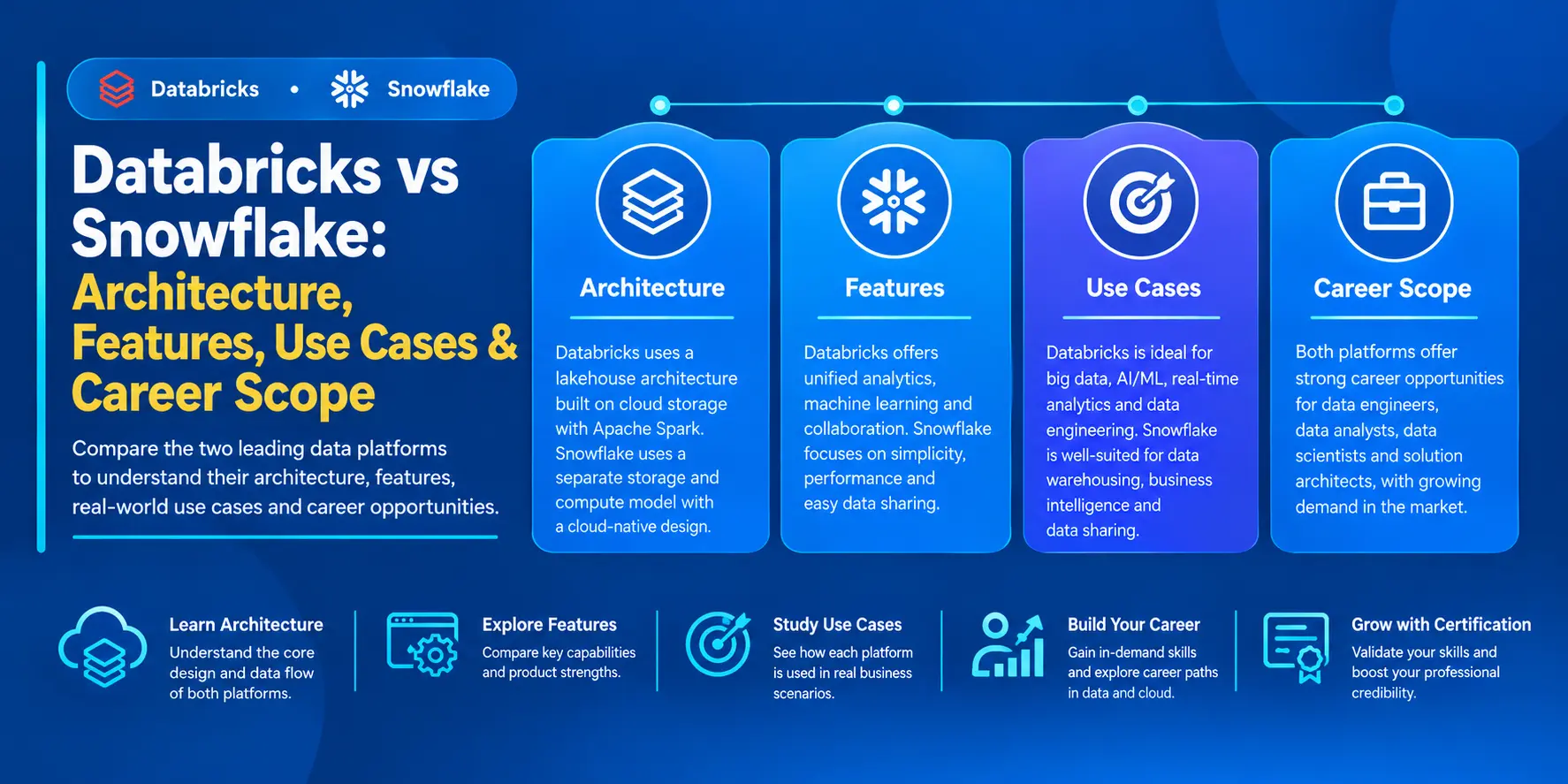
Databricks and Snowflake are cloud data platforms with different strengths. Databricks is strongly focused on lakehouse architecture, Apache Spark, data engineering, machine learning, streaming, and AI. Snowflake is widely used for cloud data warehousing, SQL analytics, data sharing, and business intelligence. The right choice depends on workload, architecture, cloud environment, team skills, and career goals.
Databricks vs Snowflake: Architecture, Features, Use Cases & Career Scope
Modern businesses generate huge volumes of data from applications, websites, customer platforms, IoT devices, financial systems, and cloud services. Managing this data requires platforms that can store, process, analyze, and secure information at scale.
Two platforms that often come up in modern data projects are Databricks and Snowflake.
Both are cloud-based data platforms, but they were built with different strengths and approaches. Databricks is strongly associated with data engineering, Apache Spark, machine learning, and AI workloads. Snowflake is widely known for cloud data warehousing, analytics, SQL-based workloads, and data sharing.
For learners planning a career in data engineering, understanding the difference between these platforms can help them choose the right skills to develop.
This guide explains Databricks vs Snowflake through architecture, features, use cases, career opportunities, and learning paths.
What Is Databricks?
Databricks is a cloud-based data and AI platform designed to support data engineering, data analytics, machine learning, and AI workloads in one environment.
It was developed around Apache Spark and has evolved into a broader lakehouse platform. A lakehouse combines capabilities commonly associated with data lakes and data warehouses.
A typical Databricks environment can support:
- Data ingestion
- Batch processing
- Stream processing
- Data transformation
- SQL analytics
- Machine learning
- Generative AI workloads
- Data governance
- Data pipelines
- Data quality
- Business intelligence
Databricks is available across major cloud platforms, including Microsoft Azure, Amazon Web Services, and Google Cloud.
For learners interested in a Databricks Data Engineering Course in Pune, understanding Spark, SQL, Python, Delta Lake, cloud storage, and data pipelines provides a strong technical foundation.
What Is Snowflake?
Snowflake is a cloud-based data platform that started with a strong focus on cloud data warehousing and analytics.
It separates storage and computing resources, allowing organizations to scale them independently. This architecture makes Snowflake useful for analytical workloads where teams need flexible compute resources and centralized data access.
Snowflake supports workloads such as:
- Enterprise data warehousing
- SQL analytics
- Data transformation
- Data sharing
- Business intelligence
- Data engineering
- Data applications
- Data science
- Governance and security
Snowflake is designed to work with structured and semi-structured data. It supports formats such as JSON, Avro, and Parquet along with traditional relational data.
Databricks vs Snowflake: Architecture Comparison
The architecture is one of the most important differences between Databricks and Snowflake.
Databricks Architecture
Databricks follows a lakehouse approach.
A simplified Databricks architecture can be visualized as:
Data Sources → Cloud Storage → Delta Lake → Databricks Processing → Analytics / ML / AI
Data may come from:
- Databases
- APIs
- Applications
- IoT systems
- Files
- Streaming platforms
- Enterprise applications
The data can be stored in cloud object storage such as Azure Data Lake Storage, Amazon S3, or Google Cloud Storage.
Delta Lake adds capabilities such as transactions, schema management, and reliable data processing on top of data lake storage.
Apache Spark provides the processing engine for large-scale data workloads.
Snowflake Architecture
Snowflake uses a cloud-native architecture with separate storage and compute layers.
A simplified view is:
Data Sources → Snowflake Storage → Virtual Warehouses → SQL Analytics / BI / Applications
Snowflake stores data centrally while virtual warehouses provide compute resources for workloads.
Different teams can use separate warehouses for different workloads. For example:
- Finance analytics
- Marketing reports
- Data transformation
- Business intelligence
- Data science
This separation can help organizations manage workloads independently.
Key Architecture Difference
The basic difference can be summarized as:
Area
Databricks
Snowflake
Core approach
Lakehouse
Cloud data platform / warehouse
Processing
Apache Spark and SQL
SQL and Snowflake compute
Data lake integration
Strong
Strong
Machine learning
Strong
Supported
Streaming
Strong
Supported
SQL analytics
Strong
Strong
AI workloads
Strong
Increasing capabilities
Data engineering
Strong
Strong
Primary strength
Data engineering, analytics, ML and AI
Analytics, warehousing and data sharing
The platforms increasingly overlap, so choosing between them should depend on the project's workload rather than simply treating one as a replacement for the other.
Databricks vs Snowflake: Core Features
Databricks Features
Databricks offers several features for modern data teams.
Important capabilities include:
- Apache Spark processing
- Delta Lake
- Data pipelines
- Databricks SQL
- Structured Streaming
- Machine learning
- Model development
- AI and GenAI workloads
- Data governance
- Notebook-based development
- Workflow orchestration
- Cloud integration
A Databricks environment can bring data engineering, analytics, data science, and AI teams into a shared platform.
Snowflake Features
Snowflake provides features focused on data storage, analytics, sharing, and modern data workloads.
Important capabilities include:
- Cloud data warehousing
- Virtual warehouses
- SQL analytics
- Semi-structured data support
- Data sharing
- Data marketplace capabilities
- Data governance
- Secure data access
- Data transformation
- Snowpark
- Support for data science and application workloads
Snowflake is especially useful when organizations need a centralized analytical platform for multiple business teams.
Databricks vs Snowflake for Data Engineering
Data engineering is an important area where both platforms can be used.
A data engineer may build pipelines that collect data from multiple sources, transform it, validate it, and make it available for analytics.
Databricks for Data Engineering
Databricks is particularly useful for large-scale transformation and processing.
A data engineer may work with:
- Python
- SQL
- PySpark
- Apache Spark
- Delta Lake
- Azure Data Lake Storage
- Amazon S3
- Streaming data
- Data pipelines
- Workflow automation
For example:
Source Systems → Ingestion → Bronze Layer → Silver Layer → Gold Layer → BI / ML
This layered approach is commonly used in lakehouse data architectures.
Learners looking for a Databricks PySpark Course in Pune can benefit from learning both Python and Spark because PySpark is widely used for distributed data processing.
Snowflake for Data Engineering
Snowflake can also support data engineering workflows.
Engineers may use:
- SQL
- Python
- Snowpark
- Data loading
- Transformation pipelines
- Stored procedures
- Tasks
- Streams
- External data integration
Snowflake can be a strong choice for teams where SQL-based transformation and analytical workloads form a major part of the data platform.
Databricks vs Snowflake: Which Workloads Do They Support?
The right platform depends heavily on the type of workload.
Databricks Is Well Suited To
Databricks can be useful for:
- Large-scale data processing
- Data lakehouse architectures
- Apache Spark workloads
- Streaming analytics
- Machine learning
- AI applications
- Complex data transformations
- Data science
- Feature engineering
- Generative AI pipelines
Snowflake Is Well Suited To
Snowflake can be useful for:
- Enterprise analytics
- Data warehousing
- SQL workloads
- Business intelligence
- Data sharing
- Reporting
- Centralized analytical data
- Semi-structured data analytics
- Data applications
However, these categories are not strict boundaries. Modern versions of both platforms support a broad range of data workloads.
Databricks and Snowflake: Performance Considerations
Performance depends on many factors.
These include:
- Data volume
- Query design
- Data format
- Partitioning
- Clustering
- Compute configuration
- Workload type
- Data model
- Pipeline design
- Concurrency
- Optimization techniques
For Databricks, Spark optimization can involve techniques such as partition management, caching, efficient transformations, and appropriate file sizes.
For Snowflake, performance can involve warehouse sizing, query optimization, clustering strategies, and efficient data modeling.
Therefore, it is better to evaluate performance based on a specific workload rather than assuming one platform will always be faster.
Databricks vs Snowflake for Machine Learning and AI
Machine learning is an important area where Databricks has a strong connection to the broader data engineering ecosystem.
A typical workflow can look like:
Data → Cleaning → Feature Engineering → Model Training → Evaluation → Deployment → Monitoring
Databricks can support several stages of this workflow in the same environment.
Snowflake also supports data science and machine learning workloads through its broader platform capabilities and Snowpark ecosystem.
For organizations where data engineering, machine learning, and AI teams need to work closely with the same data, the platform selection may depend on the existing technology stack and development requirements.
Databricks vs Snowflake: Real-World Use Cases
1. Customer Analytics
Organizations can collect customer data from websites, applications, CRM systems, and transactions.
Databricks can process large datasets and prepare them for analytics or machine learning.
Snowflake can provide a centralized environment for analytical queries and reporting.
2. Financial Data Processing
Financial organizations work with large volumes of transactional data.
Both platforms can support data transformation, reporting, analytics, and governance.
3. IoT Analytics
IoT systems can generate continuous streams of information.
Databricks can be used for large-scale streaming and real-time processing.
4. Business Intelligence
Snowflake can serve as a centralized analytical data platform for BI teams.
Databricks SQL can also support analytical workloads and connect with BI tools.
5. Machine Learning
Databricks can support data preparation, feature engineering, model development, and AI workflows.
Snowflake can also support data science workloads through its platform and development capabilities.
6. Generative AI
Modern AI applications require access to reliable enterprise data.
Databricks can help teams prepare data and build AI workflows using lakehouse architecture.
Snowflake can also support AI-related workloads where enterprise data is stored and accessed through its platform.
Databricks Training in Pune: Skills You Should Learn
Choosing a platform is only one part of becoming a data engineer.
Learners should build a broader skill set.
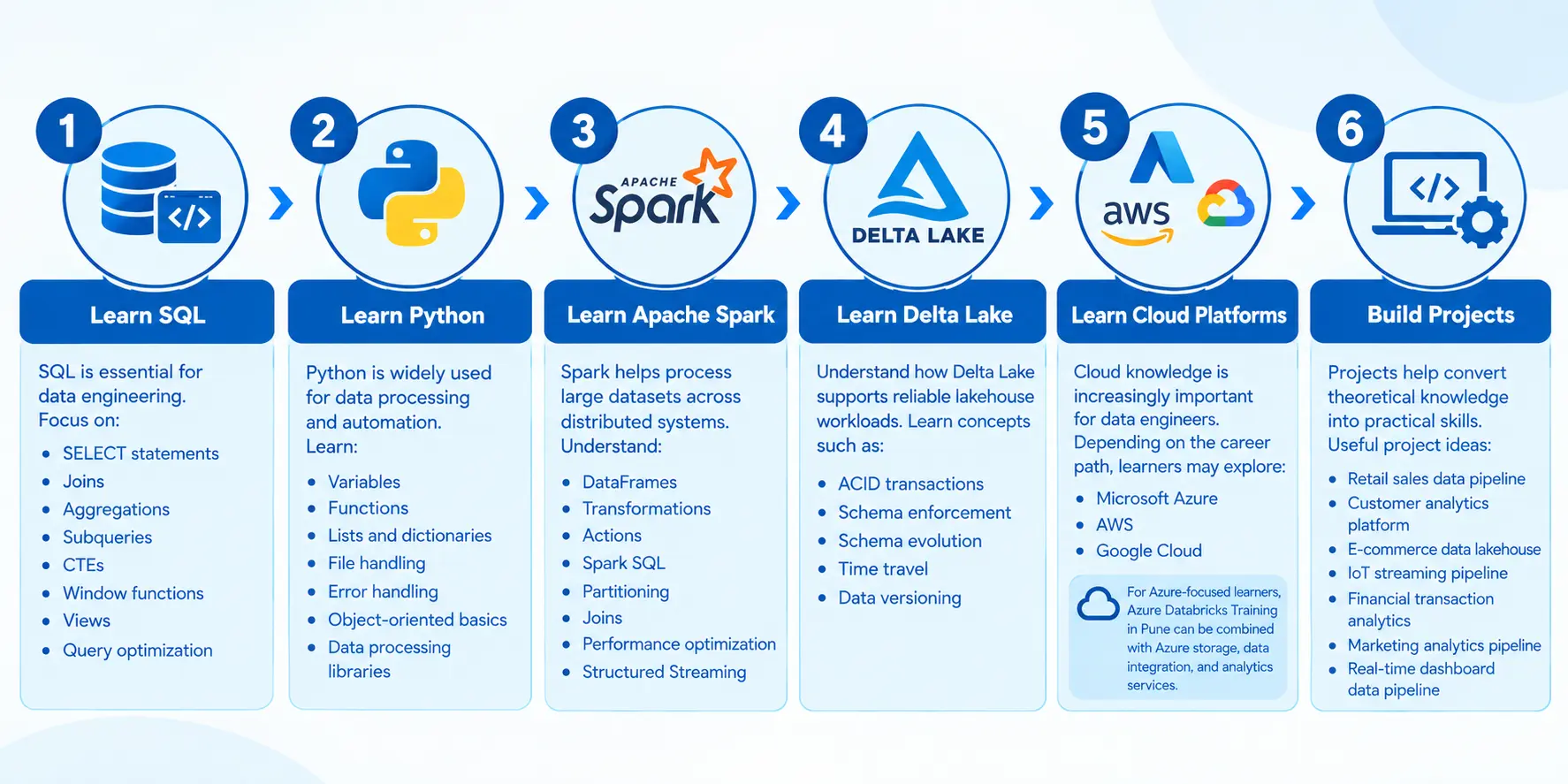
A practical learning path can include:
Step 1: Learn SQL
SQL is essential for data engineering.
Focus on:
- SELECT statements
- Joins
- Aggregations
- Subqueries
- CTEs
- Window functions
- Views
- Query optimization
Step 2: Learn Python
Python is widely used for data processing and automation.
Learn:
- Variables
- Functions
- Lists and dictionaries
- File handling
- Error handling
- Object-oriented basics
- Data processing libraries
Step 3: Learn Apache Spark
Spark helps process large datasets across distributed systems.
Understand:
- DataFrames
- Transformations
- Actions
- Spark SQL
- Partitioning
- Joins
- Performance optimization
- Structured Streaming
Step 4: Learn Delta Lake
Understand how Delta Lake supports reliable lakehouse workloads.
Learn concepts such as:
- ACID transactions
- Schema enforcement
- Schema evolution
- Time travel
- Data versioning
Step 5: Learn Cloud Platforms
Cloud knowledge is increasingly important for data engineers.
Depending on the career path, learners may explore:
- Microsoft Azure
- AWS
- Google Cloud
For learners interested in Azure environments, Azure Databricks Training in Pune can be combined with Azure storage, data integration, and analytics services.
Step 6: Build Projects
Projects help convert theoretical knowledge into practical skills.
Useful project ideas include:
- Retail sales data pipeline
- Customer analytics platform
- E-commerce data lakehouse
- IoT streaming pipeline
- Financial transaction analytics
- Marketing analytics pipeline
- Real-time dashboard data pipeline
Databricks Classes in Pune: What Should a Practical Course Include?
A practical Databricks learning program should go beyond notebooks and basic commands.
Look for training that covers:
- SQL
- Python
- PySpark
- Apache Spark
- Delta Lake
- Data pipelines
- Cloud storage
- Data ingestion
- ETL and ELT
- Streaming
- Data optimization
- Real-world projects
- Interview preparation
A course should also give learners opportunities to work with realistic datasets.
This helps students understand how data engineering concepts connect in an actual project.
For learners comparing a Databricks Course in Pune, curriculum depth, hands-on work, mentor support, project exposure, and career guidance can all be considered.
Databricks Certification Training in Pune: Is Certification Useful?
Certification can help demonstrate knowledge of a technology.
However, certification should not replace practical skills.
A strong learning plan combines:
Learning → Practice → Projects → Certification → Interview Preparation
Certification preparation can help learners understand platform concepts in a structured way.
At the same time, employers may evaluate practical abilities such as SQL, Python, Spark, cloud services, debugging, data modeling, and pipeline development.
Therefore, learners considering Databricks Certification Training in Pune should combine exam preparation with hands-on project work.
Databricks Course with Placement in Pune: What Should Learners Check?
Placement support can be useful for freshers and career transitioners.
When evaluating a Databricks Course with Placement in Pune, learners can check whether the program includes:
- Resume preparation
- Mock interviews
- Technical interview practice
- Project discussions
- Job-oriented training
- Communication support
- Career guidance
- Interview preparation
It is also useful to understand exactly what “placement support” means before joining a course.
Ask about the type of support provided, the duration of assistance, project exposure, and interview preparation process.
Career Scope After Learning Databricks
Databricks skills can support several career paths in the data ecosystem.
Potential roles include:
- Data Engineer
- Cloud Data Engineer
- Big Data Engineer
- Data Platform Engineer
- Analytics Engineer
- Machine Learning Engineer
- Data Architect
- AI Data Engineer
Career requirements vary by organization and role.
For example, a data engineering position may require strong SQL, Python, Spark, cloud services, and pipeline development skills.
A machine learning-focused role may require additional knowledge of statistics, machine learning algorithms, model development, and MLOps.
Databricks vs Snowflake: Career Skills Comparison
Skill Area
Databricks Focus
Snowflake Focus
SQL
Important
Very important
Python
Important
Useful
PySpark
Highly relevant
Less central
Apache Spark
Highly relevant
Less central
Data warehousing
Supported
Core area
Data lakes
Strong
Supported
Lakehouse
Core concept
Not the primary architecture
Machine learning
Strong
Supported
Streaming
Strong
Supported
BI analytics
Supported
Strong
Data sharing
Supported
Strong
Cloud knowledge
Important
Important
This comparison shows why learners should not select a platform based only on its popularity. The better learning path depends on the type of work they want to perform.
How to Choose Between Databricks and Snowflake
Ask these questions before choosing a platform:
What Type of Work Do You Want to Do?
If your interest is large-scale data processing, Spark, data engineering, machine learning, and lakehouse architecture, Databricks can be an important technology to learn.
If your interest is cloud data warehousing, SQL analytics, BI, and centralized enterprise data platforms, Snowflake can be highly relevant.
What Does Your Target Job Require?
Review job descriptions for the roles you want.
Look for recurring requirements such as:
- SQL
- Python
- Spark
- Databricks
- Snowflake
- Azure
- AWS
- Data modeling
- ETL
- Cloud data platforms
This gives you a practical idea of which skills to prioritize.
Do You Need One Platform or Both?
Data engineers may encounter multiple technologies during their careers.
Learning the fundamentals of both platforms can therefore be useful after building a strong foundation in SQL, Python, data modeling, and cloud concepts.
Why Databricks Skills Matter for Modern Data Engineers
Modern data engineering is moving beyond simple ETL jobs.
Data engineers increasingly work with:
- Cloud platforms
- Large-scale data
- Real-time pipelines
- AI systems
- Machine learning
- Data quality
- Governance
- Data observability
- Business intelligence
Databricks brings many of these workloads into a connected lakehouse environment.
This makes knowledge of Databricks valuable for learners who want to build modern data engineering skills.
A structured Databricks Data Engineer Training in Pune can help learners progress from foundational concepts to practical projects.
Why Learn Databricks with Practical Projects?
Reading documentation is useful, but building projects develops deeper understanding.
Consider a project such as an e-commerce analytics lakehouse.
A possible architecture is:
E-commerce App → Raw Data → Cloud Storage → Databricks → Delta Tables → Data Transformation → BI Dashboard
A learner could work on:
- Data ingestion
- Data cleaning
- Schema design
- PySpark transformations
- Delta table creation
- Data quality checks
- Aggregation
- Dashboard-ready datasets
This project connects multiple skills instead of teaching them separately.
Choosing a Databricks Course in Pune
When comparing training providers, consider the complete learning experience.
A useful checklist includes:
- Industry-relevant syllabus
- Experienced instructors
- SQL and Python foundation
- PySpark training
- Apache Spark
- Delta Lake
- Cloud integration
- Real-world projects
- Hands-on assignments
- Interview preparation
- Certification guidance
- Career support
Learners can explore the Databricks Course in Pune at IntelliBI Innovations Technologies to understand the course structure and learning approach.
For professionals who want a practical learning environment, Databricks Training in Pune can be considered as part of a broader data engineering roadmap.
Learners looking for structured Databricks Data Engineering Course in Pune can focus on building skills that connect data processing, cloud platforms, and real-world projects.
Databricks vs Snowflake: A Simple Decision Framework
Use the following framework to understand the difference:
If your focus is:
- Spark → Explore Databricks
- PySpark → Explore Databricks
- Lakehouse → Explore Databricks
- Machine learning → Explore Databricks capabilities
- Streaming → Explore Databricks capabilities
- SQL analytics → Consider both
- Cloud data warehouse → Explore Snowflake
- Enterprise BI → Consider Snowflake and other warehouse platforms
- Data sharing → Explore Snowflake capabilities
- Modern data engineering → Learn the fundamentals behind both
This is not a universal rule. Real-world technology choices depend on data architecture, cloud environment, budget, existing systems, team skills, governance requirements, and business needs.
Conclusion
Databricks and Snowflake are important platforms in the modern data ecosystem, but they have different origins and strengths.
Databricks is closely associated with Apache Spark, lakehouse architecture, data engineering, machine learning, streaming, and AI workloads.
Snowflake has a strong foundation in cloud data warehousing, SQL analytics, data sharing, and enterprise analytical workloads.
For aspiring data engineers, the most valuable approach is to build strong fundamentals first. Learn SQL, Python, data modeling, cloud concepts, and data pipeline development. Then specialize in platforms such as Databricks or Snowflake based on your career goals.
At IntelliBI Innovations Technologies, the focus is on connecting technology learning with practical skills and career development. With hands-on practice, real-world projects, and a structured roadmap, learners can build a stronger foundation for modern data engineering careers.