
Data Engineer vs Data Scientist vs Data Analyst: Which Role Fits You?
Quick Answer
A data analyst turns existing data into reports and dashboards; a data scientist builds predictive models from that data; a data engineer builds the pipelines and platforms that make both possible. If you enjoy SQL, systems and building things that run at scale, data engineering fits you best. It has the highest demand and starting salaries in Pune in 2026. IntelliBI's Data Engineering Course in Pune teaches Azure, AWS, Databricks and PySpark through real projects with placement support.
Data Engineer vs Data Scientist vs Data Analyst: Which Role Fits You?
Every week at our Thergaon campus, someone walks in with the same question: "I want a career in data, but which one?" They have seen the job titles on LinkedIn, heard the salary numbers from a friend in Hinjewadi, and maybe watched a few YouTube videos. What they have not found is a clear, practical answer that connects the roles to their own strengths.
This guide is that answer. We will compare the three most popular data careers, show you what a typical day looks like in each, lay out the skills and tools you will need, share realistic salary ranges for Pune in 2026, and give you a short self-test to decide. If data engineering turns out to be your fit, we will also explain how IntelliBI's Data Engineering Course in Pune takes you from where you are today to a job-ready portfolio.
The Three Roles in One Sentence Each
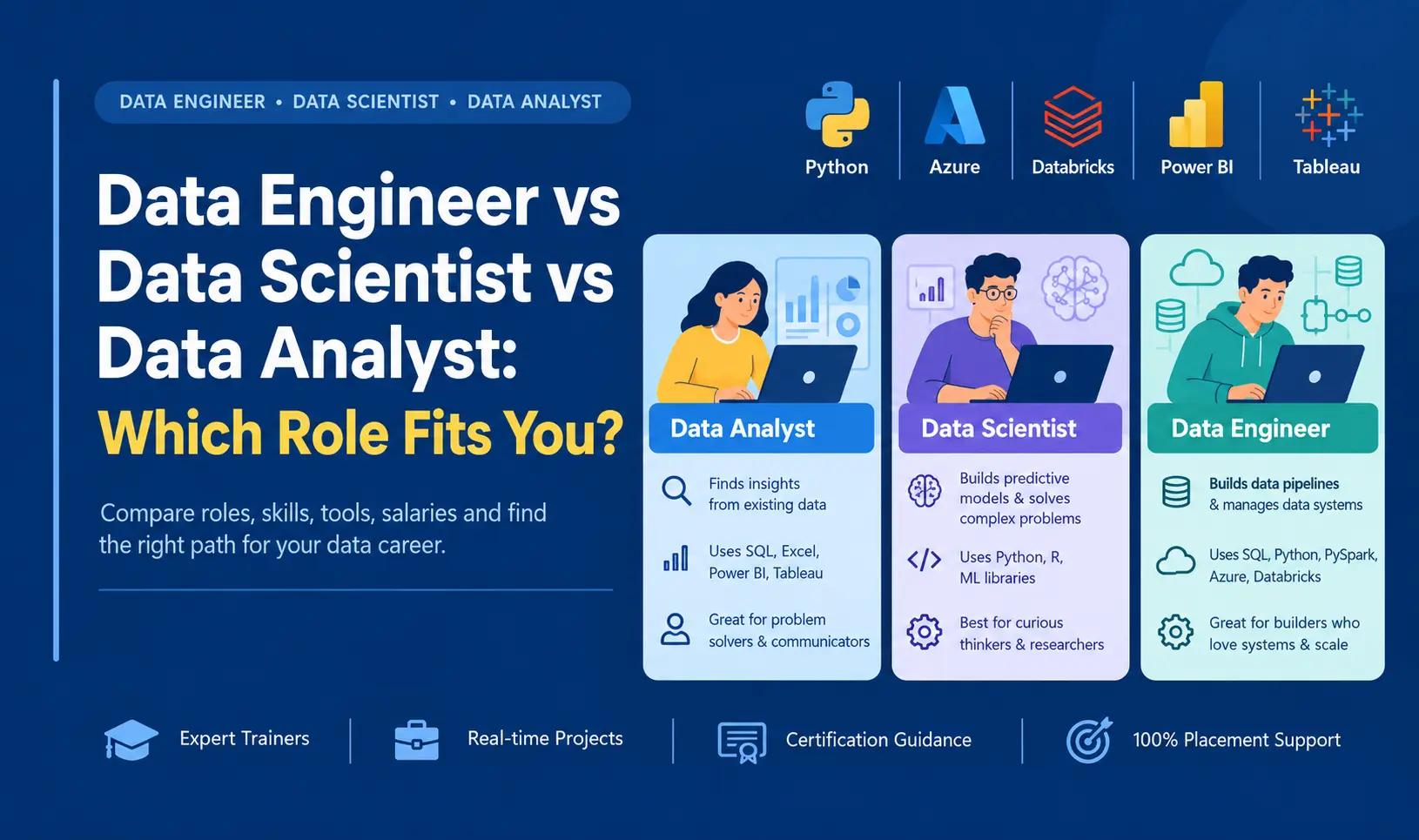
A data analyst answers questions with data that already exists. A data scientist predicts what will happen next using statistics and machine learning. A data engineer builds the systems that collect, clean, store and move the data so the other two can do their jobs.
Think of a restaurant. The data engineer designs the kitchen, the supply chain and the storage so fresh ingredients arrive reliably every morning. The data analyst is the chef who turns those ingredients into today's menu. The data scientist experiments with new recipes that might become next season's bestseller. All three matter, but without the kitchen, nothing gets cooked.
What a Data Analyst Actually Does
A data analyst spends most of the day close to the business. A typical week includes pulling data with SQL, cleaning it in Excel or Python, building dashboards in Power BI or Tableau, and presenting findings to managers who need to make a decision by Friday.
Core skills: SQL, Excel, Power BI or Tableau, basic statistics, data storytelling and strong communication.
Who it suits: people who enjoy explaining things, like variety, and want the shortest path into a data role. Many graduates and non-IT professionals start here because the learning curve is gentler.
Where it gets limited: analysts depend on data that someone else has prepared. When the pipeline breaks or the warehouse is slow, the analyst waits. Career growth often means moving towards analytics engineering, product analytics, or, increasingly, towards data engineering itself.
What a Data Scientist Actually Does
The data scientist role is the one that gets the headlines, but the daily reality is less glamorous than the hype. Expect long stretches of exploratory analysis, feature engineering, training and tuning models, and explaining to stakeholders why a 78% accurate model is still useful.
Core skills: Python or R, statistics and probability, machine learning libraries such as scikit-learn and PyTorch, experiment design, and enough SQL to get your own data.
Who it suits: people with strong mathematical intuition who enjoy research-style problems and are comfortable with ambiguity.
Where it gets limited: entry-level demand has cooled since 2023. Companies in Pune now hire fewer "generalist" data scientists and more specialists who can also deploy models. A large share of data science projects fail not because the model was wrong but because the data was unreliable, which is exactly the problem data engineers solve.
What a Data Engineer Actually Does
A data engineer designs and builds data pipelines. On a normal day you might ingest transaction files from an on-premise SQL Server into Azure Data Lake using Azure Data Factory, transform them with PySpark on Databricks, model them into a star schema in a warehouse, schedule the whole flow in Apache Airflow, and add monitoring so you know before the business does if something fails.
Core skills: advanced SQL, Python, PySpark, cloud platforms (Azure or AWS), Databricks and Delta Lake, orchestration tools, data modelling, and CI/CD.
Who it suits: people who like building things that run reliably, enjoy solving performance puzzles, and prefer systems over slides. Software developers, SQL developers, ETL developers, testers and support engineers usually find this the most natural transition because their existing habits transfer directly.
Where it gets limited: it is less customer-facing, and the tooling changes quickly, so continuous learning is part of the job. The upside is that this is precisely why a structured Data Engineering Training in Pune, built around current tools rather than a five-year-old syllabus, pays off so quickly.
Side-by-Side Comparison
Focus: Analyst describes the past, scientist predicts the future, engineer builds the foundation for both.
Primary tools: Analyst uses SQL, Excel, Power BI. Scientist uses Python, scikit-learn, PyTorch, notebooks. Engineer uses SQL, Python, PySpark, Databricks, Azure Data Factory, AWS Glue, Airflow.
Maths required: Analyst needs basic statistics. Scientist needs strong statistics and linear algebra. Engineer needs logic and systems thinking more than advanced maths.
Coding depth: Analyst light, scientist moderate, engineer heavy.
Entry barrier in 2026: Analyst low, scientist high, engineer moderate, with the best demand-to-supply ratio of the three.
Typical Pune salary, 0 to 2 years: Analyst ₹3.5 to 6 LPA, scientist ₹5 to 9 LPA, engineer ₹4.5 to 8 LPA in IT services and ₹8 to 14 LPA in product and finance companies.
Typical Pune salary, 3 to 6 years: Analyst ₹7 to 12 LPA, scientist ₹12 to 22 LPA, engineer ₹12 to 26 LPA, with Azure, Databricks and streaming skills commanding the premium.
Why Data Engineering Demand Is Rising Fastest in Pune
Pune's economy leans heavily on IT services, manufacturing, automotive, banking and insurance. Every one of these industries is moving legacy data onto the cloud, and most of them have chosen Microsoft Azure. Walk through any Hinjewadi or Kharadi job board and you will see the same requirement repeated: Azure Data Factory, Azure Databricks, Synapse, PySpark, Delta Lake. That is why an Azure Data Engineer Course in Pune has become one of the most searched upskilling programmes in the city.
There is a second driver: AI. Generative AI and agentic AI applications are only as good as the data they are fed. Companies that rushed into LLM projects in 2024 and 2025 discovered that their biggest bottleneck was not the model but the pipeline. The result is a new hybrid profile, the AI data engineer, who can build lakehouse pipelines and also wire them into retrieval systems, vector search and automated monitoring. Candidates with this combination skip the queue.
Finally, data engineering roles are harder to automate than analyst roles. AI assistants can now write a decent dashboard query, but designing an idempotent, cost-optimised, governed pipeline across two clouds still needs a human who understands the business, the data and the platform.
Which Role Fits You? A Five-Question Self-Test
Answer honestly, then count your A, B and C responses.
- When a report looks wrong, your instinct is to: (A) check the numbers and re-present them, (B) question the model or assumptions, (C) trace the data back to its source and fix the pipeline.
- The part of a project you enjoy most is: (A) presenting insights, (B) experimenting with approaches, (C) building something that runs automatically.
- Your relationship with maths: (A) comfortable with averages and trends, (B) enjoy probability and optimisation, (C) prefer logic, structure and performance tuning.
- Your current background is closest to: (A) business, finance, marketing or fresh graduate, (B) statistics, research or engineering with strong maths, (C) software development, SQL, ETL, testing or support.
- In five years you want to be: (A) an analytics manager or product analyst, (B) an ML or research lead, (C) a data architect, platform lead or AI data engineer.
Mostly A: start as a data analyst, and keep data engineering as your growth path. Mostly B: data science, ideally with deployment skills. Mostly C: data engineering is your fit, and you should look seriously at an Advanced Data Engineer Course in Pune that covers cloud, Databricks and AI together rather than in isolation.
Can You Switch Between the Roles Later?
Yes, and the most common movement is towards engineering. Analysts become analytics engineers once they learn dbt, Spark and cloud warehousing. Data scientists become ML engineers once they learn pipelines and deployment. Both transitions get easier when you learn the engineering fundamentals early. That is one reason many learners at IntelliBI choose the Best Data Engineering Course in Pune first and add analytics or AI specialisation afterwards: engineering skills open every other door.
What a Strong Data Engineering Programme Must Cover in 2026
If you have decided on data engineering, the next decision is where to learn. Here is the checklist we recommend, whichever institute you consider.
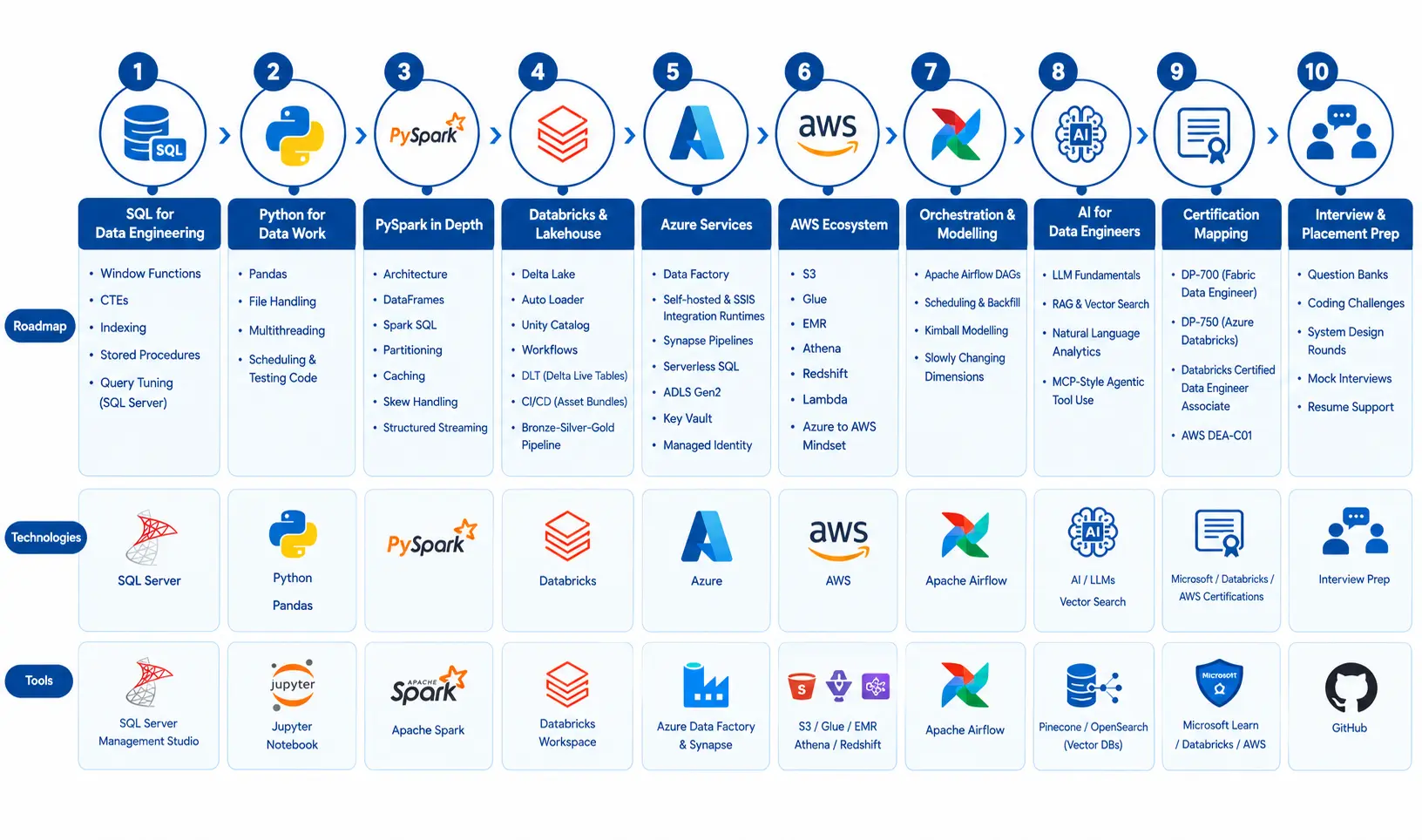
SQL that goes beyond SELECT: window functions, CTEs, indexing, stored procedures and query tuning on SQL Server.
Python for data work: pandas, file handling, multithreading, and the habit of writing code that can be scheduled and tested.
PySpark in depth: architecture, DataFrames, Spark SQL, partitioning, caching, skew handling and Structured Streaming. This is the most asked topic in Pune interviews.
Databricks and the Lakehouse: Delta Lake, Auto Loader, Unity Catalog, Workflows, Delta Live Tables and CI/CD with asset bundles. Serious Databricks Training in Pune should have you building a Bronze-Silver-Gold medallion pipeline, not just watching one.
Azure services: Data Factory with Azure, self-hosted and SSIS integration runtimes, Synapse pipelines and serverless SQL, ADLS Gen2, Key Vault and managed identity.
A second cloud: AWS S3, Glue, EMR, Athena, Redshift and Lambda, taught with an "Azure to AWS mindset" so you can work in either environment.
Orchestration and modelling: Apache Airflow DAGs, scheduling and backfill, plus Kimball dimensional modelling and slowly changing dimensions.
AI for data engineers: LLM fundamentals, RAG and vector search, natural-language analytics, and MCP-style agentic tool use for pipelines.
Certification mapping: Microsoft DP-700 (Fabric Data Engineer), the new DP-750 Azure Databricks exam, the Databricks Certified Data Engineer Associate and AWS DEA-C01.
Interview and placement preparation: technology-wise question banks, scenario-based coding challenges, system design rounds, mock interviews and resume support.
Any Data Engineering Classes in Pune that skip the cloud, skip Databricks or skip the AI module are preparing you for the 2021 job market, not the 2026 one.
How IntelliBI's Data Engineering Course in Pune Is Built
IntelliBI Innovations Technologies was founded on a simple idea: training should look like the job. Our Data Engineering Course in Pune runs for four to five months and around 300 hours, and every module above is taught hands-on by senior data engineers with 10 to 15 years of enterprise experience at companies such as TCS, Persistent and Deloitte.
You build ten or more production-grade projects across retail, healthcare, banking and insurance: an end-to-end medallion sales lakehouse on Databricks, an enterprise healthcare data platform, a revenue and claims analytics platform, and an insurance pipeline orchestrated with Airflow. These become your GitHub portfolio and your interview stories.
The programme is designed for working professionals. Classroom sessions run at Sagar Complex, Dange Chowk, Thergaon, about ten minutes from Hinjewadi Phase 1, with weekday evening batches from 7 PM to 9 PM and weekend batches from 10 AM to 2 PM. Live online attendance and lifetime access to recordings mean a missed class is never a lost class.
Placement support does not expire. Learners receive ATS-ready resume and LinkedIn optimisation, mock technical and HR interviews, referral access to a network of 300 plus hiring partners, and mentorship until they are placed. More than 2,200 professionals have transformed their careers with us, and alumni now work at Microsoft, Accenture, Infosys, Cognizant, TCS and Deloitte.
That combination of depth, currency and support is why learners consistently rate IntelliBI as the Best Data Engineering Institute in Pune, and why so many of them arrive on a referral from a colleague.
Frequently Asked Questions
Can I join without a coding background?
Yes. The Data Engineer Course in Pune starts from SQL and Python fundamentals, and a large share of our learners come from testing, support, mechanical engineering or non-IT roles.
Is data engineering better than data science for freshers?
In Pune's 2026 market, data engineering has more entry-level openings and a clearer path, because every company needs pipelines before it needs models.
Should I learn Azure or AWS first?
Pune enterprises lean Azure, so we start there and add AWS so you are not locked out of product companies and startups that use it.
How is this different from cloud engineer courses in Pune?
Cloud engineering focuses on infrastructure, networking and DevOps. Data engineering focuses on moving and modelling data on that infrastructure. If you enjoy data more than servers, choose data engineering.
Do you prepare me for certifications?
Yes. The syllabus is mapped to DP-700, DP-750, the Databricks Data Engineer Associate and AWS DEA-C01, and you receive practice tests and guidance for each.
The Bottom Line
If you love explaining, start as an analyst. If you love mathematics and experimentation, pursue data science. If you love building reliable systems and want the strongest demand, highest ceiling and clearest path in Pune today, become a data engineer.
Whichever role you choose, the skills you learn in a serious Data Engineering Training in Pune will never go to waste, because every data career ultimately rests on good pipelines. If you are ready to find out whether this is your path, book a free demo class, sit in on a live Databricks session and talk to our alumni before you decide. Explore the full syllabus of the Data Engineering Course in Pune and take the first step this October.