
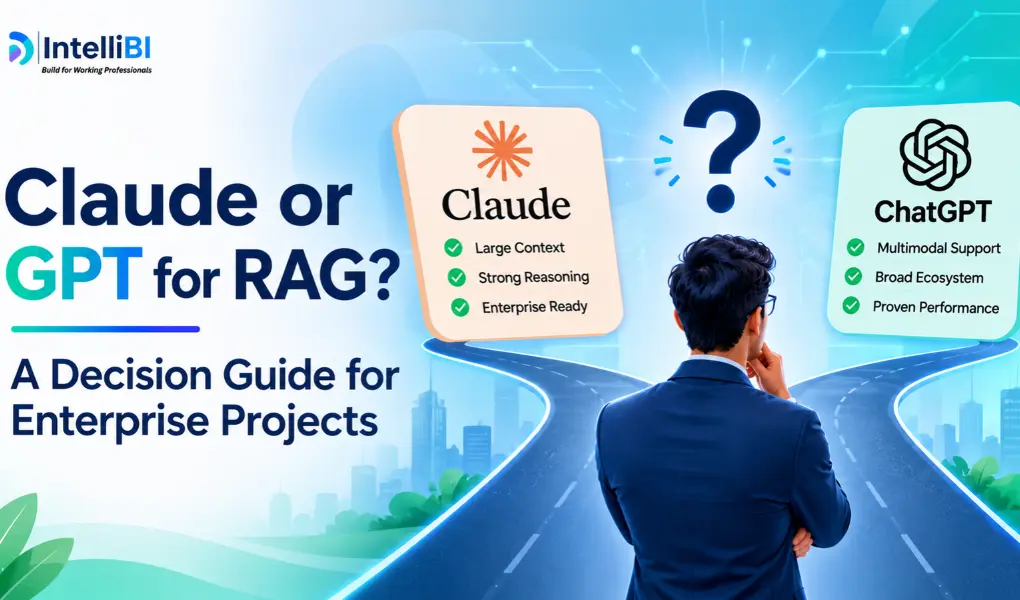
Claude or GPT for RAG? A Decision Guide for Enterprise Projects
Quick Answer
Claude and GPT can both power enterprise RAG applications. Claude can be evaluated for detailed document interpretation, extended context and document-grounded responses, while GPT offers capabilities such as structured outputs, function calling and hosted File Search. The best choice depends on retrieval quality, answer accuracy, latency, cost, security and the results of testing both models on real enterprise data.
Enterprise organisations generate large amounts of information every day. This includes customer records, internal policies, financial reports, technical documents, product manuals and operational data. Although this information is valuable, finding the right answer quickly can be difficult when it is spread across multiple systems.
Retrieval-Augmented Generation (RAG) addresses this challenge by combining information retrieval with Large Language Models (LLMs). Instead of relying only on information learned during training, a RAG application retrieves relevant content from an approved knowledge source and provides it to an LLM to generate a context-based response.
Two popular choices for building these applications are Claude, developed by Anthropic, and GPT, developed by OpenAI. Both model families can support RAG workflows, but selecting between them requires more than comparing their conversational abilities.
The right choice depends on document complexity, answer accuracy, context requirements, integration options, security, response time and operating costs.
For professionals exploring a Generative AI Course in Pune, understanding this comparison is useful because enterprise RAG is an important application of LLMs.
This guide explains how Claude and GPT can be used in RAG systems, where their capabilities differ, what enterprises should evaluate and how to make a practical model-selection decision.
1. Understanding RAG in Enterprise Applications
Retrieval-Augmented Generation is an architecture that connects an LLM with an external knowledge source. It helps the model answer questions using information retrieved from documents or databases relevant to the user's request.
A typical RAG system follows these steps:
- Document collection: Gather information from PDFs, Word files, websites, databases and internal applications.
- Document processing: Extract text, remove unnecessary content and organise the information.
- Chunking: Divide large documents into smaller, meaningful sections.
- Embedding generation: Convert text chunks into numerical representations that capture semantic meaning.
- Vector storage: Store embeddings and associated document information in a searchable database.
- Retrieval: Find relevant chunks when a user submits a question.
- Context preparation: Pass the retrieved information to the selected LLM.
- Response generation: Generate an answer using the supplied context.
- Source presentation: Display relevant references so users can verify the response.
Practical example
Imagine a financial services company with thousands of internal policy documents. Employees regularly ask questions such as:
"What documents are required to process a business loan application?"
A RAG application searches the approved policy repository, retrieves the relevant sections and sends them to Claude or GPT. The selected model then prepares an answer based on the retrieved material.
Without retrieval, the model may provide a general explanation that does not reflect the company's current policy. RAG helps connect the answer to the organisation's own information.
An important distinction is that Claude and GPT are the generation models in this architecture. The document-processing pipeline, embedding model, vector database and retrieval strategy are separate components.
2. What Is the Difference Between Claude and GPT for RAG?
Claude and GPT are families of language models that can interpret retrieved information and generate responses. They offer different model options, capabilities and development ecosystems.
The comparison should focus on the exact model and API configuration being considered rather than assuming that every model in one family behaves identically.
Claude for RAG
Claude is Anthropic's family of language models. It can be used in RAG applications that need document analysis, contextual understanding, summarisation and responses based on supplied information.
Depending on the selected model and deployment platform, Claude offers capabilities such as:
- Processing text and image inputs.
- Working with long documents and extended context.
- Following detailed instructions.
- Using tools through supported integrations.
- Producing structured responses through supported output features.
- Providing document-grounded citations through its API citation functionality.
Claude's documentation also provides RAG implementation guidance covering techniques such as summary indexing and reranking.
These capabilities can be useful when an enterprise application needs to interpret lengthy reports, compare policy sections or prepare detailed responses from retrieved documents.
GPT for RAG
GPT is OpenAI's family of language models. Developers can use GPT models to build RAG applications through APIs, retrieval systems and tool integrations.
Depending on the selected model and platform, relevant capabilities include:
- Processing retrieved context.
- Following structured instructions.
- Generating structured outputs.
- Calling functions and external tools.
- Supporting file search workflows.
- Working with vector stores and semantic retrieval.
- Using prompt caching to reduce repeated processing costs and latency in suitable workloads.
OpenAI also provides a hosted File Search tool through its Responses API. It can search uploaded knowledge bases using semantic and keyword search, reducing the amount of retrieval infrastructure a developer needs to implement independently.
Claude vs GPT: High-Level Comparison
Evaluation area
Claude
GPT
RAG implementation
Can work with external retrieval pipelines and supplied documents
Can work with external retrieval pipelines and platform-provided File Search
Long-document processing
Current models offer extended context options
Current models offer extended context options
Document analysis
Suitable for summarising and interpreting retrieved material
Suitable for summarising and interpreting retrieved material
Tool integration
Supports tools and external integrations
Supports function calling and built-in tools
Source references
Provides document citation functionality through supported API features
Can return file-search results and references through supported workflows
Customisation
Supports detailed instructions and application-level configuration
Supports detailed instructions, structured outputs and application-level configuration
Cost management
Depends on model, token usage, caching and deployment
Depends on model, token usage, caching and deployment
Best selection method
Test against the actual enterprise workload
Test against the actual enterprise workload
Neither model family is automatically the better choice for every RAG application. Performance depends on the model version, retrieval quality, prompt design and the type of questions users ask.
3. When Should Enterprises Choose Claude for RAG?
Claude may be a strong candidate when an application requires detailed document interpretation, extended context or nuanced responses based on retrieved information.
Consider the following situations.
A. Working with lengthy business documents
Some organisations manage large policy documents, technical manuals, legal material and research reports.
For example, a compliance team may need to compare multiple sections of a long policy document to understand whether a particular business activity is permitted.
A suitable Claude model can process substantial context, depending on its supported context window and the application's configuration.
However, a large context window does not remove the need for retrieval. Sending every document to the model for every question can increase cost and make it harder to focus on the most relevant information.
B. Summarising complex information
Enterprise users often need more than a direct answer. They may want a comparison, explanation or summary based on several retrieved sections.
For example, an HR application may retrieve leave policies from different employee categories and explain how their provisions differ.
The model should identify the relevant conditions, preserve important exceptions and avoid combining rules that apply to different employee groups.
C. Producing document-grounded answers
When answers need to be traceable to source material, citation support becomes important.
Anthropic provides a citation feature that can return references to supplied document content. This can help users inspect the evidence behind an answer.
However, citations alone do not guarantee that the answer is correct. Developers must still verify whether the retrieved passages actually support the generated response.
D. Building research-oriented applications
Research teams may use RAG to search technical documents, internal reports and knowledge repositories.
A model can help combine relevant passages into a readable explanation while preserving the differences between sources.
For these workloads, evaluate how well the selected Claude model handles conflicting information, missing evidence and questions that cannot be answered from the retrieved documents.
4. When Should Enterprises Choose GPT for RAG?
GPT may be a suitable option when an organisation wants to build RAG applications around OpenAI's development ecosystem, structured outputs, function calling or hosted retrieval features.
A. Using hosted File Search
OpenAI's File Search tool allows developers to create vector stores, upload documents and retrieve relevant information through a managed workflow.
The tool supports semantic and keyword search, helping applications find relevant passages even when a user's wording differs from the wording in the source document.
For example, an employee may ask:
"How many days can I take off when my child is unwell?"
The policy may use the phrase "dependent care leave" rather than the words in the question. Semantic retrieval can help identify the relevant section.
The hosted approach can reduce the amount of retrieval infrastructure a development team needs to maintain. However, developers should still understand indexing, metadata, access control and retrieval quality.
B. Generating structured responses
Some enterprise systems need answers in a predictable format rather than free-form paragraphs.
For example, an insurance application might need to return:
- Policy number.
- Claim category.
- Required documents.
- Eligibility conditions.
- Relevant source reference.
Structured output capabilities can help developers define the expected response format and make it easier to integrate model responses into applications.
C. Connecting RAG with business applications
A RAG application may need to retrieve information and then interact with other systems.
For example, an internal support assistant could retrieve a troubleshooting procedure and use an approved function to create a support ticket.
GPT's function-calling and tool capabilities can support such workflows when the application defines the available functions and permissions.
The model should not be given unrestricted access to business systems. Sensitive operations should require suitable authorisation and validation.
D. Optimising repeated requests
Enterprise applications often reuse common instructions, document context and tool definitions.
OpenAI supports prompt caching for eligible repeated prompt prefixes. This can reduce input processing costs and latency when requests share reusable context.
Caching behaviour, eligibility and pricing depend on the model and API configuration. It should be evaluated using actual application traffic rather than assumed to produce a fixed saving.
5. Claude vs GPT for Different Enterprise RAG Use Cases
The most useful way to compare models is to connect the decision to the business problem.
Enterprise use case
What matters most
What to test
Legal document search
Precise interpretation and source traceability
Clause accuracy, citations and handling of exceptions
HR policy assistant
Correct answers based on employee-specific rules
Retrieval relevance and access restrictions
Customer support
Fast, consistent answers
Response time, accuracy and escalation behaviour
Technical documentation search
Understanding technical terminology
Retrieval precision and explanation quality
Financial reporting assistant
Accurate figures and clear explanations
Calculation verification and source consistency
Research knowledge assistant
Combining information from multiple sources
Evidence quality and conflicting-source handling
IT troubleshooting
Step-by-step instructions
Correct procedure selection and tool permissions
For instance, a legal document assistant may prioritise source references and careful interpretation. A customer support application may place greater importance on response time and operating cost.
The same model does not have to serve every use case within an organisation.
6. Practical Enterprise Example: Building an Internal Knowledge Assistant
Consider a technology company that stores information across employee handbooks, technical documents, project reports and support manuals.
Employees frequently ask questions about company procedures and technical processes. The organisation wants to build an internal RAG assistant.
Step 1: Identify the knowledge sources
The development team collects approved documents from:
- SharePoint.
- Internal PDF repositories.
- Technical documentation.
- HR policy files.
- Support knowledge bases.
Each document should have appropriate ownership, access permissions and update information.
Step 2: Prepare and organise the documents
The documents are processed to extract useful text. Unnecessary headers, duplicate content and irrelevant formatting are handled during preprocessing.
The content is divided into meaningful chunks. For example, an employee handbook may be divided by policy section rather than split at arbitrary character positions.
Metadata such as department, document type, version and access category can be attached to each chunk.
Step 3: Generate embeddings and store the content
An embedding model converts the text chunks into numerical representations.
These embeddings are stored in a vector database or another supported retrieval system along with the original text and metadata.
The embedding model is a separate component from Claude or GPT. Selecting GPT for generation does not mean that OpenAI embeddings must be used, and selecting Claude does not require a particular embedding provider.
Step 4: Retrieve relevant information
An employee asks:
"What is the process for requesting access to a production database?"
The retrieval layer searches the knowledge repository and identifies relevant access-management procedures.
It can apply metadata filters so that only documents the employee is authorised to access are considered.
Step 5: Generate the answer
The retrieved sections are passed to the selected LLM with clear instructions.
For example, the prompt may require the model to:
- Answer only from the supplied context.
- Explain the steps in order.
- Mention relevant conditions.
- Identify the source document.
- State when the available information is insufficient.
- Avoid inventing missing procedures.
The same retrieval results can be tested with Claude and GPT to compare their responses.
Step 6: Evaluate the output
The team checks whether the assistant identifies the correct procedure, includes all required steps and references the right document.
If both models produce incorrect answers, the issue may be poor retrieval, outdated documentation or unclear instructions rather than the generation model itself.
This is why evaluating the complete RAG pipeline is more useful than judging a model from a few conversational examples.
7. How to Decide Between Claude and GPT: A Practical Evaluation Framework
Before choosing a model for production, enterprises should create a repeatable evaluation process.
A. Build a representative question set
Collect real questions that employees or customers are likely to ask.
Include:
- Straightforward questions.
- Questions requiring multiple documents.
- Questions containing technical terminology.
- Questions with incomplete information.
- Questions involving conflicting policies.
- Questions that have no answer in the knowledge base.
This helps identify how each model performs across different conditions.
B. Measure retrieval quality separately
A RAG application can fail before the LLM generates an answer.
For example, if the retrieval layer returns an outdated policy, even a capable model may produce an incorrect response.
Useful retrieval metrics include:
- Precision: How many retrieved chunks are relevant?
- Recall: How much of the relevant information was retrieved?
- Mean Reciprocal Rank (MRR): How highly is the first relevant result ranked?
- Context relevance: Does the retrieved material help answer the question?
C. Evaluate generated answers
Once retrieval quality is measured, compare the generated responses.
Useful evaluation criteria include:
- Answer correctness: Is the response factually correct?
- Faithfulness: Is the answer supported by the retrieved context?
- Completeness: Does it include the important details?
- Citation accuracy: Do the references support the claims?
- Instruction following: Does it follow the required response format?
- Abstention: Does it admit when the information is unavailable?
D. Compare operational performance
Accuracy is important, but enterprise deployment also requires operational checks.
Metric
What to examine
Response latency
Time required to return an answer
Token usage
Input and output consumption
Cost per query
Total model and retrieval cost
Reliability
Consistency across repeated tests
Scalability
Behaviour under concurrent requests
Security
Data access and processing controls
Maintainability
Ease of updating models and integrations
Run the same test questions through both models using the same retrieval results, instructions and output requirements wherever possible.
This creates a fairer comparison.
8. Common Mistakes to Avoid When Selecting an LLM for RAG
Choosing a model based only on popularity
A widely used model may not be the best fit for a particular business workflow. Evaluate it using your own documents and questions.
Ignoring retrieval quality
A powerful LLM cannot reliably answer a question if the retrieval system provides irrelevant or outdated information.
Assuming a large context window solves every problem
A larger context window can help with extensive material, but sending too much information may increase cost and introduce irrelevant context. Good retrieval remains important.
Comparing only the quality of sample answers
A few impressive responses do not demonstrate production reliability. Use a representative evaluation dataset.
Ignoring access control
The retrieval system must enforce document-level permissions. An employee should not receive confidential information simply because the LLM can process it.
Treating citations as proof of correctness
A citation is useful only when the cited passage genuinely supports the answer. Citation accuracy should be part of the evaluation process.
Ignoring ongoing maintenance
Enterprise documents change. A production RAG system needs processes for updating content, removing outdated information, monitoring quality and testing changes.
9. What Skills Are Useful for Building Enterprise RAG Applications?
Developing a reliable RAG application requires knowledge across several areas of Generative AI and software engineering.
Skill
How it contributes to RAG
Python
Building data-processing and application workflows
LLM fundamentals
Understanding model behaviour and limitations
Prompt engineering
Defining answer rules and response formats
Embeddings
Converting content into searchable representations
Vector databases
Storing and retrieving document embeddings
SQL
Accessing structured enterprise information
APIs
Connecting models and business applications
RAG architecture
Designing ingestion, retrieval and generation
Evaluation
Measuring retrieval and answer quality
Security
Managing permissions and sensitive information
Professionals considering Generative AI Classes in Pune can benefit from understanding these components through practical projects.
An effective learning path should cover LLM fundamentals, embeddings, vector search, prompt design, RAG pipelines and application evaluation. An Online Generative AI Course may also be worth considering when learning flexibility is an important requirement.
Frequently Asked Questions (FAQs)
1. Is Claude or GPT better for RAG?
Neither is universally better. The right choice depends on the document type, retrieval quality, answer accuracy, context requirements, cost, latency and integration needs. Test both with the same enterprise dataset before deciding.
2. Can Claude be used to build a RAG application?
Yes. Developers can provide Claude with retrieved document content and use it to generate context-based answers. It can also be integrated with external retrieval systems and supported tools.
3. Can GPT be used for enterprise RAG?
Yes. GPT models can generate answers from retrieved enterprise information. OpenAI also offers File Search through its Responses API, which supports semantic and keyword search over uploaded knowledge bases.
4. Does RAG require a vector database?
Not necessarily. Vector databases are commonly used for semantic retrieval, but RAG systems can also use keyword search, relational databases, hybrid retrieval or managed search services.
5. Are Claude and GPT responsible for generating embeddings?
The generation model and embedding model are separate components. A RAG application can use one provider's LLM with an embedding model from another provider, provided the components are integrated correctly.
6. What is more important: the LLM or the retrieval system?
Both matter. Retrieval determines which information reaches the model, while the LLM interprets that information and generates the answer. Poor performance in either stage can affect the final result.
7. How can enterprises reduce hallucinations in RAG?
Use relevant retrieval results, clear instructions, source references, answer validation and an explicit option for the model to say that the available information is insufficient. Evaluate the complete system using realistic questions.
8. Can one enterprise RAG application use both Claude and GPT?
Yes. An application can route different tasks to different models or use a second model for selected workflows. However, this introduces additional integration, monitoring and cost considerations.
9. How should companies compare Claude and GPT pricing?
Compare the current API pricing for the exact models being considered. Include input tokens, output tokens, caching, retrieval infrastructure, tool calls and other operational expenses. Measure the cost per successfully answered query rather than looking only at the price per token.
10. What should I learn before building a RAG application?
Start with Python, LLM fundamentals, prompt engineering, embeddings, vector databases and API integration. Then learn document processing, retrieval strategies, evaluation and enterprise security.
Conclusion
Choosing between Claude and GPT for an enterprise RAG project is not simply a question of identifying which model produces the most impressive response. The decision should be based on the application's requirements, the type of documents being searched, the quality of retrieved information and the operational constraints of the organisation.
Claude can be evaluated for workloads involving detailed document interpretation, extended context and source-grounded responses. GPT can be evaluated for applications that benefit from its API ecosystem, structured outputs, function calling and hosted File Search capabilities.
However, neither model can compensate for poor document preparation, irrelevant retrieval results or inadequate access controls.
The most reliable approach is to build a representative test dataset, run both models against the same retrieved context and compare accuracy, faithfulness, citation quality, latency and total cost.
For professionals interested in developing these applications, learning LLMs, embeddings, prompt engineering and RAG architecture provides a practical foundation.
Explore Generative AI Learning at IntelliBI Innovations Technologies
IntelliBI Innovations Technologies focuses on practical learning in emerging AI technologies, including LLMs, Generative AI and RAG concepts. Professionals who want to understand how enterprise AI applications are designed and implemented can explore the Generative AI Training in Pune and review the course curriculum.