
Artificial Intelligence Certification Course in Pune: Curriculum, Projects & Career Path
Quick Answer
An Artificial Intelligence Certification Course in Pune can help learners build practical AI skills through Python, SQL, machine learning, deep learning, NLP, Generative AI, LLMs, RAG, and Agentic AI. With hands-on projects, portfolio development, and interview preparation, learners can prepare for career paths such as AI Engineer, Machine Learning Engineer, Data Scientist, and Generative AI Engineer.
Artificial Intelligence Certification Course in Pune: Curriculum, Projects & Career Path
Artificial intelligence has moved from being a specialized technology area to becoming an important part of modern software, analytics, automation, and business operations. As organizations adopt machine learning, Generative AI, intelligent automation, and AI-powered applications, professionals from both technical and non-technical backgrounds are exploring AI as a career direction.
But learning AI effectively requires more than understanding a few algorithms or completing a certification examination. A structured learning path should connect programming fundamentals, data handling, machine learning, deep learning, Generative AI, practical projects, deployment, and career preparation.
For professionals researching an Artificial Intelligence Certification Course in Pune, understanding the curriculum, project exposure, and potential career path is therefore an important first step.
What Does an Artificial Intelligence Certification Course in Pune Cover?
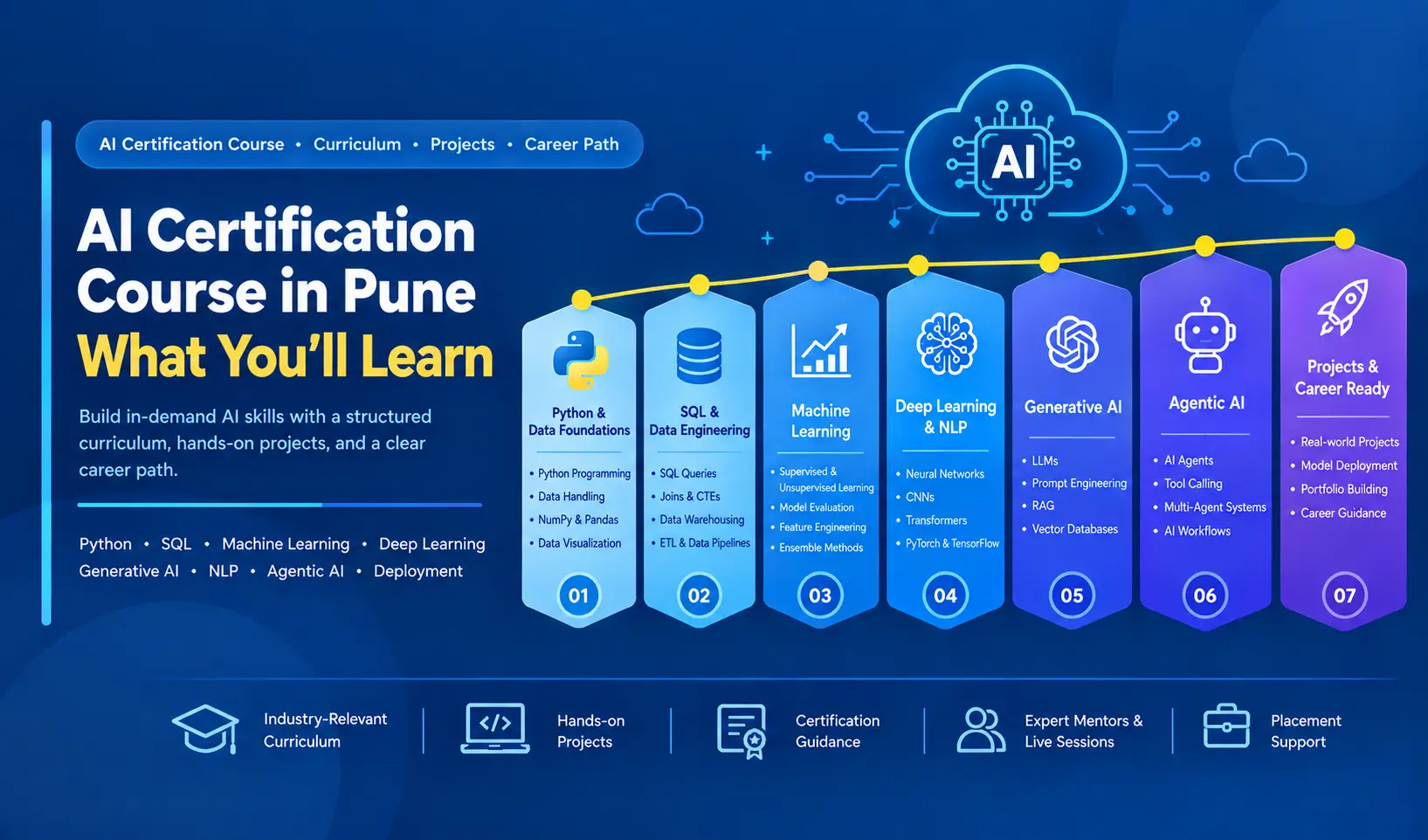
A comprehensive AI learning program typically starts with the foundations and progressively moves toward advanced applications.
The learning journey can include:
- Python programming
- SQL and data handling
- Statistics and exploratory data analysis
- Machine learning
- Deep learning
- Natural language processing
- Generative AI
- Large Language Models
- Retrieval-Augmented Generation
- Agentic AI
- AI application development
- Model deployment
- Evaluation and monitoring
- AI system architecture
IntelliBI's AI engineering curriculum follows a progression from SQL and Python foundations into Generative AI, Agentic AI, and Machine Learning, with hands-on and project-driven learning throughout the program.
This type of progression is important because advanced AI concepts become easier to understand when learners have a strong foundation in programming and data.
Why Start With Python and Data Foundations?
AI applications depend heavily on data. Before developing predictive models or LLM-based applications, learners need to understand how data is collected, cleaned, transformed, explored, and represented.
Python is widely used across data science and AI workflows. Beginners typically start with variables, data types, functions, control flow, object-oriented programming, file handling, APIs, and debugging.
Libraries such as NumPy and Pandas then introduce numerical computing, data manipulation, cleaning, and feature engineering.
IntelliBI's curriculum includes Python fundamentals, NumPy, Pandas, exploratory data analysis, visualization, REST API integration, Git, debugging, and production-oriented Python practices.
For someone considering Artificial Intelligence Classes in Pune, this foundation is valuable because it connects programming concepts with practical AI workflows.
The Role of SQL in Artificial Intelligence
SQL may not always be the first technology people associate with AI, but data is fundamental to machine learning and intelligent applications.
AI professionals often need to retrieve datasets, join information from multiple tables, aggregate records, investigate data quality, and prepare analytical datasets.
A strong curriculum can therefore include advanced SQL concepts such as joins, Common Table Expressions, window functions, stored procedures, query optimization, semi-structured data, data warehousing, ETL, validation, and transformation logic.
For learners entering an AI-focused career, SQL adds an important data engineering and analytics dimension to their technical profile.
Machine Learning as the Core of AI Training
Machine learning introduces the concepts that allow systems to learn patterns from data and generate predictions or classifications.
A structured AI program may cover:
- Linear and logistic regression
- Decision trees
- Random forests
- Support vector machines
- K-means clustering
- Principal Component Analysis
- Model evaluation
- Feature engineering
- Ensemble methods
- Hyperparameter optimization
For example, learners may work with accuracy, precision, recall, F1 score, and ROC-based evaluation when assessing classification models.
IntelliBI's AI and machine learning curriculum includes supervised and unsupervised learning, common algorithms, evaluation metrics, and hands-on model development using real datasets.
This is where an AI and Machine Learning Course in Pune can provide a useful bridge between theoretical concepts and practical implementation.
Advanced Artificial Intelligence Course: Deep Learning and NLP
Once learners understand traditional machine learning, they can progress toward deep learning and natural language processing.
Deep learning introduces neural networks, activation functions, backpropagation, optimization, regularization, and frameworks such as PyTorch and TensorFlow.
A practical exercise might involve building an image classification model using the MNIST dataset. Such projects help learners understand how data moves through a neural network and how models are trained and evaluated.
NLP introduces another major area of AI. Text processing, embeddings, language representation, transformers, and language models provide the foundation for modern conversational and document-intelligence applications.
This progression makes an Advanced Artificial Intelligence Course more meaningful because learners can understand how modern AI capabilities evolved from classical machine learning and deep learning.
Generative AI and Large Language Models
Generative AI has expanded the AI career landscape considerably.
Instead of producing only predictions or classifications, Generative AI systems can generate text, code, summaries, structured outputs, images, and other content.
Modern AI programs may introduce learners to:
- Large Language Models
- Prompt engineering
- Embeddings
- Vector databases
- Retrieval-Augmented Generation
- Function calling
- Structured outputs
- AI agents
- Model evaluation
- AI application development
The goal should not simply be to learn how to write prompts. Learners should understand how an AI application is designed around a model, data, retrieval system, tools, evaluation mechanisms, and application logic.
Agentic AI and the Next Stage of AI Engineering
Agentic AI adds another layer to modern AI application development.
An AI agent can be designed to interpret a goal, plan tasks, use tools, retrieve information, execute actions, and respond to results. This introduces concepts such as tool calling, workflows, multi-agent systems, memory, orchestration, and enterprise integrations.
IntelliBI's AI program includes enterprise use cases covering RAG, enterprise search, Agentic AI, digital workers, multi-agent systems, knowledge graphs, GraphRAG, AI assistants, MCP-based integrations, AI evaluation, observability, system architecture, and production deployment.
This makes Agentic AI an increasingly relevant area for professionals who want to progress beyond basic model usage toward AI engineering.
What Projects Should You Build During AI Training?
Projects are one of the most important components of an AI learning journey.
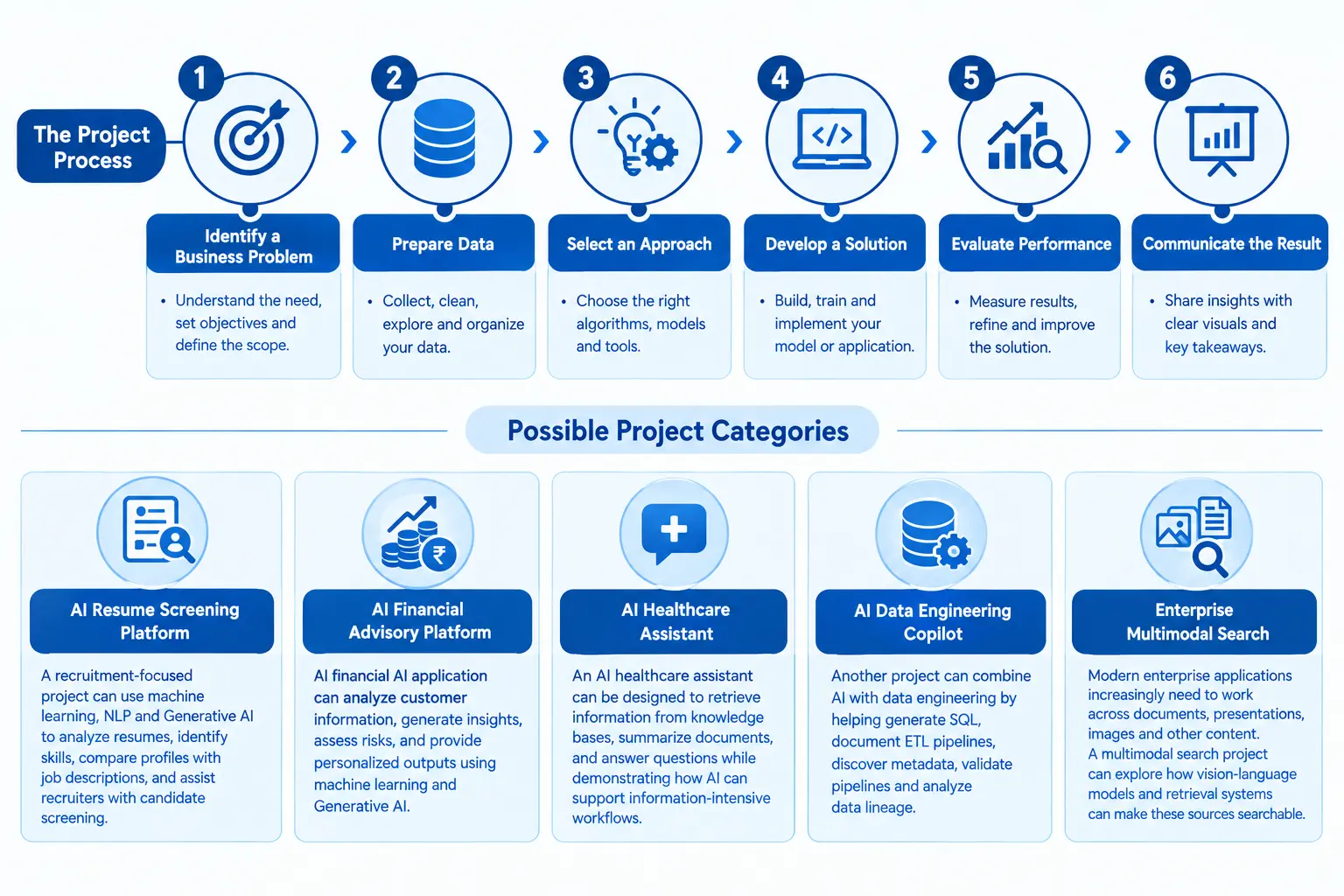
A project should demonstrate how you identify a business problem, prepare data, select an approach, develop a solution, evaluate its performance, and communicate the result.
Possible project categories include:
AI Resume Screening Platform
A recruitment-focused project can use machine learning, NLP, and Generative AI to analyze resumes, identify skills, compare profiles with job descriptions, and assist recruiters with candidate screening.
AI Financial Advisory Platform
A financial AI application can analyze customer information, generate insights, assess risks, and provide personalized outputs using machine learning and Generative AI.
AI Healthcare Assistant
An AI healthcare assistant can be designed to retrieve information from knowledge bases, summarize documents, and answer questions while demonstrating how AI can support information-intensive workflows.
AI Data Engineering Copilot
Another project can combine AI with data engineering by helping generate SQL, document ETL pipelines, discover metadata, validate pipelines, and analyze data lineage.
Enterprise Multimodal Search
Modern enterprise applications increasingly need to work across documents, presentations, images, and other content. A multimodal search project can explore how vision-language models and retrieval systems can make these sources searchable.
These projects are useful because they demonstrate application-level thinking rather than isolated knowledge of algorithms.
How to Evaluate the Best Artificial Intelligence Institute in Pune
When comparing training providers, learners should look beyond promotional claims.
A practical evaluation can include:
- Curriculum depth
- Technical coverage
- Instructor experience
- Hands-on implementation
- Number and quality of projects
- Git and portfolio practices
- AI deployment exposure
- Interview preparation
- Mock interviews
- Career mentorship
- Learning support
A strong Artificial Intelligence Training in Pune should ideally help learners understand not only how a technology works but also where it fits into an end-to-end solution.
IntelliBI's program documentation emphasizes hands-on projects, real-world case studies, technology-specific interview preparation, scenario-based challenges, system design discussions, mock technical interviews, resume and LinkedIn preparation, GitHub portfolio guidance, and placement assistance.
Artificial Intelligence Classes in Pune for Working Professionals
Working professionals often face a different challenge from full-time learners: they need to balance professional responsibilities with technical upskilling.
AI Classes in Pune for Working Professionals should therefore provide a structured progression rather than overwhelming learners with too many technologies simultaneously.
A practical approach is to divide learning into stages:
Stage 1: Python and SQL foundations
Stage 2: Data analysis and statistics
Stage 3: Machine learning
Stage 4: Deep learning and NLP
Stage 5: Generative AI and LLM applications
Stage 6: Agentic AI and enterprise applications
Stage 7: Deployment, portfolio, and interview preparation
This structure allows professionals to measure progress and connect each stage with practical projects.
From Certification to Career: What Comes Next?
Completing an Artificial Intelligence Certification Course in Pune should be considered a milestone rather than the final destination.
The next step is to build a professional profile around demonstrated skills.
A career portfolio can include:
- GitHub repositories
- Project documentation
- Technical case studies
- AI application demonstrations
- Model evaluation reports
- Deployment examples
- Technical articles
- LinkedIn project summaries
Candidates should also prepare to explain their projects during interviews. Knowing the technology is important, but being able to explain the problem, architecture, implementation decisions, challenges, evaluation process, and business value is equally important.
Potential Career Paths After AI Training
AI is a broad field, so learners can move toward different roles depending on their strengths.
Potential career directions include:
AI Engineer: Develops and integrates AI models and applications into software systems.
Machine Learning Engineer: Builds, evaluates, and deploys machine learning solutions.
Data Scientist: Uses statistical analysis and machine learning to solve data-driven problems.
Generative AI Engineer: Builds applications using LLMs, RAG, embeddings, tool calling, and related technologies.
Agentic AI Engineer: Develops AI agents and multi-step workflows that interact with tools and enterprise systems.
AI Architect: Focuses on designing scalable AI systems, integrations, governance, security, and deployment architecture.
IntelliBI's program identifies outcomes aligned with roles such as AI Engineer, Agentic AI Engineer, AI Architect, Data Scientist, and Enterprise AI Consultant, with an emphasis on practical implementation, production deployment, enterprise architecture, and business problem solving.
Is an AI Certification Enough to Get a Job?
A certification can demonstrate structured learning, but it should not be viewed as a substitute for practical capability.
Recruiters and technical interviewers may evaluate programming knowledge, problem-solving, machine learning concepts, AI architecture, project experience, communication, and the ability to explain technical decisions.
That is why a strong career path combines:
Learning + Projects + Portfolio + Certification + Interview Preparation
This combination gives candidates multiple ways to demonstrate their capabilities.
The objective of an AI-focused learning program should therefore be broader than examination preparation. It should help learners move from understanding concepts to building and discussing real solutions.
Building a Career Path With IntelliBI
For learners exploring an AI Course Pune option, a structured project-based approach can help connect foundational learning with advanced AI engineering.
IntelliBI's AI engineering program is designed around SQL and Python foundations and progresses into Generative AI, Agentic AI, and Machine Learning, with hands-on and project-driven modules.
The career-readiness component also extends beyond technical lessons. Interview preparation includes technology-specific question banks, coding challenges, system design, real-world case discussions, mock interviews, aptitude preparation, and HR preparation.
For candidates considering an AI Engineer Course in Pune, this broader approach can help connect technical learning with portfolio development and interview readiness.
Conclusion
Artificial intelligence is a broad and rapidly developing field, and successful learning requires more than completing isolated tutorials or collecting certificates. A structured Artificial Intelligence Course in Pune should take learners from programming and data foundations through machine learning, deep learning, Generative AI, Agentic AI, application development, and practical projects.
The right curriculum should also help learners understand how AI solutions are designed, evaluated, deployed, and communicated in professional environments.
For career changers and working professionals, the journey can be approached step by step: build strong foundations, practice consistently, develop meaningful projects, create a visible portfolio, prepare for technical interviews, and use certification as a way to validate structured learning.
An Artificial Intelligence Certification Course in Pune can become a valuable part of that journey when it is supported by practical skills and real project experience. With the right combination of technical depth, hands-on development, and career preparation, learners can build a foundation for progressing toward modern AI engineering and related technology roles.