
AI Engineer Course in Pune: Learn Python, ML, GenAI, LLMs & AI Agents
Quick Answer
An AI Engineer Course in Pune typically covers Python, machine learning, deep learning, Generative AI, LLMs, RAG, AI agents, APIs, projects, and deployment concepts. A practical program should help learners progress from programming fundamentals to building real-world AI applications. Students, freshers, developers, analysts, and working professionals can use these skills to prepare for AI-focused career opportunities.
AI Engineer Course in Pune: Learn Python, ML, GenAI, LLMs & AI Agents
Artificial Intelligence is becoming an important part of modern technology. Businesses use AI for automation, predictive analytics, customer support, document processing, recommendations, and decision-making.
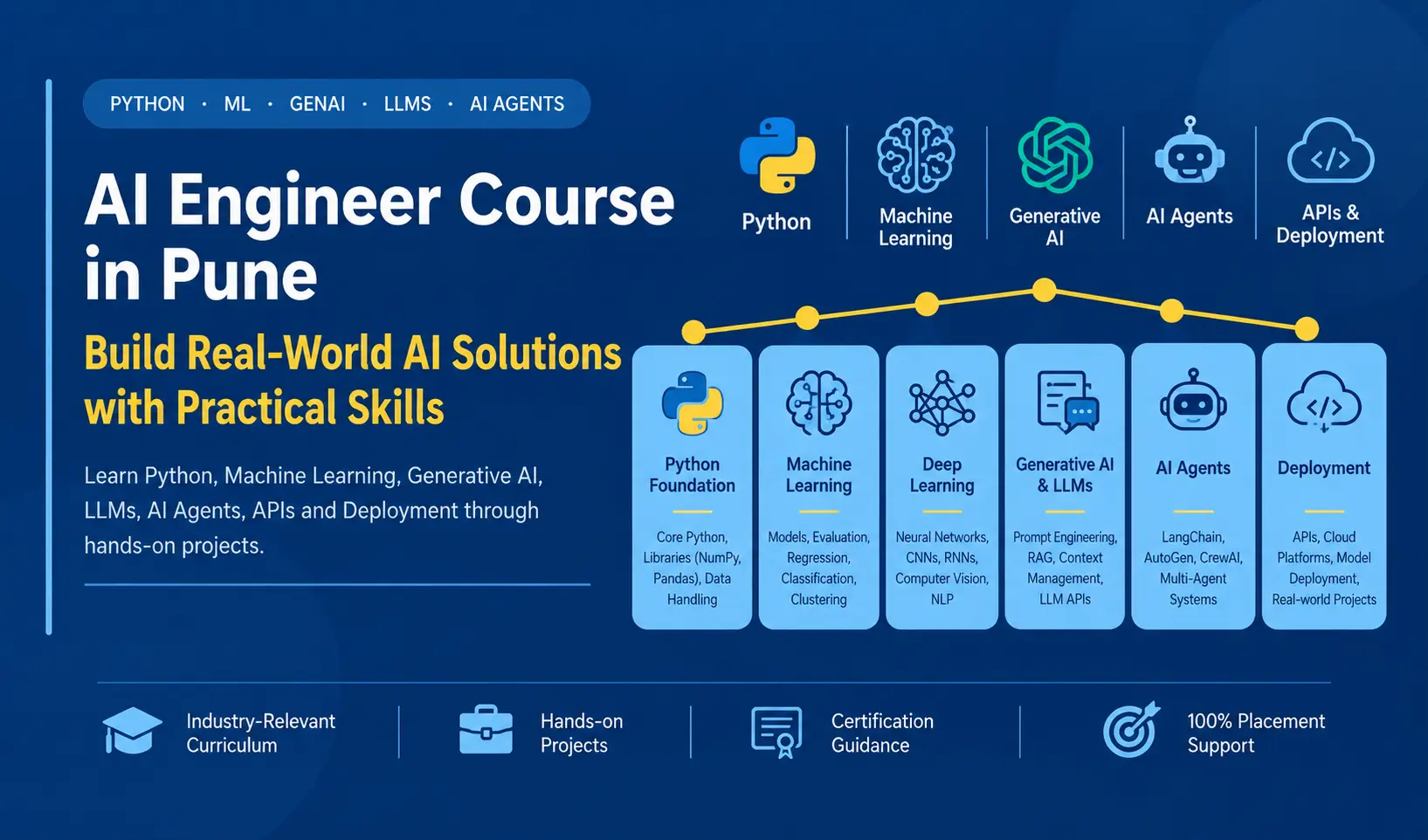
This growth is creating demand for professionals who can build and deploy practical AI solutions. Learning only AI theory, however, is not enough. Modern AI engineering combines Python, machine learning, Generative AI, Large Language Models (LLMs), AI agents, APIs, and deployment.
An AI Engineer Course in Pune can give learners a structured path to develop these skills. The focus should be on understanding concepts and applying them through practical projects.
What Does an AI Engineer Do?
An AI Engineer builds software solutions that use artificial intelligence and machine learning. Their work can involve data, text, images, language models, recommendation systems, and AI-powered workflows.
Common responsibilities include:
- Preparing data for AI applications
- Developing machine learning models
- Building Generative AI applications
- Working with LLM APIs
- Creating RAG applications
- Developing AI assistants and chatbots
- Building AI agents
- Testing AI application performance
- Connecting AI with existing software
- Deploying AI applications
AI engineering is therefore a broad field. Python is an important foundation, but professionals also need knowledge of machine learning, data handling, APIs, software development, and modern AI systems.
Why Learn Artificial Intelligence in Pune?
Pune has a strong technology and education ecosystem. Learners come from different backgrounds, including software development, data analytics, testing, cloud computing, and other technical fields.
For beginners, a structured Artificial Intelligence Course in Pune can make the learning process easier. Instead of studying unrelated tools, learners can follow a clear path from programming fundamentals to machine learning and modern AI applications.
The goal should be practical. Learners should be able to understand a business problem, select a suitable AI approach, build a solution, test it, and explain the results.
Start with Python for AI Engineering
Python is widely used in AI and machine learning. Its libraries support data preparation, model development, automation, and application development.
A good Artificial Intelligence Training in Pune program should provide enough Python practice before introducing advanced AI concepts.
Important Python topics include:
- Variables and data types
- Conditions and loops
- Functions
- Lists, dictionaries, tuples, and sets
- Object-oriented programming
- Exception handling
- File handling
- Modules and packages
- Virtual environments
- API integration
Learners can then work with libraries such as NumPy and Pandas.
The aim is not to become a Python specialist first. Instead, learners should be able to use Python confidently to solve AI and data problems.
Learn Machine Learning Step by Step
Machine learning is a core part of AI engineering. It allows systems to identify patterns in data and use them to make predictions.
An AI and Machine Learning Course in Pune should cover the full machine learning process.
A typical workflow includes:
- Define the problem
- Collect data
- Clean the data
- Explore the data
- Select useful features
- Choose a model
- Train the model
- Evaluate the results
- Improve the model
- Deploy the solution
Learners may study regression, classification, decision trees, random forests, clustering, and other common techniques.
Model evaluation is also important. Depending on the problem, professionals may use measures such as precision, recall, F1-score, ROC-AUC, or mean absolute error.
Understand Deep Learning Fundamentals
Deep learning uses neural networks to identify complex patterns in large datasets.
Important topics include:
- Neural networks
- Layers and neurons
- Activation functions
- Loss functions
- Optimizers
- Training and validation
- Overfitting
- Regularization
- Convolutional neural networks
- Sequence-based models
These concepts support applications in computer vision, natural language processing, speech systems, and Generative AI.
Understanding these foundations also helps learners understand modern AI systems instead of treating them as black boxes.
Move from Machine Learning to Generative AI
Generative AI has expanded the scope of AI engineering. These systems can generate text, code, summaries, responses, and other forms of content.
An AI Course in Pune that includes Generative AI can help learners understand how these applications are designed.
Key areas include:
- Generative AI fundamentals
- Prompt engineering
- Context management
- Embeddings
- Vector databases
- RAG
- LLM APIs
- AI application frameworks
- Response evaluation
- AI guardrails
The focus should be on application development. Learners should understand how to turn a business requirement into a useful AI solution.
Learn How Large Language Models Work
Large Language Models are used in many Generative AI applications.
An LLM processes language-based inputs and generates responses based on learned patterns and the context provided to it.
AI Engineers should understand concepts such as:
- Tokens
- Context windows
- Embeddings
- Inference
- Prompting
- Temperature
- Model selection
- Structured outputs
- LLM APIs
These concepts can be applied to document assistants, customer support tools, coding assistants, and knowledge systems.
Build RAG Applications
Retrieval-Augmented Generation, or RAG, connects an LLM with external information.
A simple RAG workflow looks like this:
Documents → Text Processing → Embeddings → Vector Database → Retrieval → LLM → Response
For example, a company could create an assistant that answers questions using internal policies, product documents, or technical manuals.
RAG is useful because it allows AI applications to work with information specific to an organization.
Understand AI Agents and Workflows
AI agents take AI applications beyond simple question-and-answer systems.
An agent can be designed to select tools, retrieve information, perform actions, and complete multiple steps.
A basic workflow can look like this:
User Request → Planning → Tool Selection → Action → Observation → Next Step → Response
For example, an AI agent could retrieve information from a knowledge base, access an API, process the result, and prepare a response.
Learners should understand tools, memory, workflows, function calling, retrieval, orchestration, and agent evaluation.
Who Can Learn AI Engineering?
AI engineering can suit learners from different backgrounds.
Freshers
Graduates from computer science, information technology, engineering, mathematics, statistics, and related fields can build a foundation in Python, machine learning, Generative AI, and project development.
Software Developers
Developers can combine their existing programming skills with LLM APIs, RAG, machine learning, and AI agents.
Data Analysts
Data analysts can expand their existing data skills into machine learning and AI application development.
Working Professionals
AI Classes in Pune for Working Professionals can provide a structured way to learn while continuing an existing career.
Career Switchers
Professionals with technical or analytical experience can use projects to demonstrate their move toward AI-focused roles.
What AI Projects Should You Build?
Practical projects help learners apply concepts.
AI Resume Screening System
Build an application that extracts information from resumes and organizes candidate details.
Intelligent Document Assistant
Create a RAG application that answers questions from uploaded documents.
Customer Support AI Assistant
Build an LLM-based assistant that responds using a business knowledge base.
Recommendation System
Develop a machine learning application that recommends relevant products, content, or services.
AI Agent for Business Workflows
Create an agent that uses tools, retrieves information, and completes multiple steps.
Each project should explain the problem, architecture, technologies, implementation, testing, and limitations.
Certification and Practical Skills
An Artificial Intelligence Certification Course in Pune can provide a structured learning milestone. However, certification works best when combined with practical skills.
Learners should develop:
- Relevant technical knowledge
- Hands-on projects
- Portfolio work
- Technical documentation
- Problem-solving skills
- Interview preparation
A project portfolio can help demonstrate what a learner can actually build.
Career Opportunities in AI
AI skills can support different technology roles, depending on experience and specialization.
Potential roles include:
- AI Engineer
- Machine Learning Engineer
- Generative AI Developer
- LLM Application Developer
- AI Application Developer
- Machine Learning Developer
- NLP Engineer
- AI Solutions Developer
- Junior Data Scientist
- AI Automation Developer
The right role depends on a learner's background, technical skills, project experience, and career goals.
How to Choose an AI Learning Program
When comparing an AI Course Pune option, look beyond the course name.
Consider whether the program covers:
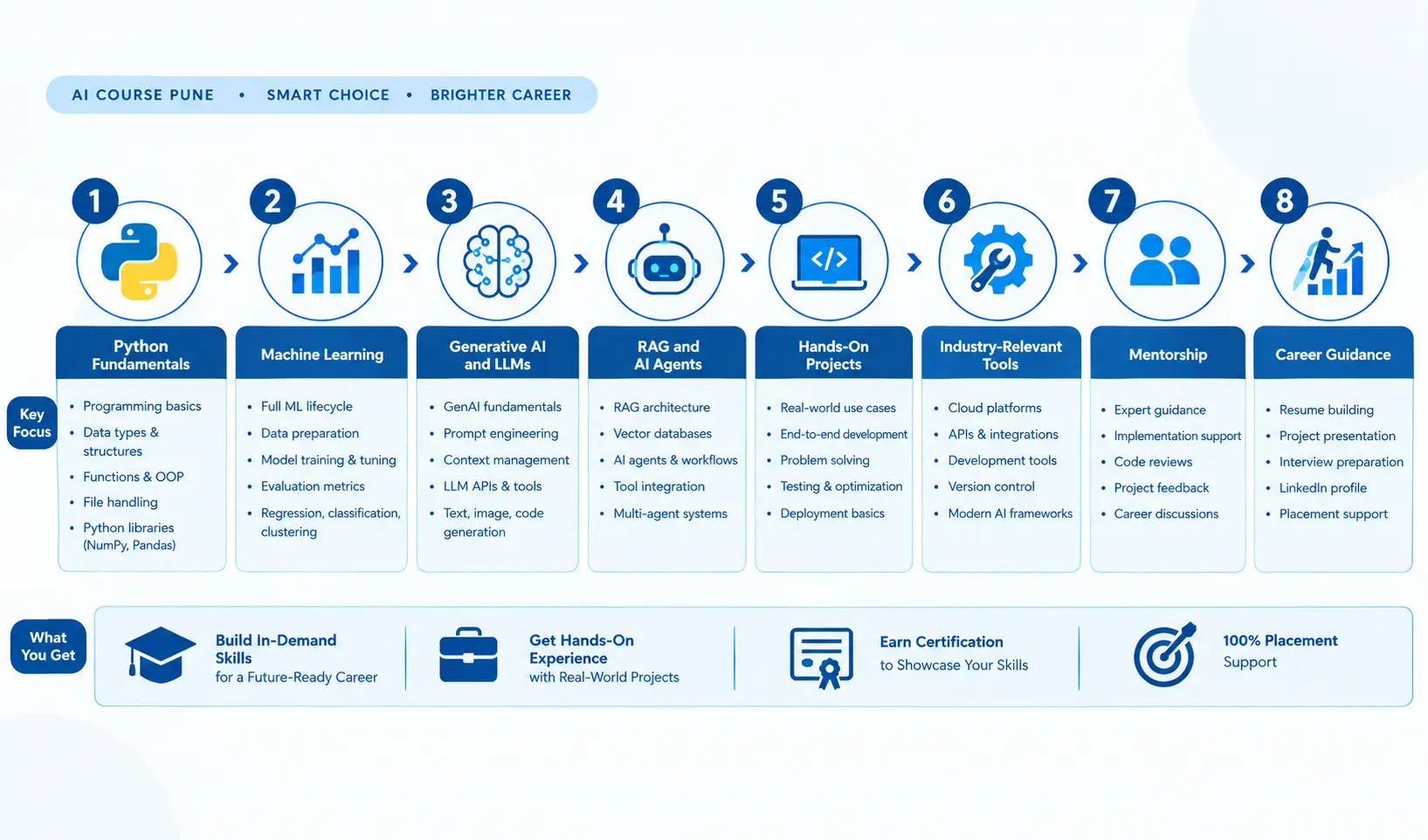
Python: Is there enough programming practice?
Machine Learning: Does the curriculum explain the complete ML workflow?
Generative AI: Does it cover modern LLM-based applications?
RAG and AI Agents: Are learners exposed to current AI application patterns?
Projects: Can learners build practical applications?
Tools: Does the program introduce relevant development tools?
Mentorship: Is guidance available during projects?
Career Preparation: Does the program include resume and interview preparation?
These factors can help learners understand what they will actually gain from a training program.
Building Practical AI Skills at IntelliBI
IntelliBI Innovations Technologies focuses on connecting technical learning with practical implementation.
The Artificial Intelligence Course in Pune covers areas that form part of the modern AI learning journey, including Python, machine learning, Generative AI, LLM concepts, and AI application development.
Learners should focus on understanding how these technologies work together. Building projects and explaining technical decisions can be just as important as completing individual modules.
For professionals, this approach can also help connect new AI skills with existing technical experience.
Build Skills, Not Just a Certificate
AI engineering is a combination of several skills.
Python provides the programming foundation. Machine learning teaches systems to learn from data. Deep learning introduces neural networks. Generative AI enables new types of applications. LLMs support language-based solutions. RAG connects these systems with external knowledge, while AI agents enable multi-step workflows.
Learning these areas together creates a stronger foundation for modern AI development.
For students, freshers, working professionals, and career switchers exploring Artificial Intelligence Classes in Pune, the goal should be practical capability. Being able to build, test, explain, and improve an AI solution is more useful than simply knowing technical terms.
Conclusion
An AI Engineer Course in Pune can provide a structured starting point for learners who want to build careers in modern artificial intelligence.
The learning journey can begin with Python, move into machine learning and deep learning, and then progress toward Generative AI, LLMs, RAG, and AI agents. Practical projects can help connect these concepts to real business applications.
AI engineering continues to evolve, so learning should not stop with a certificate. Building projects, improving technical skills, understanding new AI architectures, and staying curious can help professionals develop a stronger foundation for long-term growth in the AI field.