
AI Course in Pune with Placement: Practical Training for Students & Working Professionals
Quick Answer
An AI Course in Pune with Placement can provide structured training in Python, machine learning, deep learning, Generative AI, LLMs, RAG, AI agents, and practical projects. Students can build foundational skills and portfolios, while working professionals can combine AI with existing expertise in software, data, analytics, or cloud technologies. When selecting a program, consider curriculum depth, projects, mentoring, certification, and career support.
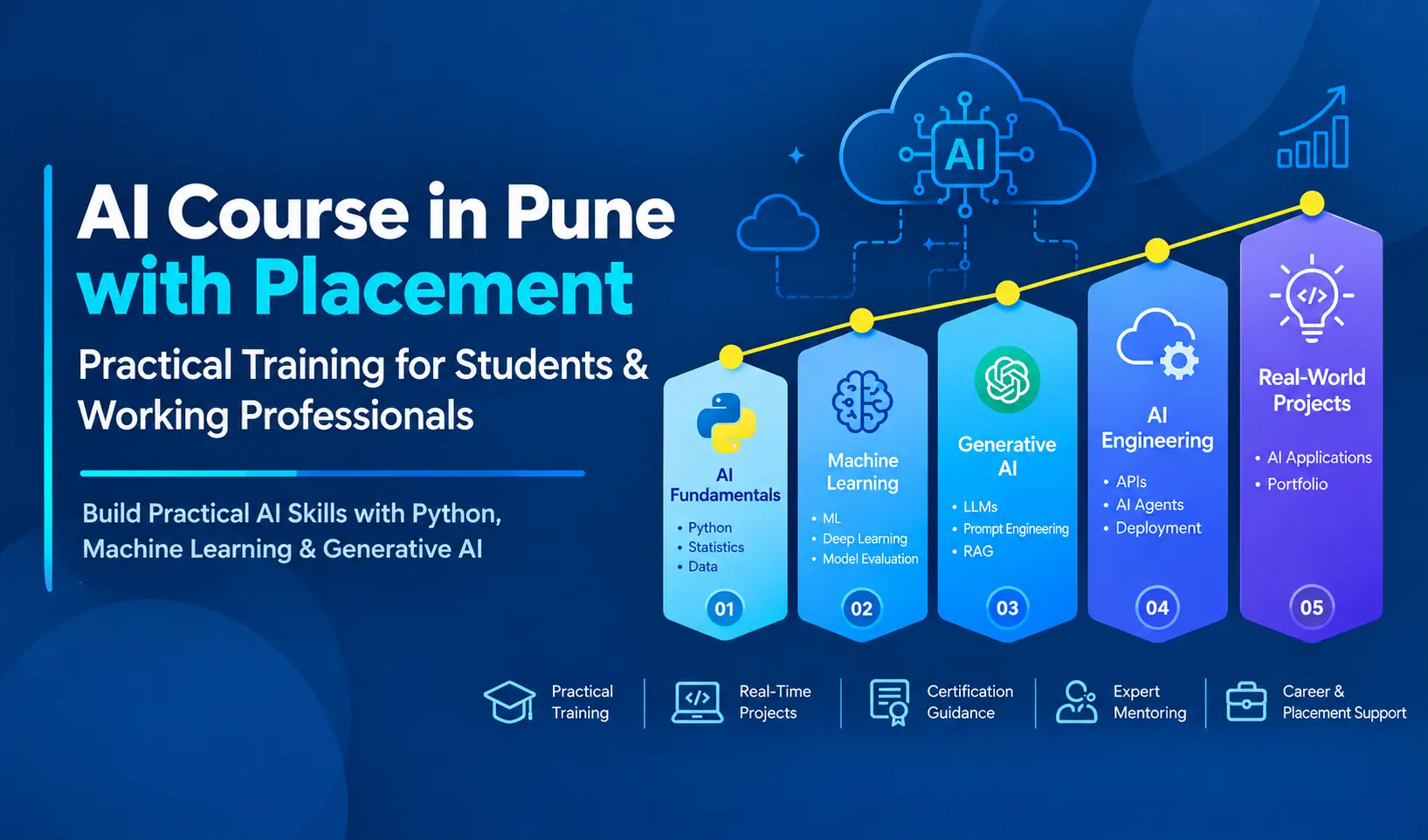
AI Course in Pune with Placement: Practical Training for Students & Working Professionals
Artificial Intelligence is no longer limited to research laboratories or highly specialized technology teams. It is becoming part of software development, data analytics, customer service, automation, cybersecurity, finance, healthcare, marketing, and many other business functions. As AI adoption expands, students and working professionals are increasingly looking for structured ways to develop practical skills and prepare for AI-focused careers.
An AI Course in Pune with Placement can provide a structured learning path for individuals who want to understand artificial intelligence through programming, machine learning, Generative AI, projects, and real-world applications. However, choosing the right program requires looking beyond course names and placement claims. The quality of curriculum, hands-on training, project exposure, mentoring, and career preparation all matter.
For students, AI education can establish a foundation for entering technology careers. For working professionals, it can provide a pathway to add AI capabilities to an existing technical or analytical background.
Why Learn Artificial Intelligence Today?
Artificial intelligence combines computer science, mathematics, data, programming, and problem-solving to develop systems capable of performing tasks that traditionally require human intelligence.
Modern AI applications include recommendation systems, fraud detection, virtual assistants, document processing, predictive analytics, image recognition, natural language processing, and intelligent automation.
The emergence of Generative AI has expanded this landscape further. Large Language Models can generate text, summarize documents, assist with coding, retrieve information, and support business workflows. More advanced systems can combine language models with tools, databases, APIs, and autonomous workflows.
This means today's AI professionals need more than theoretical knowledge. They need to understand how AI systems are designed, developed, tested, deployed, and applied to practical business problems.
What Does an AI Course in Pune Typically Cover?
A structured Artificial Intelligence Course in Pune should ideally progress from fundamentals to practical implementation.
The learning journey can include:
- Python programming
- Mathematics and statistics for AI
- Data preparation and analysis
- Machine learning
- Deep learning
- Natural language processing
- Computer vision
- Generative AI
- Large Language Models
- Prompt engineering
- Retrieval-Augmented Generation
- AI agents
- Model evaluation
- APIs and deployment
- Cloud technologies
- AI projects
The exact curriculum differs between programs, so learners should examine the depth of practical training rather than relying only on the number of technologies listed.
A good learning sequence is more valuable than simply collecting tools. Students should understand why a particular technique is used, what problem it solves, and what limitations it has.
Advanced Artificial Intelligence Course: Moving Beyond the Basics
An Advanced Artificial Intelligence Course should take learners beyond introductory concepts and expose them to modern AI application development.
Advanced learning may include neural networks, transformer architectures, Generative AI, LLM applications, RAG pipelines, vector databases, agentic workflows, model evaluation, and deployment concepts.
For example, a beginner may learn how a classification model predicts whether a transaction belongs to a particular category. At an advanced level, the learner may build an AI application that retrieves relevant information, processes user input, calls external tools, and generates a contextual response.
This progression is important because professional AI development involves combining multiple technologies rather than working with isolated algorithms.
AI Course Pune: What Should Students Learn?
Students entering AI education should first develop strong fundamentals.
Python is particularly useful because it provides access to extensive libraries for data processing, machine learning, deep learning, and AI application development. SQL is also valuable because many AI applications depend on structured business data.
Students should then understand basic statistics, probability, data preprocessing, supervised learning, unsupervised learning, model evaluation, and feature engineering.
Once these fundamentals are established, they can move toward deep learning, Generative AI, and advanced application development.
A project-based AI Course Pune pathway can help students connect classroom concepts with practical implementation.
Practical Training Matters More Than Memorization
Artificial intelligence is an implementation-oriented field. Knowing the definition of an algorithm is different from knowing how to use it to solve a business problem.
Consider a learner who understands the theory of regression but has never worked with an imperfect dataset. Real projects introduce challenges such as missing values, inconsistent formats, outliers, incorrect labels, data leakage, and changing business requirements.
Practical training helps learners experience these challenges.
Projects can include:
- Customer churn prediction
- Sales forecasting
- Fraud detection
- Recommendation systems
- Document classification
- Sentiment analysis
- Image classification
- Resume screening
- Question-answering systems
- RAG-based knowledge assistants
- AI-powered analytics applications
Each project can demonstrate a different stage of the AI development lifecycle.
Artificial Intelligence Classes in Pune: What Makes Them Useful?
Artificial Intelligence Classes in Pune can be useful when they provide an environment where learners can ask questions, work through implementation challenges, and receive feedback.
Classroom learning should ideally combine instructor explanations with demonstrations, coding exercises, assignments, project reviews, and technical discussions.
For beginners, instructor support can be particularly useful when learning concepts such as model evaluation or neural networks. For experienced professionals, discussions can focus more heavily on architecture, deployment, scalability, and business applications.
The objective should be to develop independent problem-solving ability rather than dependency on step-by-step instructions.
Artificial Intelligence Training in Pune for Career Development
Artificial Intelligence Training in Pune can support different career paths depending on a learner's existing skills.
A fresher may begin with programming, data, machine learning, and project development.
A software developer may focus on integrating AI models into applications.
A data analyst may explore predictive analytics, Generative AI, and intelligent reporting.
A data engineer may move toward AI data pipelines, feature stores, model-serving infrastructure, or LLM data workflows.
A cloud professional may explore AI deployment and scalable infrastructure.
This makes AI a broad career domain rather than a single job category.
AI and Machine Learning Course in Pune: Understanding the Connection
Artificial intelligence and machine learning are closely related, but they are not identical.
Artificial intelligence is the broader field concerned with creating systems capable of performing tasks associated with intelligent behavior.
Machine learning is a major approach within AI in which systems learn patterns from data instead of relying entirely on manually programmed rules.
Deep learning is a subset of machine learning that uses neural networks with multiple layers.
Generative AI represents another important area that focuses on creating new content such as text, images, audio, video, and code.
An AI and Machine Learning Course in Pune can therefore provide learners with a broader understanding of how these technologies relate to one another.
Learning Generative AI and Large Language Models
Modern AI education increasingly includes Generative AI because of its growing use in business applications.
Learners can explore how Large Language Models process language, how prompts influence outputs, and how applications can connect models with external knowledge.
Important concepts include:
- Prompt engineering
- Embeddings
- Vector databases
- Chunking
- Semantic search
- RAG
- Tool calling
- LLM APIs
- AI agents
- Model evaluation
- Guardrails
A practical project might involve creating an internal company knowledge assistant. Documents can be processed, converted into embeddings, stored in a vector database, retrieved based on a user's question, and supplied to an LLM for contextual response generation.
Such projects demonstrate application-building skills beyond basic chatbot usage.
AI Classes in Pune for Working Professionals
Working professionals often approach AI education differently from fresh graduates. They may already have experience in software development, testing, data analytics, cloud computing, business intelligence, or infrastructure.
AI Classes in Pune for Working Professionals should therefore help learners connect their existing expertise with new AI capabilities.
For example:
A Power BI professional could explore AI-assisted analytics.
A Python developer could transition toward LLM application development.
A data engineer could work on RAG pipelines and AI data infrastructure.
A cloud engineer could specialize in deploying AI workloads.
A business analyst could explore intelligent automation and AI-powered decision support.
This approach can make learning more relevant because professionals can build on skills they already possess.
Why Projects Matter for an AI Career
A project portfolio gives learners an opportunity to demonstrate how they apply technical concepts.
A useful AI project should explain:
- What problem was being solved?
- What data was used?
- How was the data prepared?
- Which model or AI technique was selected?
- Why was that approach chosen?
- How was performance evaluated?
- How was the application deployed?
- What limitations remained?
For example, instead of simply listing "Machine Learning" on a resume, a candidate can explain how they developed a customer churn model, compared different algorithms, evaluated precision and recall, and created a practical prediction workflow.
For Generative AI projects, candidates can demonstrate document ingestion, retrieval, prompt design, evaluation, and application integration.
AI Engineer Course in Pune: Preparing for Technical Roles
An AI Engineer Course in Pune can be particularly relevant for learners interested in building and integrating AI applications.
AI engineering sits at the intersection of software engineering, machine learning, data, and application development.
Depending on the role, professionals may work with:
- Python
- Machine learning frameworks
- Deep learning
- LLM APIs
- RAG
- Vector databases
- AI agents
- REST APIs
- Docker
- Cloud platforms
- Model monitoring
- Application deployment
The role is not limited to training machine learning models. AI engineers may also integrate existing models into production applications and create reliable workflows around them.
Certification: Useful, but Not the Whole Career Strategy
An Artificial Intelligence Certification Course in Pune can help learners follow a structured curriculum and demonstrate exposure to specific concepts.
However, certification should be considered alongside practical capability.
A certificate can indicate that a learner completed a learning program, but a portfolio can demonstrate how the learner applies that knowledge.
A balanced career preparation strategy can therefore include:
Learning → Practice → Projects → Certification → Portfolio → Interview Preparation
Technical interviews may involve programming, machine learning concepts, SQL, statistics, model evaluation, system design, or AI application architecture depending on the role.
AI Course in Pune with Placement: What Should Learners Check?
Placement support can be an important consideration, especially for freshers and career switchers.
When evaluating an AI Course in Pune with Placement, learners should examine what "placement support" actually includes.
Consider asking about:
- Resume preparation
- Mock interviews
- Technical interview preparation
- Portfolio development
- Job-oriented projects
- Career counselling
- Interview scheduling
- Employer interaction
- Communication preparation
- Post-training guidance
It is also useful to distinguish placement assistance from guaranteed employment. Learners should review the actual terms and conditions of any placement-related claims before enrolling.
How to Evaluate the Best Artificial Intelligence Institute in Pune
Rather than choosing a program based only on promotional claims, learners can compare institutes using practical criteria.
The Best Artificial Intelligence Institute in Pune for one learner may not necessarily be the right fit for another. The appropriate choice depends on experience level, career objective, learning format, curriculum depth, and time availability.
Before enrolling, review:
Curriculum: Does it cover fundamentals and modern AI technologies?
Projects: Are learners building complete applications?
Trainers: Do instructors explain implementation and architecture?
Learning format: Are classroom, online, weekend, or hybrid options available?
Career support: Does the program provide interview and resume preparation?
Tools: Does the curriculum include technologies relevant to the target role?
Practice: Are assignments and coding exercises part of the learning process?
A transparent evaluation can help learners make a decision based on their actual career requirements.
Career Opportunities After AI Training
AI skills can support several career directions.
Potential roles include:
- AI Engineer
- Machine Learning Engineer
- Generative AI Developer
- AI Application Developer
- Data Scientist
- NLP Engineer
- Computer Vision Engineer
- AI Automation Engineer
- LLM Application Developer
- AI Solutions Engineer
The required skill set varies by role.
For example, a machine learning engineer may need stronger knowledge of algorithms, statistics, model training, and MLOps. An LLM application developer may focus more heavily on APIs, RAG, prompt engineering, vector databases, and application architecture.
Therefore, learners should select projects and technologies according to the role they want to pursue.
A Practical Learning Roadmap for Students
Students can follow a structured progression:
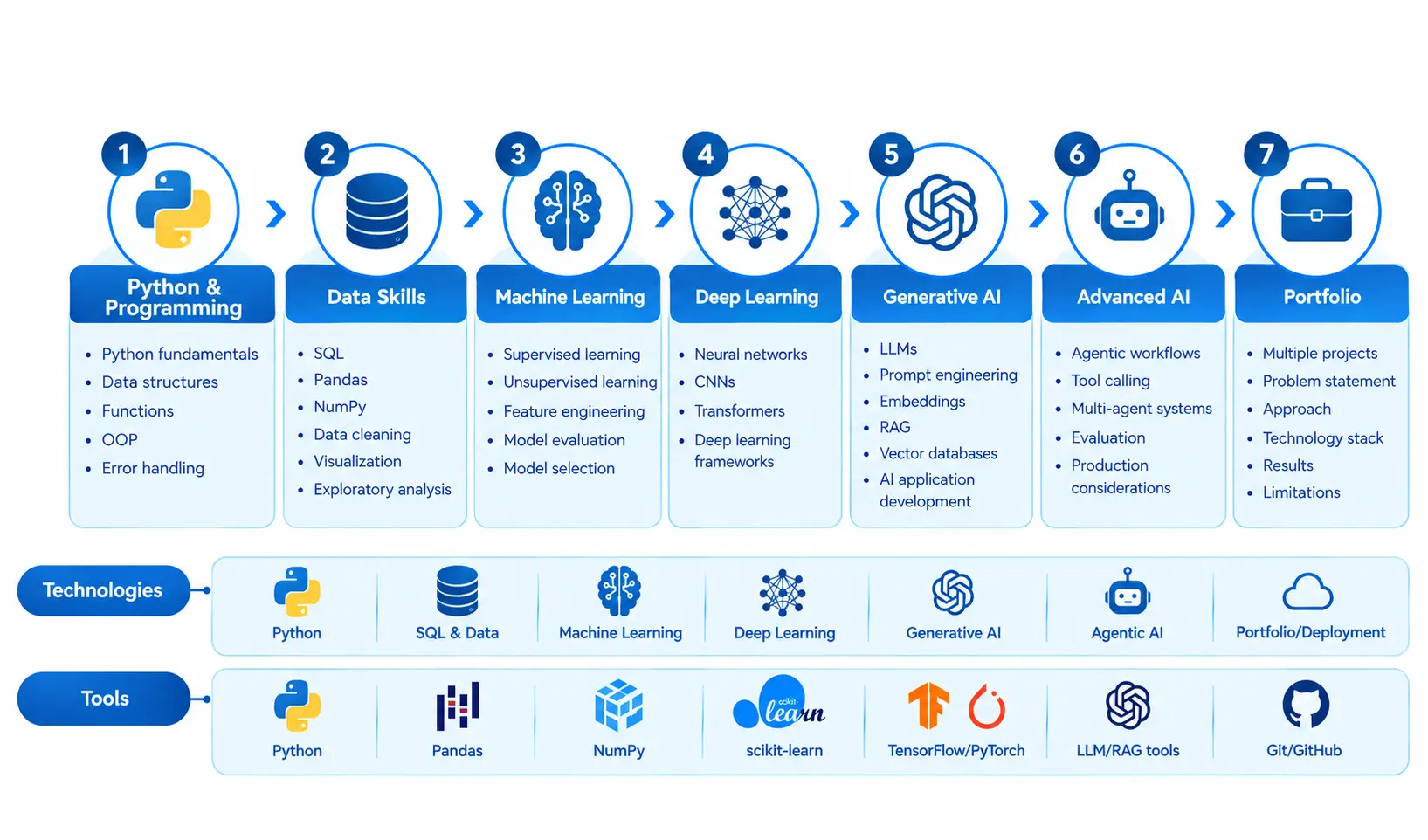
Stage 1: Programming
Learn Python, basic data structures, functions, object-oriented concepts, and error handling.
Stage 2: Data Skills
Learn SQL, Pandas, NumPy, data cleaning, visualization, and exploratory analysis.
Stage 3: Machine Learning
Study supervised learning, unsupervised learning, feature engineering, model evaluation, and model selection.
Stage 4: Deep Learning
Explore neural networks, CNNs, transformers, and deep learning frameworks.
Stage 5: Generative AI
Learn LLMs, prompt engineering, embeddings, RAG, vector databases, and AI application development.
Stage 6: Advanced AI
Explore agentic workflows, tool calling, multi-agent systems, evaluation, and production considerations.
Stage 7: Portfolio
Build multiple projects and document the problem, approach, technology stack, results, and limitations.
This approach creates a progression from fundamentals to professional application.
A Practical Roadmap for Working Professionals
Professionals can use a slightly different approach.
First, identify existing skills and choose an AI specialization that complements them.
A software developer could focus on AI application development.
A data analyst could move toward machine learning and Generative AI analytics.
A data engineer could explore AI data infrastructure and LLM pipelines.
A cloud professional could learn AI deployment and cloud architecture.
A working professional does not necessarily need to abandon their previous career path. AI skills can be layered onto existing technical expertise.
Conclusion
Artificial intelligence is creating new technical possibilities across software, data, analytics, automation, and business operations. For students, structured AI education can establish foundational knowledge and provide a pathway toward technology careers. For working professionals, AI can complement existing expertise and create opportunities to move into emerging technical roles.
An Artificial Intelligence Course in Pune should therefore be evaluated on more than its course title. Practical projects, programming, machine learning, Generative AI, modern tools, mentoring, portfolio development, and career preparation all contribute to a meaningful learning experience.
Whether the goal is to become an AI engineer, machine learning professional, Generative AI developer, or AI application specialist, the strongest foundation comes from combining concepts with consistent hands-on practice.
For learners comparing Artificial Intelligence Training in Pune, the key question is not simply how many technologies a program teaches. It is whether the learning journey helps transform those technologies into practical, demonstrable skills.