
AI Agents vs Chatbots: Key Differences, Architecture & Real-World Applications
Quick Answer
Chatbots are mainly designed to communicate with users, answer questions, and provide information. AI agents are designed to achieve goals by planning tasks, using tools, accessing information, and performing multiple steps within defined controls. Both can use LLMs, but agents generally have a broader architecture that may include memory, APIs, databases, tools, workflows, and monitoring.
AI Agents vs Chatbots: Key Differences, Architecture & Real-World Applications
Artificial Intelligence is changing how people interact with software. For years, chatbots have helped businesses answer customer questions, guide users, and automate simple conversations. Today, a new category of AI applications is gaining attention: AI agents.
Although AI agents and chatbots can both communicate through natural language, they are not the same. A chatbot may respond to a user's question based on its instructions and available information. An AI agent can go further by planning tasks, using tools, accessing information, making decisions within defined limits, and completing multiple steps toward a goal.
This difference is important for students and professionals preparing for modern AI careers.
An Artificial Intelligence Course in Pune can provide the foundation needed to understand machine learning, Generative AI, large language models, AI applications, and intelligent automation. As AI systems become more capable, learners also need to understand how conversational systems differ from systems designed to perform tasks.
At IntelliBI Innovations Technologies, our learning approach focuses on practical AI concepts, real-world applications, project work, and career-oriented skills. Understanding the architecture behind AI systems can help learners move beyond simply using AI tools and start thinking about how intelligent applications are designed.
What Is a Chatbot?
A chatbot is a software application designed to communicate with users through text, voice, or other interfaces.
Traditional chatbots often rely on predefined rules and conversation flows. Modern AI chatbots can use large language models to understand natural language and generate responses.
A chatbot may be designed to:
- Answer frequently asked questions
- Provide product information
- Guide customers through a process
- Help users find information
- Collect basic details
- Provide support
- Handle simple requests
For example, a customer may ask:
“What are your business hours?”
The chatbot can identify the question and provide the relevant answer.
Modern chatbots can be more flexible than older rule-based systems, but many are still primarily designed around conversation.
What Is an AI Agent?
An AI agent is an AI-powered system designed to pursue a specific goal by observing information, reasoning about possible actions, using tools, and completing one or more tasks.
Instead of only responding to a question, an agent may decide what steps are needed to achieve an objective.
For example, imagine a user asks:
“Find the best available flight for my trip, compare the options, and prepare the details for my approval.”
A basic chatbot might explain how to search for flights.
An AI agent could potentially:
- Understand the request.
- Identify the travel requirements.
- Search an approved flight system.
- Compare available options.
- Organize the results.
- Present the options to the user.
- Wait for approval before taking an action.
The exact capabilities depend on the tools, permissions, integrations, and controls provided to the agent.
AI Agents vs Chatbots: The Key Difference
The simplest distinction is this:
A chatbot is primarily conversation-oriented, while an AI agent is task-oriented.
A chatbot is often designed to answer or guide.
An agent is designed to work toward a goal.
However, the distinction is not always absolute. Some advanced chatbots can use tools, retrieve information, and perform actions. Likewise, an AI agent may communicate with users through a chatbot-style interface.
The architecture and level of autonomy matter more than the label.
AI Agents vs Chatbots: Key Differences
Feature
Chatbot
AI Agent
Primary purpose
Conversation
Goal completion
Interaction
User questions and responses
User goals and multi-step tasks
Planning
Usually limited
Can support multi-step planning
Tool use
May be limited
Often designed for tool use
Memory
May use conversation context
Can use short-term or persistent memory depending on design
Decision-making
Usually narrow
Can select actions within defined rules
Workflow
Often predefined or response-based
Can be dynamic
Autonomy
Usually lower
Can be higher, depending on controls
Example
Answering customer questions
Processing a support request across multiple systems
The important point is that AI agents are not simply “better chatbots.” They are designed around a different way of solving tasks.
How a Traditional Chatbot Architecture Works
A basic chatbot architecture may look like:
User → Chat Interface → Language Processing → Knowledge/Model → Response → User
For an AI-powered chatbot, the system may include a large language model.
A simplified workflow is:
- The user sends a message.
- The application processes the message.
- Relevant context may be retrieved.
- The model generates a response.
- The application displays the response.
The chatbot is primarily focused on producing an appropriate answer.
For example, a company support chatbot may answer questions about:
- Product features
- Pricing
- Policies
- Delivery
- Account procedures
- Frequently asked questions
How an AI Agent Architecture Works
An AI agent usually contains more components.
A simplified architecture can look like:
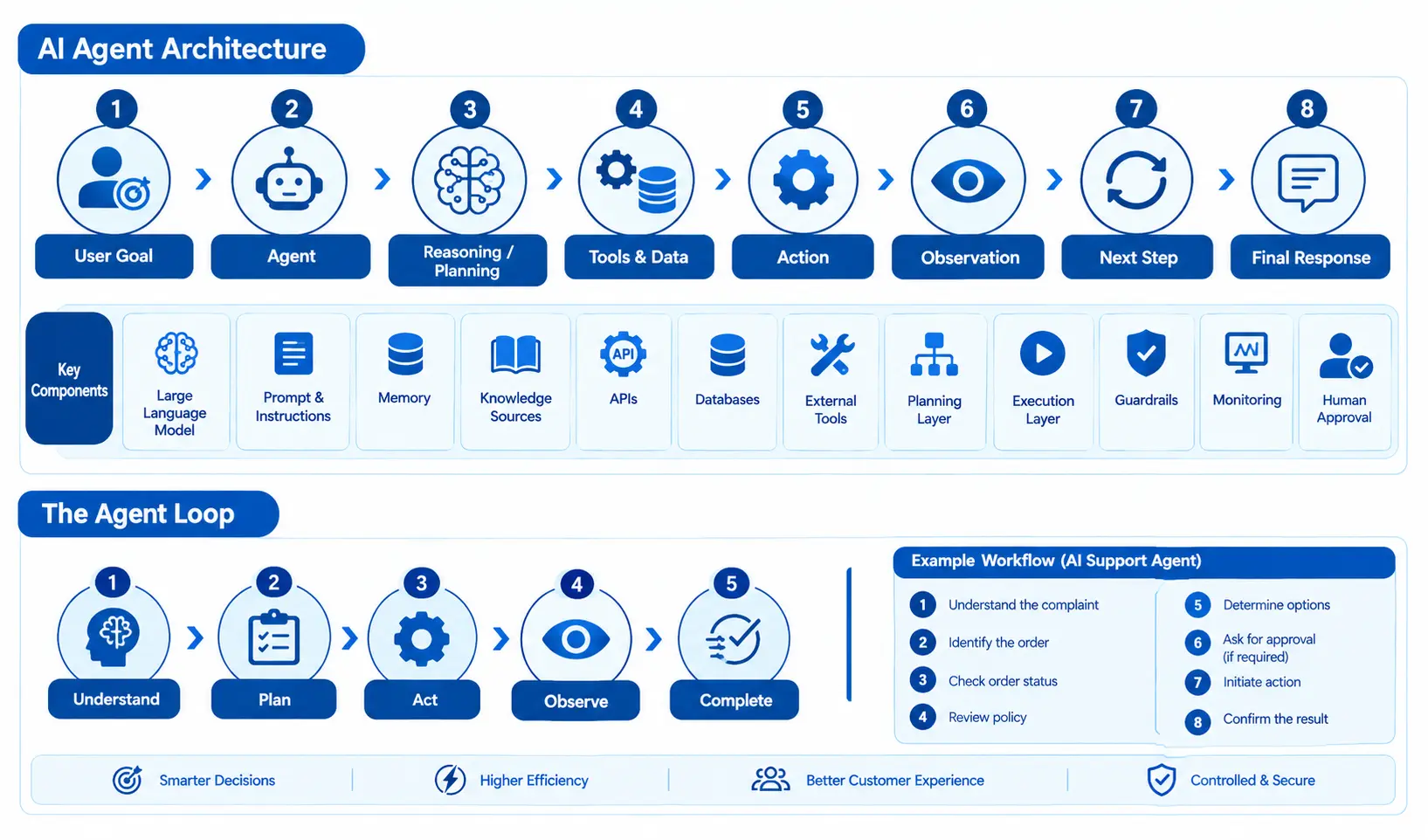
User Goal → Agent → Reasoning/Planning → Tools & Data → Action → Observation → Next Step → Final Response
Depending on the application, the architecture may include:
- Large language model
- Prompt and instructions
- Memory
- Knowledge sources
- APIs
- Databases
- External tools
- Planning layer
- Execution layer
- Guardrails
- Monitoring
- Human approval
The agent can use information from these components to decide what to do next.
The Agent Loop
One useful way to understand an AI agent is through an action loop.
Understand → Plan → Act → Observe → Adjust → Complete
For example, an AI support agent may receive a complaint about an order.
It could:
- Understand the complaint.
- Identify the customer's order.
- Check the order status.
- Review the relevant policy.
- Determine available options.
- Ask for approval if required.
- Initiate an approved action.
- Confirm the result.
The exact workflow should be controlled by business rules and system permissions.
Role of Large Language Models in AI Agents
Large language models are often used as the reasoning or language layer in modern AI agents.
An LLM can help interpret:
- User requests
- Context
- Available information
- Tool descriptions
- Intermediate results
The model can then help determine the next appropriate step.
However, an LLM alone is not necessarily an agent.
An AI agent generally requires additional components that allow it to interact with systems and complete tasks.
This distinction is important for learners studying AI.
Tools and APIs in AI Agents
Tools are a major difference between simple conversational systems and task-oriented AI applications.
An agent can be connected to tools such as:
- Search systems
- Databases
- CRM platforms
- Payment systems
- Calendar applications
- Email systems
- Internal APIs
- Business applications
- Data analysis tools
For example, an AI assistant may understand that a user wants to schedule a meeting.
The LLM can interpret the request, while a calendar API can provide the actual availability and create the meeting after the required confirmation.
This combination creates a more capable system than a standalone conversational model.
Memory and Context in AI Agents
Memory can help an AI application maintain useful information across interactions.
There are different types of memory designs.
Short-Term Context
This refers to information available within the current conversation or task.
Long-Term Memory
Some systems may store selected information for future interactions, subject to privacy and business requirements.
External Knowledge
An AI application can also retrieve information from databases, documents, or knowledge bases.
The system design should determine what information is stored, for how long, and who can access it.
Real-World Applications of Chatbots
Chatbots continue to be useful for many business scenarios.
Customer Support
A chatbot can answer common questions and provide basic troubleshooting guidance.
Banking Assistance
A conversational system may help users understand account information, product details, or common banking procedures, subject to authentication and security controls.
E-Commerce
Chatbots can help customers find products and answer questions about orders.
Education
Educational chatbots can answer questions, explain concepts, and guide learners through learning resources.
HR Support
Internal chatbots can help employees find information about policies, benefits, and company processes.
These use cases work well when the required interaction is mainly informational.
Real-World Applications of AI Agents
AI agents can be useful when a task involves multiple steps.
Customer Service Automation
An agent can potentially retrieve customer information, check an order, review policies, and prepare a response.
Sales Assistance
An AI agent could help sales teams research accounts, summarize customer information, prepare meeting notes, and update approved systems.
IT Support
An agent may analyze an issue, search technical documentation, collect diagnostic information, and recommend or execute approved actions.
Business Research
An AI agent can retrieve information from approved sources, compare findings, and prepare structured summaries.
Data Analysis
An agent can potentially retrieve datasets, run approved analysis tools, create charts, and summarize findings.
The level of automation should match the risk of the task.
Artificial Intelligence Training in Pune: What Should You Learn?
Artificial Intelligence Training in Pune should cover both foundational AI knowledge and modern application development.
A practical learning path can include:
- Python
- Machine learning
- Deep learning fundamentals
- Generative AI
- Large language models
- Prompt engineering
- RAG
- Vector databases
- AI APIs
- AI agents
- Model evaluation
- Responsible AI
- AI application development
Learning these areas helps students understand how modern AI systems are built.
Artificial Intelligence Classes in Pune: From Concepts to Projects
Artificial Intelligence Classes in Pune can be more effective when learners move from theory to practical work.
A useful learning cycle is:
Learn → Practice → Build → Test → Improve
For example, learners could first understand how an LLM works.
They can then build a simple prompt-based application.
Next, they can connect the application to a knowledge source.
After that, they can add tools and create a task-based workflow.
Finally, they can test the application and evaluate its performance.
This progression provides a clearer understanding of how AI systems evolve from simple applications into more capable workflows.
AI Course Pune: Skills for Modern AI Careers
An AI Course Pune learning path should help students develop both technical and problem-solving skills.
Important areas include:
- Python programming
- Data handling
- Machine learning
- Neural networks
- Generative AI
- LLMs
- Prompt engineering
- RAG
- AI APIs
- Agentic workflows
- Cloud fundamentals
- AI application development
- Model evaluation
Students should also learn how to explain their projects.
Being able to describe the problem, architecture, tools, limitations, and results is valuable during technical interviews.
AI and Machine Learning Course in Pune: Why Learn Both?
AI agents are built on several technologies.
Machine learning provides the broader foundation for understanding how systems learn from data.
Generative AI introduces models that can create content and understand natural language.
AI agents add tools, workflows, memory, and task execution.
Therefore, an AI and Machine Learning Course in Pune can provide useful background for learners who want to understand both traditional AI and modern AI applications.
Instead of treating machine learning and Generative AI as completely separate subjects, learners can understand how they fit into the larger AI ecosystem.
AI Engineer Course in Pune: Career Skills
An AI Engineer Course in Pune can focus on the practical development of AI-powered applications.
An aspiring AI engineer may need skills in:
- Python
- APIs
- Machine learning
- LLMs
- Prompt engineering
- RAG
- Vector databases
- AI agents
- Cloud services
- Software development
- Testing
- Monitoring
AI engineering is not limited to model development.
It can also involve integrating models into reliable applications.
AI Course in Pune with Placement: What Should Learners Evaluate?
When evaluating an AI Course in Pune with Placement, learners should consider both technical training and career support.
Look for:
- Practical projects
- AI application development
- Interview preparation
- Resume guidance
- Portfolio development
- Mock interviews
- Technical assessments
- Career guidance
- Industry-oriented assignments
Placement support can be useful, but the learner's technical skills and project understanding remain important parts of career preparation.
Artificial Intelligence Certification Course in Pune
Certifications can help learners demonstrate structured learning, but certification should be supported by practical knowledge.
An Artificial Intelligence Certification Course in Pune can be useful when learners also gain experience with:
- Python
- Machine learning
- Generative AI
- LLMs
- RAG
- AI agents
- Real-world projects
A certificate can show that a learner completed a learning program. Projects can help demonstrate what the learner can actually build.
AI Classes in Pune for Working Professionals
Working professionals often need flexible learning options.
AI Classes in Pune for Working Professionals can be designed around practical concepts that connect directly to workplace tasks.
Professionals may use AI to:
- Automate repetitive workflows
- Summarize documents
- Analyze information
- Support customer service
- Generate reports
- Assist software development
- Search internal knowledge
- Improve business processes
Learning should focus on practical use rather than simply introducing a large number of tools.
How to Choose the Best Artificial Intelligence Institute in Pune
When comparing an AI training provider, learners should evaluate the complete learning experience.
Important factors include:
- Course syllabus
- Trainer expertise
- Practical sessions
- Project work
- AI tools and frameworks
- LLM coverage
- Agentic AI concepts
- Industry examples
- Interview preparation
- Career guidance
- Learning support
The goal should be to find a program that helps learners understand AI from fundamentals through practical implementation.
Project Ideas for AI Agents
Projects can help learners understand the difference between chatbots and agents.
AI Customer Support Agent
Build an application that retrieves customer information, searches a knowledge base, and prepares a response.
Research Assistant
Create an AI workflow that gathers information from approved sources and produces a structured summary.
Data Analysis Agent
Build an application that accepts a data-related question, uses approved analytical tools, and presents the results.
Meeting Assistant
Create a workflow that summarizes meeting information, extracts action items, and organizes them for review.
Document Processing Agent
Develop an AI application that reads approved documents, extracts information, and prepares structured outputs.
These projects can demonstrate skills in LLMs, APIs, RAG, tool use, and workflow design.
AI Agent Development Roadmap
Learners can follow a step-by-step roadmap.
Step 1: Learn Python
Build programming fundamentals.
Step 2: Understand Machine Learning
Learn how traditional AI systems process data and generate predictions.
Step 3: Learn Generative AI
Understand LLMs, tokens, context, embeddings, and model behavior.
Step 4: Learn Prompt Engineering
Practice writing clear instructions and evaluating model outputs.
Step 5: Learn RAG
Understand how AI systems can retrieve information from external sources.
Step 6: Learn Tool Integration
Connect AI applications with APIs, databases, and other approved tools.
Step 7: Build Agent Workflows
Create controlled multi-step workflows.
Step 8: Test and Evaluate
Check accuracy, reliability, security, cost, latency, and failure cases.
Step 9: Build a Portfolio
Create projects that demonstrate practical AI engineering skills.
Why Responsible AI Matters for Agents
AI agents can interact with real systems. This makes safety and control especially important.
An agent connected to a database, payment system, email account, or business application can potentially perform actions that have real consequences.
Therefore, developers should consider:
- User permissions
- Authentication
- Data privacy
- Tool restrictions
- Human approval
- Logging
- Monitoring
- Error handling
- Output validation
- Security testing
High-impact actions should generally include appropriate controls and, where needed, human review.
Why Learn AI at IntelliBI Innovations Technologies?
IntelliBI Innovations Technologies focuses on practical, career-oriented learning across Artificial Intelligence, Generative AI, machine learning, data, and analytics.
Our Artificial Intelligence Course in Pune is designed to help learners understand AI fundamentals and modern AI application development.
Learners exploring Artificial Intelligence Training in Pune can build knowledge across machine learning, Generative AI, LLMs, AI applications, and practical projects.
For professionals and students looking for an AI Engineer Course in Pune, project-based learning can help connect concepts such as Python, LLMs, RAG, APIs, and AI agents.
Conclusion
Chatbots and AI agents both have an important place in modern AI applications.
Chatbots are primarily designed for conversation and information exchange. AI agents are designed to work toward goals by combining language models with tools, data, workflows, and controlled actions.
The difference becomes clearer when we look at architecture.
A chatbot may follow a relatively simple path from user message to AI-generated response. An agent can involve planning, tool selection, execution, observation, and multiple steps before completing a task.
For aspiring AI professionals, this evolution creates new learning opportunities.
Developing skills in Python, machine learning, Generative AI, LLMs, prompt engineering, RAG, APIs, and agentic workflows can provide a strong foundation for modern AI application development.
At IntelliBI Innovations Technologies, we believe practical learning is essential for turning AI concepts into useful solutions. By combining strong fundamentals with hands-on projects and career-focused learning, students and professionals can prepare to work with the next generation of intelligent applications.