

Will Data Engineers Be Replaced by AI by 2030? What the jobs numbers tell us
Quick Answer
AI is unlikely to completely replace data engineers by 2030. While Artificial Intelligence can automate SQL generation, ETL development, documentation and troubleshooting, businesses still require engineers for data architecture, governance, security and production reliability. Current job market research indicates that data and AI skills will remain important as engineering roles evolve.
Artificial Intelligence is changing the way businesses gather, process, manage and analyse data. AI-powered tools now let you do things that used to take hours of manual coding, debugging and pipeline development, faster.
But this rapid transformation has raised an important question among technology professionals: Will AI replace data engineers by 2030?
Current job market evidence suggests data engineering is more likely to evolve than to die out. While artificial intelligence can automate repetitive tasks, companies will continue to need professionals who can design robust data architectures, manage complex pipelines, protect sensitive data and support enterprise AI applications.
If you are a professional who is looking for a Artificial Intelligence Course in Pune then knowing about the relation between AI and data engineering can help you in making better career decisions.
The real opportunity is in blending traditional data engineering expertise with modern AI capabilities.
What the Job Market Data Tells Us About Data Engineering
Before we go deeper into forecasting the future of data engineering, it’s important to understand what employment research and hiring trends actually mean.
World Economic Forum Future of Jobs Report 2025
The World Economic Forum's Future of Jobs Report 2025 says that by 2030, the global workforce transformation could create around 170 million new jobs and displace 92 million existing ones.
That is a projected net gain of 78 million jobs in the global economy.
The report identifies Big Data Specialists, Machine Learning and AI Specialists, and Software and Applications Developers as some of the fastest growing occupational categories.
It also points to AI and big data as fast growing skill areas.
These projections suggest data expertise will continue to be important. But that doesn’t mean that every single data engineering job will grow in employment.
US Bureau of Labour Statistics Job Forecast
According to the U.S. Bureau of Labour Statistics, employment of database architects is projected to grow about 9% from 2025 to 2035.
Database architects are not the same as data engineers, but there is some overlap in their responsibilities in areas like data architecture, infrastructure development and database integration.
The projection is another sign that organisations will continue to need people who can design and maintain complex data systems.
Growing demand for AI hiring in India
foundit’s hiring analysis for 2025 reveals that India saw close to 2.90 lakh active AI job postings in 2025.
Over half of the AI job openings that we looked at asked for SQL and data engineering skills.
This link is especially pertinent because it demonstrates how AI development is increasingly dependent on robust data bases.
Therefore, professionals looking for AI Course Pune programs should consider learning data management, programming and cloud engineering along with Artificial Intelligence.
AI Exposure Doesn't Always Mean Job Loss
A 2025 study by the International Labour Organization found that about a quarter of workers worldwide are exposed to Generative AI at work in some way.
But the organization found that for the majority of exposed occupations, job transformation was more likely than complete replacement.
The 2026 Global AI Jobs Barometer from PwC also shows that the demand for human judgement and expertise is increasing as AI replaces routine jobs.
Overall, these findings suggest that instead of expecting their careers to disappear, professionals should plan for shifting responsibilities.
Why AI Won’t Easily Replace Data Engineers Completely
Accurate, accessible, well-organised information is the basis for AI applications. Even the best AI models can generate misleading or inconsistent results without a strong data infrastructure.
Data engineers build and maintain systems that make this data available.
They're responsible for more than just writing SQL queries or developing Python scripts. They need to understand the business requirements, the infrastructure constraints, the data linkages, and the operating risks.
For example, if a banking organization is developing an AI-powered fraud detection system, it will need data from transaction platforms, customer databases, payment gateways and historical fraud records.
While an AI tool can write transformation code, it will be up to engineers to decide if the datasets it creates are accurate, secure and production-ready.
They also have to make sure the system handles missing transactions, duplicate records, changing data formats and processing failures.
This mix of technical expertise, business understanding, and accountability makes full automation more difficult.
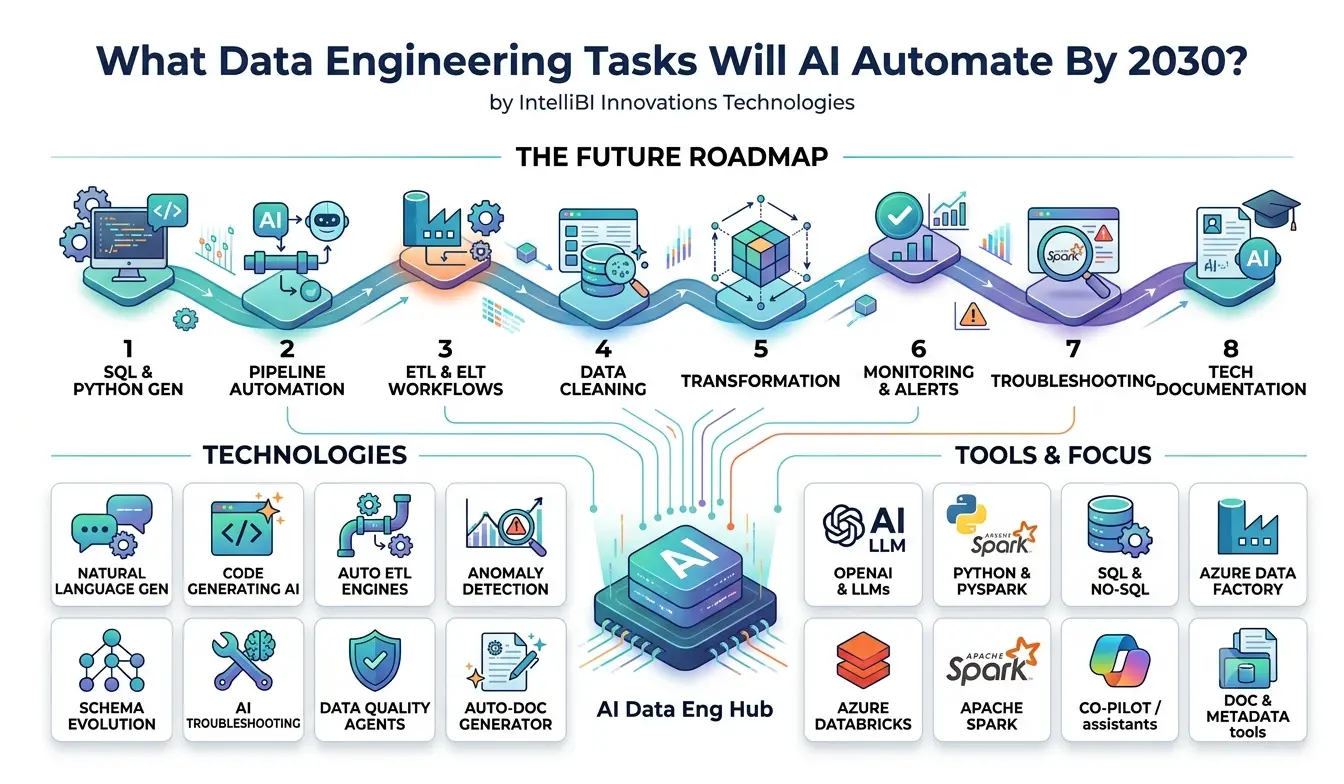
What Data Engineering Tasks Will AI Automate By 2030?
Artificial intelligence can already assist in many routine engineering tasks. These capabilities will probably become more sophisticated in the next few years.
SQL and Python code generation
AI coding assistants can produce SQL queries, Python scripts, PySpark transforms and reusable functions from natural-language instructions.
This saves time engineers spend writing repetitive code. Generated code still needs to be tested for accuracy, performance and compatibility with business requirements.
Developing ETL Pipelines
AI is able to help with building Extract, Transform and Load workflows, recommending transformation rules and flagging potential pipeline enhancements.
The engineers may spend more time reviewing pipeline designs than developing each component by hand.
Data Cleaning and Transformation
AI-powered tools can find missing values, find anomalous records, suggest standardisation rules and help with duplicate detection.
Contextual understanding is needed to ascertain whether an unusual record is an error or a real business event.
Pipeline Monitoring and Trouble Shooting
AI assistants can look through error logs, summarise pipeline failures and suggest possible solutions.
An AI assistant would know that a Spark job failed because of a memory issue or an unexpected schema change.
An engineer still needs to identify the cause and verify the proposed solution is safe.
Tech Docs
Generative AI may help with generating pipeline documentation, explaining SQL queries, summarising code changes, and helping with metadata discovery.
As these activities get easier, engineers may spend more time on architectural and operational issues.
What Data Engineering Skills Will Remain Useful?
Automation will change the day-to-day work flow, but some tasks will still be important as they require judgement and an understanding of complex systems.
Enterprise Data Architecture
Organisations have to decide how to collect, store, process and disseminate information across a number of platforms.
Performance, scalability, costs, security and business needs should all be considered when choosing between a data warehouse, data lake or lakehouse.
AI is able to suggest architecture patterns but those suggestions will have to be evaluated in relation to the organisation’s real environment.
Data Security and Governance
Businesses in regulated industries such as banking, healthcare, insurance and more must protect sensitive information.
Data engineers help implement control of access, data classification, lineage tracking and secure data processing workflows.
These responsibilities become even more critical as enterprise information is connected to AI agents and large language models.
Business Domain Knowledge
A data engineer working in healthcare has different requirements than someone building retail analytics or banking pipelines.
Grasping business processes helps engineers to identify meaningful relationships among data and to take appropriate decisions about transformations.
Generic automation is difficult to copy this expertise.
Reliability of Production and Cost Optimisation
Enterprise pipelines need to be reliable and must adjust to fluctuating data volumes and business demands.
Engineers have to deal with cloud cost management, Spark workload optimisation, system failures, and service availability.
These activities involve careful decisions rather than simply producing more code.
Those looking for Artificial Intelligence Training in Pune need to understand how AI automation can help with these responsibilities while still requiring engineering expertise.
How AI Is Changing the Role of Data Engineers
The classic data engineer is mainly responsible for gathering, transforming and delivering data for analytics and business intelligence.
Today’s data engineer is increasingly supporting machine learning algorithms, Generative AI applications, intelligent automation and enterprise knowledge systems.
Engineers may also work with documents, images, application logs, streaming events and vector embeddings, rather than just structured databases.
This opens up opportunities to develop expertise in AI-ready data pipelines, vector databases, Retrieval-Augmented Generation (RAG), Agentic AI and model monitoring.
For instance, a company building an internal AI assistant needs more than just access to a large language model.
It needs pipelines that gather enterprise documents, discard stale information, enforce access permissions, build embeddings and maintain trustworthy search indexes.
Without these engineering processes, the AI assistant can’t reliably provide trustworthy answers consistently.
Existing data experts may use an Artificial Intelligence and Machine Learning Course in Pune to see how their work fits into predictive models, intelligent applications, and enterprise automation.
Practical Example: How AI and Data Engineers Collaborate
For instance, a Pune-based manufacturing company is building an intelligent supply chain monitoring platform.
The company receives data from production systems, supplier databases, inventory applications and sensors embedded in equipment.
It aims to use AI to spot possible inventory shortages, production delays and operational issues.
The data engineering team starts by building ingestion pipelines using technologies such as Azure Data Factory, Apache Spark and cloud storage.
Engineers then take the raw information and organise it into cleaned and business-ready datasets using Delta Lake and medallion architecture.
Machine learning algorithms can then be used to analyse historical patterns and generate demand forecasts. Business teams could consult an AI assistant to pull up operational information by asking natural-language questions.
Generative artificial intelligence can assist engineers in implementation by writing PySpark code, generating test cases, documenting pipelines and investigating processing failures.
However, engineers are still responsible for checking source reliability, validating transformations, managing permissions and monitoring production performance.
If the AI system generates an incorrect inventory forecast due to incomplete source data, the engineering team has to find the root cause and fix it.
This hypothetical example illustrates how artificial intelligence can enhance engineering productivity, but also introduce new demands on reliability of data infrastructure.
What Skills Should Data Engineers Have by 2030?
Preparing for the future doesn’t mean throwing out what you already know about data engineering. Instead, professionals should build new skills that enhance what they already know.
1. PySpark and Python SQL
Strong programming foundations are still important for understanding data transformations, debugging generated code and developing reliable pipelines.
2. Cloud Data Engineering
Learn to build scalable data solutions using platforms like Microsoft Azure, AWS, Azure Databricks and cloud storage services.
3. Generative AI & Large Language Models
Grasp prompt engineering, structured outputs, model limitations, and the way in which LLMs communicate with enterprise applications.
4. Vector Databases and RAG
Understand how document ingestion, embeddings, and vector search and retrieval pipelines enable knowledge-based AI applications.
5. Workflow Automation and Agentic AI
Find out how AI agents can use tools, retrieve data from databases, run workflows and help with operations, with the right controls in place.
6. MLOps and DataOps
Gain knowledge of version control, CI/CD, Docker, monitoring, testing and production deployment to support reliable engineering and artificial intelligence (AI) systems.
7. Quality of Data and AI Governance
Understand validation, privacy, security, data lineage, and AI evaluation to avoid unreliable or unsafe outputs.
Professionals looking for Artificial Intelligence Classes in Pune should focus more on practical implementation, rather than just learning the AI principles via theory.
The Impact of AI on Entry Level Data Engineering Jobs
The job market for freshers might be different than those who entered the industry before AI went mainstream.
Simple coding and documentation work might require fewer hours of manual labour. This could lead to some employers looking for junior engineers with better problem-solving, debugging and system integration skills.
But that doesn’t mean entry-level opportunities will go away.
Candidates can better position themselves by building complete projects that show how data flows from source systems into storage, transformation pipelines, and AI applications.
A portfolio with working SQL transforms, automated data pipelines, monitoring workflows and AI integrations is more useful evidence of ability than a stack of course completion certificates.
Any freshers looking for an AI Engineer Course in Pune should look for opportunities to develop, test and explain complete technical solutions.
Will Current Data Engineers Become Artificial Intelligence?
Not necessarily. Data engineering and Artificial Intelligence are complementary disciplines
A senior data engineer brings with them a wealth of knowledge on databases, programming, cloud platforms, and enterprise data workflows.
That professional can move into AI platform engineering, intelligent data automation, MLOps and AI infrastructure jobs by learning AI.
For working professionals in Pune and PCMC, it may be more practical to make a gradual transition than start a new career from scratch.
AI Classes in Pune for Working Professionals may help to build AI capabilities in a structured way while also building on existing technical experience.
Similarly, learners seeking an Artificial Intelligence Certification Course in Pune must combine the certification preparation with practical projects that demonstrate their ability to solve real business problems.
How IntelliBI Links Data Engineering and AI
IntelliBI Innovations Technologies has a project-first learning process, linking technical concepts to real enterprise applications.
The curriculum for Advanced AI consists of Python, SQL, Machine Learning, Deep Learning, Generative AI, RAG, Agentic AI and deploying AI in production.
There is one relevant industry portfolio project, the AI Data Engineering Copilot. This project is about building an AI assistant that helps with SQL generation, ETL documentation, metadata discovery, pipeline validation and data lineage analysis.
These projects help students to see how artificial intelligence can help data professionals, without removing the need for technical judgement.
When considering a AI Course in Pune with Placement, professionals should also look into the syllabus, practical projects, mock interviews, portfolio development, and career support.
Career preparation may be aided by placement assistance, but employment results are based on individual skills and market conditions.
Common Questions
1. Is AI going to replace data engineers by 2030?
It is unlikely that AI will eliminate data engineering as an entire profession by 2030. It’s more likely to automate repetitive tasks and shift responsibilities around architecture, governance, integration and production reliability.
2. Is data engineering a good career to pursue in the future?
Present employment projections suggest continued demand for data expertise. Professionals who combine engineering fundamentals with cloud technologies and AI capabilities may be better placed to adapt to evolving requirements.
3. Can AI automate data pipeline creation?
AI is able to generate pipeline code, suggest transformations and help configure workflows. But production pipelines still need validation, monitoring, security controls and business-specific decisions.
4. Is it necessary for data engineers to learn Generative AI?
Yes. Generative artificial intelligence can assist data engineers in automating documentation, developing code, analysing errors and creating data pipelines that support intelligent applications.
5. Will AI eat the demand for junior data engineers?
AI could cut the need for some routine entry level tasks. However, junior engineers with practical project experience, programming knowledge and strong debugging skills can still go for it.
6. Do data engineers still need to know coding in the modern era of AI?
Yes. SQL, Python and PySpark continue to be important as engineers need to understand, validate and optimise code written by humans, as well as code generated by AI.
7. How to Find the Best Artificial Intelligence Institute in Pune?
Assess the real syllabus, business projects, practical training methodology, mentorship, certification preparation and career support. Pick training that ties AI concepts to real engineering problems.
Conclusion
Artificial Intelligence is not merely replacing data engineering. It is changing how data engineers work, what skills they need and how they add value to enterprise technology.
Routine coding, documentation and troubleshooting may become increasingly automated, but reliable data architecture, governance, security and business understanding will remain important.
Research on the current job market indicates the role is evolving, not evaporating.
Data engineers who build expertise in Generative AI, cloud platforms, RAG, Agentic AI and production automation can position themselves for a wider set of technical opportunities.
IntelliBI Innovations Technologies helps you to build upon your existing technical knowledge and prepare for AI integrated enterprise systems. Discover its project-oriented Artificial Intelligence Course in Pune to build hands-on AI engineering skills for the changing tech landscape.