
Microsoft Fabric Is Replacing Synapse: What Azure Data Engineers Need To Know in 2027
Quick Answer
Microsoft Fabric is emerging as a unified alternative to many Azure Synapse Analytics workloads. In 2027, Azure data engineers should learn OneLake, Fabric Data Factory, PySpark, Delta Lake, Fabric Warehouse, Direct Lake and data governance. Professionals should also retain their Azure Data Factory, Databricks and SQL skills to support existing systems and modern cloud data architectures.
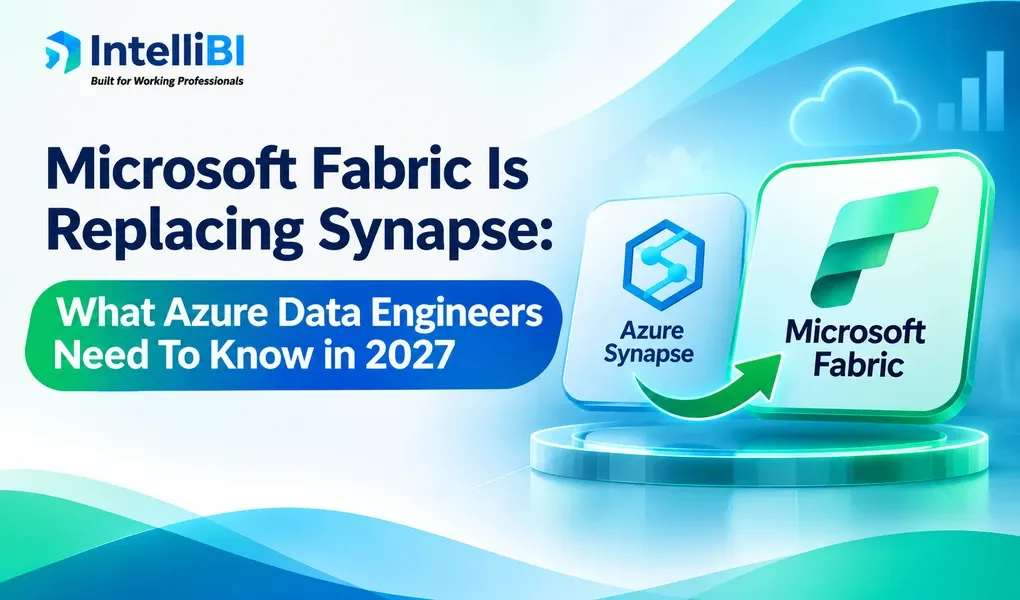
As companies move toward unified analytics platforms, intelligent data pipelines and AI-powered decision-making, a new phase of cloud data engineering is dawning. This change centers around Microsoft Fabric, which unifies data engineering, data integration, data warehousing, real-time intelligence and business intelligence into one environment.
Azure Synapse Analytics has been a key platform for enterprise data processing and analytics for years. Microsoft Fabric, however, is more integrated and gets rid of the need to manage multiple separate services.
This doesn’t mean Azure Synapse Analytics is going obsolete right away. Rather, Fabric is a strategic evolution of Microsoft's analytics ecosystem, encouraging organisations to modernise their data architecture where it makes sense.
This change is important to understand for professionals who are going for Azure Data Engineer Course in Pune. Besides learning traditional Azure technologies, engineers can prepare for changing enterprise requirements in 2027 by learning Microsoft Fabric, OneLake, Delta Lake and the modern lakehouse architecture.
1. What Is Microsoft Fabric?
Microsoft Fabric is an end-to-end Software-as-a-Service (SaaS) analytics platform that covers the complete data lifecycle—from ingestion to transformation, analytics, and reporting.
Companies can use Fabric for a number of analytics workloads in a unified environment, rather than building out multiple individual services for different data needs.
The major components of Microsoft Fabric are:
Data Factory – Data ingestion, integration, and pipeline orchestration.
Data Engineering – Big data transformation with Apache Spark.
Data Warehouse – Enterprise data warehousing based on SQL.
Data Science – Predictive Analytics and Machine Learning.
Real Time Intelligence – Analysing and processing data in a streaming manner.
Power BI – Business Intelligence, Dashboards & Reporting.
OneLake – One logical data lake for enterprise workloads.
For Azure data engineers, Fabric provides an environment where data ingestion, processing, storage and consumption can work more closely together.
2. Why Are Organisations Switching From Azure Synapse to Microsoft Fabric?
Azure Synapse Analytics brings together data warehousing, analytics for big data, and data integration. However, enterprise implementations may have several resources, configurations and integrations to manage.
Microsoft Fabric tackles many of these challenges with a unified architecture.
Unified management of data
OneLake is the central storage layer for Fabric, allowing analytics workloads to share datasets without unnecessary duplication in supported scenarios.
Infrastructure Management Simplified
Fabric’s SaaS architecture reduces the infrastructure configuration that many analytics operations require. Engineers can spend more time building data solutions and less time managing individual compute resources.
Business Intelligence Integration
Native Power BI integration allows organisations to connect engineering workflows with business reporting.
AI-Supported Development
For supported workloads, Fabric comes with Copilot capabilities that help professionals generate code, explore data and develop analytics solutions, subject to licensing and configuration requirements.
Microsoft has also provided specific migration guidance for Synapse SQL pools, Spark workloads and data pipelines, underscoring its commitment to Fabric-based modernisation.
Microsoft Training
3. Azure Synapse Analytics vs Microsoft Fabric
Grasping the distinctions between these platforms helps professionals select the right technologies for enterprise projects.
Feature Azure Synapse Analytics Microsoft Fabric
Software as a Service Architecture Platform-as-a-Service
Data storage Integration with Azure Data Lake Storage OneLake
Data integration Synapse pipelines Fabric Data Factory
Data processing Fabric Spark Apache Spark pools
SQL analytics endpoints and Fabric Warehouse Dedicated and serverless SQL pools Data Warehouse
Business intelligence Power BI integration Power BI experience in product
Cost Management Per Resource Pricing Compute Model based on Capacity, Storage Charges as applicable
Data architecture Unified analytics ecosystem Multiple integrated services
Infrastructure More control of configurations More managed infrastructure
AI capabilities External and integrated Azure services Integrated AI capabilities in supported workloads
For organisations looking for one analytics environment, Fabric will be particularly appealing. Synapse and other Azure services remain relevant for existing workloads, security requirements or architectural dependencies.
4. Will Microsoft Fabric Replace Azure Synapse by 2027?
Microsoft Fabric is billed as a major platform for modern analytics, but engineers shouldn’t assume all Synapse workloads will go away in 2027.
Factors impacting enterprise migration include application dependencies, data volumes, regulatory requirements, feature compatibility and operational costs.
Many organisations may still work with hybrid architectures and slowly introduce Fabric into their existing Azure environments.
So, professionals looking for Azure Training in Pune should pay attention to both the mature Azure technologies as well as the emerging Fabric capabilities.
A new tool is not enough for enterprise modernisation projects; what matters more is an engineer who knows migration strategies.
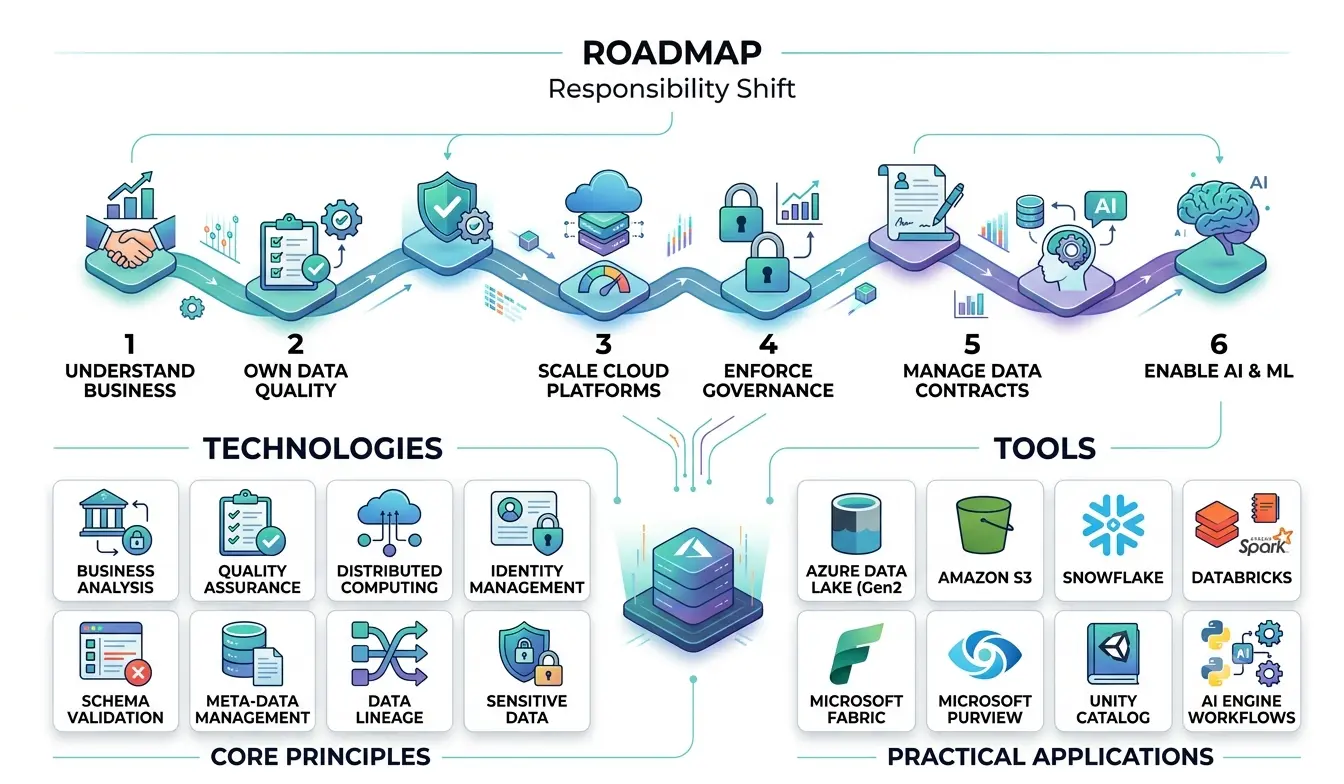
5. Microsoft Fabric Skills Azure Data Engineers Must Master In 2027
5.1 OneLake and the Data Lake Architecture
OneLake is a unified logical data lake in Microsoft Fabric. It lets organisations organise data across workspaces and supported analytics workloads and access it.
Data engineers need to know:
OneLake architecture and storage concepts
Hacks on OneLake
Integration with Azure Data Lake Storage Gen2.
Parquet files and Delta tables.
Permission to access data.
Structuring data across workspaces.
For example, an enterprise that stores historical transactions in Azure Data Lake Storage can use supported OneLake shortcuts to access existing datasets without creating an additional physical copy.
5.2 Fabric Data Factory and Modern ETL Pipelines 6.
Data ingestion remains a central task for data engineers. Fabric Data Factory offers pipeline development, workflow orchestration, and data transformation.
Key concepts are: pipeline scheduling, incremental data loading, parameterisation, error handling, Dataflows Gen2 and data quality validation.
If you are a professional looking at Azure Data Factory Training in Pune, it’s important to know how the classic ADF concepts are mapped to the Fabric-based workflows.
The knowledge of both environments allows the engineers to maintain existing pipelines, and to build modern integration solutions.
5.3 Apache Spark & PySpark
Apache Spark is and continues to be a significant technology for distributed data processing.
Fabric Data Engineering enables professionals to work with large datasets using notebooks and Spark-based jobs.
Engineers must get hands on experience in:
DataFrame PySpark.
Sparksql.
Data processing is distributed.
Joins and aggregations
Partitioning and performance tuning.
Orchestration of notebooks.
Data processing in increments.
These capabilities are cross-platform and available on Fabric, Azure Synapse, and Azure Databricks.
5.4 Delta Lake and Lakehouse Architecture
Modern data platforms are increasingly blending the flexibility of data lakes with structured data management capabilities.
Delta Lake provides reliable transactions, schema enforcement, version history, and incremental updates.
Azure data engineers should also know the medallion architecture.
Data layer Purpose Example
Bronze Raw source data Customer transactions
Silver Data cleansing and validation Standardised transaction records
Gold Business data sets ready for use Revenue summary by month
This architecture allows organisations to decouple raw ingestion from transformation and business consumption.
5.5 Fabric Datawarehouse & SQL
Although AI and distributed computing are becoming more prevalent, SQL is still relevant.
Fabric Warehouse supports relational analytics and SQL-based warehousing.
Engineers must learn dimensional modelling, star schemas, fact and dimension tables, query optimisation and incremental warehouse loading.
It’s especially important to understand the difference between a Fabric Warehouse and a lakehouse SQL analytics endpoint. They serve different workload requirements and have different data modification capabilities.
5.6 Power BI and Direct Lake
Decision-makers can access processed information when data engineering delivers greater business value.
Fabric’s Direct Lake storage mode enables supported Power BI semantic models to work with Delta-based data without the traditional full import process.
Engineers must understand the impact of semantic models, data relationships, security rules and table design on the performance of reporting.
5.7 Security & Data Governance
Enterprise data platforms must protect sensitive data, but also allow trusted access.
Key skills include Microsoft Entra ID, workspace roles, OneLake security, data lineage, Microsoft Purview, and secure connection management.
Migration projects also require engineers to rethink existing permissions, rather than assume that Synapse security configurations automatically carry over to Fabric.
Microsoft Learn
5.8 Data Engineering with AI Assistance
AI is finding its way into modern engineering workflows. Tools like Copilot can help you generate SQL, develop notebooks, write documentation, and troubleshoot issues.
But engineers still need to independently validate AI-generated code, assess performance and check security implications before deploying it in production.'
A Microsoft Azure Data Engineering Course can help professionals learn AI and understand how automation complements traditional engineering knowledge.
6. Enterprise Project: From Synapse to Fabric: Building a Retail Data Pipeline Hands-on
Let us take the example of a hypothetical retail company running multiple stores in Maharashtra. The organization collects transaction histories, stock levels, customer information and internet sales data.
Its current architecture includes Azure Data Factory, Azure Data Lake Storage, and Azure Synapse Analytics.
The company hopes to use Microsoft Fabric to simplify analytics and make data easier to access.
Current Data Architecture
Retail databases, APIs and CSV documents
Azure Data Factory
Azure Data Lake Storage Gen2
Azure Synapse Analytic
Power BI dashboard
Microsoft Fabric Modern Architecture
Sources of retail data
Textile Mills
OneLake and Fabric Lakehouses
Bronze — Raw data
Silver — PySpark transformation 4.
Gold - Tables set for business
SQL analytics endpoint / Fabric Warehouse
Dashboards and Power BI semantic model
Step 1: Data Ingestion (Input)
Fabric pipelines gather daily transaction records from retail databases and external applications.
The incoming data is stored in the Bronze layer as it is.
Step 2: Change the data
PySpark notebooks standardise date formats, remove duplicate transactions, validate product identifiers and impute missing values.
The cleaned information is saved as Delta tables in the Silver layer.
Step 3: Business Data Model
The engineering team creates Gold-layer datasets for store-wise revenue, product performance, inventory movement, and customer buying patterns.
Step 4: Reporting and Analytics
Power BI connects to curated data sets to provide sales trends, inventory insights and operational performance reports to business teams.
Step 5: Validate Migration
Engineers compare transaction counts, revenue calculations, processing times, security permissions and reporting accuracy across both platforms before retiring existing workloads.
This project shows why modern data engineers need to know about architecture, not just tools.
7. Moving Your Azure Synapse Workloads to Microsoft Fabric
Migration is not as simple as moving files from one platform to another and needs to be planned carefully.
Phase of migration Engineering activity
Assessment Identify existing workloads and dependencies
Planning Check Fabric compatability and requirements
Storage integration Set up OneLake or compatible shortcuts
Pipeline migration Migrate or rebuild supported workflows
Code transformation Edit Spark notebooks and SQL scripts
Validation Compare accuracy, performance and cost
Deployment: Incremental introduction of production workloads
Microsoft offers migration support for supported Synapse Spark and pipeline workloads. Some migration capabilities are still in preview and incompatible components might need to be manually refactored.
Microsoft Learn+1
A successful migration should also have a rollback strategy, monitoring procedures and documented acceptance criteria.
8. Microsoft Fabric Learning Roadmap for Azure Data Engineers 2028
Whether you are a fresher or a seasoned IT professional, a well-structured learning plan can make the transition easy.
Length Learning emphasis Practical result
Weeks 1-2 SQL and Python Data extraction & transformation
Weeks 3-4 Azure fundamentals and ADLS Implementation of cloud storage
Weeks 5–6 Concepts of ADF and ETL Automated ingestion pipelines
Weeks 7–8 Apache Spark and PySpark Distributed data processing
Weeks 9–10 OneLake and Fabric Lakehouse Medallion architecture
Weeks 11-12 Fabric Warehouse and Power BI End-to-end analytics solution
Weeks 13–14 Engineering workflows you can trust: security and optimisation
Weeks 15-16 Migration and capstone project Enterprise-ready project for portfolio
If you’re comparing a Microsoft Azure Course in Pune or Azure Cloud Training in Pune, make sure the curriculum focuses on practical integration, debugging, data modelling and cloud architecture, apart from the individual technologies.
9. Microsoft Fabric vs Azure Databricks: Learn Them All?
Microsoft Fabric and Azure Databricks overlap, but they each serve different enterprise needs.
Fabric is all about a unified Microsoft analytics ecosystem, while Azure Databricks provides extensive distributed processing, lakehouse engineering, machine learning and AI development capabilities.
Microsoft Fabric Azure DataBricks
Unified analytics experience Data & AI platform
Power BI native integration Integration with various analytics programs
Managed SaaS experience Many options for compute configurations
Integrated engineering and BI Advanced engineering and ML workloads
OneLake ecosystem Lakehouse architecture and Unity Catalogues
If you are a professional looking for Azure Databricks Training in Pune, do not think that Databricks is a thing of the past because Fabric is trending.
Engineers who are familiar with both platforms can make better architectural decisions based on the complexity of the workload, the integration requirements and the enterprise objectives.
10. Microsoft Azure And Fabric Certifications 2027
“Certifications can help professionals organise their learning and prove technical knowledge.
For roles that focus on Fabric, the Microsoft Certified: Fabric Data Engineer Associate (DP-700) is an appropriate certification path. Alternatively, there is Microsoft Certified: Fabric Analytics Engineer Associate (DP-600) aimed at professionals who focus on analytics solutions and semantic models.
The previous Azure Data Engineer Associate exam, DP-203, will be retired on March 31, 2025.
When searching for an Azure Certification Course in Pune, it is important for students to look at the latest Microsoft certification requirements and not use old exam prep material.
Practical projects that show data ingestion, transformation, monitoring, security and optimisation should underpin certification preparation.
11. Common Mistakes to Avoid for Azure Data Engineers
Not learning the basics of SQL and Python when learning Fabric.
Assuming that all Synapse workloads are automatically movable.
Learning tools without knowing architectural decisions.
Neglecting security, governance and capacity utilisation.
Constructing pipelines with no error handling or monitoring.
This code is fully generated by AI.
- Getting certifications without implementing them.
The best way to learn is to combine technical knowledge with problem solving and experience on real-world projects.
FAQ’s
1. Is Microsoft Fabric the new Azure Synapse Analytics?
Microsoft Fabric has migration paths and built-in alternatives for many Synapse analytics workloads. That’s not to say, however, that Azure Synapse will retire worldwide in 2027.
2. Will Azure Data Engineers Need To Learn Microsoft Fabric In 2027?
Yes. Fabric brings key capabilities in unified analytics, OneLake, data integration, lakehouse engineering and business intelligence.
3. Is Azure Data Factory a thing of the past?
No. Azure Data Factory is still relevant to existing Azure architectures. Engineers need to know both traditional ADF and Fabric Data Factory to satisfy various enterprise requirements.
4. Is Microsoft Fabric good for beginners?
Yes. Before moving on to more advanced Fabric projects, beginners should learn the basics of SQL, Python, cloud computing and ETL.
5. What certification is right for Microsoft Fabric data engineers?
Microsoft’s DP-700 certification is for Fabric data engineering professionals. To get the most up-to-date exam objectives, check out Microsoft’s official certifications website.
6. Does Microsoft Fabric need to be programmed?
Fabric has some low-code tools for some integration tasks. But SQL, Python and PySpark are still important for advanced data engineering and custom transformations.
7. Can Microsoft Fabric connect to Azure Databricks?
Indeed. Supported integrations and shared storage solutions allow organisations to integrate these platforms into broader data architectures.
8. How to select the Best Azure Data Engineering Training in Pune?
Assess the curriculum, enterprise projects, mentorship, training methodology and career support. Practical coverage of Azure Data Factory, Spark, Databricks, Delta Lake and the new Fabric technologies.
Conclusion
Microsoft Fabric is a giant leap forward in cloud analytics, bringing data integration, engineering, warehousing and business intelligence together in one place.
But the future of Azure data engineering is not that we should abandon existing technologies. It’s about applying proven Azure expertise into modern architectures and choosing the right platform for every business requirement.
As we move toward 2027, professionals should focus on OneLake, Fabric Data Factory, PySpark, Delta Lake, SQL, data governance and migration strategies.
IntelliBI Innovations Technologies’ project-first learning approach is based on correlating technical concepts with practical enterprise scenarios.
Learn about Azure ETL Training in Pune at IntelliBI to gain knowledge on cloud data pipelines, transformation workflows and modern data engineering basics.