
Microsoft Fabric Is Replacing Synapse: What Azure Data Engineers Must Learn in 2027
Quick Answer
Microsoft Fabric is emerging as a unified alternative to many Azure Synapse Analytics workloads. In 2027, Azure data engineers should learn OneLake, Fabric Data Factory, PySpark, Delta Lake, Fabric Warehouse, Direct Lake and data governance. Professionals should also retain their Azure Data Factory, Databricks and SQL skills to support existing systems and modern cloud data architectures.
Cloud data engineering is entering a new phase as businesses move towards unified analytics platforms, intelligent data pipelines and AI-powered decision-making. Microsoft Fabric is at the centre of this transformation, bringing data engineering, data integration, data warehousing, real-time intelligence and business intelligence into a single environment.
For years, Azure Synapse Analytics has been an important platform for enterprise data processing and analytics. However, Microsoft Fabric introduces a more integrated approach that reduces the need to manage multiple independent services.
This does not mean Azure Synapse Analytics is immediately becoming obsolete. Instead, Fabric represents a strategic shift in Microsoft's analytics ecosystem, encouraging organisations to modernise their data architecture wherever appropriate.
For professionals pursuing an Azure Data Engineer Course in Pune, understanding this transition is essential. Alongside traditional Azure technologies, learning Microsoft Fabric, OneLake, Delta Lake and modern lakehouse architecture can help engineers prepare for evolving enterprise requirements in 2027.
1. What Is Microsoft Fabric?
Microsoft Fabric is a unified Software-as-a-Service (SaaS) analytics platform designed to support the complete data lifecycle, from ingestion and transformation to analytics and reporting.
Instead of configuring multiple independent services for different data requirements, organisations can use Fabric to manage several analytics workloads within a connected environment.
Microsoft Fabric includes Data Factory for data integration, Data Engineering for large-scale processing, Data Warehouse for SQL-based analytics, Data Science for machine learning, Real-Time Intelligence for streaming analytics and Power BI for business reporting.
At the foundation of these experiences is OneLake, a unified logical data lake that enables supported workloads to access shared enterprise data.
For Azure data engineers, Fabric introduces an environment where data ingestion, processing, storage and consumption work together more closely.
2. Why Are Enterprises Moving from Azure Synapse to Microsoft Fabric?
Enterprise implementations can involve managing several resources, configurations and integrations.
Microsoft Fabric addresses many of these challenges through a unified architecture.
Unified Data Management
Fabric uses OneLake as its central storage layer, allowing multiple analytics workloads to access shared datasets without unnecessary duplication in supported scenarios.
Simplified Infrastructure Management
Fabric's SaaS architecture reduces the infrastructure configuration required for many analytics operations. Engineers can spend more time developing data solutions rather than managing individual compute resources.
Integrated Business Intelligence
Native integration with Power BI helps organisations connect engineering workflows with business reporting, creating a more connected analytics environment.
AI-Assisted Development
Fabric provides Copilot capabilities for supported workloads, helping professionals generate code, explore data and develop analytics solutions, subject to licensing and configuration requirements.
These capabilities make Fabric an important technology for professionals considering Azure Training in Pune and looking to understand modern enterprise data platforms.
3. Microsoft Fabric vs Azure Synapse Analytics
Although both platforms support enterprise analytics, their architecture and operational approaches differ.
Architecture and Infrastructure
Azure Synapse operates primarily as a Platform-as-a-Service solution, providing greater control over individual resources and configurations. Microsoft Fabric follows a Software-as-a-Service model that simplifies infrastructure management for many workloads.
Data Storage
Azure Synapse integrates with Azure Data Lake Storage, whereas Microsoft Fabric uses OneLake as its unified logical storage foundation. OneLake also supports shortcuts to compatible external storage systems.
Data Integration and Processing
Synapse provides integrated pipelines and Apache Spark pools for data processing. Fabric offers Data Factory, Spark notebooks and lakehouse capabilities within a connected analytics environment.
Data Warehousing and Reporting
Synapse supports dedicated and serverless SQL pools. Fabric provides a Warehouse experience and lakehouse SQL analytics endpoints, alongside native Power BI integration.
Cost Management
Synapse pricing depends on the resources and services being used. Fabric primarily follows a capacity-based compute model, with applicable storage charges. Engineers must understand workload consumption before selecting either platform.
4. Will Microsoft Fabric Completely Replace Azure Synapse in 2027?
Microsoft Fabric is positioned as an important platform for modern analytics, but engineers should not assume that every Synapse workload will disappear in 2027.
Enterprise migration depends on application dependencies, data volumes, regulatory requirements, feature compatibility and operational costs.
Many organisations may continue using hybrid architectures while gradually introducing Fabric into their existing Azure environments.
Professionals pursuing a Microsoft Azure Course in Pune should therefore focus on both established Azure technologies and emerging Fabric capabilities.
Understanding how to assess, migrate and modernise existing systems can be more valuable than learning a new platform in isolation.
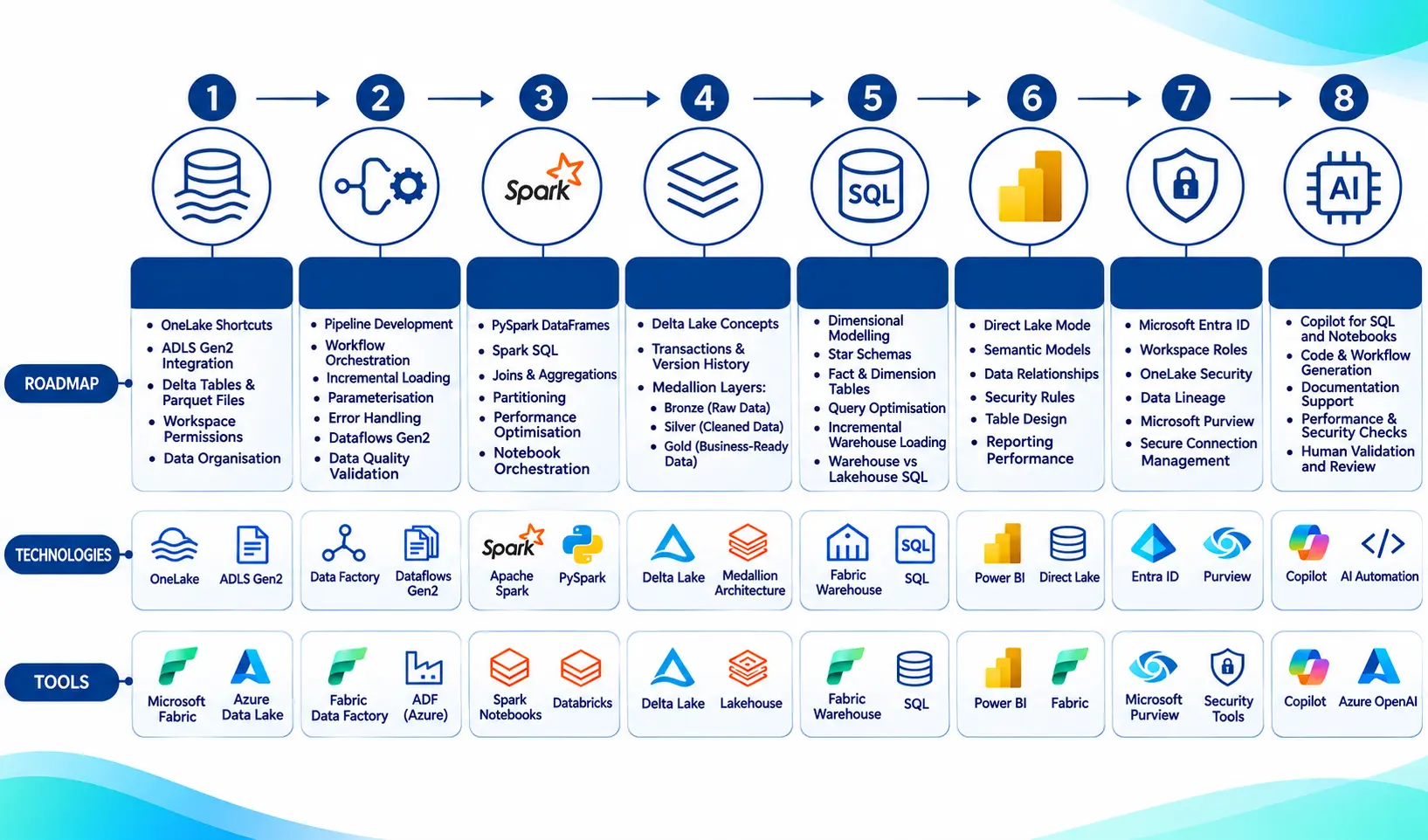
5. Essential Microsoft Fabric Skills Azure Data Engineers Must Learn in 2027
5.1 OneLake and Modern Data Lake Architecture
OneLake provides a unified logical data lake within Microsoft Fabric. It allows organisations to organise and access data across workspaces and supported analytics workloads.
Engineers should understand OneLake shortcuts, Azure Data Lake Storage Gen2 integration, Delta tables, Parquet files, workspace permissions and data organisation.
For example, an enterprise storing historical transactions in Azure Data Lake Storage can use supported OneLake shortcuts to access existing datasets without creating another physical copy.
5.2 Fabric Data Factory and Modern ETL Pipelines
Data ingestion remains a fundamental responsibility of data engineers. Fabric Data Factory supports pipeline development, workflow orchestration and data transformation.
Important concepts include pipeline scheduling, incremental data loading, parameterisation, error handling, Dataflows Gen2 and data quality validation.
Professionals considering Azure Data Factory Training in Pune should understand how traditional ADF concepts translate into Fabric-based workflows.
Learning both environments enables engineers to maintain existing pipelines while developing modern integration solutions.
5.3 Apache Spark and PySpark
Apache Spark remains an important technology for distributed data processing. Fabric Data Engineering allows professionals to process large datasets using notebooks and Spark-based jobs.
Engineers should develop practical experience with PySpark DataFrames, Spark SQL, joins, aggregations, partitioning, performance optimisation and notebook orchestration.
These capabilities are transferable across multiple platforms, including Fabric, Azure Synapse and Azure Databricks.
5.4 Delta Lake and Medallion Architecture
Modern data platforms increasingly combine the flexibility of data lakes with structured data management capabilities.
Delta Lake supports reliable transactions, schema enforcement, version history and incremental updates.
Azure data engineers should also understand the three layers of medallion architecture.
The Bronze layer stores raw data collected from databases, APIs and external applications.
The Silver layer contains cleaned, validated and standardised information.
The Gold layer provides business-ready datasets designed for reporting, analytics and decision-making.
This architecture helps organisations separate raw ingestion from transformation and business consumption.
5.5 Fabric Data Warehouse and SQL
SQL remains essential despite the increasing adoption of AI and distributed computing.
Fabric Warehouse supports relational analytics and SQL-based data warehousing. Engineers should learn dimensional modelling, star schemas, fact and dimension tables, query optimisation and incremental warehouse loading.
Understanding the difference between Fabric Warehouse and a lakehouse SQL analytics endpoint is particularly important because they serve different workload requirements.
5.6 Power BI and Direct Lake
Data engineering delivers greater business value when processed information is accessible to decision-makers.
Fabric's Direct Lake storage mode enables supported Power BI semantic models to work with Delta-based data without relying on a traditional full import process.
Engineers should understand how semantic models, data relationships, security rules and table design affect reporting performance.
5.7 Data Governance and Security
Enterprise data platforms must protect sensitive information while supporting reliable access.
Important skills include Microsoft Entra ID, workspace roles, OneLake security, data lineage, Microsoft Purview and secure connection management.
Migration projects also require engineers to reassess existing permissions rather than assume that Synapse security configurations automatically transfer to Fabric.
5.8 AI-Assisted Data Engineering
AI is becoming part of modern engineering workflows. Tools such as Copilot can support SQL generation, notebook development, documentation and troubleshooting.
However, engineers must independently validate AI-generated code, assess performance and check security implications before production deployment.
Learning AI alongside a Microsoft Azure Data Engineering Course can help professionals understand how automation complements traditional engineering expertise.
6. Practical Enterprise Project: Migrating a Retail Data Pipeline from Synapse to Fabric
Consider a hypothetical retail company operating multiple stores across Maharashtra. The organisation collects transaction records, inventory information, customer details and online sales data.
Its existing architecture uses Azure Data Factory for ingestion, Azure Data Lake Storage for storage, Azure Synapse Analytics for processing and Power BI for reporting.
The company wants to introduce Microsoft Fabric to simplify analytics and improve data accessibility.
Step 1: Data Ingestion
Fabric Data Factory pipelines collect daily transaction records from retail databases and external applications.
The incoming data is stored in the Bronze layer of the Fabric Lakehouse with its original structure preserved.
Step 2: Data Transformation
PySpark notebooks standardise date formats, remove duplicate transactions, validate product identifiers and handle missing values.
The cleaned information is saved as Delta tables in the Silver layer.
Step 3: Business Data Modelling
The engineering team creates Gold-layer datasets for store-wise revenue, product performance, inventory movement and customer purchasing patterns.
These datasets provide consistent information for different business departments.
Step 4: Reporting and Analytics
Power BI connects to curated datasets to provide business teams with sales trends, inventory insights and operational performance reports.
Step 5: Migration Validation
Before retiring existing workloads, engineers compare transaction counts, revenue calculations, processing times, security permissions and reporting accuracy across both platforms.
This project demonstrates why modern data engineers need architectural knowledge beyond individual tools.
7. How to Migrate Azure Synapse Workloads to Microsoft Fabric
Migration requires careful planning rather than simply transferring files between platforms.
Assess Existing Workloads
Identify existing Synapse pipelines, SQL scripts, Spark notebooks, storage systems and external dependencies.
Evaluate Compatibility
Determine which workloads can be migrated directly and which require architectural changes or manual code modifications.
Configure Storage Integration
Set up OneLake and supported shortcuts to existing storage systems wherever appropriate.
Migrate Pipelines and Processing Workloads
Rebuild or migrate supported data pipelines, adapt Spark notebooks and modify SQL scripts according to Fabric requirements.
Validate and Monitor Performance
Compare data accuracy, processing performance, security configurations and operational costs before moving production workloads.
A successful migration should also include a rollback strategy, monitoring procedures and documented acceptance criteria.
8. Microsoft Fabric Learning Roadmap for Azure Data Engineers in 2027
Whether you are a fresher or an experienced IT professional, a structured learning plan can make the transition easier.
Weeks 1–4: Build Strong Foundations
Start with SQL, Python, cloud computing fundamentals, relational databases and Azure Data Lake Storage. Practise extracting, cleaning and transforming structured datasets.
Weeks 5–8: Learn Data Integration and Processing
Focus on Azure Data Factory, ETL pipelines, Apache Spark and PySpark. Build automated workflows that collect and process information from multiple sources.
Weeks 9–12: Master Microsoft Fabric
Explore OneLake, Fabric Data Factory, Lakehouse, Delta Lake, Fabric Warehouse and Power BI integration. Develop an end-to-end analytics solution.
Weeks 13–16: Work on Enterprise Projects
Learn data governance, security, performance optimisation, capacity management and Synapse migration strategies. Complete a capstone project demonstrating the entire data engineering lifecycle.
Learners considering Azure Cloud Training in Pune should evaluate whether the curriculum covers practical integration, debugging, data modelling and cloud architecture alongside individual technologies.
9. Microsoft Fabric vs Azure Databricks: Should You Learn Both?
Microsoft Fabric and Azure Databricks address overlapping but different enterprise requirements.
Fabric focuses on a unified Microsoft analytics ecosystem, with native Power BI integration, managed infrastructure and connected engineering experiences.
Azure Databricks provides extensive capabilities for distributed processing, lakehouse engineering, machine learning, advanced analytics and AI development.
Professionals exploring Azure Databricks Training in Pune should not consider Databricks irrelevant simply because Fabric is gaining attention.
Both platforms can coexist within enterprise architectures. Understanding their strengths allows engineers to select appropriate solutions based on workload complexity, integration requirements, performance and business objectives.
10. Microsoft Azure and Fabric Certifications for 2027
Certifications can help professionals structure their learning and demonstrate technical knowledge.
Microsoft Certified: Fabric Data Engineer Associate (DP-700) is a relevant certification pathway for professionals working with Fabric data engineering workloads.
Microsoft Certified: Fabric Analytics Engineer Associate (DP-600) is another option for professionals focusing on analytics solutions and semantic models.
The earlier Azure Data Engineer Associate exam, DP-203, was retired on March 31, 2025.
When selecting an Azure Certification Course in Pune, learners should review the latest Microsoft certification requirements rather than rely on outdated exam preparation material.
Certification preparation should be supported by practical projects demonstrating data ingestion, transformation, monitoring, security and optimisation.
11. Common Mistakes Azure Data Engineers Should Avoid
- Ignoring SQL and Python fundamentals while learning Fabric.
- Assuming every Synapse workload can be migrated automatically.
- Learning individual tools without understanding enterprise architecture.
- Overlooking security, governance and capacity utilisation.
- Building pipelines without error handling or monitoring.
- Depending entirely on AI-generated code.
- Pursuing certifications without practical implementation.
- Assuming Fabric makes Azure Databricks or Azure Data Factory unnecessary.
The most valuable learning approach combines technical knowledge with problem-solving and real-world project experience.
Frequently Asked Questions
1. Is Microsoft Fabric replacing Azure Synapse Analytics?
Microsoft Fabric provides migration pathways and integrated alternatives for many Synapse analytics workloads. However, this does not establish a universal retirement deadline for Azure Synapse in 2027.
2. Should Azure data engineers learn Microsoft Fabric in 2027?
Yes. Fabric introduces important capabilities in unified analytics, OneLake, data integration, lakehouse engineering and business intelligence that are valuable for modern data engineering projects.
3. Is Azure Data Factory becoming obsolete?
No. Azure Data Factory remains relevant to existing Azure architectures. Engineers should understand both traditional ADF and Fabric Data Factory to support different enterprise requirements.
4. Is Microsoft Fabric suitable for beginners?
Yes. Beginners should first develop foundational SQL, Python, cloud computing and ETL knowledge before progressing to advanced Fabric projects.
5. Which certification is suitable for Microsoft Fabric data engineers?
Microsoft Certified: Fabric Data Engineer Associate (DP-700) is designed for Fabric data engineering professionals. Candidates should check Microsoft's official certification website for current exam objectives.
6. Does Microsoft Fabric require coding?
Fabric offers low-code tools for certain integration tasks. However, SQL, Python and PySpark remain important for advanced data engineering and custom transformations.
7. Can Microsoft Fabric and Azure Databricks work together?
Yes. Supported integrations and shared storage approaches allow organisations to combine these platforms within broader enterprise data architectures.
8. How do I choose the Best Azure Data Engineering Course in Pune?
Evaluate the curriculum, enterprise projects, mentorship, training methodology and career support. Look for practical coverage of Azure Data Factory, Spark, Databricks, Delta Lake and emerging Fabric technologies.
Conclusion
Microsoft Fabric represents a significant evolution in cloud analytics, bringing data integration, engineering, warehousing and business intelligence into a unified environment.
However, the future of Azure data engineering is not about abandoning existing technologies. It is about combining established Azure expertise with modern architectures and selecting the right platform for each business requirement.
As 2027 approaches, professionals should prioritise OneLake, Fabric Data Factory, PySpark, Delta Lake, SQL, data governance and migration strategies.
At IntelliBI Innovations Technologies, the project-first learning approach focuses on connecting technical concepts with practical enterprise scenarios.
Explore IntelliBI's Azure ETL Training in Pune to strengthen your understanding of cloud data pipelines, transformation workflows and modern data engineering fundamentals.