

How to Build Your First Machine Learning Model Using Python: Step-by-Step Tutorial
Quick Answer
To build your first Machine Learning model in Python: install Python with pandas, numpy, and scikit-learn; load and explore your dataset; clean and preprocess the data (handle missing values, encode categories, scale features); split data into training and testing sets; choose a simple algorithm like linear or logistic regression; train it using .fit(); evaluate performance with accuracy, precision, or RMSE; then iterate by tuning hyperparameters and engineering new features to improve results.
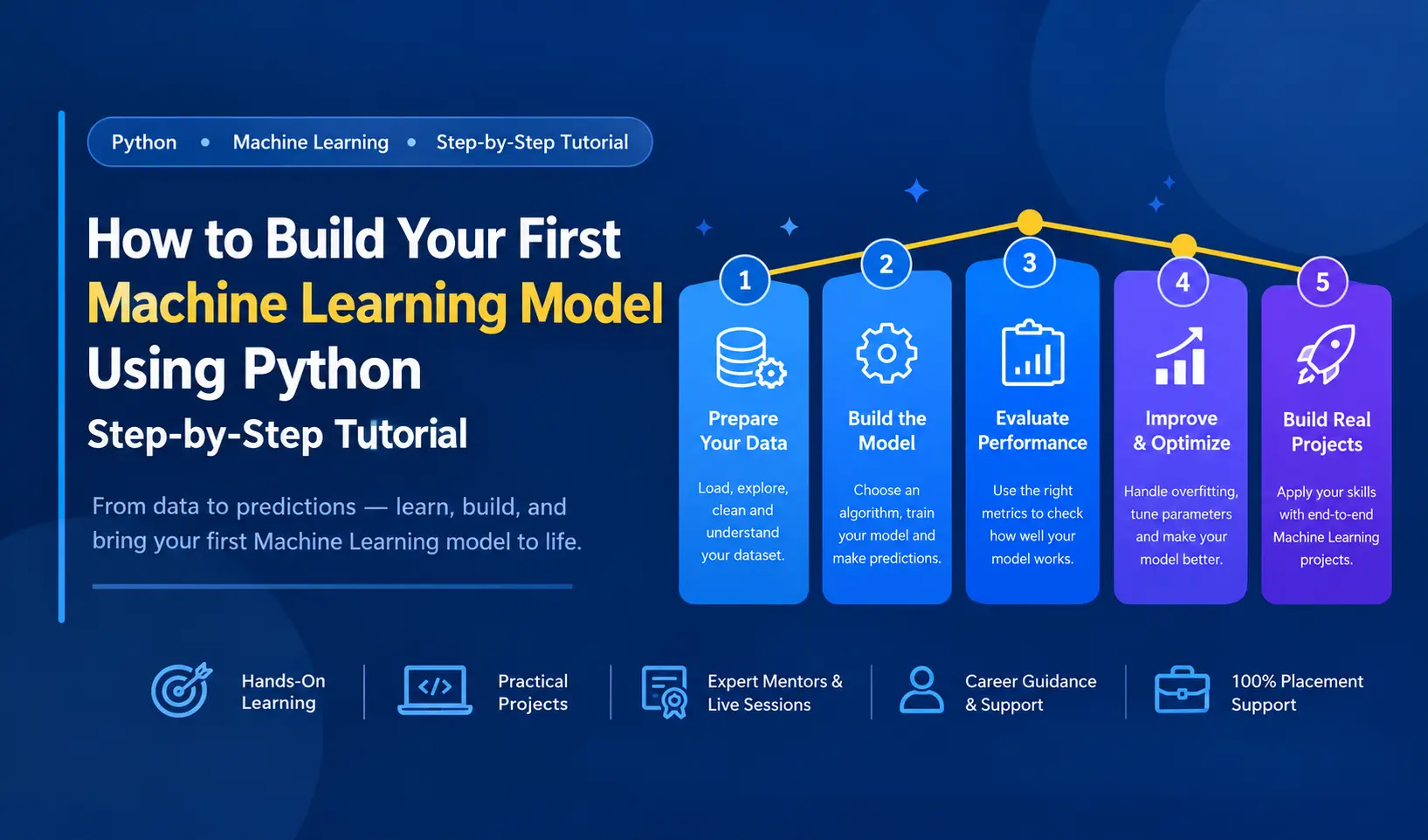
How to Build Your First Machine Learning Model Using Python: Step-by-Step Tutorial
There is a particular moment in every data professional's journey that never quite fades from memory: the first time a model you built with your own hands correctly predicts an outcome. It's a small technical win, but it often becomes the spark that transforms a curious learner into a committed AI practitioner. If you've been circling the idea of building your first Machine Learning model but haven't taken the plunge, this detailed, step-by-step tutorial will walk you through the entire process using Python. By the end, you won't just understand the theory, you'll have built something real.
Why Machine Learning Matters More Than Ever
Machine Learning has quietly embedded itself into nearly every industry you can think of, healthcare diagnostics, fraud detection in banking, personalized recommendations in retail, predictive maintenance in manufacturing, and much more. Organizations no longer treat Machine Learning as an experimental technology; it is now core infrastructure for decision-making. This shift has created enormous demand for professionals who understand not just how to use pre-built tools, but how models actually work under the hood.
That's exactly why so many career switchers and fresh graduates are exploring a Machine Learning Course in Pune. Pune's tech ecosystem, filled with established IT companies, agile startups, and a constant appetite for skilled talent, makes it one of the best cities in India to build a career in this space. But before you commit to formal training, understanding the fundamentals hands-on is the smartest first move you can make.
Why Python Is the Starting Point for Machine Learning
Python has become the default language for machine learning, and for good reason. Its clean, readable syntax means you spend less time wrestling with the language itself and more time understanding what actually matters, data preprocessing, model training, and evaluation. Compared to languages that demand verbose code for simple operations, Python lets beginners focus on concepts rather than syntax gymnastics.
Whether you're a complete beginner or someone brushing up before enrolling in a Machine Learning Course in Pune, Python offers an accessible, forgiving entry point into a field that can otherwise feel intimidating. Its massive ecosystem of libraries, pandas, numpy, scikit-learn, matplotlib, and many others, means you rarely have to build anything from scratch. You're standing on the shoulders of a global open-source community, and that's an enormous advantage for anyone just starting out.
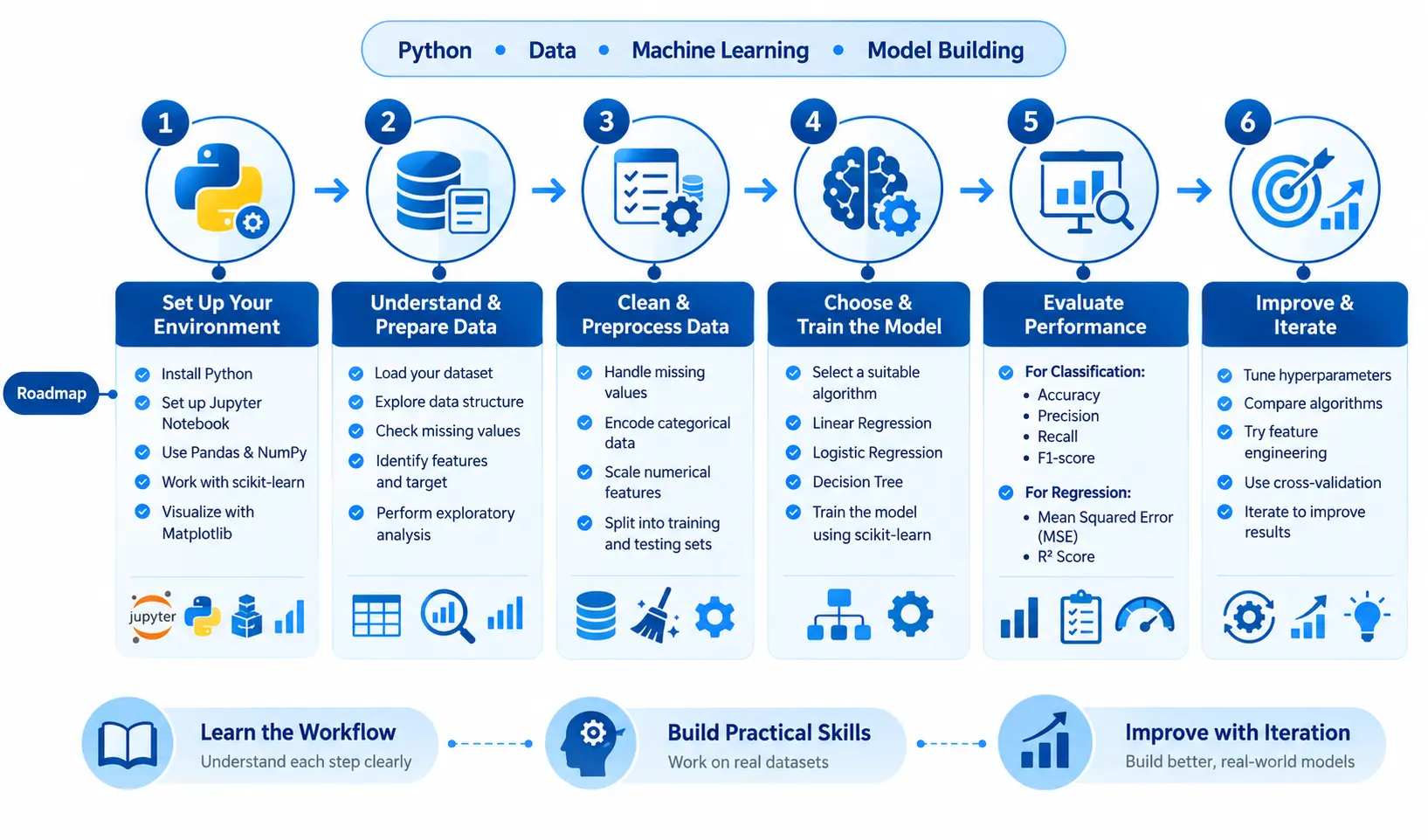
Step 1: Set Up Your Environment
Before writing a single line of model code, you need the right tools in place. Start by installing Python (version 3.8 or higher is ideal), along with essential libraries: pandas for data handling, numpy for numerical operations, scikit-learn for machine learning algorithms, and matplotlib or seaborn for visualization.
Using Jupyter Notebook is highly recommended at this stage. It allows you to run code in small, testable chunks and see results immediately, rather than executing an entire script and hoping for the best. This interactive style of learning is precisely how strong Machine Learning Classes in Pune teach beginners to build intuition alongside syntax. You learn by watching your code respond in real time, not by memorizing abstract rules.
Once your environment is ready, take a moment to install any additional packages you might need, such as xgboost for advanced algorithms or plotly for interactive visualizations. A clean, well-organized setup saves you hours of frustration later.
Step 2: Understand and Prepare Your Dataset
Every machine learning project starts with data, and understanding it deeply is absolutely non-negotiable. Load your dataset using pandas' read_csv() function, then begin exploring: check for missing values using isnull().sum(), understand the distribution of your features with describe(), and visually inspect relationships using scatter plots or histograms.
This stage, commonly called exploratory data analysis or EDA, is where many beginners make their first mistake, they rush through it to get to the "exciting" part of training a model. Resist that urge. A well-structured Machine Learning Training in Pune program will always emphasize that a model is only as good as the data feeding it. Spend real time here. Ask questions: Are there outliers skewing your results? Is your target variable balanced, or heavily skewed toward one class? Do certain features correlate strongly with your outcome, or with each other?
Answering these questions before you touch a single algorithm will save you countless hours of confusion down the line.
Step 3: Clean and Preprocess Your Data
Raw data is almost never ready for modeling straight out of the box. You'll typically need to handle several preprocessing tasks:
Handling missing values: You can either drop rows with missing data or fill them using strategies like mean, median, or mode imputation, depending on the nature of your dataset.
Encoding categorical variables: Machine learning algorithms work with numbers, not text. Techniques like one-hot encoding or label encoding convert categorical columns into a numerical format your model can understand.
Feature scaling: Algorithms like logistic regression and support vector machines are sensitive to the scale of your input features. Standardization or normalization ensures that no single variable dominates the learning process simply because of its numerical range.
Train-test split: Finally, split your dataset into training and testing sets, usually an 80-20 or 70-30 split, using scikit-learn's train_test_split() function. This ensures your model is evaluated on data it has never seen before, giving you an honest measure of how it will perform in the real world.
These preprocessing habits are foundational, and they're exactly the kind of practical detail covered in depth during any serious AI ML Course in Pune, where instructors emphasize that clean data pipelines are often more valuable than complex algorithms.
Step 4: Choose and Train Your Model
For your first project, start simple. Don't reach for deep learning or ensemble methods just yet, master the fundamentals first.
If you're predicting a continuous value, like house prices or sales figures, a linear regression model is your best starting point. If you're solving a classification problem, like predicting whether a customer will churn or whether an email is spam, logistic regression or a decision tree classifier are excellent, interpretable choices.
Using scikit-learn, training a model takes surprisingly little code:
You import the algorithm class, instantiate it, call the .fit() method on your training data, and you already have a working model. It really is that straightforward at a technical level. The real skill lies in understanding why a model performs the way it does, not just in calling the right function.
Don't worry about picking the "perfect" algorithm right away. The goal at this stage is understanding the full workflow: data in, model trained, predictions out. Accuracy and optimization come later, with experience.
Step 5: Evaluate Your Model's Performance
Once your model is trained, the real test begins: how well does it actually perform? Use your test set to generate predictions, then compare them against actual outcomes using appropriate metrics.
For classification tasks, look at accuracy, precision, recall, and the F1 score. Accuracy alone can be misleading, especially with imbalanced datasets, so understanding precision and recall gives you a fuller picture of your model's strengths and weaknesses. A confusion matrix is also an incredibly useful visualization at this stage, showing you exactly where your model is getting confused.
For regression tasks, metrics like mean squared error (MSE), root mean squared error (RMSE), and R-squared tell you how close your predictions are to reality.
This evaluation step is where many learners realize an important truth: building a model is easy, but building a good model takes iteration, thoughtful feature engineering, and a genuine understanding of the problem you're solving. If you want to go deeper into these evaluation techniques and the statistical reasoning behind them, a machine learning certification course in Pune can provide structured guidance, expert feedback, and real-world case studies that self-study often lacks.
Step 6: Improve and Iterate
Your first model is rarely your best model, and that's completely normal. Improvement comes through iteration:
Hyperparameter tuning: Adjust settings like the number of trees in a random forest, or the regularization strength in logistic regression, using techniques like grid search or random search.
Feature engineering: Create new features from your existing data that might better capture underlying patterns, this is often where the biggest performance gains come from.
Trying different algorithms: Compare how a decision tree performs against a random forest, or how logistic regression stacks up against a support vector machine, for your specific problem.
Cross-validation: Instead of relying on a single train-test split, use k-fold cross-validation to get a more robust estimate of your model's real-world performance.
This iterative mindset is what separates hobbyist experimentation from professional-grade machine learning work, and it's a core focus in any advanced machine learning course in Pune designed for learners ready to move beyond the basics and into production-level thinking.
Common Mistakes Beginners Make
As you work through your first few projects, watch out for a few common pitfalls: skipping exploratory data analysis because it feels tedious, ignoring data leakage (where information from your test set accidentally influences training), overfitting your model by making it too complex for the amount of data available, and neglecting to interpret your results in a business context. Understanding why a model works is just as important as knowing how to build one.
Where to Go From Here
If working through this tutorial sparked genuine excitement, that's a strong signal you're ready to formalize your learning journey. Self-guided tutorials are a fantastic starting point, but structured mentorship accelerates your growth exponentially, helping you avoid common mistakes and understand industry best practices from day one.
Whether you're based in the city center or exploring machine learning classes in Pimpri Chinchwad, structured, in-person or hybrid mentorship makes an enormous difference in how quickly you progress from beginner to job-ready professional. For working professionals who can't commit to a traditional classroom schedule, an online machine learning course with placement support offers the flexibility to learn without pausing your career, while still building a genuinely job-ready portfolio.
And if you're serious about finding the best machine learning course in Pune, look beyond flashy marketing. Prioritize programs that combine strong theoretical fundamentals with real, substantial projects, dedicated industry mentorship, and genuine placement assistance, not just pre-recorded video lectures and a certificate at the end. Look specifically for a Machine Learning Course in Pune with placement built into the curriculum from day one, not bolted on as an afterthought once your classes conclude.
Conclusion
Building your first machine learning model is a genuine milestone worth celebrating, but it's only the beginning of a much larger, more rewarding journey. The concepts you practiced here, data preparation, model training, evaluation, and iteration, form the backbone of every advanced machine learning application you'll encounter as your skills grow. Mastering these fundamentals now sets the foundation for everything from deep learning to generative AI down the road.
At IntelliBI Innovations Technologies, we believe the best way to learn machine learning is by doing it, one dataset, one model, and one breakthrough at a time. If this tutorial has convinced you that this is the career path for you, structured training, real mentorship, and hands-on project experience are exactly where that journey should continue. Your first model was just the beginning, what you build next is entirely up to you.