
How to Become an Azure Data Engineer in Pune: Step-by-Step Guide
Quick Answer
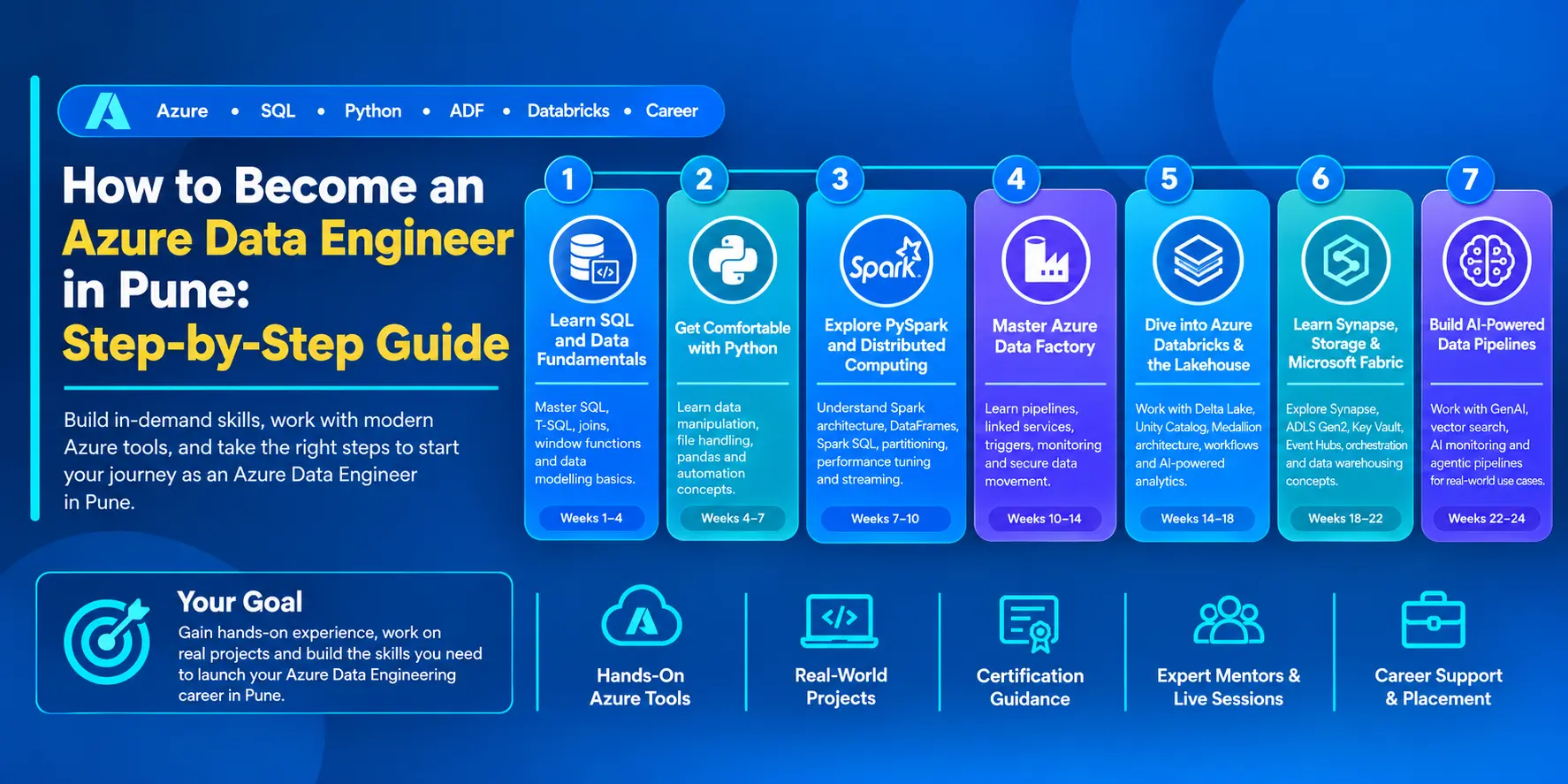
To become an Azure Data Engineer in Pune, learn SQL and Python first, then PySpark, Azure Data Factory, Azure Databricks, Synapse Analytics and ADLS Gen2. Build 3–5 end-to-end pipeline projects (Medallion lakehouse, data warehouse, streaming), prepare for Microsoft DP-700 or DP-750, and practise interview questions. A structured Azure Data Engineer Course in Pune such as IntelliBI's 4–5 month, project-based program in Thergaon (PCMC) covers all of this with placement support.
How to Become an Azure Data Engineer in Pune: Step-by-Step Guide
Every company in Hinjewadi, Kharadi, Magarpatta and Pimpri-Chinchwad is sitting on more data than it knows what to do with. Sales records, sensor logs, clinical trials, insurance claims, app events: all of it has to be collected, cleaned, stored and served before anyone can build a dashboard or train an AI model. The people who make that happen are data engineers, and in Pune, where enterprises lean heavily on Microsoft's cloud, the most in-demand version of that role is the Azure Data Engineer.
If you are a fresher, a working professional stuck in support or testing, or someone from a non-IT background wondering whether this path is realistic, this guide is for you. We will walk through exactly what an Azure Data Engineer does, the skills you need in order, the certifications that matter in 2026, the projects that get you hired, and how a structured Azure Data Engineer Course in Pune can compress a two-year self-study journey into four to five focused months.
What Does an Azure Data Engineer Actually Do?
An Azure Data Engineer designs and runs the pipelines that move data from source systems into analytics-ready storage on Microsoft Azure. On a typical day that means building ingestion pipelines in Azure Data Factory, transforming data with PySpark in Azure Databricks, modelling it into a warehouse in Synapse Analytics or a Delta Lake lakehouse, securing it with Key Vault and Entra ID, and monitoring everything so that the morning reports are correct and on time.
What makes the role rewarding is that it sits between raw chaos and real decisions. The analysts, data scientists and AI teams downstream can only be as good as the data you deliver. That is also why salaries are strong: in Pune, entry-level data engineers in IT services typically start around ₹4–6.5 LPA, mid-level engineers with three to five years of Azure experience earn ₹12–26 LPA depending on the industry, and senior engineers in finance, manufacturing and product companies cross ₹30 LPA. Working professionals who complete an Azure Training in Pune and switch into this role commonly report jumps into the ₹15–40 LPA band.
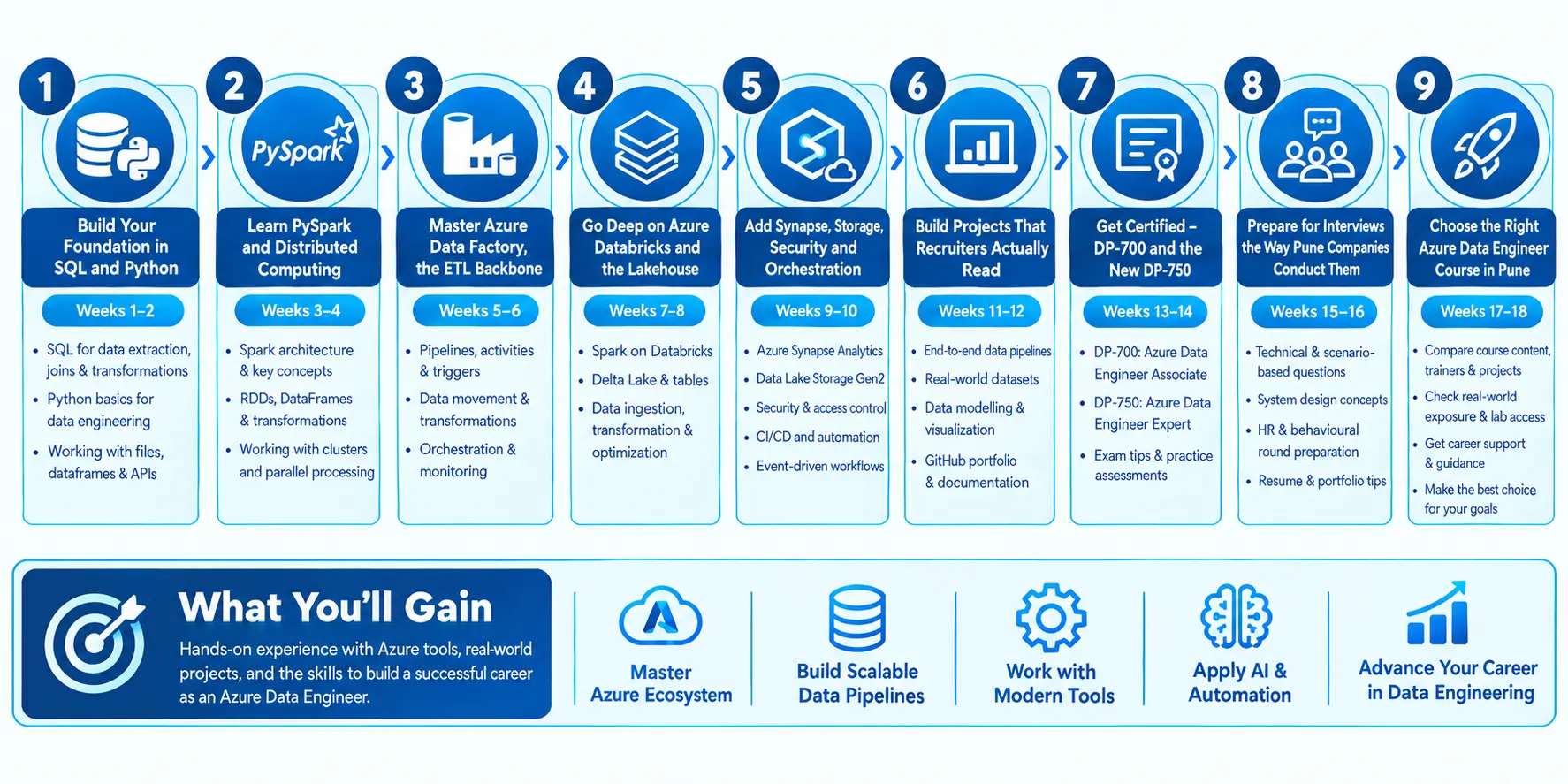
Step 1: Build Your Foundation in SQL and Python
Before you touch any cloud console, you need two languages. SQL is the language of data; Python is the language of automation.
Start with SQL Server and T-SQL: SELECT to HAVING, joins and set operators, subqueries and CTEs, window functions, indexes and query tuning, views, and stored procedures. These are not "basics" you move past; senior Azure engineers write SQL every single day, and the hardest interview rounds at Pune MNCs are still SQL rounds.
Then move to Python: data types and operators, functions, file handling, working with CSV, JSON and Parquet, pandas for transformation, and enough multithreading to understand how pipelines parallelise work. A good Microsoft Azure Course in Pune will not skip this stage, because every Databricks notebook and every Data Factory custom activity you build later depends on it.
Time to allocate: four to six weeks of daily practice.
Step 2: Learn PySpark and Distributed Computing
Azure's data services are built on Apache Spark, so the next step is PySpark. You should understand Spark architecture (driver, executors, cluster manager), the DAG-to-stages-to-tasks execution model, DataFrames and Spark SQL, user-defined functions, file formats and partitioning, caching and storage levels, and performance topics such as data skew, broadcast joins and Adaptive Query Execution. Structured Streaming rounds it out.
This is the module most self-learners rush through, and it shows in interviews. "Why did your job fail with an out-of-memory error?" is a question you will hear in every Azure Databricks Training in Pune worth attending, because it is a question you will hear in every real interview.
Step 3: Master Azure Data Factory, the ETL Backbone
Azure Data Factory (ADF) is the orchestration and ingestion service at the centre of most Azure data platforms, which is why Azure Data Factory Training in Pune is the single most requested module in our enquiries.
Here is what you need to know, roughly in order:
- Azure fundamentals: subscriptions, resource groups, regions, storage accounts and provisioning ADF through the portal or ARM templates.
- Linked services, datasets and integration runtimes: Azure IR, Self-Hosted IR for on-premise SQL Server, and SSIS IR for lifting legacy packages.
- Copy activity, mapping data flows, parameterised and metadata-driven pipelines, incremental loads and change data capture.
- Connecting ADF to ADLS Gen2, Synapse Analytics, Azure SQL Database, Databricks notebooks, Azure Functions and Logic Apps.
- Git integration, triggers, monitoring and alerting.
Think of this as your Azure ETL Training in Pune core: by the end you should be able to take an on-premise database and land it, incrementally and securely, in a cloud data lake on a schedule, without manual intervention.
Step 4: Go Deep on Azure Databricks and the Lakehouse
If ADF moves the data, Databricks is where the heavy transformation happens. In 2026, Databricks skills carry the biggest premium in Pune job descriptions, and Microsoft has just launched a dedicated certification for it (more on that below).
Your Azure Databricks Training in Pune should cover the workspace, clusters and jobs; Auto Loader for incremental ingestion; Delta Lake with ACID transactions, time travel, schema evolution and Change Data Feed; Unity Catalog for governance; Medallion architecture (Bronze, Silver, Gold); Databricks Workflows and pipelines; CI/CD with Repos and Asset Bundles; and Databricks SQL with AI/BI dashboards and Genie for natural-language analytics.
This is also where the AI era meets data engineering. Modern programs now include LLMs, retrieval-augmented generation, vector search and agentic tool use with MCP, so that you can build AI-ready data products rather than just tables. That is the difference between a 2022 data engineer and a 2026 one.
Step 5: Add Synapse, Storage, Security and Orchestration
A complete Azure Cloud Training in Pune covers the services around the two big ones:
- Azure Synapse Analytics: architecture and pricing, pipelines, dedicated and serverless SQL pools, and Spark pools.
- Azure Data Lake Storage Gen2 and Blob Storage: containers, hierarchical namespaces, access tiers.
- Azure Key Vault, Microsoft Entra ID and Managed Identity: how real companies secure pipelines without passwords in code.
- Azure Event Hubs for streaming ingestion.
- Apache Airflow (and an introduction to Dagster) for orchestration beyond ADF, including DAGs, scheduling, backfills and XComs.
- Data warehousing theory: Kimball dimensional modelling, slowly changing dimensions (Type 2 is an interview favourite) and ETL versus ELT design.
When all of these come together in one learning path, that is what a genuine Microsoft Azure Data Engineering Course looks like, as opposed to a tool tutorial.
Step 6: Build Projects That Recruiters Actually Read
Here is the uncomfortable truth about hiring in Pune: a certificate gets your CV opened; a project gets you the interview. Recruiters at Hinjewadi product companies and PCMC manufacturing groups ask the same question in every screening call: "Tell me about a pipeline you built end to end."
Aim for a portfolio of three to five production-style projects. Good examples, and the ones our learners build:
- An end-to-end Medallion lakehouse: raw e-commerce events landed in ADLS with Auto Loader, cleaned in Silver, aggregated in Gold Delta tables, served to a dashboard.
- An enterprise retail sales data warehouse in Synapse with a star schema and SCD Type 2 dimensions.
- A healthcare data processing and automation pipeline with ADF, hybrid on-premise ingestion and Key Vault secrets.
- A revenue and claims analytics platform for insurance with streaming ingestion and quality checks.
- A Python plus Airflow pipeline, scheduled and monitored, so you can show orchestration outside the Azure UI.
Document each project on GitHub with an architecture diagram, a README that explains the business problem, and a short note on what broke and how you fixed it. That last section is what separates a copied tutorial from real engineering experience.
Step 7: Get Certified – DP-700 and the New DP-750
Certifications matter more in Azure than in most ecosystems because Microsoft partners and enterprise clients ask for them. The landscape changed recently, so make sure you are targeting the right exams:
- DP-203 (the old Azure Data Engineer Associate) has been retired.
- DP-700, Microsoft Certified: Fabric Data Engineer Associate, is now the mainstream Azure data engineering certification, covering ingestion, transformation, lakehouse and warehouse design on Fabric and Azure.
- DP-750, Azure Databricks Data Engineer Associate, is Microsoft's new 2026 exam focused entirely on Databricks data engineering; it entered beta in March 2026 and is already appearing in job descriptions.
- Databricks Certified Data Engineer Associate and Professional remain the vendor-neutral gold standard for lakehouse skills.
A well-designed Azure Certification Course in Pune should map every module to these exam objectives so that your training and exam prep are the same work, not two separate efforts. Budget roughly ₹5,000 plus GST per Microsoft exam attempt and schedule it within four weeks of finishing the relevant module, while the material is fresh.
Step 8: Prepare for Interviews the Way Pune Companies Conduct Them
Azure Data Engineer interviews in Pune generally run in four rounds: SQL and Python coding, a technology round on ADF, Databricks and Synapse, a system design round ("design a pipeline for 10 TB of daily clickstream data"), and a project discussion. Prepare for each deliberately:
- Work through technology-wise question banks: 50 questions each on SQL, PySpark, ADF and Databricks.
- Practise scenario and coding challenges in a HackerRank or LeetCode style.
- Rehearse your projects out loud until you can draw the architecture on a whiteboard in two minutes.
- Do at least two mock interviews with senior engineers, not friends.
- Prepare STAR-format answers for HR questions, and know your salary number before the call.
Alongside this, build an ATS-friendly resume and a LinkedIn profile that uses the exact keywords recruiters search for: Azure Data Factory, Azure Databricks, PySpark, Delta Lake, Synapse, DP-700.
Step 9: Choose the Right Azure Data Engineer Course in Pune
Can you do all of this alone with YouTube and documentation? Some people do. Most do not, because the path has too many moving parts and no feedback loop. If you decide to join a program, here is what to look for in the Best Azure Data Engineering Course in Pune:
- A full learning path, not a tool tutorial: SQL, Python, PySpark, ADF, Databricks, Synapse, Azure services, Airflow and data warehousing in one sequence.
- Real projects across industries (retail, healthcare, insurance, banking), with code you own.
- Trainers who are working Azure data engineers with 10–15 years of enterprise experience, not career instructors.
- Alignment to DP-700, DP-750 and Databricks certifications.
- Batches built for working professionals: weekday 7–9 PM, weekend 10 AM–2 PM, with recordings and lifetime LMS access.
- Placement support that does not expire: mock interviews, referrals, a hiring-partner network, and help until you are placed.
- A physical classroom you can actually reach. For learners in PCMC, Hinjewadi, Wakad, Nigdi, Baner and Aundh, a Thergaon centre is ten minutes away rather than an hour across the city.
IntelliBI Innovations Technologies built its Azure Data Engineer Course in Pune around exactly this checklist: a 4–5 month, 250+ hour, project-driven program at Dange Chowk, Thergaon, with live online and recorded options for anyone outside Pune. Learners have built 2,200+ career transformations through IntelliBI programs, with a 300+ company hiring-partner network and senior mentors from TCS, Persistent and Deloitte backgrounds.
A Realistic Timeline from Zero to Azure Data Engineer
Here is how the journey looks when it is structured, whether you follow it independently or through Azure Training in Pune at IntelliBI:
- Weeks 1–5: SQL Server and Python, with daily practice problems and your first small ETL script.
- Weeks 6–9: PySpark fundamentals, Spark architecture, performance tuning and streaming basics.
- Weeks 10–13: Azure Data Factory and Azure services, culminating in a hybrid ingestion project.
- Weeks 14–17: Azure Databricks, Delta Lake, Unity Catalog and your Medallion lakehouse capstone.
- Weeks 18–19: Synapse Analytics, data warehousing and Airflow orchestration.
- Week 20: GenAI and agentic AI for data engineers, plus production monitoring.
- Weeks 21–22: Interview preparation, mock interviews, certification exams, resume and LinkedIn.
Twenty-two weeks is roughly five months of evening and weekend effort. That is the same amount of time most people spend "planning to start".
Who Should Take This Path?
Freshers with any graduate degree who are willing to put in daily practice can reach entry-level roles, especially with a strong project portfolio. Working professionals in manual testing, support, SQL development, SSIS or Informatica ETL, and Power BI development have the easiest transition, because they already understand data and simply need the cloud and Spark layers. Career switchers from non-IT backgrounds succeed too; it takes longer at the SQL and Python stage, and a program with mentors makes the difference between finishing and giving up.
The one group this is not for: people looking for a shortcut. Azure data engineering is a practical craft. The learners who get hired are the ones who built, broke and fixed real pipelines.
Frequently Asked Questions
Do I need coding experience to join an Azure Data Engineer Course in Pune? No. Good programs start from SQL and Python basics. You need discipline, not a prior IT job.
How long does it take to become an Azure Data Engineer? Four to five months of structured learning with projects, or 12–24 months self-taught alongside a job.
Which certification should I take first, DP-700 or DP-750? If your target roles mention Fabric or general Azure data engineering, take DP-700 first. If the job descriptions you are reading are Databricks-heavy, which is increasingly common in Pune, DP-750 is the better first exam.
Is Azure or AWS better for a data engineer in Pune? Both are valuable, but Pune's enterprise market, especially manufacturing, finance and IT services, leans Azure. Many professionals learn Azure first and add AWS later; our flagship data engineering track covers both.
What is the salary after an Azure Data Engineer course? Freshers typically start between ₹4 and ₹7 LPA in Pune; experienced professionals who upskill into Azure data engineering commonly move into the ₹15–40 LPA range depending on prior experience and industry.
Your Next Step
Becoming an Azure Data Engineer in Pune is not about collecting tools; it is about building the ability to turn messy, real-world data into something reliable, and proving it through projects, certifications and interviews. Follow the nine steps above in order, be honest about the fundamentals, and the cloud layers will come faster than you expect.
If you would rather do it with a mentor, a cohort and a placement team behind you, book a free demo class for the Microsoft Azure Course in Pune at IntelliBI Innovations Technologies. Visit us at Sagar Complex, Dange Chowk, Thergaon, or join live online, and see what a project-driven Azure Data Engineering Course in Pune looks like from the inside. The next batch starts this October; your first pipeline could be running before Diwali.