
How to Become a Data Engineer in India in 2026: A Practical Guide
Quick Answer
To become a data engineer in India in 2026, learn SQL and Python first, then PySpark, Databricks (Delta Lake, Unity Catalog), one cloud (Azure Data Factory/Synapse or AWS Glue/Redshift), Apache Airflow and data warehousing, plus basics of GenAI and RAG pipelines. Build 5–10 real projects, earn DP-700, DP-750 or AWS DEA-C01, and practise SQL, PySpark and system-design interviews. A structured Data Engineering Course in Pune makes this achievable in 4–5 months (250–300 hours).
How to Become a Data Engineer in India in 2026: A Practical Guide
Every company in India is now a data company, whether it sells insurance, runs a hospital chain or ships groceries in thirty minutes. Behind every dashboard, every recommendation and every AI model sits a data engineer who collected, cleaned and delivered the data on time. That is why data engineering has become one of the most dependable tech careers in the country, and why so many working professionals in Pune are asking the same question: how do I actually get in?
This guide answers that question step by step. It is written for freshers, for people from non-IT backgrounds, and for professionals in testing, support, SQL development or BI who want to move into a higher-paying, future-proof role. It also explains what to look for in a Data Engineering Course in Pune, because the right training shortens the journey from months of confusion to a clear, project-backed path.
What Does a Data Engineer Actually Do in 2026?
A data engineer builds the pipelines that move data from where it is created (apps, sensors, ERP systems, payment gateways) to where it is used (warehouses, lakehouses, dashboards and AI models). The job has four parts: ingest data reliably, transform it into clean, trusted tables, store it in the right format and layer, and serve it to analysts, scientists and applications.
In 2026 the role has widened. Data engineers are expected to run streaming pipelines, manage lakehouse platforms such as Databricks and Microsoft Fabric, control cloud costs, and increasingly build the data foundations for generative AI, retrieval-augmented generation (RAG) and agentic AI systems. That is why an Advanced Data Engineer Course in Pune now includes modules on LLMs, vector search and AI-powered pipeline monitoring, not just ETL.
Why Data Engineering Is a Smart Career Move in India
Three facts explain the demand. First, Indian enterprises are migrating from on-premise SQL Server, Informatica and Hadoop stacks to Azure, AWS and Databricks, and every migration needs engineers who know both worlds. Second, every AI initiative is bottlenecked by data quality, so AI budgets flow to data engineering teams. Third, there are far fewer qualified data engineers than data analysts or software testers, which keeps salaries high.
Pune, in particular, is a data engineering hub. Hinjewadi, Kharadi, Magarpatta and the Pimpri-Chinchwad industrial belt host IT services firms, product companies, banks, insurers and manufacturers that all run Azure- or AWS-based data platforms. Pune enterprises lean strongly towards Azure, which is one reason an Azure Data Engineer Course in Pune is such a popular entry point. Typical salary bands in the city in 2026 run from roughly ₹4–6.5 LPA for freshers in IT services to ₹9–16 LPA for freshers at product companies, ₹7–30 LPA with three to five years of experience, and ₹20–45 LPA for senior engineers in finance and manufacturing. Engineers who already know Databricks, Delta Lake and Azure-native tooling consistently skip the queue.
Step 1: Build the Foundation with SQL and Python
Every data engineering journey starts with two languages. SQL is non-negotiable: joins, window functions, CTEs, indexes, stored procedures and query tuning are asked in almost every interview. Python comes next: file handling, pandas, working with CSV, JSON and Parquet, APIs, multithreading and writing clean, reusable functions.
If you come from a non-IT background, this is where you spend your first four to six weeks. The good news is that no prior coding knowledge is required to begin. Good Data Engineering Classes in Pune start exactly here, with SQL Server and Python taught from scratch, and move to distributed computing only after you can comfortably write production-style queries and scripts.
Step 2: Learn Distributed Processing with PySpark
Once data grows beyond a single machine, you need Apache Spark. PySpark is the Python interface to Spark and the most in-demand processing skill in Indian job descriptions. You should understand Spark architecture (driver, executors, DAGs, stages and tasks), DataFrames and Spark SQL, file formats such as Parquet and Delta, caching and partitioning, data skew and performance tuning, and Structured Streaming for real-time data.
Performance tuning is the single most asked PySpark topic in interviews. Any serious Data Engineering Training in Pune should make you debug slow jobs in the Spark UI, not just run tutorials in a notebook.
Step 3: Master the Lakehouse with Databricks
Databricks has become the default platform for modern data engineering on both Azure and AWS, and it is the common thread across almost every Pune job posting for data engineers. You need to know the Lakehouse architecture, Auto Loader for ingestion, Delta Lake (ACID transactions, time travel, schema evolution and Change Data Feed), Unity Catalog for governance, Databricks Workflows and pipelines for orchestration, CI/CD with Repos and Asset Bundles, and Databricks SQL with AI/BI dashboards and Genie for natural-language analytics.
The most convincing portfolio project you can build is an end-to-end Medallion pipeline: raw events land in Bronze, get cleaned and conformed in Silver, and are modelled into Gold tables that feed a dashboard. Quality Databricks Training in Pune walks you through exactly this build, with the same tooling used in enterprise accounts.
Step 4: Pick a Cloud, Then Learn the Second One
Cloud is where data engineering lives today. On Azure, the core services are Azure Data Factory (pipelines, linked services, integration runtimes, hybrid ingestion from on-premise), Azure Synapse Analytics (serverless SQL pools and Spark pools), ADLS Gen2, Key Vault, Entra ID with managed identities, and Microsoft Fabric. On AWS, the equivalents are S3, Glue (Data Catalog, crawlers and ETL jobs), EMR, Lambda, Athena and Redshift, plus IAM and cost optimisation.
Start with the cloud your target employers use, and check that any Data Engineering Classes in Pune you consider cover it hands-on. In Pune, that usually means Azure first, which is why many learners begin with an Azure Data Engineer Course in Pune and add AWS afterwards using an Azure-to-AWS mindset (ADF maps to Glue, Synapse to Redshift, ADLS to S3, Event Hubs to Kinesis). Being able to work on both clouds is what separates a ₹12 LPA offer from a ₹20 LPA offer. This is also the gap that general cloud engineer courses in Pune often leave: they teach infrastructure and DevOps, not data pipelines, so make sure your training is built for data engineering specifically.
Step 5: Add Orchestration, Modelling and Data Warehousing
Pipelines need a scheduler, and an Advanced Data Engineer Course in Pune will treat orchestration as a core module rather than an afterthought. Apache Airflow (DAGs, operators, scheduling, backfills, XComs and connections) is the industry standard, and Databricks Workflows and Dagster are worth knowing. Equally important is data warehousing theory: Kimball dimensional modelling, star schemas, slowly changing dimensions (SCD Type 2), and the difference between ETL and ELT. In 2026, conceptual knowledge such as modelling, idempotency, data quality and observability matters more than ever, because AI coding assistants have made syntax cheap while design judgement remains scarce.
Step 6: Learn the AI Layer That Employers Now Expect
The newest expectation is that data engineers can support AI workloads. That means understanding LLM basics, building RAG pipelines with vector search, using tools like Genie for natural-language analytics, and working with the Model Context Protocol (MCP) so AI agents can safely call data tools. It also means using AI to monitor and auto-triage pipeline failures. Very few programmes teach this yet, so choosing a Data Engineer Course in Pune that includes a GenAI and agentic AI module gives you a visible edge in interviews.
Step 7: Build Real Projects, Not Toy Demos
Recruiters in Pune do not hire on certificates alone; they hire on projects you can explain line by line. Aim for at least five portfolio projects across different domains, for example:
- A retail sales data warehouse on Azure Synapse with SCD Type 2 dimensions.
- A healthcare data processing and automation pipeline built with ADF and Databricks.
- An end-to-end Medallion Lakehouse on Databricks with Auto Loader and Delta Live Tables.
- An insurance revenue and claims analytics platform with Airflow orchestration.
- A RAG chatbot over lakehouse data using vector search.
Push every project to GitHub with a README, architecture diagram and cost notes. This portfolio is what the Best Data Engineering Course in Pune should leave you with, because it is the single strongest asset in a career switch.
Step 8: Get Certified (Strategically)
Certifications validate what your projects demonstrate. In 2026 the relevant exams are Microsoft DP-700 (Fabric Data Engineer Associate, which replaced DP-203), the new DP-750 (Azure Databricks Data Engineer Associate), the Databricks Certified Data Engineer Associate and Professional, and the AWS Certified Data Engineer – Associate (DEA-C01). Pick one or two that match your target stack; Databricks Training in Pune paired with an Azure Data Engineer Course in Pune covers the most common combination. A well-designed Data Engineering Course in Pune maps its modules directly to these exam objectives, so you prepare for the certification while you learn the job.
Step 9: Prepare for Interviews the Way Companies Hire
Data engineering interviews in India typically have four rounds: SQL and Python coding (HackerRank or LeetCode style), a PySpark or Databricks technical round focused on optimisation, a system design round where you design a pipeline for a business case, and an HR round. Prepare technology-wise question banks (the Best Data Engineering Course in Pune will hand you these), practise explaining your projects end to end, and run mock interviews with senior engineers. An ATS-friendly resume and an optimised LinkedIn profile matter more than most candidates realise, because the first filter is often a recruiter search for "Azure Data Engineer Pune" or "Databricks".
How Long Does It Take?
With a structured plan, a working professional can become job-ready in four to five months at roughly 250 to 300 hours of learning, which is achievable with evening classes (7–9 PM on weekdays) or weekend batches (Saturday and Sunday mornings). Self-study without a roadmap, or generic cloud engineer courses in Pune that skip data pipelines, commonly takes twelve to eighteen months and often stalls at the cloud stage. The time you save is the main reason to invest in a well-run Data Engineering Course in Pune rather than stitching together free videos.
How to Choose the Best Data Engineering Institute in Pune
Not all training is equal. Use this checklist when you compare any Data Engineering Course in Pune:
- Syllabus depth: SQL, Python, PySpark, Databricks, Azure Data Factory, Synapse, AWS Glue and Redshift, Airflow, data warehousing and a GenAI module. If the brochure stops at Hadoop and Hive, walk away.
- Trainers: senior engineers with ten to fifteen years of enterprise experience, not fresh graduates reading slides.
- Projects: at least ten production-grade projects across healthcare, banking, retail and insurance, built by you, not demonstrated to you.
- Certification alignment: DP-700, DP-750, Databricks and DEA-C01 mapped to modules.
- Format: classroom plus live online plus lifetime recordings, with batches that fit a working schedule.
- Placement support: mock interviews, resume and LinkedIn optimisation, referrals, and support that continues until you are placed.
- Proof: verifiable Google reviews, alumni you can speak to, and hiring-partner names.
The Best Data Engineering Institute in Pune will tick every box without hesitation. Ask for a free demo class and judge the teaching yourself before you pay.
Why Professionals Choose IntelliBI for Data Engineering Training in Pune
IntelliBI Innovations Technologies, based at Dange Chowk, Thergaon in Pimpri-Chinchwad, about ten minutes from Hinjewadi Phase 1, built its Data Engineering Course in Pune around exactly the roadmap above. The programme runs for four to five months with 300 hours of hands-on training that covers SQL, Python, PySpark, Databricks, Azure Data Factory, Azure Synapse, AWS (S3, Glue, EMR, Lambda, Athena, Redshift), Apache Airflow, data warehousing, and a dedicated GenAI and agentic AI module with LLMs, RAG, vector search and MCP.
Learners build more than ten enterprise-level projects, prepare for DP-700, DP-750, Databricks and DEA-C01 certifications, and receive interview preparation that mirrors real hiring rounds: technology-wise question banks, scenario-based coding challenges, system design rounds and mock interviews with senior professionals. Classes are available in classroom, live online and recorded formats, with evening and weekend batches for working professionals. With 2,200+ career transformations, a 4.9-star Google rating and a network of 300+ hiring partners, this Data Engineer Course in Pune is designed to take you from your first SQL query to your first data engineering offer letter.
Frequently Asked Questions About a Data Engineering Course in Pune
Can I become a data engineer without an IT background? Yes. Many successful data engineers in Pune started in testing, support, mechanical engineering, finance or teaching. You need strong SQL, working Python and a project portfolio, all of which a structured programme builds from zero.
Is Azure or AWS better for data engineering in India? Azure has a larger footprint in Pune's enterprises and is the easier first cloud; AWS is strong in product companies and start-ups. Learn one deeply, then map it to the other. Multi-cloud engineers earn more.
Do I need Databricks to get a data engineering job? In 2026, Databricks appears in most Indian data engineering job descriptions. Databricks Training in Pune that covers Delta Lake, Unity Catalog and Workflows is close to essential.
What salary can a fresher data engineer expect in Pune? Roughly ₹4–6.5 LPA in IT services and ₹9–16 LPA at product companies, rising quickly with Azure, Databricks and AWS skills and a strong portfolio.
Which certification should I take first? If you are Azure-focused, DP-700 followed by DP-750; if AWS-focused, DEA-C01. Pair either with the Databricks Certified Data Engineer Associate.
Your Next Step
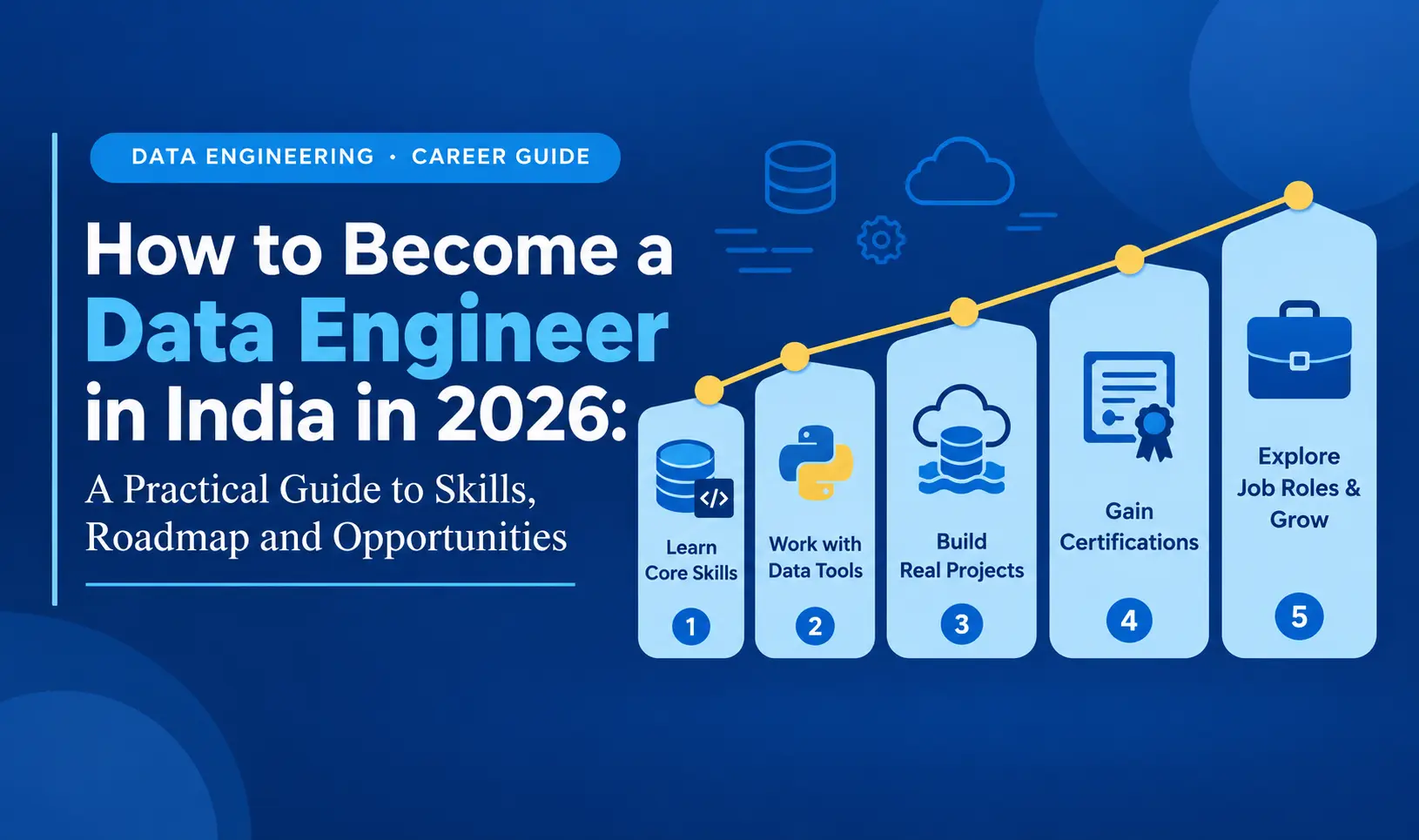
Becoming a data engineer in India in 2026 is a clear, learnable path: foundations, Spark, Databricks, cloud, orchestration, modelling, the AI layer, projects, certification and interview practice. The difference between people who complete the journey and those who stall is structure and mentorship. If you are ready to commit four to five months, explore the Data Engineering Training in Pune at IntelliBI, book a free demo class, and start building the pipelines that every AI-driven business now depends on.