
GraphRAG vs Vector RAG: Choosing for Relationship-Based Questions
Quick Answer
Vector RAG retrieves information using semantic similarity between text embeddings, making it suitable for document search and contextual question answering. GraphRAG uses knowledge graphs to identify entities and relationships, making it useful for multi-hop and relationship-based questions. Hybrid RAG combines both approaches to support complex enterprise AI applications.
GraphRAG vs Vector RAG: Choosing for Relationship-Based Questions
Retrieval-Augmented Generation (RAG) has become an important technique for building AI applications that provide answers using external knowledge rather than relying entirely on information learned during model training. From enterprise knowledge assistants to customer support applications, RAG helps Large Language Models (LLMs) retrieve relevant information before generating responses.
However, not every business question can be answered effectively through traditional semantic search.
Consider an enterprise employee asking:
"Which suppliers are connected to the manufacturing plants affected by the recent delivery delays, and which products could experience production disruptions?"
This question requires more than finding documents containing similar words. The AI system must identify suppliers, manufacturing plants, delivery delays, products and the relationships connecting them.
This is where GraphRAG becomes valuable.
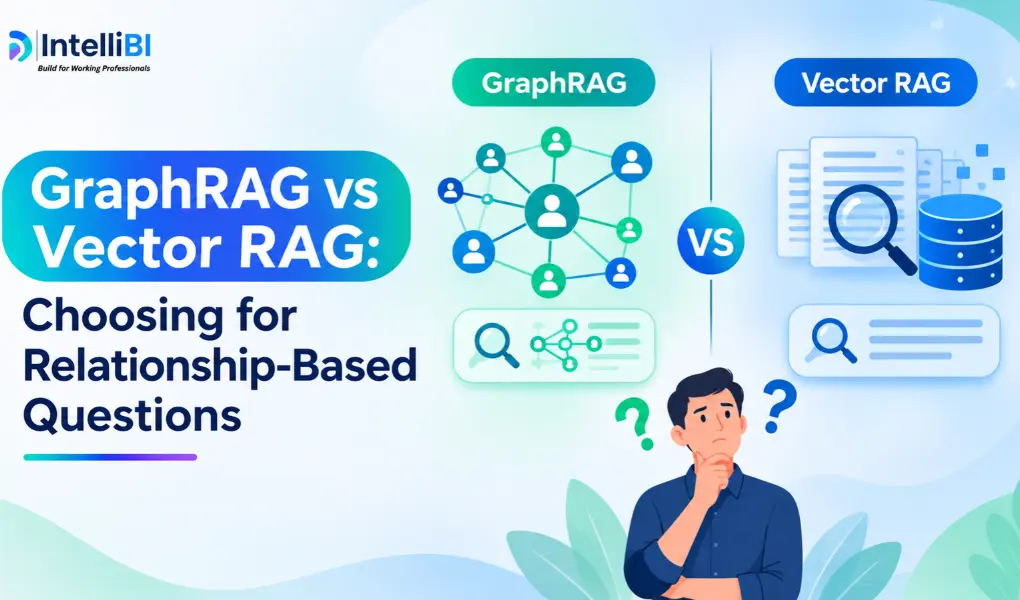
Vector RAG retrieves information based primarily on semantic similarity, whereas GraphRAG uses knowledge graphs to understand entities and their relationships. Both approaches can improve AI-powered information retrieval, but they solve different challenges.
For professionals exploring an Artificial Intelligence Course in Pune, understanding these architectures is useful because modern AI applications increasingly combine LLMs, vector databases, knowledge graphs and advanced retrieval techniques.
In this guide, we will compare GraphRAG and Vector RAG, understand their architectures, examine practical enterprise examples and identify when each approach should be used.
1. What Is Vector RAG?
Vector RAG is a retrieval architecture that uses vector embeddings to find information relevant to a user's question.
An embedding is a numerical representation of text that captures aspects of its meaning. Text with similar semantic meaning generally has nearby vector representations in an embedding space.
Instead of searching only for exact keywords, vector search can retrieve documents based on contextual similarity.
How Vector RAG works
A typical Vector RAG pipeline includes the following steps:
Step 1: Collect documents
The system collects information from PDFs, Word documents, websites, databases and internal knowledge repositories.
Step 2: Split documents into chunks
Large documents are divided into smaller sections called chunks. This makes retrieval more focused and manageable.
Step 3: Generate embeddings
An embedding model converts each chunk into a numerical vector.
Step 4: Store vectors
The generated embeddings and associated metadata are stored in a vector database.
Step 5: Process the user query
When a user asks a question, the system converts that question into an embedding using a compatible embedding model.
Step 6: Retrieve relevant information
The vector database searches for chunks that are semantically similar to the query.
Step 7: Generate the response
The retrieved information is passed to the LLM as context, and the model generates an answer.
Example of Vector RAG
Imagine an organization maintaining thousands of employee policy documents.
An employee asks:
"What is the company's work-from-home policy?"
Vector RAG searches the document collection and retrieves relevant sections discussing remote work, eligibility, approval procedures and working hours.
The LLM uses these retrieved sections to generate a response.
This approach works well because the answer is usually contained in one or a few related document sections.
Common technologies used in Vector RAG
- Embedding models: OpenAI embeddings, BGE and Sentence Transformers.
- Vector databases: Pinecone, Weaviate, Qdrant and Milvus.
- Frameworks: LangChain and LlamaIndex.
- LLMs: GPT models and other compatible language models.
2. What Is GraphRAG?
GraphRAG is a retrieval approach that uses a knowledge graph to represent information through entities and their relationships.
A knowledge graph consists of:
- Nodes: Represent entities such as people, companies, products and locations.
- Edges: Represent relationships between entities.
- Properties: Store additional information about nodes and relationships.
Unlike a conventional document retrieval system, a knowledge graph explicitly represents how different pieces of information are connected.
For example:
A company supplies components to a manufacturing plant. The plant produces products, and those products are distributed through regional warehouses.
These connections can be represented as a graph.
Example of a knowledge graph
Consider the following relationships:
- Supplier A supplies Component X.
- Component X is used by Manufacturing Plant B.
- Manufacturing Plant B produces Product Y.
- Product Y is distributed through Warehouse C.
The graph represents these connections explicitly.
If a user asks, "Which products depend on Supplier A?", the system can traverse the graph to identify the relevant components, plants and products.
How GraphRAG works
A typical GraphRAG implementation involves the following stages:
Step 1: Collect enterprise information
The system gathers information from structured databases, documents, reports and other knowledge sources.
Step 2: Extract entities
An LLM or information extraction pipeline identifies important entities such as organizations, people, products, locations and events.
Step 3: Identify relationships
The system identifies connections between entities.
For example, it may identify that a supplier provides components to a manufacturing facility.
Step 4: Build the knowledge graph
Entities become nodes, while their relationships become edges. Properties and source references can also be maintained.
Step 5: Process the user question
The application identifies relevant entities and determines which graph information is required to answer the question.
Step 6: Retrieve connected information
The graph retrieval process explores relevant relationships, neighbourhoods or paths. Depending on the implementation, vector search may also help identify relevant starting entities or passages.
Step 7: Generate the response
The retrieved graph information and supporting context are passed to the LLM, which generates the final answer.
Common technologies used in GraphRAG
- Graph databases: Neo4j and Amazon Neptune.
- Graph query languages: Cypher and Gremlin.
- LLM frameworks: LangChain and LlamaIndex.
- Microsoft GraphRAG: An open-source approach for graph-based retrieval and global question answering over document collections.
- Embedding models: Used in hybrid architectures for semantic retrieval.
3. GraphRAG vs Vector RAG: Key Differences
Although both approaches support retrieval-augmented generation, their underlying retrieval strategies are different.
Comparison
Vector RAG
GraphRAG
Retrieval method
Semantic similarity
Graph relationships and traversal
Main data structure
Vector embeddings
Nodes and edges
Primary focus
Relevant content
Connected entities and relationships
Best suited for
Document-based questions
Relationship-based questions
Data preparation
Chunking and embedding
Entity and relationship extraction
Storage
Vector database
Knowledge graph
Multi-hop questions
Requires additional retrieval strategies
Can explicitly traverse connected relationships
Implementation
Often simpler
Generally more complex
Maintenance
Embedding and index updates
Graph and relationship updates
Global analysis
Requires additional aggregation
Can use graph communities and summaries
The important difference is not that GraphRAG is always more intelligent or accurate. It is that the graph structure makes explicit relationships available to the retrieval process.
4. Why Relationship-Based Questions Are Difficult for Vector RAG
Vector RAG is effective when relevant information is available in documents that are semantically similar to the user's question.
However, some questions require combining information from multiple documents.
Consider an enterprise with the following information:
Document 1: Supplier A provides electronic components to Plant B.
Document 2: Plant B manufactures Product X.
Document 3: Product X is distributed through Warehouse C.
Document 4: Supplier A has reported a delivery delay.
A user asks:
"Which products could be affected by Supplier A's delivery delay?"
A basic Vector RAG system might retrieve Document 1 and Document 4 because they directly mention Supplier A.
However, identifying Product X requires connecting the supplier, plant and product information.
The system may need multiple retrieval steps, careful context assembly and reasoning to establish the complete relationship.
This is where explicit graph relationships can help.
GraphRAG can represent:
Supplier A → supplies components to → Plant B
Plant B → manufactures → Product X
Supplier A → experiences → Delivery Delay
The retrieval process can explore these connections to identify potentially affected products.
Common challenges with Vector RAG for relationship-based questions
- Fragmented information: Related facts may be stored in different documents.
- Multi-hop reasoning: The answer may require following several relationships.
- Entity ambiguity: Different entities may have similar names.
- Context limitations: Retrieving relevant chunks does not automatically establish how their information connects.
- Cross-document analysis: Questions involving multiple departments or business systems may require additional retrieval and reasoning.
These challenges do not mean Vector RAG cannot answer relationship-based questions. Advanced techniques such as query decomposition, iterative retrieval, metadata filtering and reranking can improve its performance.
However, when relationships are central to the problem, an explicit knowledge graph can provide a more structured foundation.
5. When Should You Choose GraphRAG?
GraphRAG is particularly useful when the business question depends on connections between multiple entities.
A. Enterprise dependency analysis
Organizations often need to understand relationships between suppliers, products, departments and operations.
GraphRAG can help retrieve connected information and identify dependencies.
Example question: Which products depend on suppliers affected by recent disruptions?
B. Financial relationship analysis
Financial institutions may need to understand relationships between companies, subsidiaries, directors, transactions and ownership structures.
Graph-based retrieval can help explore these connections.
Example question: Which subsidiaries are connected to a company through common ownership?
C. Healthcare knowledge systems
Healthcare knowledge often involves relationships between diseases, symptoms, medications, treatments and clinical research.
A properly governed knowledge graph can help retrieve connected medical information.
Example question: Which documented treatments are associated with a particular condition and its related complications?
Such applications require validated medical sources and appropriate clinical oversight.
D. Cybersecurity investigation
Cybersecurity teams examine relationships between users, devices, IP addresses, applications and security events.
Graph-based retrieval can help investigate connected events and potential attack paths.
Example question: Which systems are connected to the compromised user account?
E. Complex enterprise knowledge management
Large organizations maintain interconnected information across departments, projects, documents and business processes.
GraphRAG can help answer questions requiring information from multiple connected sources.
6. When Should You Choose Vector RAG?
Vector RAG is a practical choice when the primary requirement is finding relevant information from a large document collection.
A. Document question answering
For applications involving employee manuals, policy documents, technical guides and training materials, Vector RAG is often an effective starting point.
B. Customer support assistants
A customer support assistant can retrieve relevant troubleshooting instructions, product documentation and frequently asked questions.
C. Internal knowledge search
Employees can ask questions about company procedures, documentation and project information without searching manually through multiple files.
D. Product recommendation support
Vector search can retrieve products or descriptions that are semantically relevant to a customer's requirements.
E. Technical documentation assistants
Developers can ask questions about software documentation, configuration instructions and troubleshooting guides.
In these scenarios, explicit relationship modelling may not provide enough additional value to justify its implementation complexity.
7. Practical Enterprise Project: GraphRAG vs Vector RAG for Supply Chain Analysis
Let's understand the differences through an enterprise project.
Project objective: Build an AI-powered supply chain assistant that identifies how supplier disruptions affect manufacturing plants and finished products.
Business scenario
Consider a manufacturing company operating across multiple locations.
Its information is distributed across:
- Supplier databases.
- Purchase order records.
- Manufacturing reports.
- Product catalogues.
- Warehouse management systems.
- Internal operational documents.
Management wants to ask questions such as:
"Which products could experience delays if Supplier A cannot deliver components this month?"
Approach 1: Implementing Vector RAG
The development team follows these steps:
- Collect supplier, purchase order and manufacturing documents.
- Convert documents into text.
- Split the content into chunks.
- Generate embeddings.
- Store the embeddings in a vector database.
- Convert the user's question into an embedding.
- Retrieve relevant chunks.
- Pass the retrieved context to the LLM.
- Generate the answer.
The system may retrieve documents about Supplier A, delivery delays and manufacturing operations.
However, if the supplier-to-component-to-plant-to-product connections are distributed across separate records, additional retrieval and reasoning may be required.
Approach 2: Implementing GraphRAG
The team creates a knowledge graph containing:
Entities:
- Suppliers.
- Components.
- Manufacturing plants.
- Products.
- Warehouses.
- Purchase orders.
Relationships:
- Supplier supplies Component.
- Component is used by Plant.
- Plant manufactures Product.
- Product is stored at Warehouse.
- Purchase Order belongs to Supplier.
The graph might represent the following:
Supplier A → Component X → Plant B → Product Y → Warehouse C.
When management asks about Supplier A's delivery delay, the application identifies Supplier A and retrieves the connected entities.
The LLM receives the relevant graph information and generates a business-oriented explanation.
Comparing both project approaches
Evaluation area
Vector RAG
GraphRAG
Supplier document retrieval
Effective
Effective with supporting retrieval
Identifying connected plants
Requires retrieval and reasoning
Graph traversal
Tracing product dependencies
May require multiple retrieval steps
Explicit relationship paths
Cross-document connections
Depends on retrieval strategy
Represented in the graph
Initial development
Generally simpler
More involved
Relationship maintenance
Not explicitly modelled
Requires graph updates
Project takeaway: Vector RAG is suitable for finding relevant supply chain documents, while GraphRAG is particularly useful for exploring supplier, component, plant and product dependencies.
8. What Is Hybrid RAG? Combining GraphRAG and Vector RAG
Organizations do not always need to choose between GraphRAG and Vector RAG.
A hybrid RAG architecture combines semantic retrieval with graph-based retrieval.
This approach is useful when enterprise applications need both document-level context and structured relationships.
How Hybrid RAG works
A typical workflow looks like this:
- The user submits a natural-language question.
- The system identifies the relevant entities and intent.
- Vector search retrieves semantically relevant documents.
- Graph retrieval explores connected entities and relationships.
- The application combines both retrieval results.
- The LLM generates an answer using the retrieved context.
- The application provides supporting source references where available.
For example, an employee asks:
"Which suppliers are affected by the latest delivery policy, and what products depend on them?"
Vector retrieval can identify the latest policy documents.
Graph retrieval can identify suppliers, manufacturing plants and dependent products.
Combining the two can provide a more complete answer than relying on either retrieval method alone.
Benefits of Hybrid RAG
- Combines semantic search with explicit relationship exploration.
- Supports complex enterprise questions.
- Connects unstructured documents with structured business information.
- Helps retrieve information across multiple knowledge sources.
- Provides flexibility for different types of queries.
However, hybrid RAG also introduces additional engineering requirements, including graph construction, synchronization, retrieval orchestration and evaluation.
9. How to Evaluate GraphRAG and Vector RAG
Choosing an architecture should involve testing rather than assuming one approach is universally better.
Organizations should prepare a representative set of business questions and evaluate both retrieval systems.
Important evaluation metrics include:
Retrieval precision: How many retrieved results are actually relevant?
Retrieval recall: How much of the required information was successfully retrieved?
Answer correctness: Does the generated answer accurately reflect the underlying information?
Faithfulness: Is the answer supported by the retrieved evidence?
Relationship accuracy: Does the system correctly identify connections between entities?
Latency: How long does the application take to generate an answer?
Operational cost: What are the infrastructure, indexing, storage and model-inference costs?
A useful evaluation dataset should include:
- Simple factual questions.
- Semantic document search questions.
- Multi-hop relationship questions.
- Cross-document questions.
- Questions involving ambiguous entities.
- Questions requiring global summaries across a large knowledge collection.
The final architecture should be selected according to retrieval quality, reliability, security, latency and total operating cost.
10. Skills Required to Build GraphRAG and Vector RAG Applications
Developing advanced RAG applications requires knowledge of multiple technologies.
Skill
Application
Python
Building retrieval pipelines and AI applications
SQL
Accessing structured enterprise data
LLMs
Understanding and generating natural-language responses
Embeddings
Converting text into vector representations
Vector databases
Performing semantic similarity search
Knowledge graphs
Representing entities and relationships
Neo4j and Cypher
Building and querying graph databases
LangChain and LlamaIndex
Developing retrieval workflows
RAG evaluation
Measuring retrieval and response quality
APIs
Integrating external enterprise systems
For learners considering an AI and Machine Learning Course in Pune, these technologies provide a practical direction for progressing from basic AI concepts to advanced enterprise AI applications.
A structured learning path should begin with Python, machine learning fundamentals and LLM concepts before moving into embeddings, vector databases, knowledge graphs and advanced retrieval architectures.
Working professionals exploring Artificial Intelligence Classes in Pune can also benefit from understanding how these technologies solve real business problems rather than learning them only as isolated tools.
11. Common Mistakes When Choosing Between GraphRAG and Vector RAG
Selecting an architecture without understanding the business requirement can create unnecessary complexity.
Avoid these common mistakes:
1. Assuming GraphRAG is always better
GraphRAG is useful for relationship-heavy problems, but it may be unnecessary for straightforward document search.
2. Ignoring data quality
Incorrect entity extraction or outdated relationships can lead to unreliable graph retrieval.
3. Using poor document chunking
In Vector RAG, poorly designed chunks can reduce retrieval relevance and remove important context.
4. Overlooking entity resolution
Different names may refer to the same organization, person or product. The system needs an appropriate entity resolution strategy.
5. Ignoring evaluation
A working demonstration does not prove that a retrieval architecture is accurate or reliable in production.
6. Forgetting governance
Enterprise systems must protect sensitive information and enforce user-level permissions across retrieval operations.
12. Future of Graph-Based Retrieval in Generative AI
As enterprise AI applications become more sophisticated, retrieval systems are evolving beyond simple document similarity searches.
Graph-based retrieval, knowledge graphs, vector databases and agentic AI workflows are increasingly relevant to complex information-processing applications.
Future enterprise systems may combine:
- Vector search for semantic retrieval.
- Knowledge graphs for entity relationships.
- RAG for grounding LLM responses.
- AI agents for orchestrating approved tools.
- Graph analytics for relationship discovery.
- Evaluation frameworks for measuring response reliability.
The goal is not to replace Vector RAG with GraphRAG. It is to choose an architecture that matches the nature of the information and the questions users need answered.
For relationship-based questions, graph retrieval can offer a useful advantage. For document-focused questions, Vector RAG remains a strong and practical option.
Frequently Asked Questions (FAQs)
1. What is the main difference between GraphRAG and Vector RAG?
Vector RAG retrieves information using semantic similarity between embeddings, whereas GraphRAG uses knowledge graphs to retrieve connected entities and relationships. Vector RAG is useful for document search, while GraphRAG is particularly valuable for relationship-based questions.
2. Is GraphRAG better than Vector RAG?
Not in every situation. GraphRAG is useful when questions require exploring relationships across multiple entities. Vector RAG is often more suitable for straightforward document retrieval. The right choice depends on the application and data structure.
3. Can GraphRAG work without a vector database?
Yes. GraphRAG can retrieve information through graph queries and relationship traversal without requiring vector search. However, some implementations combine graph databases with vector indexes for better semantic retrieval.
4. What is a knowledge graph in GraphRAG?
A knowledge graph is a structured representation of entities and their relationships. It contains nodes representing entities and edges representing connections, making it possible to explore how different pieces of information are related.
5. Which database is used for GraphRAG?
Neo4j and Amazon Neptune are examples of graph databases used for graph-based applications. Microsoft GraphRAG is an open-source framework that provides a graph-based approach to indexing and querying document collections.
6. Can GraphRAG answer multi-hop questions?
Yes. GraphRAG can support multi-hop questions by traversing multiple connected relationships. For example, it can identify which products depend on a supplier through intermediate components and manufacturing plants.
7. What is Hybrid RAG?
Hybrid RAG combines multiple retrieval techniques, commonly vector search and graph retrieval. It helps applications retrieve semantically relevant documents while also exploring explicit relationships between entities.
8. Is GraphRAG expensive to implement?
GraphRAG can require additional investment in entity extraction, graph construction, database infrastructure, relationship maintenance and evaluation. Its value depends on whether the business benefits justify this additional complexity.
9. Which programming language is commonly used for RAG applications?
Python is widely used for developing RAG applications because it supports popular AI frameworks, embedding models, vector databases and graph integrations. SQL and graph query languages such as Cypher are also useful.
10. Should beginners learn Vector RAG before GraphRAG?
Learning Vector RAG first is a practical approach because it introduces document processing, embeddings, retrieval and LLM integration. After understanding these concepts, learners can explore knowledge graphs and graph-based retrieval.
Conclusion
GraphRAG and Vector RAG are two important approaches to building retrieval-augmented AI applications, but their strengths are different.
Vector RAG is effective for semantic document retrieval, contextual search and knowledge assistants. GraphRAG is particularly useful when business questions require understanding relationships between entities, following multi-hop connections and exploring interconnected enterprise information.
For many organizations, a hybrid architecture combining both techniques can provide a flexible solution.
The most important consideration is understanding the business question before selecting the retrieval architecture. A well-designed RAG system should balance retrieval quality, data accuracy, security, scalability and operating cost.
Explore Artificial Intelligence Training at IntelliBI Innovations Technologies
Professionals interested in building practical AI applications can explore the Artificial Intelligence Course in Pune offered by IntelliBI Innovations Technologies. Developing a foundation in Python, machine learning, LLMs, RAG and modern AI technologies can help learners understand how advanced retrieval architectures are applied in real-world enterprise projects.