
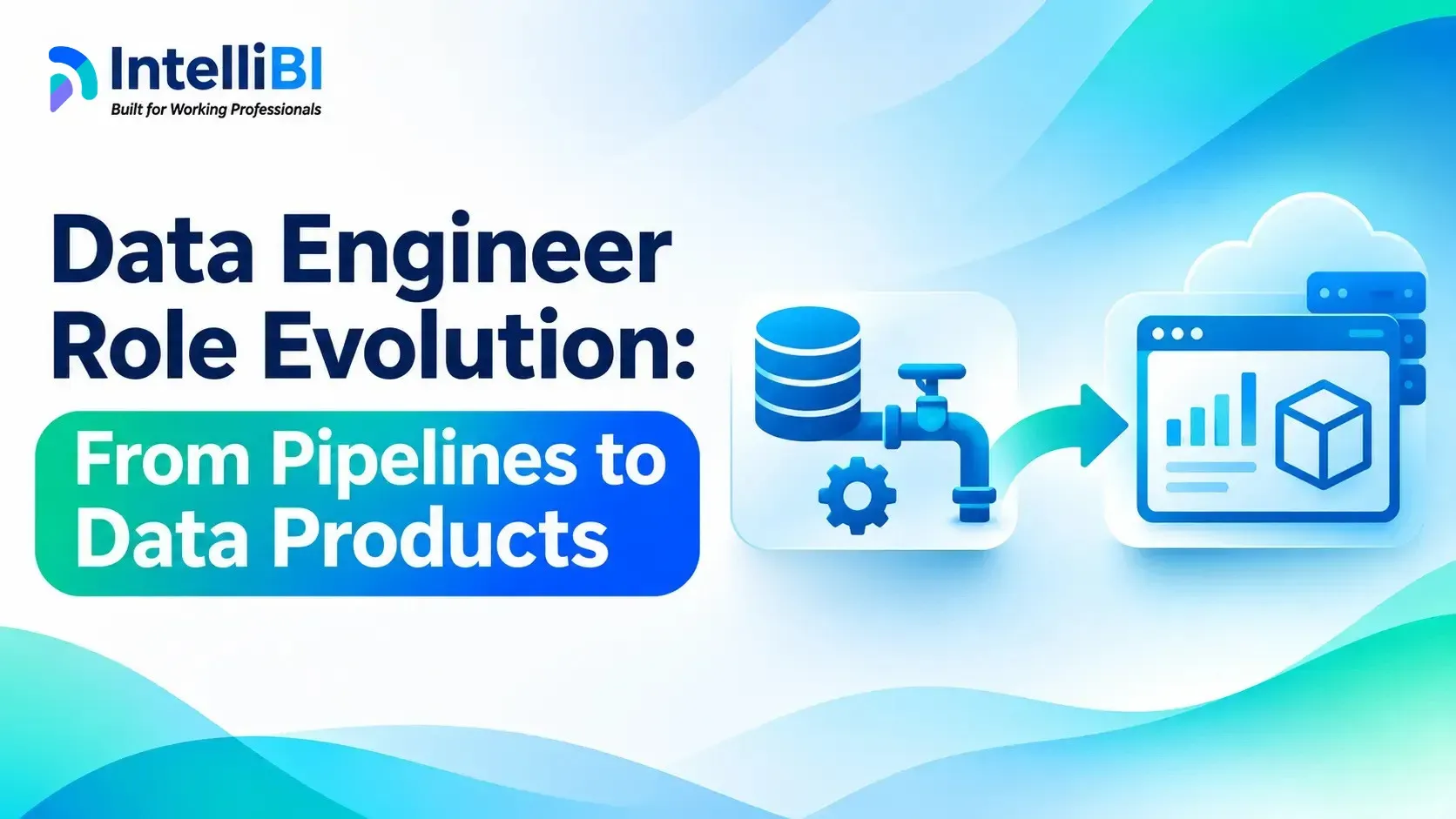
Data Engineer Role Evolution: From Pipelines to Data Products
Quick Answer
The data engineer role is evolving from building ETL pipelines to delivering reliable, governed and reusable data products. Modern data engineers manage data quality, ownership, cloud infrastructure, automation and AI-ready datasets. Essential skills include SQL, Python, PySpark, Databricks, cloud computing, data modelling and workflow orchestration to support business decisions and scalable analytics.
Imagine a data pipeline that you want to run successfully every morning, processing millions of records and delivering information to a data warehouse. It all works, technically. But the business team still can’t read the data, reports show inconsistent numbers, and analysts spend hours fixing errors.
But did the data engineer really solve the business problem?
This is a big change in modern data engineering. Organisations increasingly want engineers to be building reliable, reusable and business-ready data products, not just building and maintaining pipelines.
And they are increasingly expected to have skills in data quality, data governance, automation, business acumen and AI integration.
This transition is crucial for professionals who are pursuing a Data Engineering Course in Pune, to build skills that go beyond traditional ETL development.
What's driving the evolution of Data Engineering?
Historically, data engineers were concerned with collecting, transforming and storing data. Their primary job was to ensure that data moved correctly between different systems.
Today’s enterprises do far more than just report with their data. They use it for customer personalisation, fraud detection, predictive maintenance, business automation, and artificial intelligence.
This change is being shaped by several trends:
Adoption of cloud data platforms.
rising demand for real-time analytics
Increased application of machine learning and artificial intelligence.
Greater focus on data quality and governance.
Increasing complexity of enterprise data landscapes.
Demand for self-service and reusable data solutions.
If you are a professional looking for cloud engineer courses in Pune, you should know about the integration of cloud infrastructure, distributed processing with business applications on modern data platforms.
The focus is gradually changing from moving information to delivering measurable business value.
What is Data Pipeline?
A data pipeline is an automated process that takes data from one or more sources and moves it to a destination, performing any processing and transformation required along the way.
For example, an e-commerce company may gather information from customer databases, payment systems, mobile applications and order management platforms.
The data pipeline is a standard one: duplicate records are removed, formats are standardised, and the resulting data is loaded into a warehouse.
Common technologies used to build these workflows include:
SQL and Python
PySpark and Apache Spark.
Azure Data Factory
Airflow (Apache)
AWS Glue
Databricks
Snowflake –
Pipelines are still important, but a successful pipeline does not guarantee that what comes out of the pipeline is correct, understandable or useful for the business teams.
What is a Data Product?
A data product is a trusted, supported, and reusable data asset that is designed to meet a specific business or technical need.
Data products are not just raw datasets, but are designed with the end user in mind. These users could be business analysts, data scientists, application developers, marketing teams or standard artificial intelligence systems.
A data product usually includes:
Well-defined business objectives.
Reliable and validated data sets.
Business definitions documented.
Traceable ownership.
Security and Access Control.
Set expectations for data freshness.
Processes of monitoring and maintenance.
For example, customer intelligence datasets, fraud detection data services, inventory forecasting datasets, financial reporting models, and AI-ready knowledge collections.
A Modern Data Engineer Course in Pune should help learners get an understanding of how raw data becomes a trusted asset to support business decisions.
Data Pipelines vs Data Products: What’s the Difference?
From Technical Execution to Business Results
Traditional pipeline development is about successfully extracting, transforming and loading data.
The development of data products is about whether the information that comes out of it helps users solve a meaningful problem.
Moving sales records into a warehouse, for example, is a pipeline task. A data product is a trusted sales intelligence dataset for revenue analysis, forecasting and measuring product performance.
From one time delivery to ongoing ownership
When a pipeline is deployed and running, it can be considered complete.
Ongoing maintenance is needed for data products. Engineers have to monitor quality, respond to changing business needs and make sure that downstream applications can work with it.
Isolated Workflows to Reusable Assets
Traditional projects sometimes have separate pipelines per department.
A reusable data product can provide the same information to multiple teams, reducing duplicated transformation logic and conflicting business definitions.
System uptime to Data trust
A pipeline can run successfully and still produce incomplete or wrong data.
Data product engineering adds extra checks to make sure information is accurate, timely, accessible and fit for its purpose.
What’s Changing for Data Engineers’ Responsibilities
1. Know the Business Needs
Modern data engineers need to know why you’re collecting the information, and what you’re going to do with it.
For example, a bank organization might want to find unusual financial transactions. Before the engineer can design the solution, they need to understand transaction patterns, business rules, reporting requirements and data privacy considerations.
Technical expertise is more valuable when combined with knowledge of the industry.
2. Taking Ownership of Data Quality
Data quality is not simply a matter of removing duplicate records or filling in missing values.
Engineers should consider completeness, accuracy, consistency, uniqueness, and freshness throughout the data lifecycle.
For example, an online retailer processes thousands of orders a day. Automated validation should catch missing order identifiers, invalid product prices and inconsistent customer details before the data is published.
Practical Data Engineering Training in Pune should teach you to troubleshoot such problems and not just concentrate on successful pipeline execution.
3. Designing Scalable Cloud Data Platforms
“Many of the modern data products require platforms that can handle big and changing data volumes.
Depending on your architecture engineers may use Azure Data Lake Storage, Amazon S3, Snowflake, Databricks or Microsoft Fabric .
Knowledge of cloud storage, distributed computing, identity management and resource optimisation helps engineers design reliable solutions.
This is also the reason why cloud engineer courses in Pune can offer useful complementary knowledge for professionals seeking to enter data engineering.
4. Building Data Governance
Organisations need to know where information is coming from, who has access to it and how it changes over time.
Data engineers are working more with governance and security teams in the implementation of:
Role based access control.
Meta-data Management.
Lineage of data.
logging of audits
Security of sensitive data.
Credential management security.
Products like Microsoft Purview and Unity Catalogue offer capabilities for governed data environments.
5. Data Contract Management
A data contract defines expectations between a data producer and its consumers.
For example a customer dataset may require a unique customer identifier, a consistent date of registration format and an agreed update frequency.
The contract can help determine if a change in the data structure of an upstream application could break downstream analytics.
Engineers must understand schema compatibility, versioning, validation and communication to effectively manage such changes.
6. Supporting AI & Machine Learning Applications
Artificial intelligence applications rely on reliable information.
Data engineers support preparation of structured datasets, processing of documents, maintenance of knowledge sources and development of ingestion workflows for AI applications.
For example, a customer-support assistant in an enterprise may require latest product documentation, past service records and company policies approved.
Even the most sophisticated AI models can provide wrong or outdated answers if data engineering is not reliable.
Practical example: From the retail pipeline to a data product
Take a hypothetical retail business that has both physical stores and an online shopping platform in Maharashtra.
The organization gathers information from point-of-sale systems, e-commerce applications, inventory databases and customer relationship management software.
It has a traditional data pipeline that every nite pushes sales information into a warehouse. But the marketing, finance and inventory teams have different definitions of revenues and customer activity.
The engineering team has decided to build one retail sales data product.
Step 1: Define Business Requirements
The team identifies who the target users are and what they need.
Finance needs the correct numbers of revenues, marketing needs insights about the customers’ purchasing behaviour and the inventory managers need to know the demand of the products.
The teams agree on common business definitions prior to implementation.
Step 2: Building Data Ingestion Layer.
Azure Data Factory or another suitable ingestion service pulls data from databases, APIs and transactional systems.
Incremental loading and Change Data Capture (CDC) can be used to process new or modified records without repeatedly transferring the entire data set.
Step 3: Develop the Lakehouse Architecture
The engineering team uses Databricks, PySpark, and Delta Lake to structure information with medallion architecture.
The Bronze layer stores the original transaction data. The Silver layer has records that are validated, cleaned and standardised. Gold layer provides business-ready sales and inventory data sets.
If you want to learn about it, you can practise this architecture with Databricks Training in Pune to understand how distributed processing enables reusable data products.
Step 4. Add automated quality checks
The team searches for transaction identifiers, product references, revenue totals and duplicate records.
Instead of automatically entering business reports, invalid information is isolated for investigation.
Step 5: Publish governed data products
Authorised users are given the curated datasets and documentation.
Business intelligence team can build dashboards, machine learning team can use the relevant datasets for demand forecast.
Step 6. Monitor product performance
Engineers keep track of data freshness, processing failures, quality violations and use of cloud resources.
They also set up recovery procedures and inform consumers about material changes.
The end result is more than a functional pipeline. It is a supported data product that meets a range of business needs.
Skills Required for a Data Product Engineer
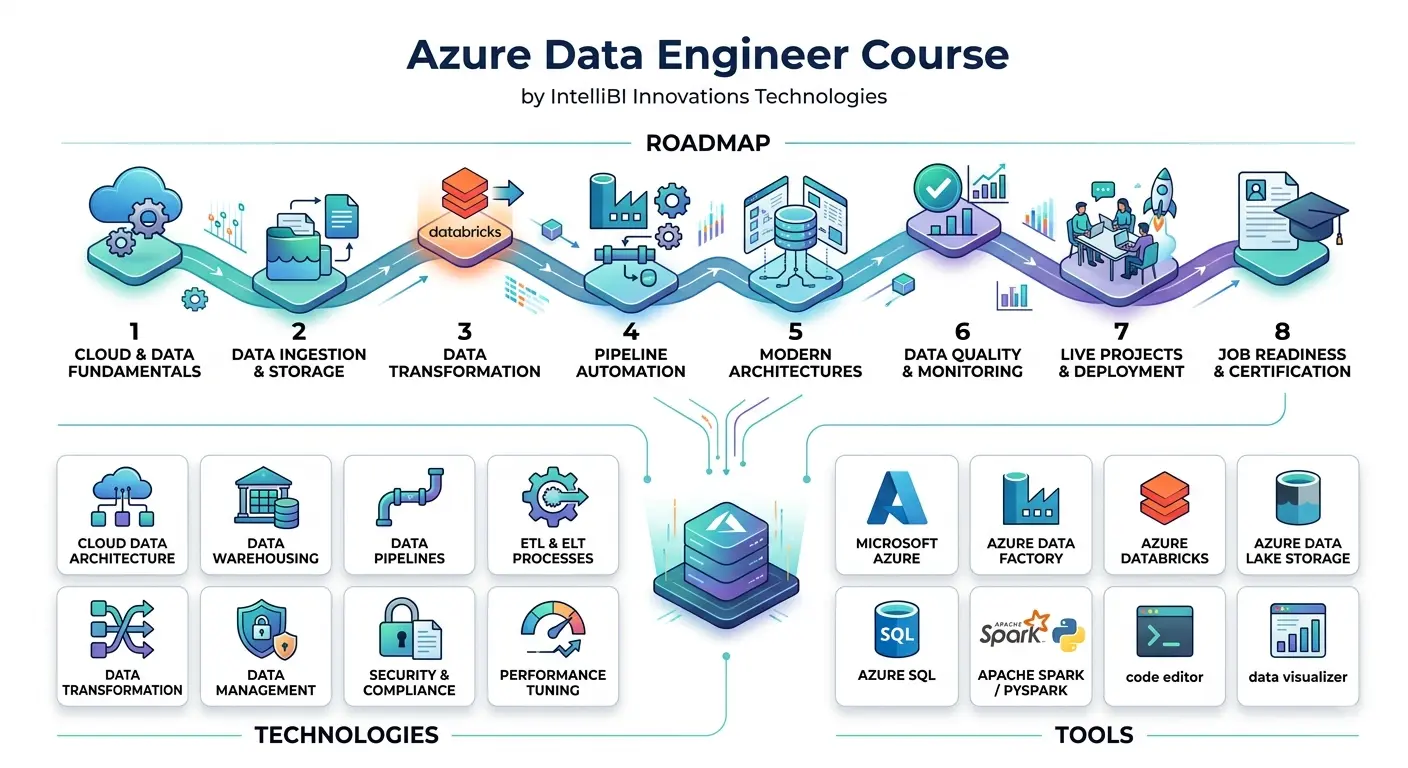
SQL and Python
SQL is still the go-to for data extraction, transformation, validation and modelling. It supports automation, API integration and reusable processing logic.
You can build advanced data engineering tasks with both languages.
Distributed processing using Apache Spark
Engineers use Apache Spark and PySpark to manage large datasets in distributed computing environments.
Engineers need to understand partitioning, joins, memory management and performance optimisation.
Cloud Data Engineering
Cloud platforms provide services for storage, processing, integration and security.
Azure Data Engineer Course in Pune helps learners to know how Azure services are embedded in enterprise data workflows, especially when supported by hands-on implementation.
Data Modelling and Lakehouse Architecture
Data engineers have to understand how to organise information for different consumption needs.
Dimensional modelling, star schemas, Slowly Changing Dimensions (SCD), Delta Lake and medallion architecture are still valid concepts.
DataOps & Workflow Orchestration
Apache Airflow, Azure Data Factory and CI/CD practices help in automation, testing, deployment and monitoring of engineering workflows.
Engineers should learn to recover failed jobs and reprocess historical information safely, without introducing duplicate records.
Generative AI in Data Engineering
Generative artificial intelligence can help engineers with SQL development, documentation, troubleshooting and data discovery.
More advanced applications include RAG-based reporting, data-quality assistants, and AI-powered monitoring tools.
But engineers must independently verify AI generated code and safeguard sensitive information.
An Advanced Data Engineer Course In Pune should be a combination of the latest in AI and core engineering skills.
How Data Mesh Supports the Data Product Approach
Data mesh is an organisational and architectural approach focusing on increased accountability for data producers on the data that they produce.
Four principles are generally accepted:
Domain-centric ownership of data
Data is a product.
Self-serve data infrastructure.
Governance of federated computation.
For example a retail organization might assign ownership of customer data to its customer domain and ownership of inventory data to its supply chain domain.
These teams maintain their respective data products using common infrastructure, security policies and interoperability standards.
But data mesh is not a prerequisite for building data products. Smaller organisations can implement product-oriented engineering based on a centralised data platform.
What Can Aspiring Data Engineers Do To Prepare For This Evolving Role?
Professionals should start with building a strong technical foundation and then move to a product-oriented architecture.
Begin with SQL, Python, databases and ETL concepts. Move into distributed processing using PySpark and Cloud Data Integration services.
Then build lakehouse and warehouse projects with quality checks, documentation, security, monitoring and business requirements.
While comparing Data Engineering Classes in Pune, don’t just consider the number of tools that are included in the syllabus. See if the learning approach helps you connect those technologies through meaningful projects.
Likewise, while searching for the Best Data Engineering Institute in Pune, check the depth of the curriculum, the complexity of the projects, mentorship and opportunities to practise troubleshooting.
A strong portfolio shows not only what you built, but why you built it, how you validated it and how it can be used by other teams.
FAQs
1. What’s the difference between a data product and a data pipeline?
Data pipeline moves and processes data between systems. A data product is a piece of information that is maintained, documented and reliable and is designed for a specific use case.
2. Are Data Products Going to Replace Traditional Data Pipelines?
Nope. Pipelines continue to be the core building blocks of data products. The product-oriented approach broadens the engineering responsibilities to include quality, governance, usability and long-term maintenance.
3. What skills do you need to be a modern data scientist?
Key skills include: SQL, Python, Pyspark, cloud computing, data modelling, orchestration, data quality, governance and AI integration.
4. Are cloud engineer courses in Pune useful for data engineers?
Yes. Data engineers need cloud engineering knowledge to understand infrastructure, storage, security, networking and deployment. But specialist skills in data processing and modelling are also required.
5. Yes, freshers can learn data product engineering.
Yes. Freshers can start with SQL, Python and traditional ETL development, then move on to cloud platforms, lakehouse architecture and product-oriented projects
6. What is AI changing in data engineering?
AI is able to help with code development, documentation, troubleshooting and monitoring. This creates additional engineering requirements for the preparation of governed datasets and the maintenance of stable knowledge pipelines.
7. How to Select the Best Data Engineering Course in Pune?
Assess the curriculum, hands-on projects, cloud technologies, data modelling, governance, monitoring and career preparation. Select a course that teaches you how to tackle real-world business problems, not just how to use tools.
Summary
The data engineering world is moving from pipelines to data products and it is a big change. Traditional ETL workflows are still required but modern engineers are increasingly expected to deliver trusted, reusable and business-focused data assets.
Success in this evolving role requires a mix of technical skills, architectural insight, business acumen and continuous learning.
Tools like SQL, Python, PySpark, Databricks, Azure Data Factory and Apache Airflow are still applicable. What matters more and more is how engineers combine these technologies to provide reliable outcomes.
IntelliBI Innovations Technologies’s project-first learning approach bridges data engineering fundamentals with real-world enterprise scenarios like retail data warehousing, healthcare data processing and lakehouse development.
Gain practical experience in building modern data platforms and learn how engineering workflows are facilitating data solutions for business use with IntelliBI's Data Engineer Course in Pune