
Data Engineer Roadmap 2026: Step-by-Step Path from SQL to Agentic AI
Quick Answer
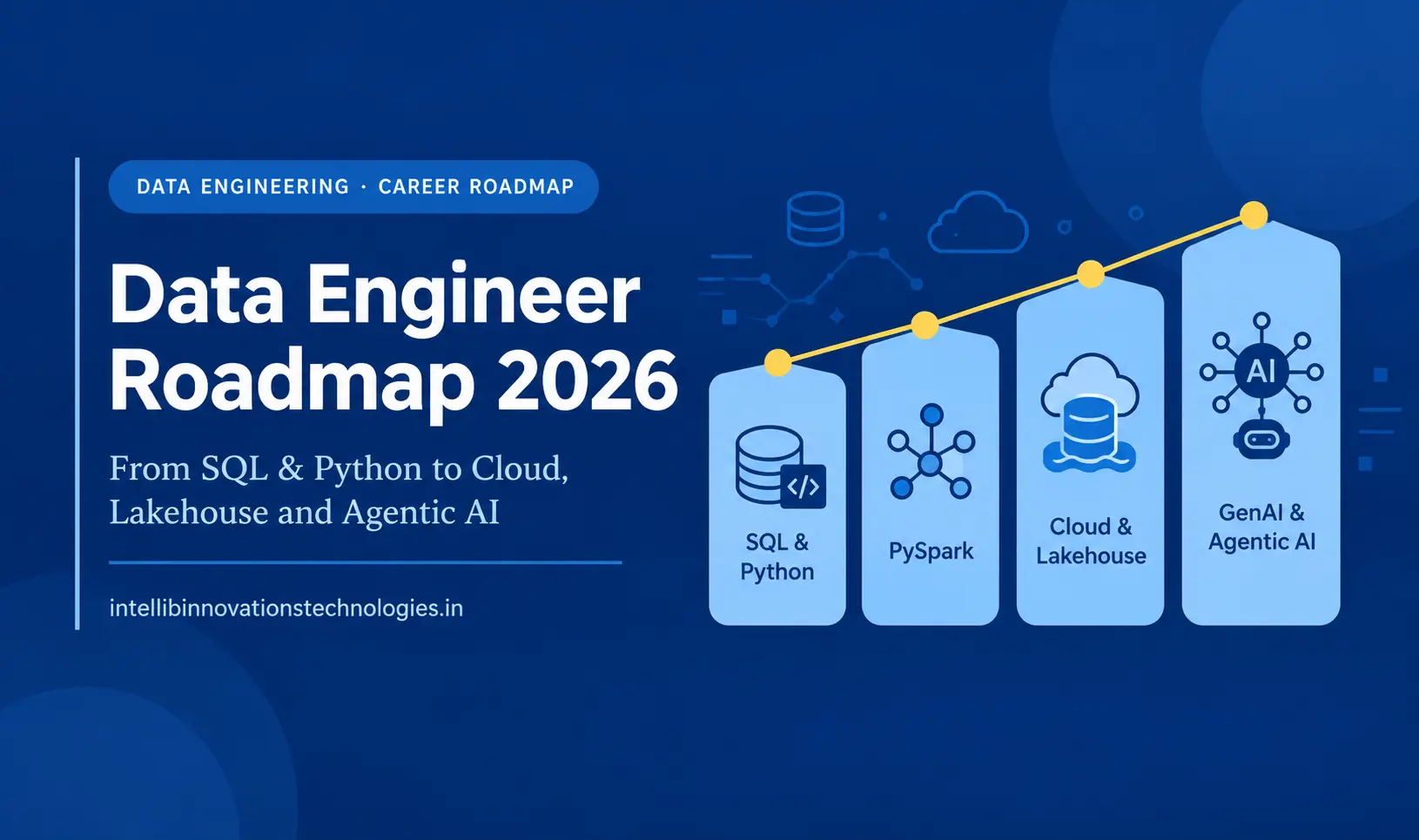
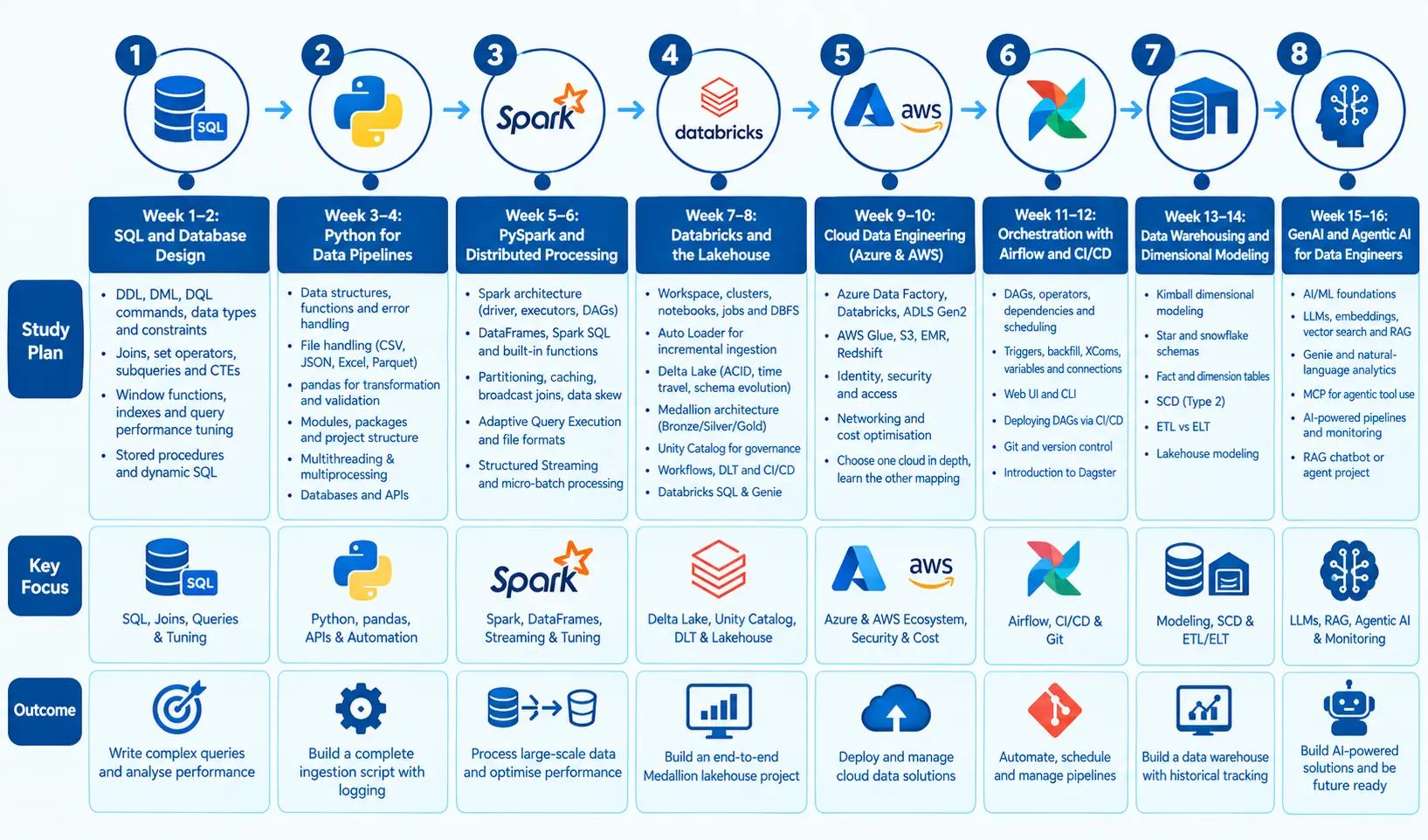
A data engineer roadmap for 2026 has eight steps: (1) SQL and data modeling, (2) Python for pipelines, (3) PySpark and distributed processing, (4) Databricks Lakehouse with Delta Lake and Unity Catalog, (5) cloud data services on Azure (ADF, Synapse, ADLS) and AWS (S3, Glue, Redshift), (6) Airflow orchestration and CI/CD, (7) dimensional modeling and data warehousing, (8) GenAI and Agentic AI for data engineers (LLMs, RAG, MCP). Followed full-time with projects, it takes 4–5 months.
Data Engineer Roadmap 2026: Step-by-Step Path from SQL to Agentic AI
Every week at our Thergaon campus, someone walks in with the same question: "I want to become a data engineer, but where do I actually start?" They have watched twenty YouTube tutorials, bookmarked a dozen tools and still feel stuck between Spark, Snowflake, Databricks, Fabric and something called Agentic AI.
That confusion is understandable. Data engineering in 2026 is not the job it was three years ago. The pipelines are the same, but the expectations around cloud, lakehouse architecture and AI have moved fast. This roadmap is the exact sequence we teach in our , laid out so you can follow it on your own or with us. No fluff, no tool-of-the-week. Just the order that works.
Why a Roadmap Matters More Than Ever in 2026
Hiring managers in Pune's IT corridors, from Hinjewadi to Kharadi, are no longer asking "Do you know Spark?" They are asking "Can you build a production pipeline on Databricks, orchestrate it, keep it cheap and add an AI layer on top?" A roadmap gives you that end-to-end picture, so you learn each skill in the context of the next one.
It also saves time. Most self-learners spend six months on Python basics and never reach the cloud. Learners who follow a structured Data Engineering Training in Pune programme reach their first cloud project in week eight, because the sequence was decided for them.
Step 1: SQL and Database Design – The Foundation Nobody Skips
SQL is still the language every data engineer speaks daily. Before anything cloud-shaped, you should be comfortable with:
- DDL, DML and DQL commands, data types and constraints
- Joins, set operators, subqueries and CTEs
- Window functions for running totals, rankings and moving averages
- Indexes, execution plans and query performance tuning
- Stored procedures and dynamic SQL for automation
A good test: can you write a query that finds the top three customers per region by revenue, using a window function, and explain why it runs slowly on 50 million rows? If yes, you are ready for Step 2. Our Data Engineering Classes in Pune spend the first three weeks here on purpose, with SQL Server and SSMS, because weak SQL shows up later as broken Spark jobs.
Step 2: Python for Data Pipelines
You do not need to be a software developer, but you do need production-quality Python. Focus on the parts data engineers actually use:
- Data structures, functions and error handling
- File handling for CSV, JSON, Excel and Parquet
- pandas for transformation and validation
- Modules, packages and project structure
- Multithreading and multiprocessing for parallel loads
- Connecting to databases and APIs
Your first mini-project at this stage should be a complete ingestion script: read raw files, clean them with pandas, write them to a target and log every step. It sounds small, but it is the pattern behind every pipeline you will ever build.
Step 3: PySpark and Distributed Processing
This is where data engineering becomes "big data" engineering. Apache Spark is the processing engine behind Databricks, Synapse Spark pools, AWS Glue and EMR, so PySpark is non-negotiable.
Learn Spark architecture first: driver, executors, DAGs, jobs, stages and tasks. Then DataFrames, Spark SQL, built-in functions and UDFs. Then the topics interviewers love: partitioning, caching, broadcast joins, data skew and salting, Adaptive Query Execution and file formats like Parquet and Delta. Finish with Structured Streaming so you understand micro-batch processing.
If you are evaluating a Data Engineer Course in Pune, check whether PySpark performance tuning is a dedicated module. It is the single most asked topic in Pune data engineering interviews, and many programmes skip it.
Step 4: Databricks and the Lakehouse
By 2026 the lakehouse has become the default architecture for enterprise data platforms, and Databricks is where most Pune companies run it. This is why Databricks Training in Pune has become one of the most searched upskilling topics this year.
Your Databricks checklist:
- Workspace, clusters, notebooks, jobs and DBFS
- Auto Loader for incremental ingestion
- Delta Lake: ACID transactions, time travel, schema evolution and Change Data Feed
- Medallion architecture: Bronze, Silver and Gold layers
- Unity Catalog for governance and lineage
- Workflows, pipelines, Delta Live Tables and Asset Bundles for CI/CD
- Databricks SQL, AI/BI dashboards and Genie for natural-language analytics
Capstone target: an end-to-end Medallion sales lakehouse that ingests raw e-commerce events, cleans them into Silver, aggregates them into Gold and serves a dashboard. This one project answers half the questions in a Databricks interview.
Step 5: Cloud Data Engineering on Azure and AWS
Here the roadmap splits, and here is where many self-learners get lost. Our advice is simple: go deep on one cloud, then learn the mapping to the other.
Azure track
Pune enterprises lean Azure, which is why an Azure Data Engineer Course in Pune is the most common entry point. Cover Azure Data Factory (pipelines, linked services, integration runtimes, hybrid ingestion from on-premises SQL Server), Azure Synapse Analytics (serverless SQL pools and Spark pools), ADLS Gen2, Blob Storage, Key Vault and Microsoft Entra ID with managed identities. Then connect ADF to Databricks, Delta Lake, Azure Functions and Logic Apps. Add Microsoft Fabric awareness, because the DP-700 Fabric Data Engineer exam has replaced DP-203.
AWS track
Once Azure makes sense, AWS is a translation exercise: ADF becomes Glue, ADLS becomes S3, Synapse becomes Redshift, Event Hubs becomes Kinesis. Learn IAM for data pipelines, S3 data lakes, Glue Data Catalog and crawlers, Glue ETL, EMR, Lambda, Athena and Redshift, plus CI/CD, monitoring and cost optimisation.
This dual-cloud approach is what separates an Advanced Data Engineer Course in Pune from a basic one. Employers in 2026 run multi-cloud estates, and the "Azure to AWS mindset" module in our programme exists precisely because learners who know both get shortlisted faster. It is also why learners searching for cloud engineer courses in Pune often end up in data engineering: the cloud skills overlap, but the data engineering role pays more.
Step 6: Orchestration with Apache Airflow and CI/CD
Pipelines that run once are demos. Pipelines that run every night, retry on failure and alert someone are products. Apache Airflow is still the orchestration standard, alongside Databricks Workflows.
Learn DAGs, operators, task dependencies, scheduling, triggers and backfill, XComs, variables and connections, the web UI and CLI, and how to deploy DAGs through CI/CD. A short introduction to Dagster helps you talk about modern alternatives in interviews.
Pair this with Git from day one. Every project in your portfolio should live in a repository with branches, pull requests and a README. Recruiters in Pune now open GitHub links before they open resumes.
Step 7: Data Warehousing and Dimensional Modeling
This is the step most roadmaps leave out, and it is the one that senior engineers say matters most. Tools change; modeling does not. Learn Kimball dimensional modeling, star and snowflake schemas, fact and dimension tables, Slowly Changing Dimensions (Type 2 especially), ETL versus ELT trade-offs and how to model on a lakehouse.
A practical capstone is a clinical or retail data warehouse with SCD Type 2 history on Redshift or Synapse. If you can explain why a customer's address change creates a new row rather than an update, you understand more than most applicants.
Step 8: GenAI and Agentic AI for Data Engineers
This is the 2026 layer, and it is what makes the roadmap end at "Agentic AI" rather than "cloud". Data engineers are now expected to build the data foundations for AI and to use AI inside their own pipelines.
The skills that matter:
- AI and ML foundations: enough to speak with data scientists
- LLMs, embeddings, vector search and Retrieval-Augmented Generation (RAG) over lakehouse data
- Genie and natural-language analytics on Databricks
- MCP (Model Context Protocol): agentic tool use, where an AI agent can query your catalog, trigger a pipeline or diagnose a failure
- AI-powered pipelines and production monitoring, including LLM-based failure triage and alerting
A strong portfolio project here is a RAG chatbot over your Gold-layer tables, or an agent that monitors Airflow runs and summarises failures. Very few candidates in Pune can show this yet, which is exactly why the Best Data Engineering Course in Pune for 2026 should include it rather than treat AI as a separate course.
Certifications That Match the Roadmap
Certifications do not replace projects, but they do get your resume past filters. Align them to the steps above:
- Databricks Certified Data Engineer Associate (Step 4)
- Microsoft DP-700: Fabric Data Engineer Associate (Step 5, Azure)
- Microsoft DP-750: Azure Databricks Data Engineer Associate, the new 2026 exam (Steps 4–5)
- AWS Certified Data Engineer – Associate, DEA-C01 (Step 5, AWS)
Take one after your first capstone, not before. Exam prep makes far more sense once you have built the thing the exam describes.
Projects: The Portfolio That Gets You Hired
Across the roadmap, aim for at least five to ten production-grade projects spanning different domains. The ones our learners present most successfully to recruiters include an insurance data pipeline with Python and Airflow, a healthcare data processing platform on Azure, a Medallion lakehouse on Databricks, a revenue and claims analytics platform, and a streaming pipeline for banking transactions. Domain variety matters: Pune hires heavily in BFSI, healthcare, retail and manufacturing.
How Long Does the Roadmap Take?
Followed seriously, with weekday evenings and weekends, the full path takes four to five months, roughly 250 to 300 hours of learning and building. That is the duration of our Data Engineering Training in Pune, and it is deliberately not shorter. Compressing Spark, Databricks, two clouds and AI into six weeks produces people who recognise the words but cannot ship.
For working professionals, a 7 to 9 PM weekday batch or a Saturday–Sunday morning batch works well. For freshers and non-IT career switchers, the same sequence applies; you simply spend an extra week or two on Steps 1 and 2.
Salaries in Pune After Completing the Roadmap
Pune runs two economies for data engineers. IT services firms typically start freshers at ₹4 to 6.5 LPA and reach ₹13 to 20 LPA at six-plus years. Product, finance and manufacturing companies pay noticeably more: ₹9 to 16 LPA at entry level and ₹30 LPA and above for senior engineers who know Databricks, Azure-native tooling and modern modeling. Learners completing an advanced programme with cloud and AI skills typically land in the ₹15 to 40 LPA range after upskilling, depending on prior experience.
Choosing Where to Learn: What to Look For
If you decide to learn with an institute rather than alone, the roadmap doubles as a checklist. The Best Data Engineering Institute in Pune for your goals should offer:
- The full sequence above, SQL to Agentic AI, in one programme
- Trainers with ten-plus years of enterprise data experience, not just certifications
- Ten or more real projects across domains, with code reviews
- Classroom, live online and recorded options
- Interview preparation with technology-wise question banks, mock interviews and system design rounds
- Placement support that continues until you are placed
At IntelliBI, 2,200-plus professionals have transformed their careers through this exact path, with a network of 300-plus hiring partners and a 4.9-star Google rating from learners. Our Data Engineering Course in Pune is built module by module on this roadmap, taught from Dange Chowk, Thergaon, ten minutes from Hinjewadi Phase 1, and live online for learners across India.
A 20-Week Plan You Can Start Today
- Weeks 1–3: SQL and database design, first analytical queries
- Weeks 4–5: Python for pipelines, first ingestion script
- Weeks 6–8: PySpark architecture, DataFrames, tuning, streaming
- Weeks 9–11: Databricks Lakehouse, Delta Lake, Unity Catalog, Medallion capstone
- Weeks 12–15: Azure Data Factory, Synapse, ADLS, Key Vault; then the Azure-to-AWS mapping with S3, Glue, Redshift
- Weeks 16–17: Airflow, CI/CD, Git portfolio
- Week 18: Dimensional modeling, SCD Type 2 warehouse project
- Weeks 19–20: GenAI and Agentic AI: RAG, Genie, MCP, AI-monitored pipelines, plus interview preparation
Follow it on your own, or follow it with mentors who have built these systems for TCS, Persistent and Deloitte clients through the Data Engineer Course in Pune at IntelliBI.
Final Word: Start with SQL, Finish with Agents
The 2026 data engineer is a builder of trustworthy, governed, AI-ready data platforms. The roadmap is long, but it is linear, and every step makes the next one easier. Start with SQL this week. Build something small in Python next week. By the time you reach Databricks and the cloud, you will understand why the lakehouse exists, and by the time you reach Agentic AI, you will have the data foundations an agent actually needs.
If you want the shortest reliable path, with projects, certification guidance and placement support built in, explore our Advanced Data Engineer Course in Pune, book a free demo class and bring your questions. We have heard most of them before, and we know where each one leads.