
Data Analytics with Gen AI Course in Pune: SQL, Power BI, Python & AI
Quick Answer
A Data Analytics with Gen AI Course in Pune teaches SQL, Python, Power BI, statistics, data visualization, business analysis, Generative AI and prompt engineering. Learners can practice turning raw data into business insights, creating dashboards, analyzing datasets and using AI to support analytics workflows. The course can suit freshers, working professionals and career switchers.
Data Analytics with Gen AI Course in Pune: SQL, Power BI, Python & AI
Data is no longer used only for monthly reports. Businesses now use data to understand customers, improve operations, reduce costs, plan strategies, and make faster decisions. At the same time, Generative AI is changing how analysts work with information.
Modern data analysts are expected to do more than create spreadsheets. They need to collect and clean data, write SQL queries, build dashboards, understand business needs, use Python for analysis, and explore AI tools that can speed up everyday tasks.
This combination of data analytics and Generative AI is creating new learning opportunities for students, working professionals, and career switchers.
A Data Analytics with Gen AI Course in Pune can help learners build these skills through a structured learning path. The focus is not only on learning individual tools but also on understanding how SQL, Python, Power BI, and AI can work together to solve practical business problems.
At IntelliBI Innovations Technologies, our approach focuses on practical learning, real-world examples, project experience, and career-oriented guidance. The goal is to help learners understand how modern analytics works and how they can apply their skills in professional environments.
Why Data Analytics Is Changing With Generative AI
Traditional data analysis often involves several repetitive steps.
An analyst may need to:
- Collect data from different sources
- Clean missing or incorrect values
- Write SQL queries
- Analyze trends
- Create calculations
- Build dashboards
- Prepare reports
- Explain findings to business teams
Generative AI can assist with parts of this workflow.
For example, AI can help an analyst understand a SQL query, generate an initial Python script, summarize trends, suggest questions for exploration, or help draft explanations for business users.
However, AI does not replace the need for analytical thinking.
An analyst still needs to understand the data, check the output, identify errors, and decide whether the result makes business sense.
That is why modern learning should combine analytics fundamentals with responsible use of AI.
What Is a Data Analytics with Gen AI Course in Pune?
A Data Analytics with Gen AI Course in Pune combines traditional data analysis skills with modern AI-assisted workflows.
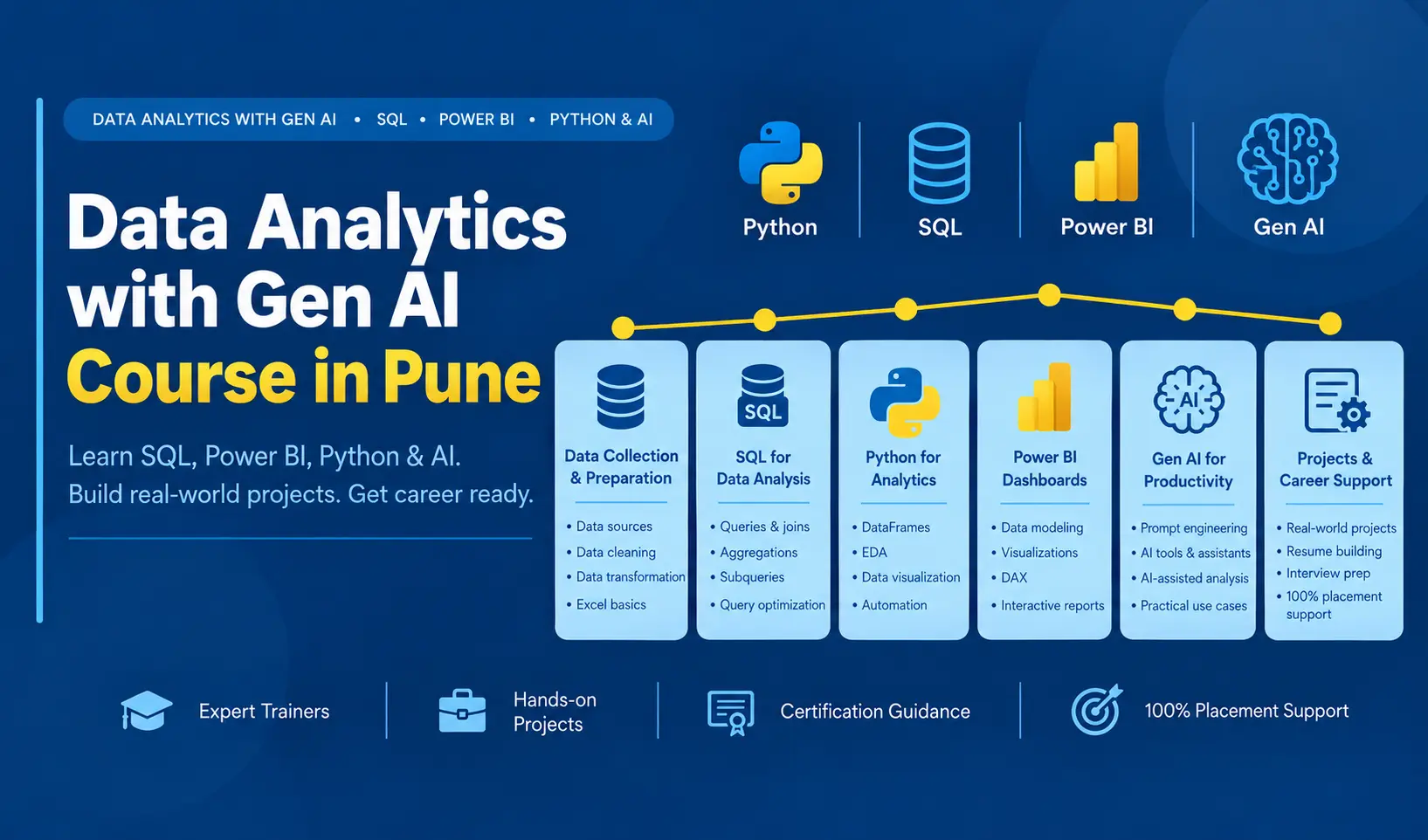
A comprehensive learning path can include:
- SQL
- Excel fundamentals
- Data cleaning
- Python
- Statistics
- Data visualization
- Power BI
- Dashboard development
- Business analysis
- Generative AI fundamentals
- Prompt engineering
- AI-assisted data analysis
- Practical projects
- Interview preparation
The objective is to help learners understand the complete analytics process.
Instead of learning Power BI separately from SQL or Python separately from AI, learners can understand how these technologies fit into a larger business workflow.
Why Learn SQL for Data Analytics?
SQL remains one of the most useful skills for data analysts.
Most organizations store important business information in databases. This information may include customer records, orders, payments, products, employees, or transactions.
SQL allows analysts to retrieve and analyze this information.
Important SQL Skills for Analysts
Learners can build skills in:
- SELECT statements
- Filtering
- Sorting
- GROUP BY
- Aggregations
- JOIN operations
- Subqueries
- Common table expressions
- Window functions
- CASE statements
- Data cleaning with SQL
- Basic query optimization
For example, an analyst may need to answer:
- Which products generated the most revenue?
- Which region has the highest sales growth?
- Which customers have not purchased recently?
- What is the average order value?
- Which month recorded the highest number of transactions?
SQL provides the foundation for answering these questions from structured business data.
How Python Supports Modern Data Analysis
Python is another valuable skill for analysts who want to work beyond basic reporting.
Python can help with data preparation, exploration, automation, and advanced analysis.
Learners can explore libraries and concepts such as:
- Pandas
- NumPy
- Matplotlib
- DataFrames
- Data cleaning
- Data transformation
- Exploratory data analysis
- Basic statistical analysis
- Automation
Python is especially useful when an analysis requires repeated processing or a workflow that would be difficult to manage manually.
Python and Generative AI
Generative AI can also support Python-based workflows.
For example, an analyst can use an AI assistant to:
- Explain Python code
- Suggest code structures
- Identify possible errors
- Create an initial data-cleaning script
- Explain library functions
- Suggest analysis approaches
The analyst should still test and review the generated code before using it.
This creates a useful combination of human judgment and AI assistance.
Power BI for Business Intelligence and Visualization
Data becomes more useful when business users can understand it quickly.
This is where Power BI can play an important role.
A Power BI Course in Pune can help learners understand how to turn raw data into interactive dashboards and reports.
Important areas include:
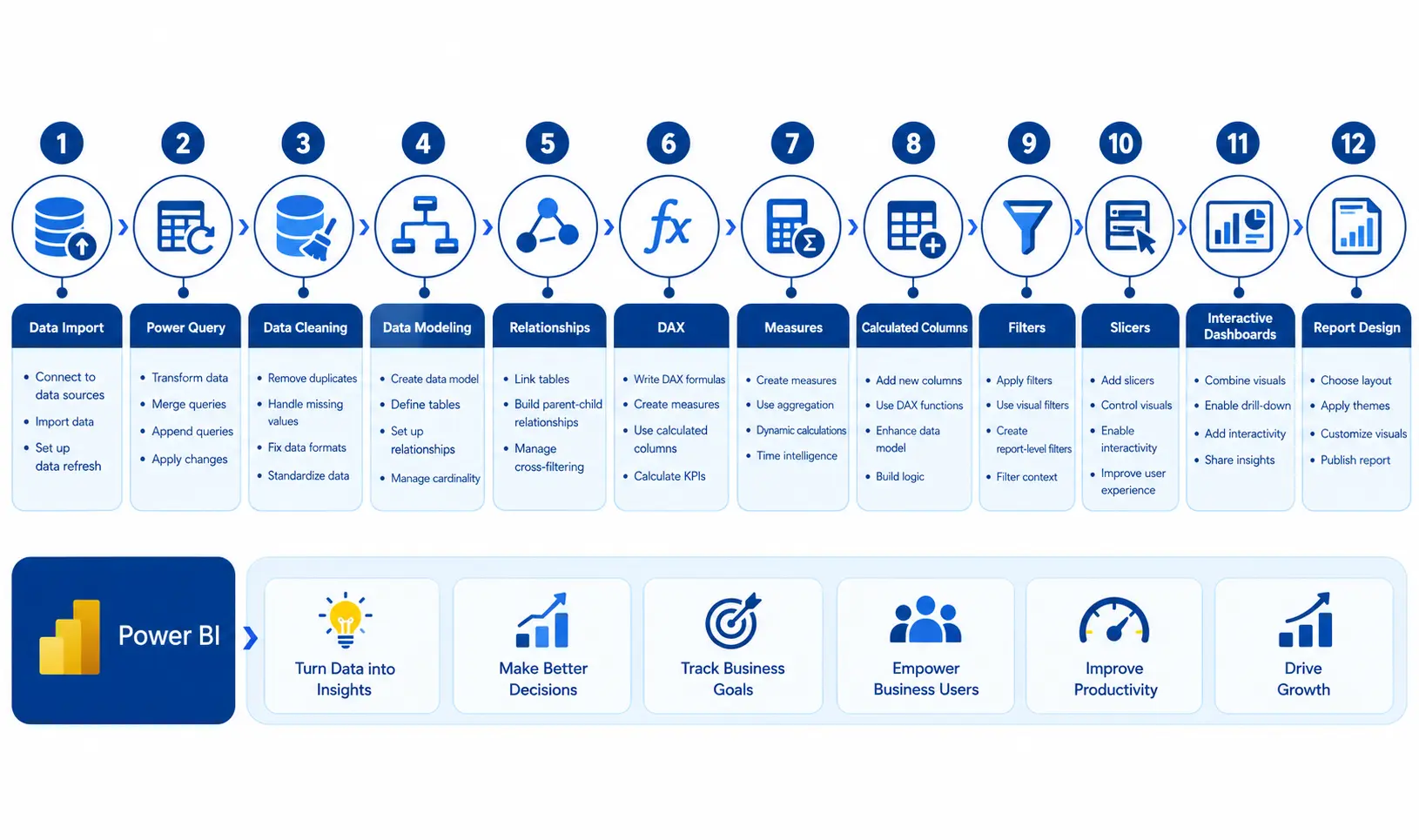
- Data import
- Power Query
- Data cleaning
- Data modeling
- Relationships
- DAX
- Measures
- Calculated columns
- Filters
- Slicers
- Interactive dashboards
- Report design
A good dashboard should not simply contain many charts. It should help users answer important business questions.
What Makes a Useful Power BI Dashboard?
A useful dashboard should have:
- Clear objectives
- Relevant KPIs
- Simple navigation
- Logical data structure
- Easy-to-read visuals
- Appropriate filters
- Consistent calculations
- Useful business insights
For example, a sales dashboard might show revenue, profit, sales volume, regional performance, product performance, and monthly trends.
The purpose is to help decision-makers understand what is happening and where attention may be needed.
Data Analytics Course in Pune: From Raw Data to Business Insight
A strong Data Analytics Course in Pune should teach the complete analytics lifecycle.
The process can be understood through five broad stages.
1. Understand the Business Problem
Before analyzing data, understand the question.
For example:
A company may notice that sales have declined.
The analyst should determine:
- When did the decline begin?
- Which products are affected?
- Which locations are affected?
- Has customer behavior changed?
- Are prices affecting demand?
2. Collect and Prepare Data
The next step is to gather relevant data.
Data may come from:
- Databases
- CSV files
- Excel files
- APIs
- CRM systems
- Business applications
The data then needs to be checked and cleaned.
3. Analyze the Data
Analysts use SQL, Python, statistics, and other tools to identify patterns.
They may examine:
- Trends
- Outliers
- Correlations
- Segments
- Growth rates
- Customer behavior
- Operational performance
4. Visualize the Findings
Power BI and other visualization tools can turn analysis into understandable reports.
5. Communicate the Insight
The final step is explaining what the data means.
A strong analyst does not simply say that sales dropped.
They explain:
What happened → Why it may have happened → What the business should investigate next
How Generative AI Can Help Data Analysts
Generative AI can become a useful assistant when used carefully.
AI for SQL
AI can help learners understand SQL queries and create initial query structures.
For example, a learner can describe a business question in simple language and ask an AI assistant to suggest an SQL approach.
The analyst should then validate the query against the database and business requirements.
AI for Python
AI can help explain Python code and suggest approaches for repetitive tasks.
It can also help learners understand errors and explore different ways to perform an analysis.
AI for Data Exploration
AI can help analysts generate possible questions for a dataset.
For example, after loading customer data, an analyst might explore:
- Customer segments
- Purchase frequency
- Average order value
- Churn patterns
- Regional differences
AI can help suggest areas to investigate, but the analyst must decide which questions are relevant.
AI for Reporting
Generative AI can assist with summarizing analytical findings.
For example, after identifying major sales trends, an analyst may use AI to create an initial summary for a business audience.
The summary should be reviewed before being shared.
Prompt Engineering for Data Analysts
AI output depends heavily on the quality of the instructions.
This makes prompt engineering a useful skill.
A good analytics prompt can provide:
- Business context
- Data context
- Desired output
- Constraints
- Audience
- Examples
- Required format
Instead of asking:
“Analyze this data.”
A better instruction might explain what the dataset represents, which business question needs to be answered, which metrics matter, and how the result should be presented.
Learning this approach can help analysts use AI more effectively.
Data Analyst Course in Pune: Skills You Should Build
A modern analyst should develop both technical and business skills.
A structured Data Analyst Course in Pune can focus on the following areas:
- SQL
- Excel
- Python
- Statistics
- Data visualization
- Power BI
- Data cleaning
- Data modeling
- Business analysis
- Generative AI
- Prompt engineering
- Communication
- Presentation skills
Technical knowledge helps analysts work with data.
Communication skills help them explain what the data means.
Both are important.
Who Should Join a Data Analyst Course in Pune?
Data analytics is relevant to learners from different backgrounds.
Fresh Graduates
Graduates from computer science, engineering, mathematics, commerce, economics, and related fields can explore analytics as a career option.
Working Professionals
Professionals who already work with reports, spreadsheets, operations, finance, sales, or business processes can use analytics skills to expand their responsibilities.
Career Switchers
People moving from another field into technology can build a structured foundation through an analytics program.
Business Professionals
Professionals who frequently use business data can learn technical tools such as SQL, Python, and Power BI.
Data Analyst Course in Pune with Placement: What Should Learners Look For?
When evaluating a Data Analyst Course in Pune with Placement, learners should look beyond the placement label.
Consider the complete learning experience.
Important areas include:
- Practical projects
- SQL practice
- Python exercises
- Power BI dashboard projects
- Resume support
- Interview preparation
- Mock interviews
- Portfolio development
- Career guidance
- Industry-oriented assignments
Placement support can be useful, but learners should also focus on building skills that can be demonstrated during interviews.
Data Analytics Classes in Pune: Why Hands-On Practice Matters
Data analytics is a practical field.
Watching tutorials can help explain concepts, but solving problems creates deeper understanding.
During Data Analytics Classes in Pune, learners should work with datasets that resemble real business situations.
For example, they could analyze:
- Retail sales
- Customer transactions
- Employee data
- Marketing campaigns
- E-commerce orders
- Financial transactions
- Supply chain data
Each project should involve more than creating a chart.
Learners should identify the business problem, prepare the data, perform analysis, create visuals, and explain the findings.
Business Analyst Course in Pune vs Data Analytics
Data analytics and business analysis can overlap, but they focus on different areas.
A Business Analyst Course in Pune may focus more heavily on business requirements, processes, stakeholders, documentation, and solution analysis.
Data analytics focuses more on working directly with data to identify patterns and insights.
Both areas can benefit from:
- Business understanding
- Communication
- Problem-solving
- Data interpretation
- Reporting
Professionals can choose a path based on their interests and career goals.
How to Choose the Best Data Analyst Course in Pune
There is no single course structure that fits every learner.
When comparing a Best Data Analyst Course in Pune option, consider:
- Syllabus depth
- Trainer experience
- Practical exercises
- Real-world datasets
- SQL coverage
- Python coverage
- Power BI training
- Generative AI coverage
- Project work
- Interview preparation
- Career support
A course should provide a clear progression from fundamentals to practical application.
What Makes a Good Data Analyst Institute in Pune?
A Data Analyst Institute in Pune can add value when it provides more than classroom lectures.
Look for a learning environment that encourages:
- Hands-on practice
- Questions and discussions
- Project-based learning
- Tool exposure
- Problem-solving
- Industry examples
- Feedback
- Interview preparation
The learning process should help students become comfortable working with unfamiliar datasets.
Building a Career Roadmap for Data Analytics
A simple roadmap can make the learning journey easier.
Step 1: Learn Excel and Data Basics
Understand spreadsheets, formulas, tables, sorting, filtering, and basic data handling.
Step 2: Learn SQL
Practice querying databases and answering business questions.
Step 3: Learn Statistics
Understand averages, distributions, variation, correlation, and basic statistical reasoning.
Step 4: Learn Python
Use Python for data cleaning, exploration, and automation.
Step 5: Learn Power BI
Build data models, DAX calculations, reports, and dashboards.
Step 6: Learn Generative AI
Understand LLM basics, prompting, AI-assisted analysis, and responsible AI use.
Step 7: Build Projects
Create portfolio projects that demonstrate your complete workflow.
Step 8: Prepare for Interviews
Practice SQL questions, analytical cases, Power BI scenarios, Python exercises, and project discussions.
Projects for a Data Analytics with Gen AI Learning Path
Projects can help learners demonstrate their skills.
Sales Performance Dashboard
Use SQL and Power BI to analyze sales, revenue, profit, products, and regional performance.
Customer Churn Analysis
Use Python to explore customer behavior and identify patterns related to churn.
Marketing Campaign Analysis
Analyze campaign data to compare conversion rates, customer segments, and campaign performance.
AI-Assisted Business Reporting
Create a workflow where analytical findings are summarized with the help of Generative AI and then reviewed by a human analyst.
E-Commerce Analytics
Analyze orders, customers, products, revenue, and purchase behavior using SQL, Python, and Power BI.
These projects can demonstrate both technical and business skills.
The Future of Data Analytics and AI
The role of a data analyst is evolving.
AI tools can automate some repetitive activities, but organizations still need professionals who can understand business problems, question data, validate results, and communicate insights.
Future-ready analysts should therefore focus on combining:
- Analytical thinking
- Technical skills
- Business knowledge
- Data visualization
- AI literacy
- Communication
The strongest learning approach is not about choosing between analytics and AI.
It is about understanding how both can work together.
Why Learn Data Analytics at IntelliBI Innovations Technologies?
IntelliBI Innovations Technologies focuses on practical, career-oriented learning across data, analytics, AI, and related technologies.
Our Data Analyst Course in Pune is designed to help learners develop practical knowledge across analytics tools and workflows.
Learners exploring a Data Analytics Course in Pune can focus on building skills that connect SQL, Python, Power BI, business analysis, and modern AI workflows.
For learners searching for a Data Analyst Institute in Pune, practical projects and career-focused learning can provide an important foundation for developing professional confidence.
Conclusion
Data analytics is becoming more powerful as Generative AI becomes part of everyday technology workflows.
SQL helps analysts access data. Python supports deeper analysis and automation. Power BI turns information into interactive dashboards. Generative AI can assist with coding, exploration, documentation, and communication.
Learning these skills together can create a more complete analytics foundation.
A Data Analytics with Gen AI Course in Pune can be a useful learning path for graduates, working professionals, and career switchers who want to build modern data skills.
At IntelliBI Innovations Technologies, the focus is on practical learning, real-world projects, and career-oriented guidance so learners can move from understanding concepts to applying them with confidence.