
Data Analyst Course in Pune: Complete Roadmap from SQL to Power BI & AI
Quick Answer
A Data Analyst Course in Pune typically covers SQL, Excel, Python, statistics, data cleaning, data visualization, Power BI, dashboard development, and AI-powered analytics. A career-focused program should also include real-world projects, interview preparation, and practical business cases. IntelliBI Innovations Technologies provides industry-oriented learning designed to help students, and working professionals build practical analytics skills and prepare for modern data-driven careers.
Data has become one of the most valuable assets for modern businesses. From understanding customer behavior to forecasting sales and monitoring business performance, organizations rely on data analysts to turn raw information into meaningful insights.
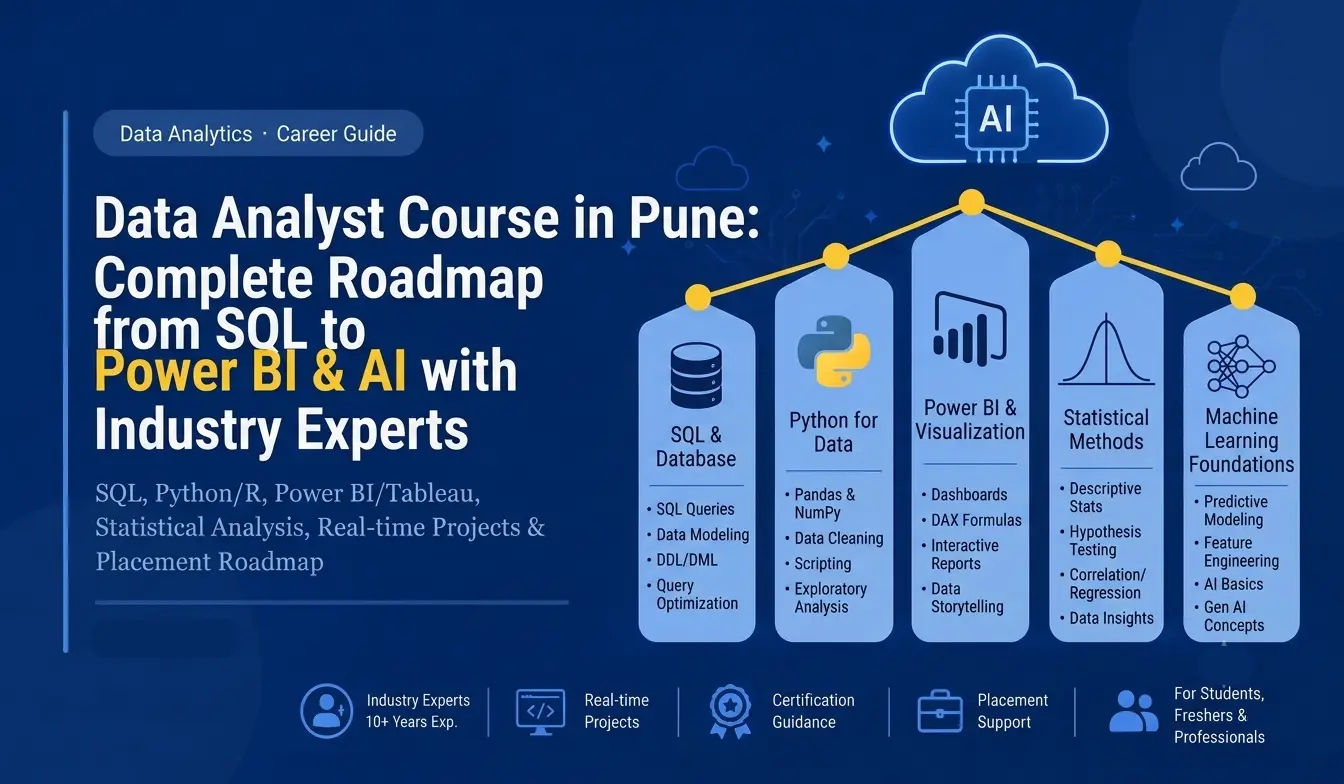
For students, freshers, and working professionals planning a career in analytics, choosing the right Data Analyst Course in Pune is an important first step. But becoming a successful data analyst is not simply about learning one software or completing a certification. It requires a structured learning journey covering SQL, Excel, statistics, Python, data visualization, Power BI, and increasingly, Artificial Intelligence.
This roadmap explains how you can progress from the fundamentals of SQL to advanced Power BI and AI-powered analytics while developing the practical skills employers look for.
Why Choose a Data Analyst Career in 2026?
Businesses across industries generate enormous amounts of information every day. Retail companies analyse customer purchases, banks study transactions, healthcare organizations examine patient data, and technology companies monitor product usage.
Someone needs to transform this information into actionable business insights.
That is where data analysts play an important role.
A data analyst may be responsible for:
- Collecting and cleaning data
- Writing SQL queries
- Analysing business trends
- Building dashboards
- Creating reports
- Identifying performance gaps
- Communicating insights to stakeholders
- Supporting data-driven decisions
The role is also becoming more technology-driven. Modern analysts are increasingly using automation, machine learning, and Generative AI to analyse information faster.
This makes a practical Data Analytics Course in Pune valuable for professionals who want to develop both traditional analytics and modern AI skills.
Step 1: Start with SQL – The Foundation of Data Analytics
If you want to become a data analyst, SQL should be one of your first priorities.
SQL allows analysts to interact with databases and retrieve the information required for business analysis. Even when organizations use advanced analytics platforms, SQL remains an essential skill.
A strong learning roadmap should cover:
- SELECT statements
- Filtering and sorting
- GROUP BY and aggregation
- Joins
- Subqueries
- Common Table Expressions
- Window functions
- CASE statements
- Data manipulation
- Query optimization
For example, a business may ask, “Which products generated the highest revenue last quarter?”
A data analyst can use SQL to retrieve sales information, aggregate revenue, compare product performance, and prepare the dataset for further analysis.
This practical problem-solving approach is more valuable than memorizing SQL syntax.
Step 2: Master Excel for Business Analysis
Excel continues to be widely used in reporting and business analysis.
A good Data Analyst Training in Pune should therefore include advanced Excel skills alongside SQL.
Important areas include:
- Formulas and functions
- XLOOKUP
- INDEX and MATCH
- Pivot Tables
- Conditional formatting
- Data cleaning
- Charts
- Data validation
- Basic automation
- Dashboard creation
Excel is especially useful when working with smaller datasets or when business teams need quick analysis.
For aspiring analysts, combining SQL and Excel creates a strong foundation before moving into advanced visualization and programming.
Step 3: Learn Statistics for Better Decision-Making
Tools can process data, but analysts need statistical thinking to interpret the results correctly.
Statistics helps analysts understand patterns, relationships, variation, and uncertainty.
Key concepts include:
- Mean, median, and mode
- Standard deviation
- Probability
- Distribution
- Correlation
- Regression
- Sampling
- Hypothesis testing
- Outliers
You do not necessarily need advanced mathematical knowledge to begin a data analytics career. However, understanding the fundamentals of statistics helps you make more accurate conclusions from data.
Step 4: Learn Python for Data Analysis
Once you are comfortable with SQL, Excel, and statistics, Python can take your analytical capabilities further.
Python is widely used for data preparation, automation, exploratory analysis, and advanced analytics.
A practical curriculum should introduce:
- Python fundamentals
- NumPy
- Pandas
- Matplotlib
- Data cleaning
- Exploratory Data Analysis
- File handling
- Basic automation
Pandas, in particular, is highly useful for working with structured datasets.
Python also creates a bridge between traditional analytics and Artificial Intelligence. As you progress toward machine learning and Generative AI, Python becomes increasingly valuable.
Step 5: Master Power BI for Business Intelligence
Learning how to analyse data is only one part of the job. You also need to communicate your findings clearly.
This is where Power BI becomes important.
A Power BI Course in Pune should ideally go beyond basic dashboard creation and teach learners how to develop meaningful business intelligence solutions.
Important Power BI skills include:
- Power Query
- Data transformation
- Data modelling
- Relationships
- DAX
- Calculated columns
- Measures
- Interactive dashboards
- Data visualization
- Report publishing
- Dashboard storytelling
Imagine a sales manager opening a dashboard and immediately seeing revenue, profit, regional performance, product trends, and monthly targets.
That is the value of effective data visualization.
A strong analyst does not simply create attractive dashboards. They design dashboards that answer business questions.
Step 6: Develop Business Analysis Skills
Technical skills alone are not enough.
A successful analyst must understand why the business needs the analysis in the first place.
This is why a Business Analyst Course in Pune can complement a data analytics learning path.
Business-oriented skills include:
- Requirement gathering
- Stakeholder communication
- Business process understanding
- KPI identification
- Problem definition
- Data storytelling
- Report presentation
- Decision support
For example, instead of simply saying that sales declined by 12%, an effective analyst investigates why.
Was the decline caused by a particular region?
Did a product category underperform?
Did customer acquisition decrease?
Did pricing change?
The ability to connect numbers with business context makes an analyst more valuable.
Step 7: Build Real-World Projects
One of the biggest differences between learning a technology and becoming job-ready is project experience.
A practical Data Analytics Classes in Pune program should provide opportunities to work with realistic business scenarios.
Potential projects include:
- Sales performance dashboard
- Customer segmentation analysis
- E-commerce analytics
- Employee attrition analysis
- Financial performance dashboard
- Marketing campaign analysis
- Retail inventory analytics
- Customer churn analysis
Each project should demonstrate your ability to collect data, clean it, analyse it, visualize the results, and communicate recommendations.
These projects can also become part of your portfolio when applying for jobs.
Step 8: Add AI to Your Data Analytics Skills
Artificial Intelligence is changing how analysts work.
AI can help automate repetitive tasks, generate summaries, identify patterns, create formulas, assist with data exploration, and support business reporting.
This is why modern learners are increasingly considering a Data Analytics with Gen AI Course in Pune.
Generative AI can support analysts with tasks such as:
- Query assistance
- Data interpretation
- Report summarization
- Automated insights
- Formula generation
- Documentation
- Natural-language analysis
- Report preparation
However, AI does not eliminate the need for analytical thinking.
An analyst still needs to validate information, understand business context, check data quality, and make responsible decisions.
The future belongs to analysts who know how to combine human judgment with AI-powered productivity.
What Should You Look for in the Best Data Analyst Course in Pune?
With many training options available, choosing the Best Data Analyst Course in Pune requires careful evaluation.
Look for a program that includes:
- SQL
- Advanced Excel
- Statistics
- Python
- Power BI
- Data visualization
- Business analytics
- Real-world projects
- Generative AI
- Interview preparation
- Resume guidance
- Career mentoring
Do not select a course only because it has a long syllabus.
Check whether the program gives you opportunities to actually use the technologies.
A strong curriculum should help you progress from learning concepts to solving practical business problems.
Data Analyst Course in Pune with Placement: What Should Learners Expect?
Many learners specifically search for a Data Analyst Course in Pune with Placement because they want support beyond classroom training.
Placement-oriented learning should include more than a promise of job opportunities.
Look for:
- Resume development
- LinkedIn profile guidance
- Portfolio preparation
- Mock interviews
- Technical interview preparation
- SQL interview practice
- Power BI interview questions
- Project explanation practice
- Communication guidance
- Career counselling
At IntelliBI Innovations Technologies, career-focused learning emphasizes practical skills, projects, mentorship, and interview readiness to help learners approach the job market with greater confidence.
Why Choose a Data Analyst Institute in Pune That Focuses on Practical Learning?
Selecting the right Data Analyst Institute in Pune can influence how effectively you convert theoretical knowledge into practical capability.
A good training environment should allow you to ask questions, practise with datasets, work on projects, receive feedback, and understand how analytics is applied in business.
IntelliBI Innovations Technologies focuses on industry-oriented technology education across Data Analytics, AI, Data Engineering, Power BI, Cloud Computing, and related domains.
The objective is not simply to help learners finish a course. It is to help them develop skills they can demonstrate in interviews and apply in professional environments.
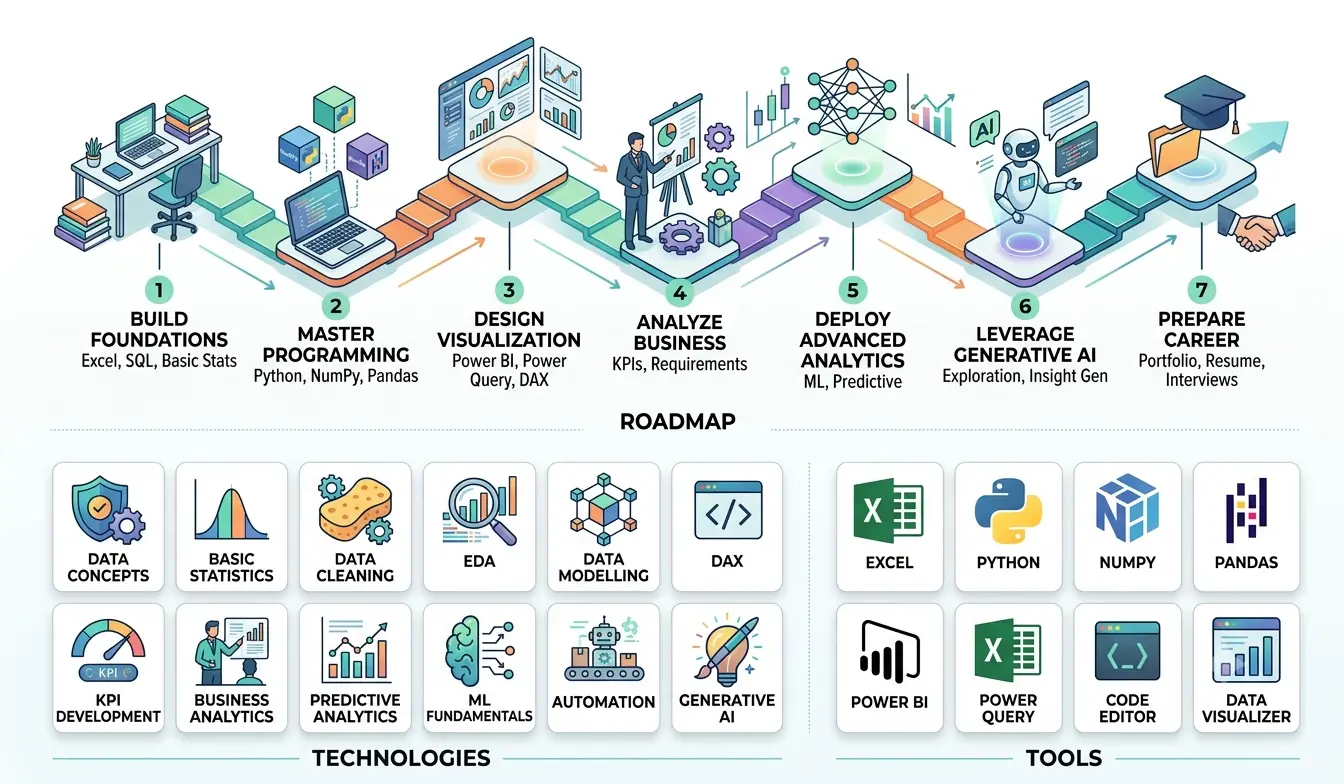
Complete Data Analyst Roadmap: SQL to Power BI & AI
Your learning journey can follow this sequence:
Stage 1 – Fundamentals
Learn:
- Excel
- SQL
- Basic statistics
- Data concepts
Stage 2 – Programming
Learn:
- Python
- NumPy
- Pandas
- Data cleaning
- Exploratory analysis
Stage 3 – Visualization
Learn:
- Power BI
- Power Query
- Data modelling
- DAX
- Dashboard storytelling
Stage 4 – Business Analytics
Learn:
- KPIs
- Business requirements
- Stakeholder communication
- Business problem-solving
Stage 5 – Advanced Analytics
Explore:
- Machine learning fundamentals
- Predictive analytics
- Automation
- Advanced statistics
Stage 6 – Generative AI
Learn how AI can support:
- Data exploration
- Reporting
- Query generation
- Insight generation
- Workflow automation
Stage 7 – Portfolio & Career Preparation
Build several practical projects, create a professional portfolio, prepare your resume, practise interviews, and learn how to explain your analytical decisions clearly.
Career Opportunities After Data Analytics Training
After developing the right combination of technical and business skills, learners can explore roles such as:
- Data Analyst
- Business Analyst
- Reporting Analyst
- BI Analyst
- Power BI Developer
- Junior Data Scientist
- Analytics Consultant
Your exact career path will depend on your education, experience, technical depth, portfolio, and interview performance.
Working professionals can also use analytics skills to move into reporting, business intelligence, product analytics, marketing analytics, or data-driven management roles.
Frequently Asked Questions
What does a Data Analyst Course in Pune include?
A comprehensive program generally covers SQL, Excel, statistics, Python, data cleaning, Power BI, data visualization, business analytics, projects, and increasingly Generative AI.
Is SQL necessary for a data analyst?
Yes. SQL is one of the most important technical skills for analysts because many organizations store business data in relational databases.
Is Power BI important for data analysts?
Yes. Power BI helps analysts transform data into interactive dashboards and communicate business insights to decision-makers.
Can working professionals join data analytics training?
Yes. Working professionals can learn analytics skills through flexible schedules and structured programs designed around career transitions or upskilling.
Is AI useful for data analysts?
Yes. Generative AI can improve productivity by assisting with queries, summaries, documentation, exploration, and repetitive analytical tasks. Analysts still need to validate outputs and apply business judgment.
What is the difference between a data analyst and a business analyst?
A data analyst primarily works with data to identify trends and insights, while a business analyst focuses more broadly on business requirements, processes, stakeholders, and solutions. There can be significant overlap between the two roles.
How can I choose the Best Data Analyst Course in Pune?
Compare the syllabus, practical projects, trainer expertise, tools covered, learning format, career support, interview preparation, and opportunities to build a portfolio rather than selecting a program based only on price or certification.
Conclusion: Start Your Journey from SQL to Power BI and AI
Becoming a data analyst is a journey rather than a single certification.
Start with SQL. Strengthen your Excel and statistical foundations. Learn Python for data analysis. Master Power BI for visualization and business intelligence. Develop business communication skills. Then add AI and Generative AI to become more productive and future-ready.
For learners evaluating a Data Analyst Course in Pune, the most important question is not simply, “Which course should I join?”
The better question is, “Will this learning path help me solve real business problems and demonstrate my skills confidently?”
At IntelliBI Innovations Technologies, the focus is on practical, industry-oriented learning across analytics, Power BI, AI, Data Engineering, and cloud technologies. With hands-on projects, mentorship, career guidance, and interview preparation, learners can build a structured pathway toward modern data careers.
If you are searching for a Data Analytics Course in Pune, Power BI Course in Pune, Data Analyst Training in Pune, or a Data Analytics with Gen AI Course in Pune, start by building the right foundation and progress step by step.
Your journey from SQL to Power BI and AI can begin today.