
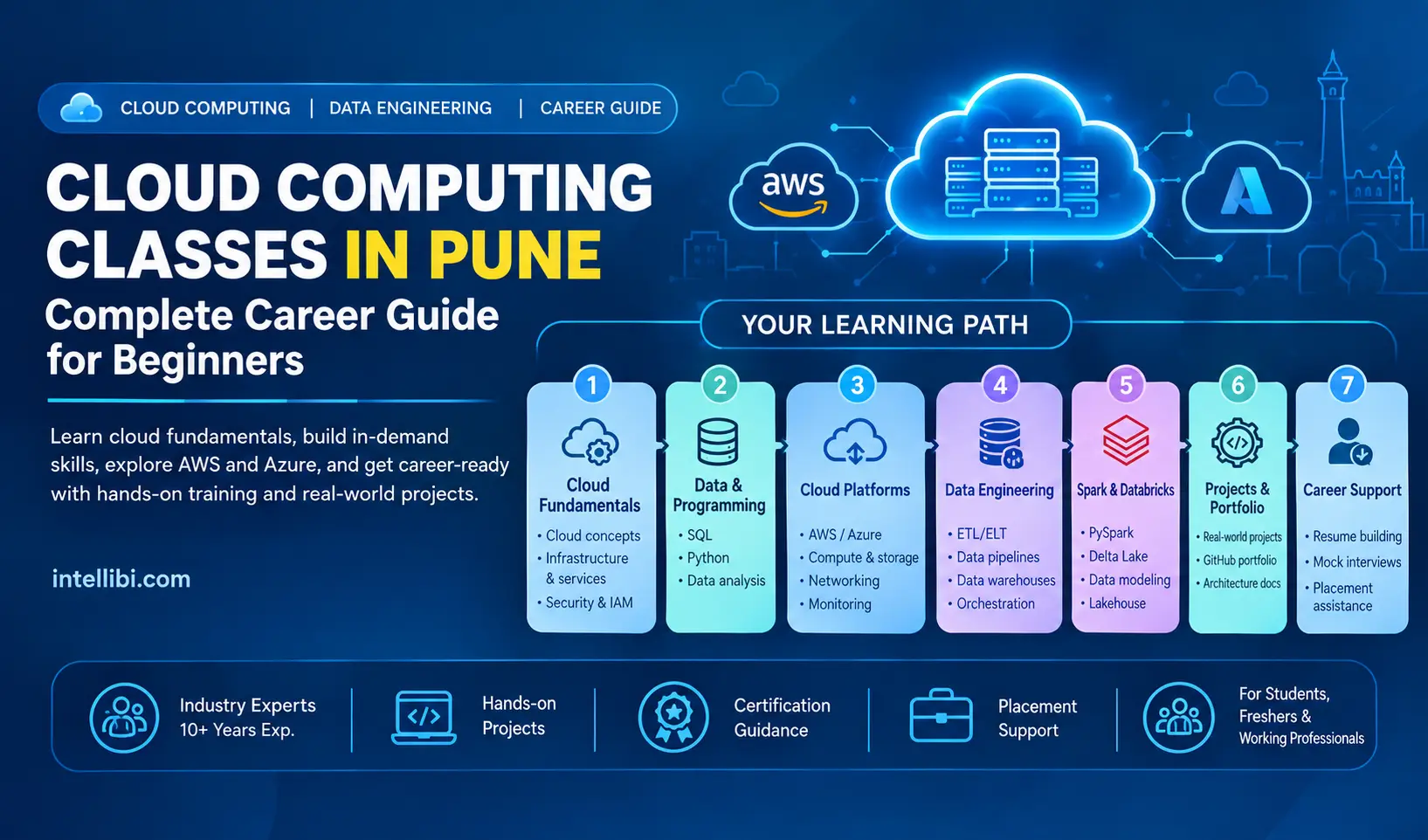
Cloud Computing Classes in Pune: Complete Career Guide for Beginners
Quick Answer
Beginners should start with cloud fundamentals, then learn SQL, Python, storage, compute, databases, networking, security, and monitoring. After choosing AWS or Azure, aspiring data professionals can progress to ETL/ELT, data pipelines, Spark, PySpark, Databricks, and data warehousing. The best learning path combines concepts with hands-on projects, portfolio development, and interview preparation.
Cloud Computing Classes in Pune: Complete Career Guide for Beginners
Cloud computing has changed the way businesses build applications, store information, process data, and deliver digital services. From startups to large enterprises, organizations increasingly depend on cloud platforms for scalable infrastructure, data platforms, analytics, automation, and modern application development.
For beginners, this creates an exciting career opportunity—but it can also make the learning journey confusing. Should you start with AWS or Azure? Do you need programming? Is cloud computing different from data engineering? Should you learn Databricks? What skills actually matter when applying for your first job?
This guide explains how beginners can approach cloud computing, what technologies to learn, and how Cloud Computing Classes in Pune can fit into a practical career roadmap.
Why Learn Cloud Computing?
Cloud computing is more than learning how to create a virtual machine or upload files to online storage. Modern cloud professionals need to understand how infrastructure, databases, security, networking, storage, applications, analytics, and automation work together.
The cloud has also become an important foundation for data engineering and artificial intelligence. Data pipelines can collect information from multiple sources, process it in the cloud, store it in scalable data platforms, and make it available for analytics and AI workloads.
For this reason, Cloud Computing Classes in Pune can be a useful starting point for students, fresh graduates, career switchers, and working professionals who want to understand modern technology environments.
At IntelliBI, the broader technology learning approach connects cloud platforms with data engineering, Databricks, PySpark, ETL pipelines, analytics, and real-world projects rather than treating individual technologies as isolated skills. The program documentation describes a hands-on, project-driven structure covering multiple technologies and practical deliverables.
Cloud Computing Classes in Pune: What Should Beginners Learn First?
One common mistake beginners make is trying to learn every cloud service at once. AWS, Azure, and other platforms contain hundreds of services, but you do not need to memorize all of them.
A better approach is to understand the fundamental concepts first.
Start with:
- Cloud computing fundamentals
- Public, private, and hybrid cloud
- Infrastructure as a Service
- Platform as a Service
- Software as a Service
- Virtualization
- Compute
- Storage
- Databases
- Networking
- Identity and access management
- Security
- Monitoring
- Cost management
Once these concepts become familiar, learning a specific cloud platform becomes much easier.
A structured Data Engineering Training in Pune can also introduce these concepts through data-focused examples, helping learners understand why cloud services are used rather than simply memorizing service names.
Cloud Computing and Data Engineering
Cloud computing and data engineering are closely connected.
A traditional data environment may depend heavily on local servers and fixed infrastructure. Cloud platforms provide scalable storage and computing resources that can support large data workloads.
A data engineer may work with cloud object storage, databases, data integration services, distributed processing platforms, orchestration tools, and analytics systems.
This is why many beginners choose a Data Engineer Course in Pune after developing basic cloud knowledge.
A practical learning journey can look like:
Cloud Fundamentals → SQL → Python → Cloud Storage → Data Integration → Spark/PySpark → Databricks → Data Warehousing → Projects
The IntelliBI curriculum follows a broader technology path that includes SQL, Python, PySpark, Databricks, Azure, AWS, Airflow, and data warehousing.
AWS or Azure: Which Should a Beginner Learn?
This is one of the most common questions asked by beginners joining Cloud Computing Classes in Pune.
The answer depends on your career objective.
AWS has a broad ecosystem covering storage, compute, databases, analytics, serverless services, networking, and data engineering.
Azure is particularly relevant for organizations already working with Microsoft's enterprise ecosystem, including SQL Server, Microsoft Entra, Power BI, and other Microsoft technologies.
Rather than trying to master both platforms immediately, beginners can choose one as their primary platform and gradually understand the equivalent services on the other.
For learners interested in data engineering, an Azure Data Engineer Course in Pune can be a logical route if the goal is to work with Azure-based data platforms.
Important Azure Skills for Beginners
If you choose Azure, begin with the fundamentals before moving into specialized services.
Important areas include:
- Azure fundamentals
- Resource groups
- Storage
- Azure Data Lake Storage
- Azure SQL
- Azure Data Factory
- Azure Synapse
- Identity and security
- Monitoring
- Data integration
- Cloud-based data pipelines
Azure Data Factory is especially useful for learners interested in data engineering because it introduces concepts such as pipelines, activities, linked services, datasets, triggers, parameterization, data movement, transformation, and monitoring.
As you progress through an Azure Data Engineer Course in Pune, these concepts can be connected into complete data workflows rather than learned independently.
AWS Skills Worth Learning
For AWS-focused careers, beginners can start with the fundamental services before moving toward advanced data engineering.
Important areas include:
- Amazon S3
- AWS Glue
- Amazon Athena
- Amazon Redshift
- Amazon EMR
- AWS Lambda
- IAM
- CloudWatch
- Data pipelines
- Serverless workflows
The IntelliBI curriculum's AWS foundation covers core services including S3, Glue, Athena, Redshift, EMR, Lambda, and Step Functions, along with AWS identity and access concepts.
Understanding how these services fit together is more useful than memorizing individual definitions.
Why Amazon S3 Matters in Cloud Data Careers
Storage is one of the most important cloud concepts to understand.
Amazon S3 is widely used as an object-storage foundation for data lake architectures. Data engineers can organize information into raw, cleansed, and curated zones and work with formats such as CSV, JSON, Parquet, ORC, and Avro.
The IntelliBI curriculum covers S3 data lake foundations, Bronze/Silver/Gold zoning, partitioning, file layout, security, Glue Data Catalog, and serverless Spark-based processing.
This is where Cloud Computing Classes in Pune can become especially valuable for aspiring data professionals. Instead of learning cloud storage as an isolated concept, you can understand how storage becomes part of an end-to-end pipeline.
Learn SQL Before Going Too Deep Into Cloud
Cloud knowledge alone does not make someone a data engineer.
SQL remains an important skill for working with structured data, databases, warehouses, reporting systems, and analytics.
Beginners should become comfortable with:
- SELECT statements
- Filtering
- Joins
- Aggregations
- Subqueries
- CTEs
- Window functions
- Views
- Query optimization
- Data integrity
A Best Data Engineering Course in Pune should ideally combine cloud learning with SQL because real-world data workloads usually involve both.
The IntelliBI program includes SQL fundamentals through advanced concepts such as joins, CTEs, analytical functions, query performance, views, data warehousing patterns, case studies, and interview preparation.
Why Python Is Important
Python is another useful skill for beginners planning a cloud or data career.
You do not necessarily need to become an advanced software developer before starting cloud learning. Begin with Python fundamentals and gradually use Python for data processing, automation, APIs, and engineering workflows.
Important areas include:
- Variables and data types
- Lists, dictionaries, and sets
- Conditions and loops
- Functions
- Exception handling
- File handling
- APIs
- NumPy
- Pandas
The IntelliBI curriculum places Python before data-focused libraries and includes NumPy, Pandas, visualization, and data engineering fundamentals.
For beginners attending Data Engineering Classes in Pune, Python and SQL together provide a strong technical foundation.
Where Databricks Fits In
Databricks has become an important technology to understand when moving toward modern data engineering and lakehouse environments.
Beginners do not need to start with advanced optimization techniques. First understand Apache Spark, DataFrames, transformations, Spark SQL, and distributed data processing.
Then move toward Databricks, Delta Lake, Medallion Architecture, orchestration, performance optimization, and analytics.
Databricks Training in Pune can therefore be useful after you have developed basic SQL, Python, and Spark knowledge.
The IntelliBI curriculum covers Databricks architecture, advanced transformations, partitioning, performance tuning, Delta Lake, MERGE, OPTIMIZE, Z-ORDER, Medallion Architecture, CI/CD, orchestration, Databricks SQL, and dashboards.
Cloud + Databricks + Data Engineering
One of the strongest combinations for aspiring data professionals is cloud plus data engineering plus Databricks.
Consider a simplified architecture:
Data Sources → Cloud Storage → Data Processing → Delta Lake → Data Warehouse → BI
Each stage requires different skills.
Cloud services provide infrastructure and storage. Spark or Databricks handles distributed processing. Delta Lake helps manage reliable data tables. Data warehouses support analytics, while BI tools help business users consume the results.
This is why a Best Data Engineering Institute in Pune should ideally teach the relationships between technologies instead of focusing exclusively on individual tools.
What Does a Data Engineer Actually Do?
Beginners sometimes assume that data engineering means simply writing SQL queries.
In practice, the role can involve:
- Designing data pipelines
- Ingesting data from different sources
- Cleaning and transforming datasets
- Managing cloud storage
- Building data models
- Implementing incremental processing
- Monitoring pipelines
- Handling failures
- Improving performance
- Managing data quality
- Supporting analytics teams
An Advanced Data Engineer Course in Pune should therefore go beyond introductory concepts and expose learners to realistic engineering scenarios.
Practical project work can make these responsibilities much easier to understand.
Hands-On Projects Matter
Learning cloud concepts through videos or presentations can provide theoretical knowledge, but projects help you understand how technologies work together.
A beginner project could involve:
- Collecting data from a source
- Storing raw data in cloud storage
- Cleaning and transforming the data
- Loading curated data into an analytics platform
- Creating business-level metrics
- Monitoring the pipeline
- Documenting the architecture
More advanced projects can introduce incremental loads, CDC, SCD patterns, Delta Lake, orchestration, and cloud deployment.
IntelliBI's documented program outcomes include projects and capstones, GitHub portfolios, architecture documents, deployment pipelines, evaluation dashboards, and professional assets such as resumes and interview preparation kits.
How to Choose Data Engineering Classes in Pune
When comparing Data Engineering Classes in Pune, avoid choosing a program only because it has a long list of technologies.
Instead, ask practical questions:
Does the program teach fundamentals first?
Are SQL and Python included?
Does it cover cloud platforms?
Are there hands-on projects?
Will you work with real datasets?
Does the curriculum include Spark or PySpark?
Is Databricks covered?
Are data pipelines and orchestration included?
Is interview preparation provided?
Can you build a portfolio?
These questions are more useful than simply comparing the number of modules.
Who Should Consider Cloud Computing Classes in Pune?
Cloud learning is not limited to computer science graduates.
Cloud Computing Classes in Pune can be useful for:
- College students
- Fresh graduates
- Software professionals
- Database professionals
- Testing professionals
- System administrators
- Business analysts
- Data analysts
- Career switchers
- Professionals returning to IT
Your starting point may be different from another learner's. Someone with SQL experience may move quickly toward data engineering, while someone with programming experience may focus more on cloud development.
The key is to create a roadmap based on your existing skills.
Career Roadmap for a Beginner
A practical roadmap could be divided into several stages.
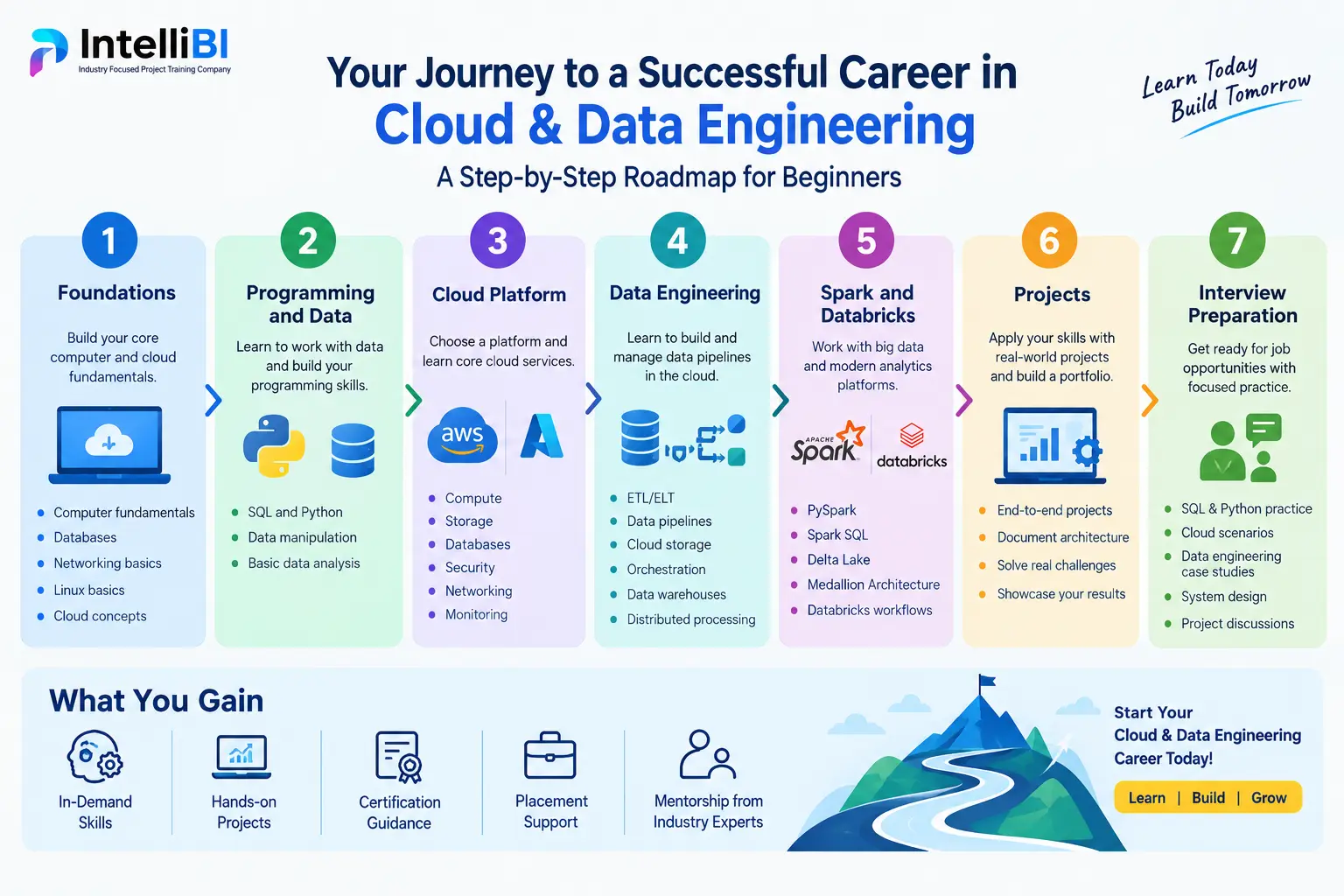
Stage 1 — Foundations
Learn computer fundamentals, databases, networking basics, Linux basics, and cloud concepts.
Stage 2 — Programming and Data
Build SQL and Python skills. Learn data manipulation and basic data analysis.
Stage 3 — Cloud Platform
Choose AWS or Azure and understand compute, storage, databases, security, networking, and monitoring.
Stage 4 — Data Engineering
Learn ETL/ELT, data pipelines, cloud storage, orchestration, data warehouses, and distributed processing.
Stage 5 — Spark and Databricks
Learn PySpark, Spark SQL, Delta Lake, Medallion Architecture, and Databricks workflows.
Stage 6 — Projects
Build end-to-end projects and document your architecture, decisions, challenges, and results.
Stage 7 — Interview Preparation
Practise SQL problems, Python questions, cloud scenarios, data engineering case studies, system design, and project discussions.
This progression can make your learning journey more structured and less overwhelming.
Certifications vs Practical Skills
Certifications can be useful because they provide a structured learning target and demonstrate familiarity with a platform. However, certification alone should not become the entire learning strategy.
During interviews, you may be asked to explain how a pipeline works, how you would handle a failed workflow, how you would design cloud storage, or how you would optimize a large data-processing job.
That requires understanding—not just memorization.
Therefore, when evaluating the Best Data Engineering Course in Pune or an Advanced Data Engineer Course in Pune, look for a balance between structured learning, practical assignments, projects, and interview preparation.
How IntelliBI's Approach Supports Practical Learning
IntelliBI's documented program emphasizes hands-on learning and project-driven training. Its broader program includes multiple technologies and focuses on practical implementation, production deployment, architecture, and business problem solving.
The program also includes interview preparation through technology-wise question banks, coding challenges, case studies, mock technical interviews, HR preparation, resume development, LinkedIn profile building, GitHub documentation, and placement assistance.
For someone comparing Data Engineering Training in Pune, this kind of integrated approach can be helpful because technical learning and career preparation happen as connected parts of the journey.
Common Mistakes Beginners Should Avoid
The first mistake is trying to learn too many cloud platforms simultaneously.
The second is ignoring SQL and Python because the goal is "cloud."
The third is focusing only on certification questions.
The fourth is watching tutorials without building projects.
The fifth is learning tools without understanding architecture.
The sixth is ignoring communication and interview preparation.
A better approach is simple: learn one concept, practise it, connect it with another technology, and then use both in a project.
Conclusion
Cloud computing offers a broad range of career possibilities, but beginners do not need to master everything at once. The most effective approach is to build a strong foundation and gradually connect cloud technologies with programming, databases, data engineering, analytics, and modern processing platforms.
Cloud Computing Classes in Pune can provide structure to this journey, especially when the learning path includes practical projects rather than only theoretical concepts.
If your long-term goal is data engineering, begin with SQL and Python, learn cloud fundamentals, choose AWS or Azure, understand storage and data pipelines, and then progress toward Spark, Databricks, data warehousing, and advanced engineering concepts.
Whether you are researching a Data Engineer Course in Pune, comparing the Best Data Engineering Course in Pune, exploring an Azure Data Engineer Course in Pune, or considering Databricks Training in Pune, focus on one question: will the learning experience help you understand how technologies work together to solve real business problems?
That mindset can turn cloud learning from a collection of services into a practical career skill set.