
Best Data Engineering Course in Pune: Azure, AWS, Spark & Databricks
Quick Answer
The Best Data Engineering Course in Pune should cover SQL, Python, ETL/ELT, cloud platforms such as Azure and AWS, Apache Spark, Databricks, data warehousing, data lakes, and practical projects. A career-focused program should combine hands-on training with real-world pipeline development, cloud data engineering concepts, project guidance, and interview preparation to help learners build job-ready data engineering skills.
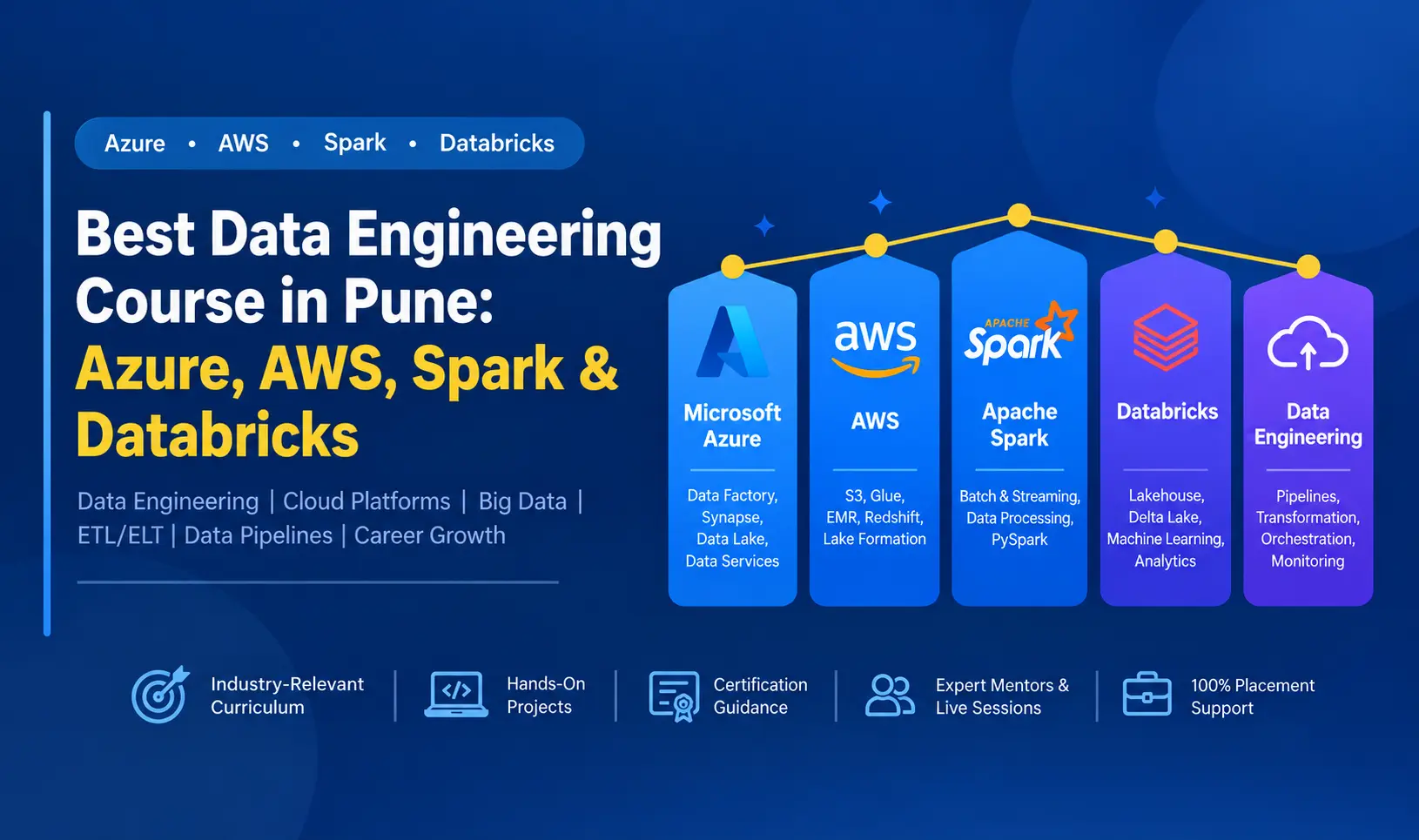
Best Data Engineering Course in Pune: Azure, AWS, Spark & Databricks
Data is at the center of modern business decisions. From customer transactions and financial records to application logs, IoT devices, and digital interactions, organizations generate enormous volumes of information every day. But raw data becomes valuable only when it can be collected, processed, transformed, stored, and delivered efficiently for analytics and business applications.
This growing demand has created strong career opportunities for professionals who understand modern data platforms and cloud technologies. A well-structured Data Engineering Course in Pune can help learners develop the practical skills required to design and manage scalable data pipelines.
For aspiring data engineers, learning technologies such as Azure, AWS, Apache Spark, and Databricks can provide a strong foundation for working with modern data infrastructure. The right training should go beyond theoretical concepts and include hands-on projects, cloud platforms, data processing frameworks, and real-world engineering practices.
Why Choose a Data Engineering Career?
Data engineering focuses on building the systems that make data usable. While data analysts and data scientists primarily work with processed information to generate insights or build models, data engineers are responsible for creating and maintaining the infrastructure through which data flows.
A data engineer may work on tasks such as:
- Designing data pipelines
- Extracting data from multiple sources
- Cleaning and transforming datasets
- Building data warehouses and data lakes
- Managing batch and streaming workloads
- Implementing cloud-based data platforms
- Optimizing data processing jobs
- Supporting analytics and machine learning teams
The increasing adoption of cloud computing, artificial intelligence, business intelligence, and big data technologies has increased the importance of reliable data infrastructure.
This makes structured Data Engineering Training in Pune relevant for fresh graduates, IT professionals, software developers, database professionals, and individuals looking to transition into data-focused careers.
What Makes the Best Data Engineering Course in Pune?
Not every training program provides the same learning experience. The Best Data Engineering Course in Pune should combine fundamental concepts with practical exposure to technologies used in modern data environments.
A strong curriculum should cover:
- SQL and database fundamentals
- Python programming
- Data structures and file formats
- ETL and ELT concepts
- Data warehousing
- Data lakes and lakehouse architecture
- Cloud computing
- Apache Spark
- Microsoft Azure data services
- AWS data services
- Databricks
- Data pipeline orchestration
- Data quality and monitoring
- Real-world data engineering projects
The objective should not simply be to memorize tools. Learners should understand why a particular technology is used, where it fits into a data architecture, and how different components work together.
Core Skills Covered in a Data Engineer Course in Pune
A professional Data Engineer Course in Pune should begin with the fundamentals before progressing toward cloud and distributed data technologies.
SQL and Database Fundamentals
SQL remains one of the most important skills for data engineering. Engineers frequently use SQL to query databases, transform datasets, validate data, and support analytical workloads.
Students should learn:
- SELECT queries
- Joins
- Subqueries
- Common table expressions
- Window functions
- Aggregations
- Stored procedures
- Query optimization
- Data modeling
Understanding relational databases also helps learners understand how data is structured before moving into distributed and cloud-based environments.
Python for Data Engineering
Python is widely used for automation, data processing, scripting, API integration, and pipeline development.
A data engineering curriculum should introduce Python concepts relevant to practical engineering tasks, including file processing, API consumption, exception handling, automation, data manipulation, and reusable programming practices.
ETL and ELT Pipelines
ETL stands for Extract, Transform, Load. It involves extracting information from source systems, transforming it into a usable format, and loading it into a target system.
Modern cloud environments also commonly use ELT, where data is loaded into a scalable target platform before transformation.
Learning both approaches helps students understand how organizations build different types of data pipelines.
Azure Data Engineer Course in Pune: Building Cloud Data Skills
Microsoft Azure provides a broad collection of services for data storage, processing, integration, analytics, and governance.
An Azure-focused curriculum can introduce learners to services and concepts such as:
- Azure Data Factory
- Azure Data Lake Storage
- Azure Synapse Analytics
- Azure Databricks
- Azure SQL
- Cloud-based data pipelines
- Data integration
- Data orchestration
An Azure Data Engineer Course in Pune can be particularly useful for learners interested in Microsoft’s cloud ecosystem.
Students can understand how data moves from source systems into cloud storage, how transformations are performed, and how processed information becomes available for analytics.
The learning process should also include practical pipeline development rather than only service-level theory.
AWS and Cloud Computing for Data Engineers
AWS is another major cloud ecosystem used for data storage, processing, analytics, and application development.
A data engineering curriculum can introduce services such as Amazon S3, AWS Glue, Amazon Redshift, Amazon EMR, and related data services.
Cloud Computing Classes in Pune that include data engineering concepts can help learners understand how cloud infrastructure changes the way organizations build scalable data platforms.
Instead of maintaining every component on physical infrastructure, organizations can use cloud services to scale storage and compute resources according to workload requirements.
For aspiring data engineers, understanding cloud concepts is therefore an important part of becoming comfortable with modern data architectures.
Apache Spark: Processing Data at Scale
As organizations work with increasingly large datasets, traditional single-machine processing may not always be sufficient.
Apache Spark is a distributed data processing framework designed to process large datasets across clusters.
A practical data engineering curriculum should introduce concepts such as:
- Spark architecture
- DataFrames
- Spark SQL
- Transformations
- Actions
- Partitioning
- Distributed processing
- Performance optimization
- Batch processing
- Structured Streaming
Learners should understand not only how to write Spark code but also how distributed processing works.
For example, a pipeline processing millions of records can use Spark to distribute computation across multiple machines, making large-scale processing more practical.
Databricks Training in Pune
Databricks has become an important platform for modern data and AI workloads. It combines data engineering, analytics, machine learning, and collaborative development capabilities within a unified environment.
Databricks learning can cover:
- Apache Spark
- Data lakehouse concepts
- Delta Lake
- Data transformation
- Notebook-based development
- Pipeline development
- Data quality
- Workflow orchestration
- Performance optimization
Databricks Training in Pune can help learners connect their Spark knowledge with practical cloud-based data engineering workflows.
A strong learning program should demonstrate how raw data can be ingested, transformed, stored in a lakehouse architecture, and prepared for downstream analytics.
Understanding Data Lakes and Lakehouse Architecture
Modern data platforms increasingly rely on scalable storage systems that can accommodate structured, semi-structured, and unstructured data.
A data lake provides a centralized environment for storing large volumes of raw and processed data.
A lakehouse architecture extends this approach by combining flexible data lake storage with capabilities traditionally associated with data warehouses.
Learners should understand:
- Data lake architecture
- Data warehouse architecture
- Lakehouse architecture
- Structured and unstructured data
- Metadata
- Data governance
- Data quality
- Transactional data management
These concepts help students understand why organizations choose different architectures for different business requirements.
What Projects Should You Build During Data Engineering Training?
Projects are one of the most important parts of Data Engineering Classes in Pune because they allow learners to apply technical concepts to practical problems.
A strong project should demonstrate the complete data lifecycle.
Retail Sales Data Pipeline
A retail project can involve extracting transaction data, cleaning records, transforming sales information, and loading the processed data into a cloud-based analytical environment.
Students can use Python, SQL, cloud storage, Spark, and visualization tools to create an end-to-end solution.
Real-Time Streaming Pipeline
A streaming project can demonstrate how data is processed as it arrives rather than waiting for a scheduled batch process.
For example, learners can design a pipeline for application events, IoT information, or transaction monitoring.
Cloud Data Warehouse Project
Another useful project can involve building a cloud data warehouse from multiple source systems.
Students can implement ingestion, transformation, validation, dimensional modeling, and reporting layers.
Lakehouse Data Engineering Project
A more advanced project can combine cloud storage, Spark, Delta Lake, and Databricks to create a scalable lakehouse pipeline.
Such a project can demonstrate how modern data platforms support analytics and machine learning workloads.
Advanced Data Engineer Course in Pune: Moving Beyond the Basics
Once learners understand SQL, Python, cloud platforms, and Spark, they can progress toward more advanced engineering concepts.
An Advanced Data Engineer Course in Pune can cover areas such as:
- Advanced Spark optimization
- Partitioning strategies
- Incremental data processing
- Slowly changing dimensions
- Data pipeline orchestration
- Streaming architecture
- Data quality frameworks
- Pipeline monitoring
- Error handling
- Cloud security
- Data governance
- Infrastructure considerations
- CI/CD for data pipelines
Advanced concepts become especially valuable when working with production-scale data systems.
The objective is to help learners think like engineers rather than simply tool users.
Data Engineering Workflow: From Source to Business Insight
A typical data engineering workflow may look like this:
Source Systems → Data Ingestion → Cloud Storage → Transformation → Data Quality → Data Warehouse/Lakehouse → Analytics
For example, customer transactions may originate in an application database. A pipeline extracts the data and transfers it to cloud storage. Spark can then transform and clean the data before it is stored in a structured analytical environment.
Business intelligence tools can subsequently use the prepared data to create dashboards and reports.
This workflow demonstrates why data engineering is an important foundation for analytics and AI.
Who Should Join Data Engineering Classes in Pune?
Data engineering is not limited to experienced software professionals. With a structured learning path, several groups can begin developing relevant skills.
Fresh Graduates
Graduates from computer science, information technology, engineering, mathematics, statistics, or related backgrounds can build foundational skills through a structured program.
Software Developers
Developers who already understand programming can expand their careers by learning databases, cloud platforms, distributed processing, and data pipelines.
Database Professionals
Database administrators and SQL professionals can transition toward broader data engineering responsibilities by learning cloud platforms and distributed data technologies.
Data Analysts
Analysts who want to move closer to the data infrastructure layer can learn Python, SQL optimization, cloud technologies, Spark, and pipeline development.
Working Professionals
Professionals looking for career growth can choose structured learning that fits around their existing work schedule. AI Classes in Pune for Working Professionals are not the only relevant option for technology professionals; data engineering programs can also provide a practical path toward cloud and data infrastructure skills.
How to Choose the Best Data Engineering Institute in Pune
Selecting a training institute should involve more than comparing course duration or fees.
Consider the following factors:
Curriculum: Check whether the program covers SQL, Python, cloud platforms, Spark, Databricks, data warehousing, and pipeline development.
Hands-on learning: Look for opportunities to work on practical datasets and projects.
Cloud exposure: Modern data engineering requires familiarity with cloud platforms such as Azure and AWS.
Project portfolio: Projects can help demonstrate your skills during interviews.
Mentorship: Access to experienced trainers can make complex concepts easier to understand.
Career guidance: Resume development, interview preparation, technical discussions, and project presentation guidance can support job readiness.
Technology relevance: The curriculum should reflect modern data engineering practices rather than focus only on outdated tools.
Certification and Career Preparation
Certifications can help demonstrate structured learning, but they should complement practical skills rather than replace them.
Learners can explore relevant certifications across cloud platforms and data technologies based on their career goals.
At the same time, candidates should build a portfolio that demonstrates:
- SQL skills
- Python programming
- Cloud data pipelines
- Spark processing
- Databricks workflows
- Data modeling
- ETL/ELT implementation
- Data quality practices
During interviews, candidates may also be asked to explain how they would design a pipeline, handle failures, process large datasets, or optimize a slow data job.
Practical understanding therefore becomes an important part of career preparation.
Why Choose IntelliBI Innovations Technologies for Data Engineering Learning?
At IntelliBI Innovations Technologies, the focus is on connecting technical learning with practical career requirements.
A structured Data Engineering Course in Pune should help learners understand not just individual technologies but how those technologies fit together within an end-to-end data platform.
The learning journey can progress from SQL and Python fundamentals toward cloud platforms, Spark, Databricks, data pipelines, and real-world projects.
This approach helps learners build a stronger understanding of modern data engineering workflows while developing practical skills that can be demonstrated through projects and technical discussions.
A Practical Roadmap to Become a Data Engineer
A simple learning roadmap can help beginners avoid jumping between technologies without understanding their relationship.
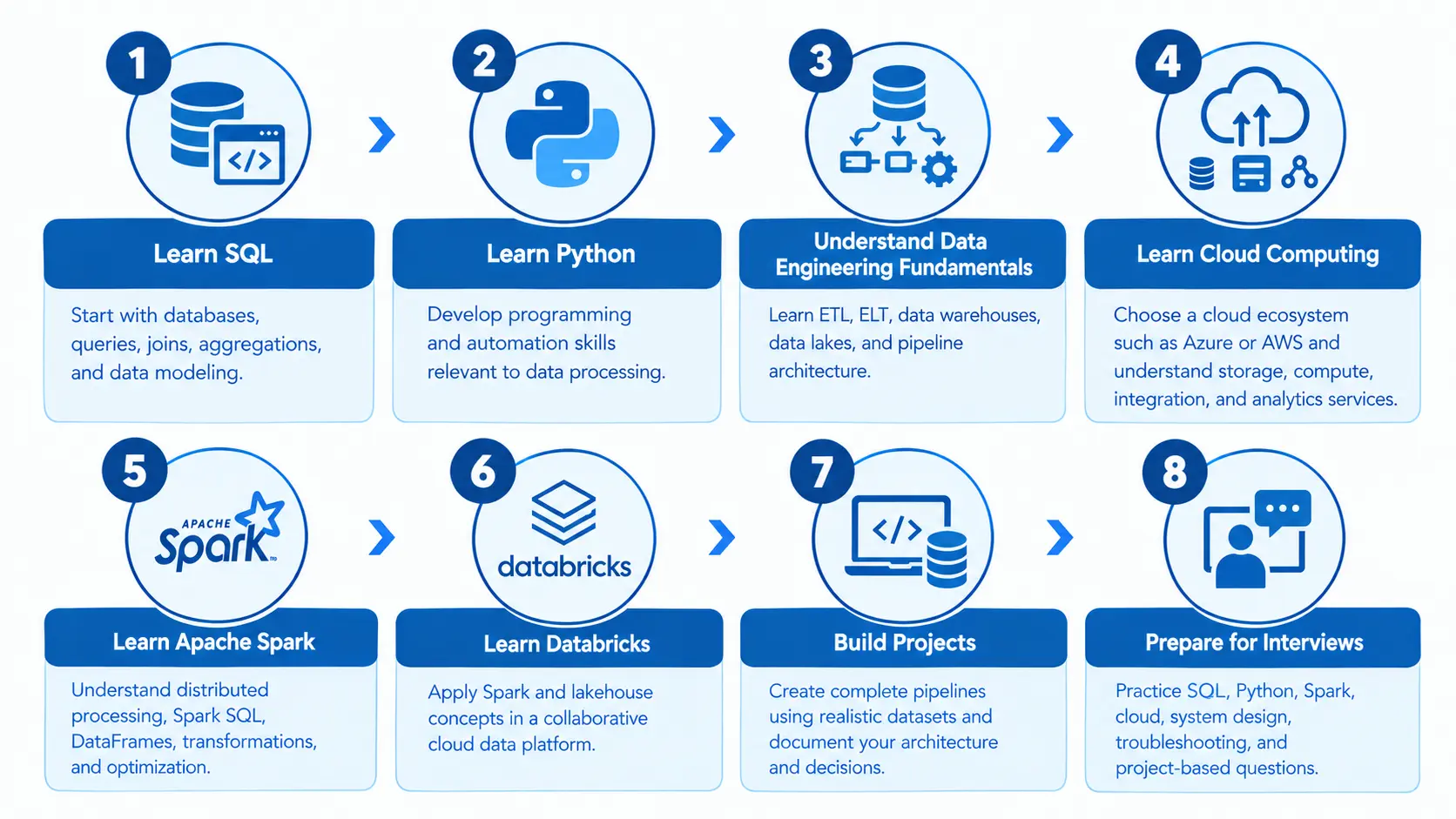
Step 1: Learn SQL
Start with databases, queries, joins, aggregations, and data modeling.
Step 2: Learn Python
Develop programming and automation skills relevant to data processing.
Step 3: Understand Data Engineering Fundamentals
Learn ETL, ELT, data warehouses, data lakes, and pipeline architecture.
Step 4: Learn Cloud Computing
Choose a cloud ecosystem such as Azure or AWS and understand storage, compute, integration, and analytics services.
Step 5: Learn Apache Spark
Understand distributed processing, Spark SQL, DataFrames, transformations, and optimization.
Step 6: Learn Databricks
Apply Spark and lakehouse concepts in a collaborative cloud data platform.
Step 7: Build Projects
Create complete pipelines using realistic datasets and document your architecture and decisions.
Step 8: Prepare for Interviews
Practice SQL, Python, Spark, cloud, system design, troubleshooting, and project-based questions.
The Future of Data Engineering
Data engineering continues to evolve alongside cloud computing, artificial intelligence, machine learning, and analytics.
Modern data engineers increasingly work with platforms that support batch processing, real-time data, lakehouse architectures, automated pipelines, data governance, and AI-ready infrastructure.
As organizations generate more data and adopt AI-driven applications, the need for reliable, scalable, and well-managed data systems remains important.
For learners, this creates an opportunity to develop a technology skill set that connects databases, cloud computing, big data, analytics, and artificial intelligence.
Conclusion
A career in data engineering requires more than learning a collection of tools. It requires an understanding of how data moves through modern technology environments and how reliable pipelines can transform raw information into business-ready data.
A well-designed Data Engineering Course in Pune can provide a structured path from SQL and Python fundamentals to Azure, AWS, Apache Spark, Databricks, cloud data platforms, and practical projects.
Whether you are a graduate starting your technology career, a developer expanding your skills, or a professional planning a transition into data engineering, hands-on learning and consistent project practice can help you build a strong technical foundation for the evolving data ecosystem.