
Azure Data Engineering Course in Pune: ADF, ADLS, Synapse & Databricks
Quick Answer
An Azure Data Engineering Course in Pune teaches learners how to build cloud-based data solutions using Azure Data Factory, ADLS, Synapse Analytics, and Databricks. The learning path typically covers SQL, Python, ETL pipelines, data lakes, Spark, data warehousing, cloud concepts, and practical projects to develop job-ready data engineering skills.
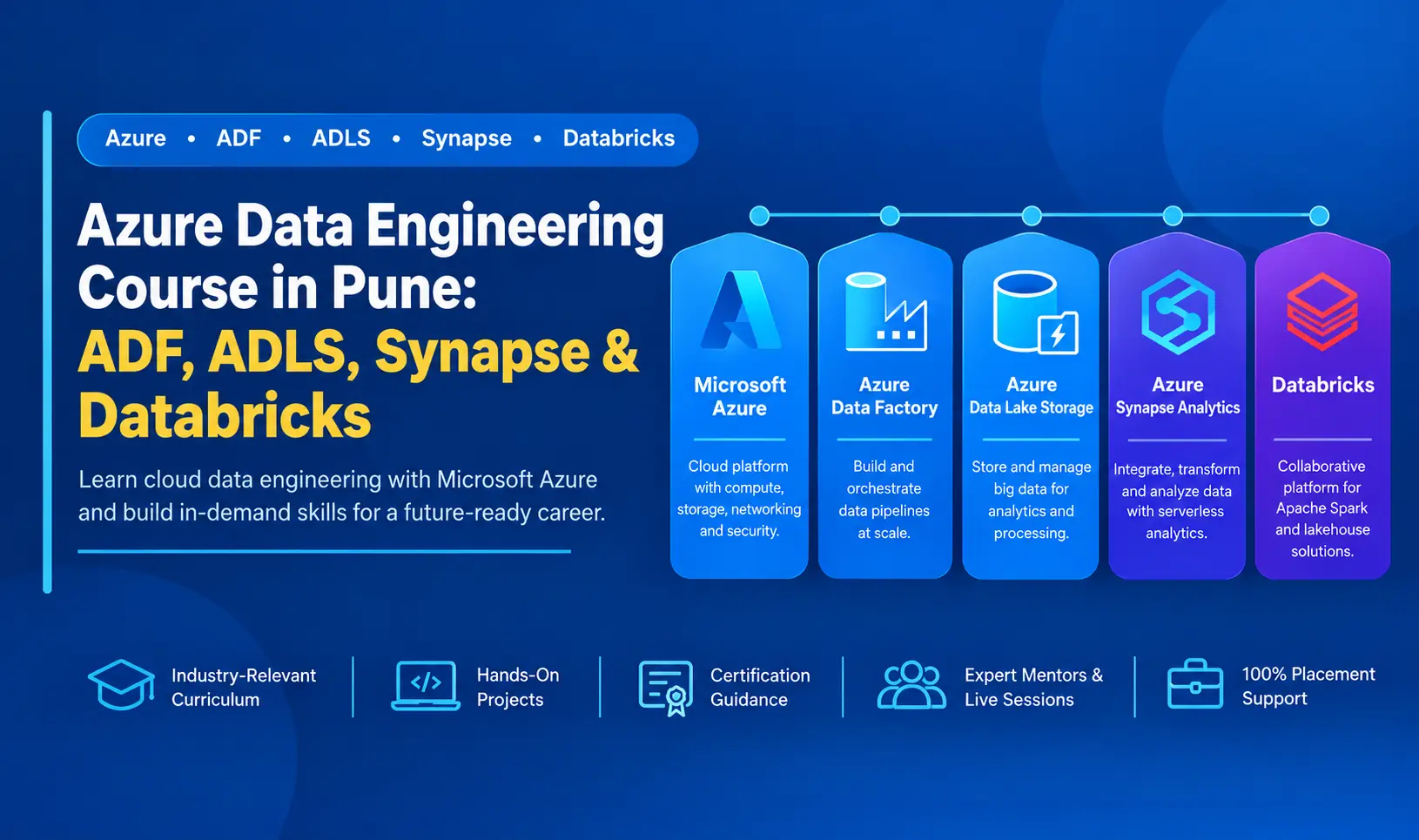
Azure Data Engineering Course in Pune: ADF, ADLS, Synapse & Databricks
Data is now at the center of modern business. Companies collect information from websites, applications, customer platforms, IoT devices, business systems, and cloud applications. But raw data has limited value until it is collected, processed, stored, and made ready for analysis.
This is where data engineers play an important role.
A data engineer builds the systems that move data from different sources into reliable and usable data platforms. Microsoft Azure has become a popular cloud ecosystem for these workloads. Tools such as Azure Data Factory (ADF), Azure Data Lake Storage (ADLS), Azure Synapse Analytics, and Databricks help data engineers build modern data pipelines and analytics platforms.
For learners planning a career in this field, an Azure Data Engineer Course in Pune can provide a structured way to understand these technologies and apply them through practical projects.
At IntelliBI Innovations Technologies, our learning approach focuses on combining cloud concepts, data engineering skills, hands-on practice, and real-world problem solving.
Why Choose Data Engineering as a Career?
Every growing organization needs reliable data. However, data is often spread across multiple systems and formats.
A typical organization may have:
- Customer data in a CRM system
- Sales information in databases
- Application logs in cloud storage
- Marketing data from APIs
- Financial information in enterprise applications
- Large datasets generated by business applications
Someone needs to design the pipelines that bring this information together.
That is one of the main responsibilities of a data engineer.
Data engineering can therefore be a strong career path for people interested in programming, cloud technology, databases, analytics, and large-scale data systems.
A structured Data Engineering Course in Pune can help learners build these skills step by step instead of trying to learn every cloud service separately.
What Is an Azure Data Engineering Course?
An Azure-focused data engineering program teaches learners how to build and manage cloud-based data solutions using Microsoft Azure services.
The learning journey generally covers:
- Data ingestion
- Data storage
- Data transformation
- Data integration
- Data pipeline development
- Distributed data processing
- Data warehousing
- Cloud security concepts
- Monitoring and optimization
- Data analytics architecture
The goal is not simply to understand individual tools. Learners should understand how these tools work together to solve a complete business data problem.
For example, data may be collected using Azure Data Factory, stored in Azure Data Lake Storage, transformed with Databricks, and made available for analytics through Azure Synapse Analytics.
This end-to-end approach is important for anyone considering a Data Engineer Course in Pune.
Core Technologies Covered in Azure Data Engineering
A practical Azure data engineering learning path should cover several technologies.
Azure Data Factory for Data Integration
Azure Data Factory is a cloud-based data integration service.
It can be used to create pipelines that move and transform data between different systems.
For example, a company may receive sales data from an on-premises SQL Server database. ADF can help create a pipeline that extracts the data and moves it into cloud storage.
Learners can explore concepts such as:
- Pipelines
- Activities
- Linked services
- Datasets
- Integration runtimes
- Triggers
- Parameters
- Variables
- Pipeline monitoring
ADF is particularly useful when organizations need automated data movement between different systems.
Azure Data Lake Storage for Scalable Data Storage
Azure Data Lake Storage, commonly known as ADLS, provides cloud storage designed for large volumes of data.
It can store structured, semi-structured, and unstructured data.
A data lake may contain:
- CSV files
- JSON files
- Parquet files
- Application logs
- Images
- Transaction records
- Historical datasets
Learners should understand how data can be organized into logical layers and how storage design affects downstream processing.
Common concepts include:
- Containers
- Files and folders
- Access control
- Data organization
- Storage security
- File formats
- Partitioning
Understanding ADLS is an important part of modern Azure data engineering.
Azure Synapse Analytics for Data Warehousing
Azure Synapse Analytics combines data integration, analytics, and data warehousing capabilities.
It can support large-scale analytical workloads and help organizations work with data from multiple sources.
Learners can explore:
- Dedicated SQL pools
- Serverless SQL
- SQL-based analytics
- Data warehousing concepts
- External data
- Query optimization
- Integration with other Azure services
Synapse helps learners understand how cloud data platforms can support business intelligence and analytical workloads.
Databricks for Data Processing
Databricks is widely used for large-scale data processing and engineering workflows.
It provides a collaborative environment for working with technologies such as Apache Spark.
In a practical learning environment, learners can work with:
- Apache Spark
- PySpark
- DataFrames
- ETL workflows
- Data transformation
- Batch processing
- Large datasets
- Delta Lake concepts
Databricks is especially useful when data processing requirements become more complex or datasets become very large.
This makes Databricks Training in Pune relevant for learners who want to build advanced data processing skills.
How ADF, ADLS, Synapse and Databricks Work Together
One of the most important things to understand is how these technologies connect.
Imagine an e-commerce company that receives customer and sales information from different sources.
A simplified architecture could look like this:
Data Sources → Azure Data Factory → ADLS → Databricks → Synapse → BI Reports
ADF can orchestrate data movement.
ADLS can act as cloud storage.
Databricks can process and transform large datasets.
Synapse can provide an analytical environment.
A business intelligence platform can then use the prepared data for reporting and decision-making.
This kind of workflow gives learners a practical understanding of an Azure data platform.
Why Practical Learning Matters in Data Engineering
Data engineering is difficult to learn through theory alone.
Reading about pipelines is different from creating one.
Understanding Spark concepts is different from processing a real dataset.
That is why practical work should be an important part of Data Engineering Training in Pune.
Learners should get opportunities to:
- Create data pipelines
- Connect different data sources
- Store files in ADLS
- Transform data using Spark
- Work with SQL
- Build data warehouse structures
- Handle errors
- Monitor pipeline execution
- Optimize data workflows
- Build end-to-end projects
Hands-on work also helps learners understand how different services interact.
What You Can Learn in Data Engineering Classes in Pune
A structured learning program can cover the data engineering lifecycle from beginning to end.
1. SQL and Database Fundamentals
SQL remains an important skill for data engineers.
Learners should understand:
- SELECT statements
- Joins
- Aggregations
- Subqueries
- Window functions
- Views
- Stored procedures
- Data manipulation
- Query optimization basics
Strong SQL knowledge makes it easier to work with both traditional databases and cloud data platforms.
2. Python for Data Engineering
Python can be used for data processing, automation, scripting, and working with cloud services.
Learners can focus on practical concepts such as:
- Variables
- Functions
- Loops
- Data structures
- File handling
- Exception handling
- APIs
- Libraries used for data processing
The objective is to develop enough Python knowledge to solve practical data engineering problems.
3. Data Pipeline Development
Pipeline development is a core part of data engineering.
Learners can understand how to:
- Extract data
- Validate data
- Transform data
- Load data
- Schedule pipelines
- Monitor execution
- Handle pipeline failures
ADF provides a useful environment for understanding these workflows.
4. Data Lake Architecture
Learners should also understand how data lakes are designed.
Topics may include:
- Raw data
- Processed data
- Curated data
- File formats
- Partitioning
- Folder structures
- Access control
A well-designed data lake can make data easier to manage and process.
5. Spark and Databricks
Spark becomes especially useful when working with large datasets.
Learners can practice:
- DataFrames
- Transformations
- Actions
- Joins
- Aggregations
- Filtering
- Partitioning
- PySpark
- Delta-based workflows
These skills can help learners move beyond basic data processing.
Career Opportunities After Data Engineering Training
After building the required technical skills, learners can explore several career paths.
Potential roles include:
- Data Engineer
- Azure Data Engineer
- Cloud Data Engineer
- ETL Developer
- Data Platform Engineer
- Analytics Engineer
- Databricks Data Engineer
- Big Data Engineer
The exact role depends on the learner's skills, previous experience, project portfolio, and organizational requirements.
A Data Engineering Course in Pune can be particularly useful for learners who want to move from traditional IT, software development, database administration, analytics, or related technical roles into cloud data engineering.
Who Should Join an Azure Data Engineer Course in Pune?
This learning path can be suitable for several groups.
IT Professionals
Software developers, database professionals, testers, system administrators, and other IT professionals can explore data engineering as a career direction.
Data Analysts
Data analysts who want to understand how data is collected, transformed, and stored can expand their technical knowledge through data engineering.
Fresh Graduates
Graduates with backgrounds in computer science, information technology, engineering, mathematics, or related fields can build foundational skills through structured learning.
Career Switchers
Professionals moving toward cloud and data roles can use a structured program to develop practical skills.
Cloud Technology Learners
People already learning Azure can combine their cloud knowledge with data engineering concepts.
How to Select the Best Data Engineering Course in Pune
Choosing a course requires more than checking the list of technologies.
Learners should look at the overall learning experience.
Consider these factors:
- Course syllabus
- Trainer experience
- Practical assignments
- Real-world projects
- Cloud platform exposure
- SQL and Python coverage
- Databricks practice
- Interview preparation
- Career guidance
- Learning support
- Project portfolio development
A strong program should explain not only what each technology does, but also when and why it should be used.
Why IntelliBI Can Be a Learning Option
IntelliBI Innovations Technologies focuses on practical learning across AI, data, cloud, analytics, and related technologies.
The Data Engineering Course in Pune is designed around technologies and skills that learners can use to understand modern data workflows.
The learning approach can help students connect individual concepts with larger data engineering solutions.
For learners exploring Azure Data Engineer Course in Pune options, the focus should be on developing practical understanding rather than simply completing a list of topics.
Learners looking for a Best Data Engineering Course in Pune should also evaluate how much hands-on work, project exposure, and career support are included in the learning journey.
Projects You Can Build While Learning
Projects can make technical learning more practical.
Here are some examples of Azure data engineering projects:
Retail Sales Data Pipeline
Build a pipeline that collects sales files, stores them in ADLS, transforms the data with Databricks, and prepares it for analytics.
Customer Data Integration Platform
Combine customer data from multiple sources and create a structured cloud data workflow.
Financial Data Processing Pipeline
Process transaction datasets and create curated tables for analytical reporting.
IoT Data Pipeline
Design a workflow for handling high-volume sensor data and preparing it for analysis.
Marketing Analytics Platform
Combine campaign, website, and customer datasets to create a centralized analytical data platform.
Projects like these help learners understand the complete data lifecycle.
Azure Data Engineering and Cloud Computing Skills
Data engineering is increasingly connected with cloud computing.
This is why Cloud Computing Classes in Pune can complement a data engineering learning path.
Learners should understand basic cloud concepts such as:
- Compute
- Storage
- Networking
- Identity
- Security
- Scalability
- Monitoring
- Resource management
These concepts help data engineers understand the environment in which their pipelines operate.
Advanced Skills for an Advanced Data Engineer Course in Pune
Once the fundamentals are clear, learners can explore advanced concepts.
An Advanced Data Engineer Course in Pune may include topics such as:
- Advanced Spark processing
- Delta Lake
- Pipeline optimization
- Data partitioning
- Incremental data loading
- Slowly changing dimensions
- Data quality checks
- Monitoring
- Security
- Performance optimization
- Cloud architecture
- CI/CD concepts
- Infrastructure considerations
Advanced learning should build on practical fundamentals rather than introduce complex topics without context.
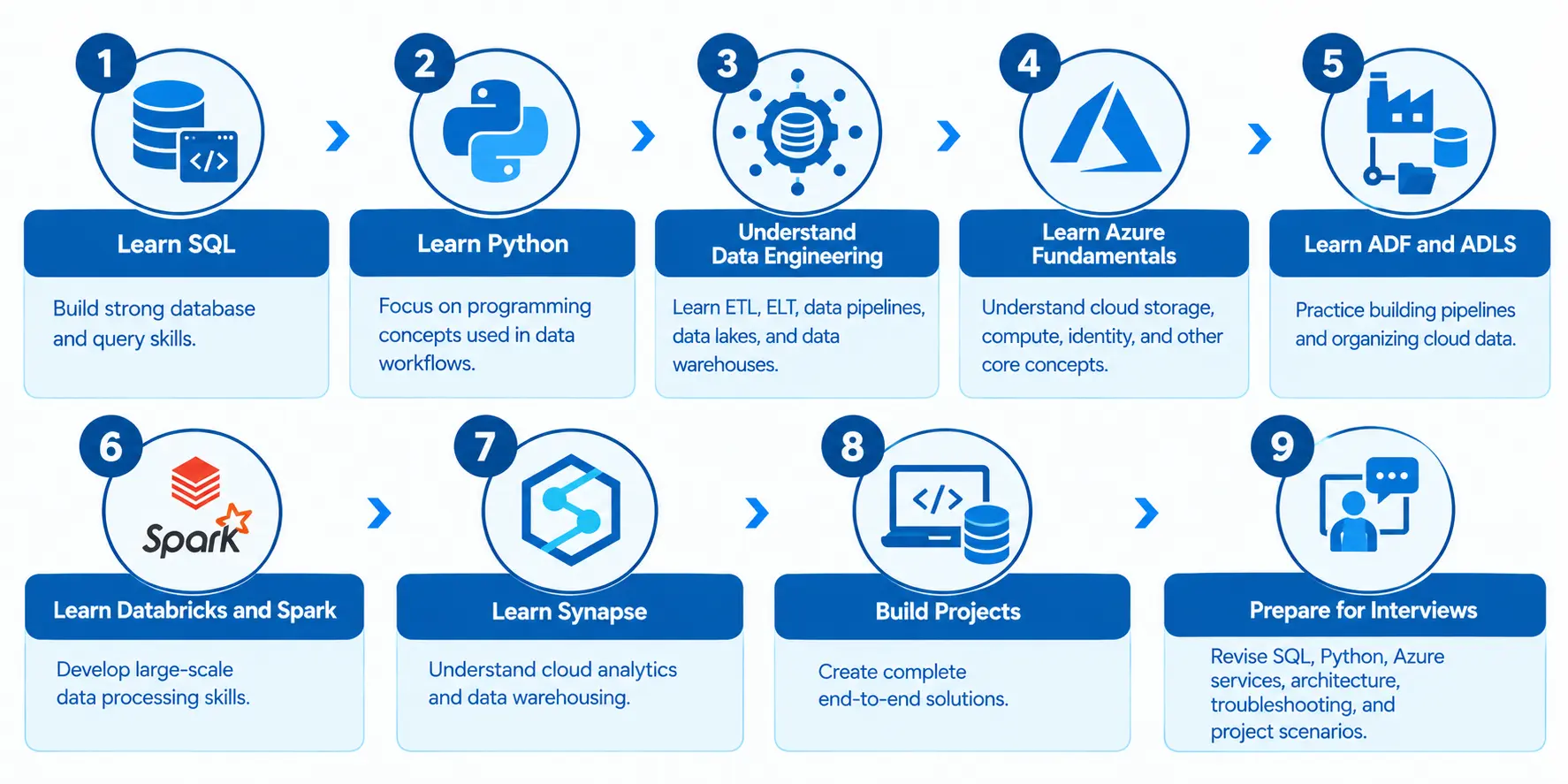
Building a Career Roadmap in Data Engineering
A simple roadmap can help learners stay focused.
Step 1: Learn SQL
Build strong database and query skills.
Step 2: Learn Python
Focus on programming concepts used in data workflows.
Step 3: Understand Data Engineering
Learn ETL, ELT, data pipelines, data lakes, and data warehouses.
Step 4: Learn Azure Fundamentals
Understand cloud storage, compute, identity, and other core concepts.
Step 5: Learn ADF and ADLS
Practice building pipelines and organizing cloud data.
Step 6: Learn Databricks and Spark
Develop large-scale data processing skills.
Step 7: Learn Synapse
Understand cloud analytics and data warehousing.
Step 8: Build Projects
Create complete end-to-end solutions.
Step 9: Prepare for Interviews
Revise SQL, Python, Azure services, architecture, troubleshooting, and project scenarios.
What Makes a Data Engineer Job-Ready?
Completing a course is only one part of career preparation.
A job-ready learner should be able to explain how a data solution works.
For example, they should be able to discuss:
- Where the data comes from
- How it is ingested
- Where it is stored
- How it is transformed
- How data quality is checked
- How pipelines are monitored
- How failures are handled
- How the solution can scale
- How data is prepared for reporting
Project-based learning can help learners develop this type of practical thinking.
Conclusion
Modern businesses need reliable systems that can handle growing amounts of data. Azure provides a broad ecosystem for building these systems, while ADF, ADLS, Synapse, and Databricks can support different stages of the data engineering lifecycle.
For learners planning a career in this domain, the right Data Engineering Training in Pune should combine cloud concepts with SQL, Python, data pipelines, distributed processing, and practical projects.
At IntelliBI Innovations Technologies, the focus is on helping learners understand technology through practical learning and career-oriented guidance.
Whether you are a graduate, IT professional, analyst, or career switcher, building strong fundamentals and working on realistic projects can help you develop the skills needed for modern data engineering roles.