
Azure Data Engineer Roadmap 2026: From SQL to Agentic AI Pipelines
Quick Answer
The 2026 Azure Data Engineer roadmap covers 8 stages: SQL and data modelling, Python, PySpark, Azure Data Factory, Databricks and Lakehouse, Synapse, ADLS Gen2, Key Vault, Microsoft Fabric, Airflow and CI/CD, followed by GenAI and Agentic AI pipelines using RAG, vector search and MCP. Target DP-700 and DP-750 certifications. With focused learning, complete the roadmap in 4–5 months, building 10+ hands-on projects.
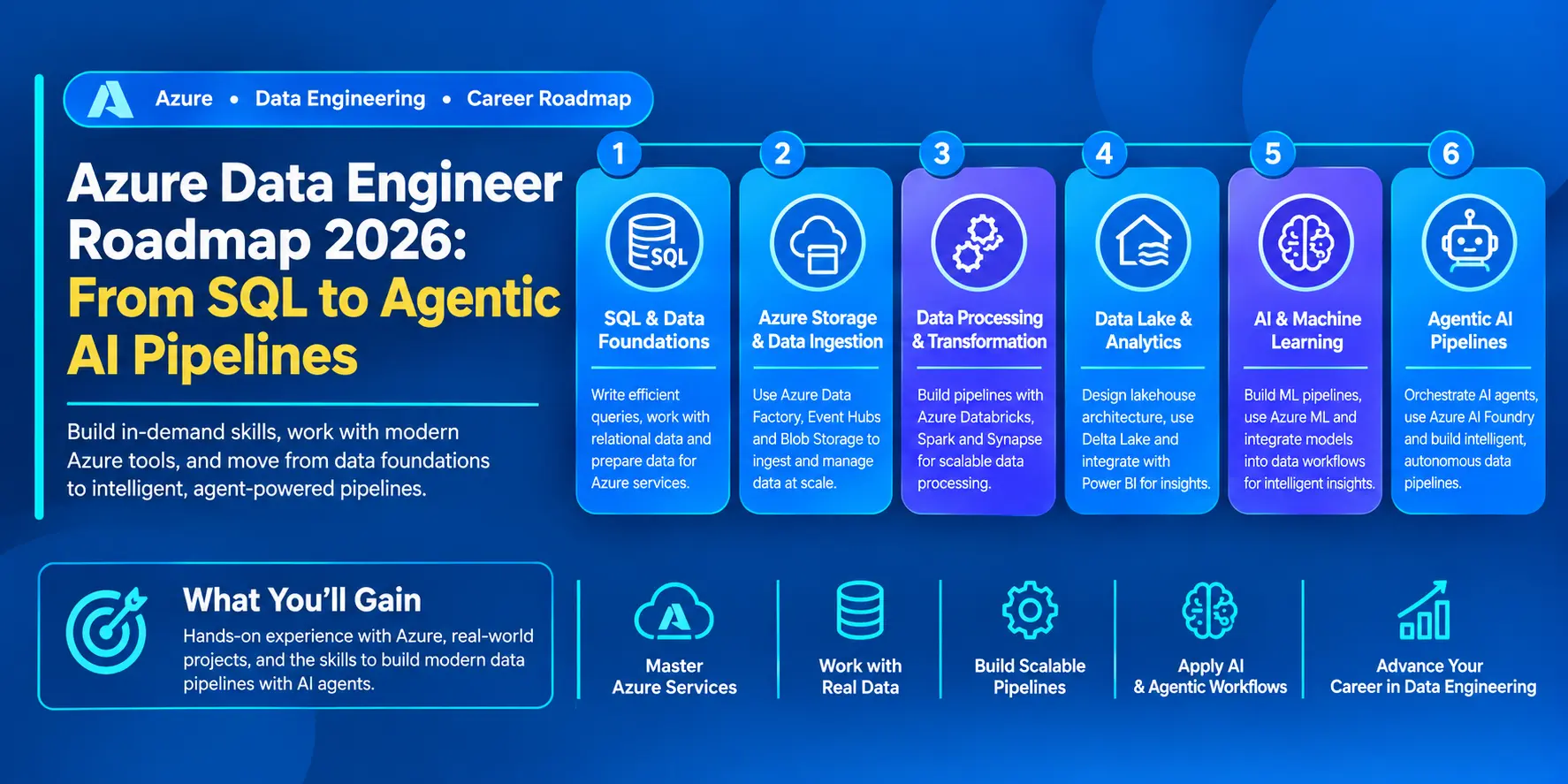
Azure Data Engineer Roadmap 2026: From SQL to Agentic AI Pipelines
Two years ago, an Azure data engineer's job was to move data reliably from point A to point B. In 2026, the job description has quietly changed. Hiring managers in Hinjewadi, Kharadi and Magarpatta now expect you to build pipelines that feed AI models, govern data for LLM applications, and increasingly, let AI agents operate parts of the pipeline themselves.
That shift is good news if you plan for it. The fundamentals have not disappeared; they have become the floor, not the ceiling. This roadmap lays out the eight stages that take you from your first SELECT statement to production-grade Agentic AI pipelines, and shows where a structured Azure Data Engineer Course in Pune can compress the journey from years into months.
Why Azure, and Why Now?
Pune's enterprise landscape leans Microsoft. Banks, insurers, manufacturers and the large IT services firms that serve them run on Azure SQL, Synapse, Databricks and, increasingly, Microsoft Fabric. That is why a Microsoft Azure Course in Pune tends to translate into interviews faster than a generic cloud certificate.
Three things make 2026 the right moment to commit:
- Microsoft retired the DP-203 exam and replaced it with DP-700 (Fabric Data Engineer Associate), and launched DP-750 (Azure Databricks Data Engineer Associate) in beta this year. The certification path has been reset, so everyone is starting fresh.
- The Lakehouse pattern on Delta Lake has become the default architecture, replacing the old warehouse-versus-data-lake debate.
- GenAI workloads need clean, governed, retrievable data. Companies are discovering that their AI projects stall without strong data engineering, which is exactly why Azure Cloud Training in Pune has seen a surge in working professionals enrolling after hours.
Let's walk the road.
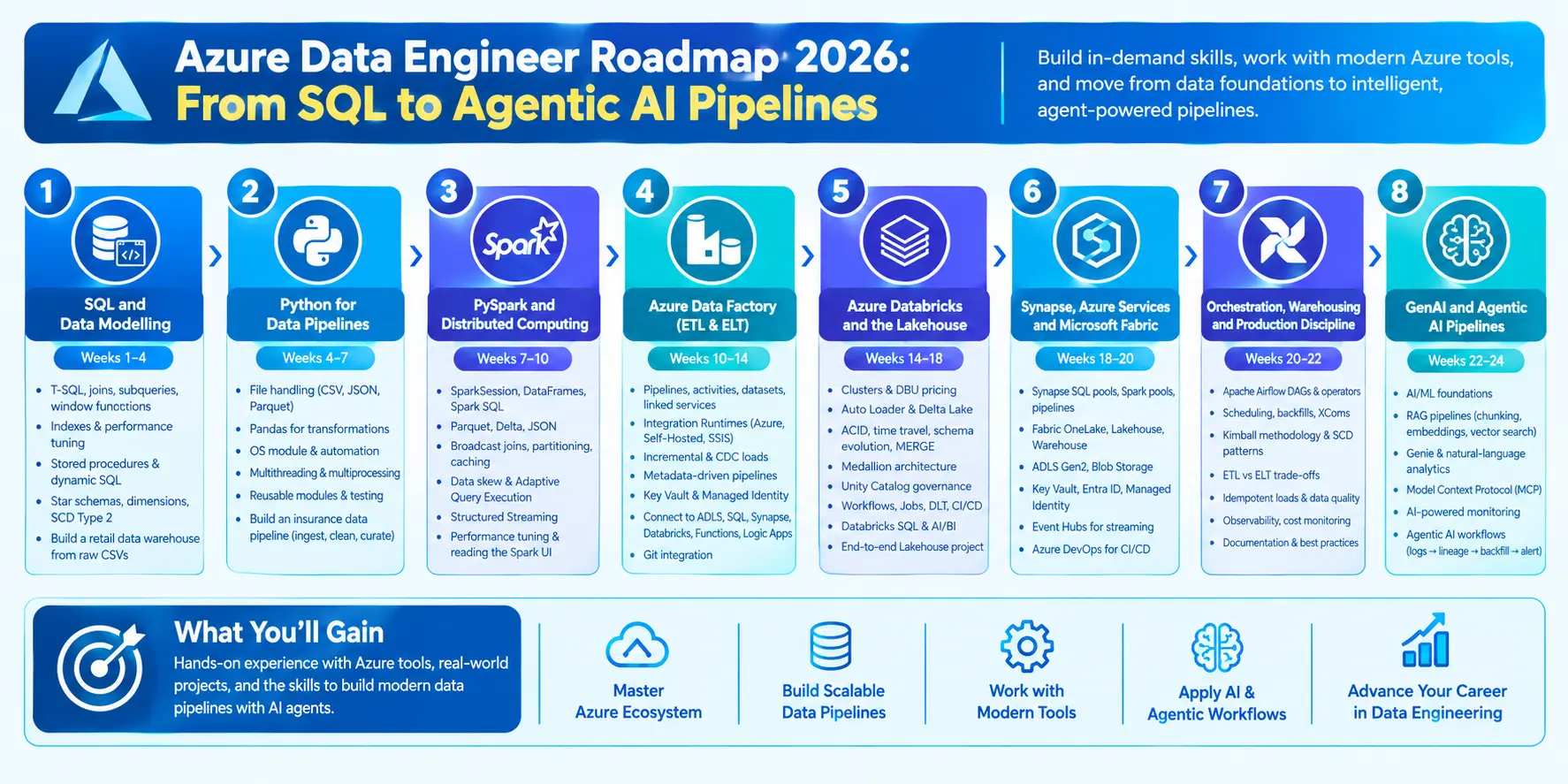
Stage 1: SQL and Data Modelling (Weeks 1–4)
Every Azure data engineer, whether they touch Databricks or Fabric, spends a surprising share of the day writing SQL. Start with T-SQL on SQL Server and SSMS because that is what most Pune enterprises run on-premises, and it is what you will migrate to the cloud later.
What to master:
- DDL, DML, joins, set operators and subqueries until they are second nature
- Common Table Expressions and window functions (ROW_NUMBER, LAG, running totals) — these appear in almost every interview
- Indexes and query performance tuning
- Stored procedures and dynamic SQL
- Dimensional modelling: star schemas, fact and dimension tables, and Slowly Changing Dimensions Type 2
Build a small retail sales warehouse from raw CSVs by hand. Nothing teaches data modelling like loading messy data and discovering why your keys do not match.
Stage 2: Python for Data Pipelines (Weeks 4–7)
Python is the glue of the Azure data stack. You will use it in Databricks notebooks, Azure Functions, Airflow DAGs and data-quality scripts.
Focus on what pipelines actually need rather than everything the language can do: file handling across CSV, JSON and Parquet; the pandas library for transformations; working with the OS module for automation; multithreading and multiprocessing for parallel ingestion; and packaging code into modules so it can be reused and tested.
A good checkpoint project is an insurance data pipeline that ingests raw claim files, cleans them with pandas and writes curated outputs on a schedule. You will rebuild this same project on Spark and then on Azure later, which is a powerful way to see what each layer adds.
Stage 3: PySpark and Distributed Computing (Weeks 7–10)
This is where many self-taught learners stall, and where a Best Azure Data Engineering Course in Pune earns its fee. Spark is not just "pandas for big data". You need to understand how a job becomes a DAG, how stages and tasks are scheduled across executors, and why shuffles are expensive.
Cover:
- SparkSession, DataFrames and Spark SQL
- Reading and writing Parquet, Delta and JSON at scale
- Broadcast joins, partitioning, caching and storage levels
- Data skew detection and salting, and Adaptive Query Execution in Spark 3.x
- Structured Streaming with micro-batches
Performance tuning is the single most asked topic in PySpark interviews. Spend a full week deliberately breaking jobs and reading the Spark UI to fix them.
Stage 4: Azure Data Factory — ETL and ELT in the Cloud (Weeks 10–14)
Azure Data Factory is the orchestration backbone for most Azure enterprises, and Azure Data Factory Training in Pune is often the module that turns a learner into someone who can ship.
What a 2026-ready ADF skill set looks like:
- Pipelines, activities, datasets and linked services
- Integration Runtimes: Azure IR, Self-Hosted IR for on-premises SQL Server, and SSIS IR for legacy packages
- Hybrid ingestion patterns — full load, incremental load and change data capture
- Parameterised, metadata-driven pipelines that handle hundreds of tables with one design
- Storing secrets in Azure Key Vault and authenticating with Managed Identity
- Wiring ADF to ADLS Gen2, Azure SQL Database, Synapse, Databricks notebooks, Azure Functions and Logic Apps
- Git integration from day one so every pipeline is version-controlled
This is also where Azure ETL Training in Pune should teach you the ELT mindset: land raw data cheaply in the lake, then transform with Spark or SQL where compute is elastic.
Stage 5: Azure Databricks and the Lakehouse (Weeks 14–18)
If ADF is the backbone, Databricks is the engine. Nearly every modern Azure job posting in Pune names it, and the new DP-750 exam makes it a formal certification path. Quality Azure Databricks Training in Pune should take you well beyond notebooks:
- Workspace, cluster types (all-purpose, job, serverless) and the DBU pricing model
- Auto Loader for incremental file ingestion
- Delta Lake in depth: ACID transactions, time travel, schema evolution, MERGE, and Change Data Feed as a CDC source
- The Medallion architecture — Bronze, Silver and Gold layers — and when to break the rules
- Unity Catalog for governance, lineage and fine-grained access
- Databricks Workflows, Jobs versus Pipelines, Delta Live Tables and Asset Bundles for CI/CD
- Databricks SQL, AI/BI Dashboards and Genie for natural-language analytics
Your capstone here should be an end-to-end Medallion Lakehouse: raw e-commerce events landing in ADLS, streamed into Bronze with Auto Loader, cleaned into Silver, aggregated into Gold and served to a dashboard. Put it on GitHub. It is the project recruiters ask about most.
Stage 6: Synapse, Azure Services and Microsoft Fabric (Weeks 18–20)
Synapse Analytics still runs a large share of Pune's enterprise warehouses, and Microsoft Fabric is where new builds are heading. Treat them as one family: Synapse's dedicated and serverless SQL pools, Spark pools and pipelines on one side; Fabric's OneLake, Lakehouse and Warehouse items on the other.
Alongside these, every Azure data engineer needs the supporting services: ADLS Gen2 and Blob Storage foundations, Azure Key Vault, Microsoft Entra ID and Managed Identity, Azure Event Hubs for streaming ingestion, and Azure DevOps for CI/CD pipelines. This is the breadth that separates an Azure Certification Course in Pune from a tool tutorial.
Stage 7: Orchestration, Warehousing and Production Discipline (Weeks 20–22)
Pipelines that work on your laptop are not pipelines; pipelines that run every night without you are. Apache Airflow remains the orchestration standard outside the Microsoft-native tools, and you should be comfortable writing DAGs, operators and task dependencies, scheduling with backfills, passing data with XComs, and deploying DAGs through CI/CD.
Pair this with data warehousing theory — Kimball methodology, SCD patterns, ETL versus ELT trade-offs — and with production habits: idempotent loads, data-quality checks, observability, cost monitoring and documentation. These are the questions senior interviewers use to separate engineers from notebook writers.
Stage 8: GenAI and Agentic AI Pipelines (Weeks 22–24)
Here is what is new in 2026, and what most roadmaps still leave out.
AI applications are only as good as the data pipelines beneath them. Azure data engineers are now expected to:
- Understand AI and ML foundations well enough to serve feature data and evaluation data correctly
- Build retrieval pipelines for LLMs: chunking documents, generating embeddings, loading vector search indexes and keeping them fresh
- Use Genie and natural-language analytics to let business users query the Lakehouse directly
- Work with the Model Context Protocol (MCP), which lets AI agents call tools — including your pipelines, catalogs and quality checks — safely and with governance
- Add AI-powered monitoring: anomaly detection on volumes and schemas, automatic triage of failures and suggested fixes
An Agentic AI pipeline, in practice, is one where an agent can read a failed job's logs, check lineage in Unity Catalog, re-run a bounded backfill and notify the owner, all within guardrails you designed. That is the skill that moves you from ₹8–12 LPA to the ₹15–40 LPA band that Pune's product and finance employers pay for.
Few programmes teach this yet. It is a core module of the Microsoft Azure Data Engineering Course at IntelliBI, where learners build a RAG chatbot over Lakehouse data and an AI-monitored pipeline as their final capstones.
Certifications That Matter in 2026
Certifications do not replace projects, but they do get your resume past filters. Target these, in this order:
- DP-700: Microsoft Certified Fabric Data Engineer Associate — the successor to DP-203 and the baseline Microsoft credential
- DP-750: Azure Databricks Data Engineer Associate — new in 2026, and a strong differentiator while most candidates have not heard of it
- Databricks Certified Data Engineer Associate, then Professional — vendor credentials that hiring managers trust
A well-designed Azure Certification Course in Pune should map every module to these exam domains so that your course projects double as exam preparation.
How Long Does the Roadmap Take?
For a working professional studying 10–12 hours a week, the full path is realistically 4–5 months, around 250 hours of guided learning plus project time. Self-study usually takes two to three times longer, mostly because of the stalls at PySpark and Databricks where there is nobody to unblock you.
Evening batches from 7 to 9 PM and weekend sessions on Saturday and Sunday mornings are the formats that work for people already employed, which is why most Azure Training in Pune for working professionals is scheduled that way.
Who This Roadmap Is For
- SQL developers, ETL developers and SSIS or Informatica professionals who want to move their skills to the cloud
- Data analysts and Power BI developers who keep hitting the limits of the data they are given
- Manual and automation testers, support engineers and non-IT graduates with strong logic who want a durable technical career
- Freshers who prefer a defined, project-led path over scattered tutorials
If you can learn SQL, you can walk this road. No prior coding background is required at Stage 1; it is built up deliberately.
Projects That Get You Hired
Across the roadmap, aim for a portfolio of at least five substantial builds:
- Enterprise retail sales data warehouse on Azure SQL and Synapse with SCD Type 2
- Healthcare data processing and automation with ADF hybrid ingestion
- End-to-end Medallion Lakehouse on Azure Databricks with Unity Catalog
- Insurance revenue and claims analytics platform with streaming from Event Hubs
- RAG chatbot and AI-monitored pipeline over governed Lakehouse data
Document each one: architecture diagram, cost estimate, the problems you hit and how you solved them. Interviewers remember the engineer who explained a data-skew fix far longer than the one who listed tools.
Walking the Roadmap With IntelliBI
At IntelliBI Innovations Technologies in Thergaon, Pune, ten minutes from Hinjewadi, this exact roadmap is the syllabus. Senior mentors with 10–15 years at enterprise MNCs teach every stage hands-on, learners build 10+ production-grade projects rather than toy demos, and placement support continues until you are placed, with mock interviews, system-design rounds, ATS resume and LinkedIn optimisation. Classroom, live online and recorded options cover every schedule, and lifetime LMS access means the roadmap stays with you as the stack evolves.
The 2026 Azure data engineer is part SQL craftsman, part distributed-systems engineer and part AI platform builder. The road is longer than it was, but it is also clearer, and the demand at the end of it has never been higher. If you want a guided, project-driven path through every stage above, explore the Azure Data Engineer Course in Pune and book a free demo class for the October 2026 batch.
Your first step is a SELECT statement. Your last is an agent running your pipeline. Everything in between is this roadmap.