
Advanced Data Engineer Course in Pune: Cloud, Spark, Databricks & Big Data
Quick Answer
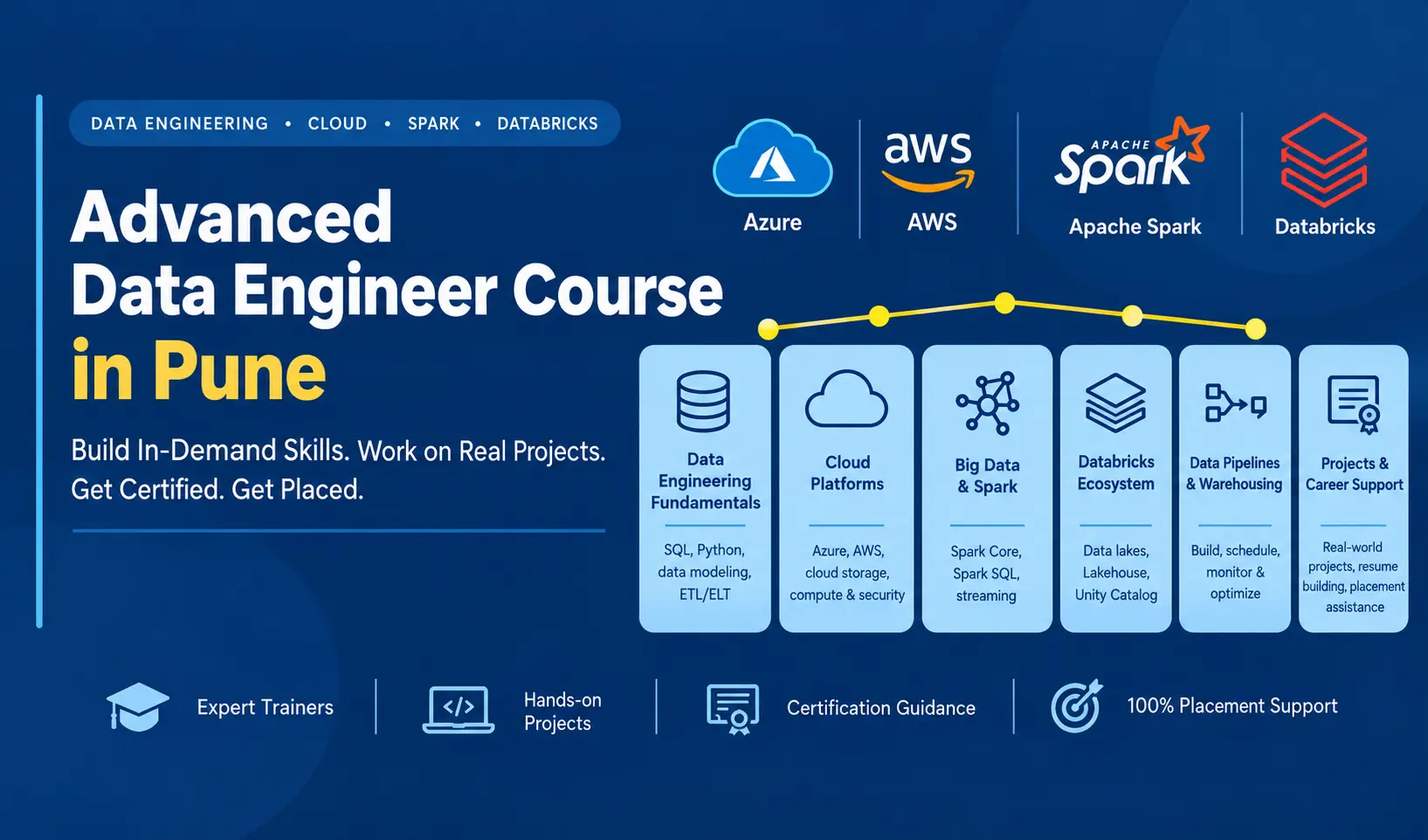
An Advanced Data Engineer Course in Pune helps learners build modern data engineering skills in SQL, Python, cloud platforms, Apache Spark, Databricks, big data, data pipelines, and data warehousing. A practical program should include hands-on projects, cloud-based workflows, Spark processing, Databricks, data quality, and interview preparation to help learners prepare for modern data engineering careers.
Advanced Data Engineer Course in Pune: Cloud, Spark, Databricks & Big Data
Data is now at the heart of modern business. Every app, website, transaction, customer interaction, and digital service creates data. But raw data alone has limited value. Businesses need reliable systems that can collect, process, store, transform, and deliver data for analytics and AI.
This is where data engineering plays a key role.
An advanced data engineer understands more than databases and SQL. Modern professionals need skills in cloud platforms, distributed processing, Apache Spark, Databricks, data pipelines, data warehouses, and big data systems.
For learners planning a career in this field, an Advanced Data Engineer Course in Pune can provide a structured path to build these skills through practical learning and projects.
At IntelliBI Innovations Technologies, our approach focuses on connecting technical concepts with real business use cases. The goal is not just to learn tools, but to understand how modern data platforms work together.
Why Choose an Advanced Data Engineer Course in Pune?
Data engineering has changed significantly over the last few years. Traditional databases are still important, but organizations now work with large and varied data sources.
A modern data environment may include:
- Cloud storage
- Relational and NoSQL databases
- APIs
- Streaming data
- Data lakes
- Data warehouses
- Distributed computing
- Business intelligence platforms
- Machine learning systems
An advanced learning program helps learners understand how these components connect.
A structured Data Engineering Course in Pune can also help learners move from basic SQL and database concepts toward complete data engineering workflows.
The focus should be on learning how to design a pipeline from the source to the final business output.
For example:
Data Source → Ingestion → Storage → Processing → Transformation → Data Warehouse → Analytics
Understanding this complete flow is important for anyone planning to become a data engineer.
What Will You Learn in an Advanced Data Engineer Course?
An advanced course should cover both fundamentals and modern technologies. Learners should gradually move from core concepts to cloud-based and distributed data systems.
The major areas include:
- SQL and database concepts
- Python for data engineering
- ETL and ELT processes
- Data modeling
- Data warehousing
- Big data concepts
- Apache Spark
- Databricks
- Cloud data platforms
- Data pipeline development
- Data quality
- Data security
- Monitoring and optimization
This combination makes learning more practical and closer to the technologies used in modern organizations.
Core Data Engineering Skills to Build
Before moving into advanced tools, learners should understand the foundation of data engineering.
SQL and Database Management
SQL remains one of the most important skills for data engineers.
A data engineer may use SQL to:
- Query business data
- Join multiple tables
- Aggregate large datasets
- Create views
- Transform data
- Validate data
- Analyze pipeline results
Strong SQL knowledge also makes it easier to understand data warehouses and analytical systems.
Python for Data Engineering
Python is widely used for automation, data processing, API integration, scripting, and pipeline development.
Learners should understand:
- Variables and data types
- Functions
- Loops
- File handling
- Exception handling
- APIs
- Data processing libraries
- Object-oriented programming basics
The objective is not to become a software developer. The focus is to use Python effectively for data workflows.
Understanding Cloud Data Engineering
Cloud platforms have become an important part of modern data infrastructure.
Organizations use cloud services because they can support scalable storage, processing, security, and data management.
An advanced Data Engineer Course in Pune should introduce learners to cloud concepts such as:
- Cloud storage
- Compute services
- Databases
- Data warehouses
- Identity and access management
- Networking basics
- Data integration
- Monitoring
- Security
Learners can also explore services available on platforms such as Microsoft Azure and AWS.
Azure Data Engineering Skills
For professionals interested in Microsoft technologies, an Azure-focused learning path can be valuable.
An Azure Data Engineer Course in Pune can cover concepts related to:
- Azure Data Lake Storage
- Azure Data Factory
- Azure Synapse
- Azure Databricks
- Cloud-based data pipelines
- Data transformation
- Data monitoring
The key is to understand how these services work together rather than learning each service in isolation.
Big Data Concepts Every Data Engineer Should Know
Traditional data systems may struggle when datasets become extremely large or arrive at high speed.
Big data technologies address these challenges by distributing storage and processing across multiple systems.
Three common characteristics are often discussed:
- Volume: The amount of data
- Velocity: The speed at which data is generated
- Variety: Different types and formats of data
Data engineers need to understand how distributed systems process such data efficiently.
This is where technologies such as Apache Spark become important.
Apache Spark for Large-Scale Data Processing
Apache Spark is one of the most widely known technologies in the big data ecosystem.
Spark allows data processing tasks to be distributed across multiple computing resources.
Learners should understand concepts such as:
- Spark architecture
- DataFrames
- Spark SQL
- Transformations
- Actions
- Partitioning
- Caching
- Joins
- Performance optimization
- Batch processing
Spark is especially useful when working with large datasets that require scalable processing.
Why Spark Matters for Data Engineers
Consider a company that receives millions of customer transactions every day.
A basic script may work well with a small dataset. But as the data grows, processing time and resource requirements can increase.
Distributed processing allows the workload to be divided across multiple machines.
This gives learners a practical understanding of why big data technologies are needed.
Databricks Training in Pune: From Spark to Modern Data Platforms
Databricks brings together data engineering, analytics, and AI capabilities in a cloud-based environment.
Practical Databricks Training in Pune can help learners understand how Spark-based workloads are developed and managed in a modern platform.
Important concepts include:
- Databricks workspace
- Notebooks
- Apache Spark
- Data pipelines
- Delta Lake
- Data transformation
- Job scheduling
- Data quality
- Performance optimization
Databricks also provides a practical environment where learners can work with real datasets and build data workflows.
Understanding Delta Lake
Data lakes can store large amounts of structured and unstructured data. However, managing reliability and consistency can become difficult.
Delta Lake introduces features that help improve reliability for data lake workloads.
Learners should understand concepts such as:
- ACID transactions
- Schema management
- Version history
- Data updates
- Data quality
- Reliable analytical workloads
These concepts help bridge the gap between traditional data warehouses and flexible data lake architectures.
Building Modern Data Pipelines
A data engineer is often responsible for moving data from different sources into systems where it can be analyzed.
A typical pipeline may look like:
Source Systems → Data Ingestion → Data Lake → Transformation → Data Warehouse → BI Dashboard
Sources can include:
- Databases
- APIs
- CSV files
- Application logs
- Cloud services
- Streaming platforms
The pipeline must be reliable, scalable, and easy to monitor.
A good Data Engineering Training in Pune should therefore include hands-on pipeline development rather than only theoretical lessons.
ETL vs ELT: What Should Data Engineers Understand?
ETL stands for Extract, Transform, and Load.
The data is extracted from a source, transformed, and then loaded into a target system.
ELT stands for Extract, Load, and Transform.
Here, data is first loaded into a modern storage or warehouse platform and transformed afterward.
Cloud platforms have made ELT approaches increasingly practical because modern systems can provide significant storage and processing capacity.
Understanding both approaches helps data engineers select the right architecture for different projects.
Cloud Computing Classes in Pune for Data Engineering
Cloud knowledge is increasingly connected to data engineering.
Cloud Computing Classes in Pune can help learners understand the basic infrastructure behind modern data platforms.
Important areas include:
- Virtual machines
- Cloud storage
- Databases
- Networking
- Security
- Scalability
- Monitoring
- Serverless services
- Cloud data warehouses
For a data engineer, the goal is not necessarily to master every cloud service. It is to understand how cloud infrastructure supports data workloads.
Data Warehousing and Data Modeling
Data engineering also requires an understanding of how data should be organized.
A data warehouse is designed to support analytical workloads.
Learners should understand concepts such as:
- Fact tables
- Dimension tables
- Star schema
- Snowflake schema
- Primary keys
- Foreign keys
- Slowly changing dimensions
- Data marts
Good data modeling can make analytical queries easier to manage and maintain.
Why Data Quality Matters
A pipeline can run successfully and still produce incorrect results.
For example, customer records may contain:
- Missing values
- Duplicate records
- Incorrect formats
- Invalid dates
- Unexpected data types
Data engineers therefore need to include validation and quality checks within their workflows.
A reliable data platform is not only fast. It must also deliver trustworthy data.
Real-World Projects in a Data Engineering Course
Projects help learners connect concepts and tools.
A practical Advanced Data Engineer Course in Pune can include projects such as:
Project 1: Cloud Data Pipeline
Build a pipeline that collects data from multiple sources, stores it in cloud storage, transforms it, and loads it into an analytical platform.
Project 2: Spark Data Processing
Use Apache Spark to process a large dataset and perform transformations, joins, aggregations, and optimization.
Project 3: Databricks Lakehouse Project
Create a data workflow using Databricks and Delta Lake.
The project can include:
- Data ingestion
- Data cleaning
- Transformation
- Storage
- Data validation
- Pipeline scheduling
Project 4: Business Intelligence Data Pipeline
Build a complete pipeline that prepares data for reporting.
The workflow can connect data sources with a warehouse and finally provide clean data for BI dashboards.
Projects like these help learners understand how individual technologies fit into a complete solution.
Who Should Join an Advanced Data Engineer Course?
An advanced data engineering program can be useful for several learner groups.
It may suit:
- Fresh graduates
- IT professionals
- Software developers
- Database professionals
- Data analysts
- BI professionals
- Cloud professionals
- Career transitioners
- Professionals moving toward big data
Learners should ideally have basic programming and database knowledge. However, a structured course can help build the required foundation before moving into advanced topics.
How to Choose the Best Data Engineering Course in Pune
When comparing training programs, do not look only at the course title.
Check what the program actually covers.
Important factors include:
- SQL and Python foundation
- Cloud technologies
- Apache Spark
- Databricks
- Big data concepts
- Data pipelines
- Data warehousing
- Real-world projects
- Practical assignments
- Mentorship
- Interview preparation
- Career guidance
The Best Data Engineering Course in Pune for a learner depends on their existing skills, career goals, preferred technology stack, and learning requirements.
Why Practical Data Engineering Classes in Pune Matter
Reading about data pipelines is different from building one.
Data Engineering Classes in Pune can be more effective when learners get opportunities to work with datasets, write queries, create pipelines, debug errors, and optimize workloads.
Hands-on learning helps learners understand questions such as:
- Why did the pipeline fail?
- Why is the query slow?
- Why is data duplicated?
- How can Spark processing be optimized?
- Where should the data be stored?
- How can pipeline failures be monitored?
These are the types of questions professionals encounter in real projects.
Career Opportunities After Data Engineering Training
Data engineering skills can support several technology career paths.
Depending on experience and specialization, learners may explore roles such as:
- Data Engineer
- Cloud Data Engineer
- Big Data Engineer
- Databricks Data Engineer
- Azure Data Engineer
- ETL Developer
- Data Platform Engineer
- Analytics Engineer
Career growth depends on technical ability, project experience, communication skills, and continuous learning.
A course should therefore be viewed as a starting point rather than the final step.
A Practical Roadmap to Become a Data Engineer
Learners can follow a step-by-step approach.
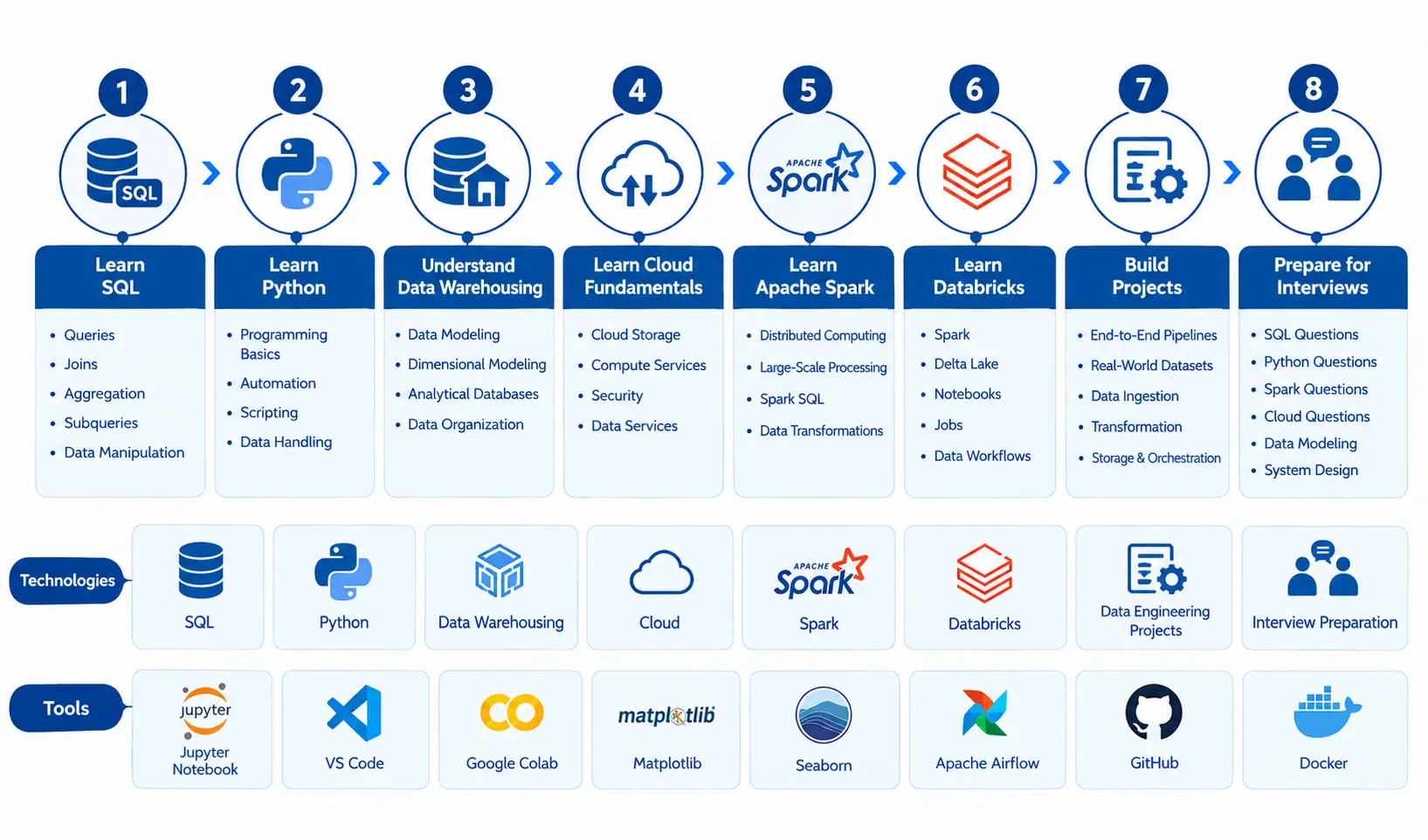
Step 1: Learn SQL
Start with queries, joins, aggregation, subqueries, and data manipulation.
Step 2: Learn Python
Build programming and automation skills.
Step 3: Understand Data Warehousing
Learn data modeling and analytical database concepts.
Step 4: Learn Cloud Fundamentals
Understand cloud storage, compute, security, and data services.
Step 5: Learn Apache Spark
Practice large-scale data processing.
Step 6: Learn Databricks
Work with Spark, Delta Lake, notebooks, jobs, and data workflows.
Step 7: Build Projects
Create complete data pipelines using realistic datasets.
Step 8: Prepare for Data Engineering Interviews
Practice SQL, Python, Spark, cloud, data modeling, and system-based questions.
This gradual approach can make advanced topics easier to understand.
Why Learn Data Engineering With IntelliBI Innovations Technologies?
At IntelliBI Innovations Technologies, we focus on practical and career-oriented learning.
Our approach connects foundational concepts with modern technologies such as cloud platforms, Spark, and Databricks.
Learners can explore structured learning through our Data Engineering Course in Pune, with a focus on practical skills and industry-relevant concepts.
The learning journey is designed to help students understand not just what a technology does, but also where and why it is used.
Conclusion
Data engineering is becoming an important part of modern technology environments. As organizations generate more data, they need professionals who can build reliable systems for collecting, processing, storing, and delivering that data.
An Advanced Data Engineer Course in Pune can help learners develop skills across cloud computing, Apache Spark, Databricks, big data, data pipelines, and data warehousing.
The strongest learning journey combines concepts, hands-on practice, real-world projects, and continuous career development.
If your goal is to move toward modern data engineering, start with the fundamentals, build practical projects, and gradually expand into cloud and big data technologies.