
50 Azure Data Engineer Interview Questions and Answers (2026)
Quick Answer
Azure Data Engineer interviews in 2026 test five areas: Azure Data Factory (pipelines, integration runtimes, incremental loads), Azure Databricks (Delta Lake, Unity Catalog, PySpark tuning), Azure Synapse and Microsoft Fabric (serverless vs dedicated pools, Lakehouse), storage and security (ADLS Gen2, Key Vault, Managed Identity) and scenario design (medallion architecture, SCD Type 2, CI/CD). Practise answers with examples from real projects, and target DP-700/DP-750 certification.
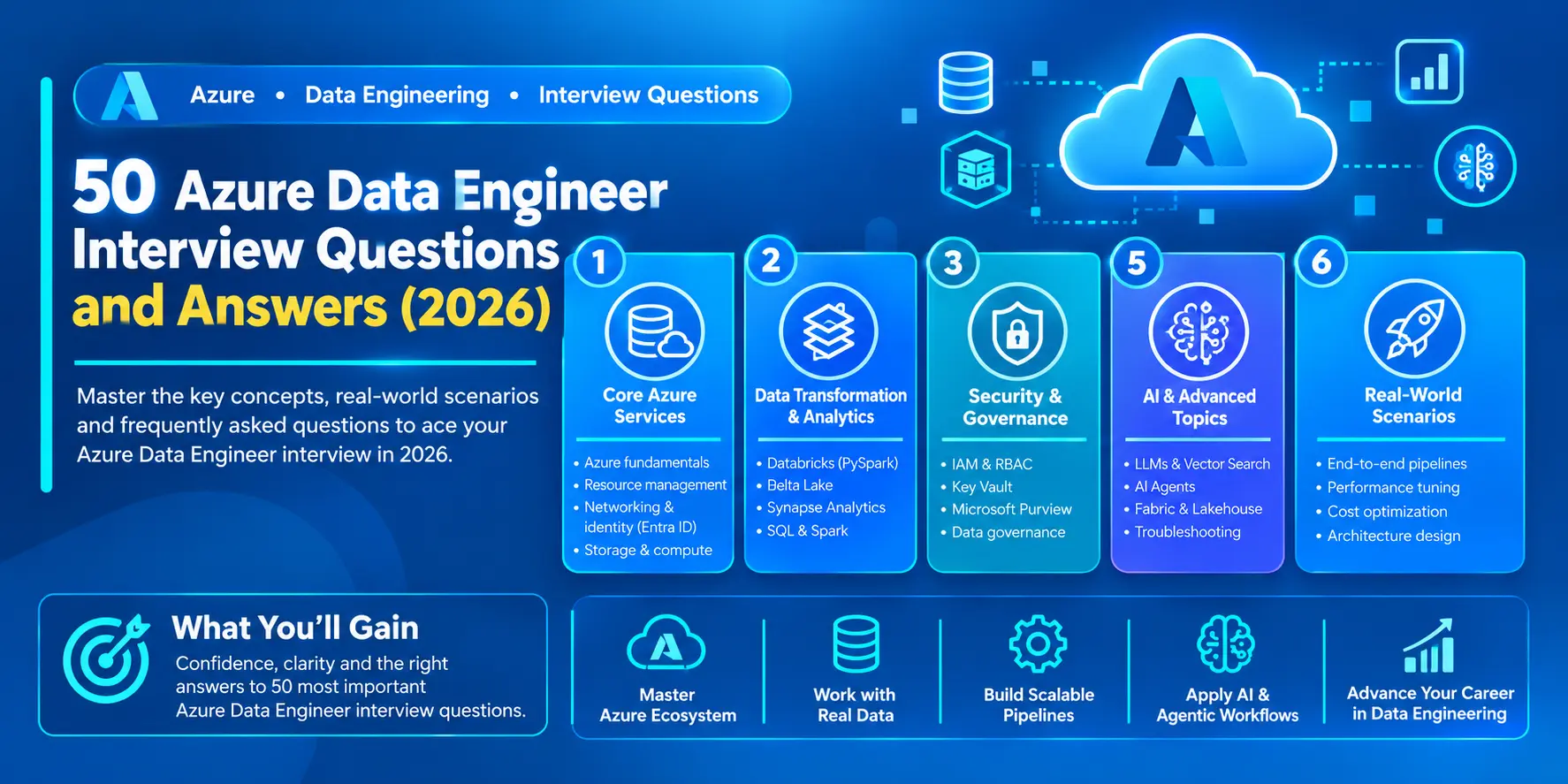
50 Azure Data Engineer Interview Questions and Answers (2026)
Azure data engineering interviews have changed. In 2026, hiring managers in Hinjewadi, Kharadi and Magarpatta no longer ask you to define a pipeline; they ask you to design one, debug one and explain what it costs. If you are preparing for your first Azure role, or stepping up from an ETL or SQL background, this list of 50 questions is the exact ground we cover in the Azure Data Engineer Course in Pune at IntelliBI Innovations Technologies. Every answer is short on purpose: learn the idea, then practise explaining it with a project of your own.
Section 1: Azure Fundamentals and Architecture Questions
Interviewers start here to see whether you understand the Microsoft Azure Data Engineering Course basics before touching tools.
- What does an Azure Data Engineer do? Designs, builds and operates pipelines that ingest, transform, store and serve data on Azure, using services such as Data Factory, Databricks, Synapse, ADLS Gen2 and Fabric, while owning quality, security and cost.
- Explain the modern Azure data stack in one line each. ADF orchestrates and moves data; ADLS Gen2 stores it; Databricks transforms it with Spark; Synapse and Fabric warehouse and serve it; Key Vault and Entra ID secure it; Power BI visualises it.
- What is the medallion architecture? A Lakehouse pattern with Bronze (raw), Silver (cleaned, conformed) and Gold (business-ready) layers, usually implemented on Delta Lake.
- ETL vs ELT on Azure: which do you choose? ELT is the default on cloud because storage is cheap and compute scales; raw data lands in ADLS first and transforms run in Databricks or Synapse. ETL still fits when data must be masked before landing.
- What is the difference between a data lake, a data warehouse and a Lakehouse? A lake stores any format cheaply, a warehouse stores structured, modelled data for BI, and a Lakehouse (Delta on ADLS) gives warehouse reliability on lake storage.
- How do Resource Groups, Subscriptions and Regions matter to a data engineer? They control cost allocation, access boundaries and data residency; keeping storage and compute in the same region avoids egress charges and latency.
- What is Microsoft Fabric and why does it matter in 2026? Fabric unifies Data Factory, Synapse-style warehousing, Spark, real-time analytics and Power BI on OneLake. Since DP-203 was retired, the DP-700 Fabric Data Engineer exam is the certification employers ask about.
Section 2: Azure Data Factory Interview Questions
Most Azure ETL Training in Pune interviews put ADF first, because it is the first tool you touch on the job.
- What are the main components of an ADF pipeline? Pipelines, activities, datasets, linked services, integration runtimes and triggers.
- Explain the three integration runtimes. Azure IR for cloud-to-cloud moves, Self-Hosted IR for on-premises or private-network sources, and SSIS IR for lifting existing SSIS packages to Azure.
- How do you implement incremental (delta) loads in ADF? Use a watermark column stored in a control table or variable, pass it as a parameter to the source query, copy only rows newer than the watermark, then update the watermark on success.
- What is the difference between Copy activity and Data Flow? Copy moves data as-is at scale; Mapping Data Flows transform data visually on a managed Spark cluster.
- How do you parameterise a pipeline? With pipeline parameters, dataset parameters and linked-service parameters, plus dynamic content expressions, so one pipeline can load hundreds of tables through a metadata table.
- How do you handle failures and retries? Activity-level retry settings, On-Failure and On-Completion dependency paths, Web activity alerts to Teams or Logic Apps, and a logging table written by a Stored Procedure activity.
- What triggers does ADF support? Schedule, tumbling window (with dependencies and backfill), storage event (blob created or deleted) and custom event triggers.
- How do you move ADF from dev to prod? Git integration with Azure Repos or GitHub, ARM template export from the collaboration branch, and Azure DevOps release pipelines with environment-specific parameters.
- How would you copy 500 tables from on-prem SQL Server nightly? Metadata-driven framework: a control table lists tables and watermarks, a Lookup feeds a ForEach that runs a parameterised Copy via Self-Hosted IR, in parallel batches of 10–20.
- How do you secure credentials in ADF? Store secrets in Azure Key Vault and reference them from linked services using ADF's Managed Identity; never hard-code connection strings.
Section 3: Azure Databricks and Delta Lake Questions
This is where Azure Databricks Training in Pune pays off, because Databricks questions decide senior roles.
- Explain the Databricks architecture. A control plane managed by Databricks (workspace, notebooks, jobs) and a data plane in your subscription where clusters run and data lives; serverless shifts compute to Databricks-managed infrastructure.
- What is Delta Lake and why use it? An open storage format adding ACID transactions, schema enforcement, time travel and upserts (MERGE) to Parquet files on ADLS.
- How does Delta time travel work? The _delta_log keeps versioned JSON commits; VERSION AS OF or TIMESTAMP AS OF reads an older snapshot, and RESTORE rolls back.
- What is Auto Loader? An incremental ingestion feature (cloudFiles) that discovers new files in ADLS efficiently, with schema inference and evolution, and exactly-once processing.
- What is Unity Catalog? Databricks' centralised governance layer: a three-level namespace (catalog.schema.table), fine-grained permissions, lineage and audit across workspaces.
- Explain Change Data Feed. A Delta feature that records row-level inserts, updates and deletes per version, so downstream tables can consume only changes.
- Jobs vs Pipelines (Delta Live Tables) in Databricks Workflows? Jobs orchestrate arbitrary tasks; DLT pipelines declaratively define streaming or batch tables with built-in quality expectations and dependency handling.
- How do you implement SCD Type 2 in Delta? Use MERGE to close the current row (set end_date and is_current=false) when a tracked attribute changes and insert a new row with a new effective date.
- What is OPTIMIZE and Z-ORDER? OPTIMIZE compacts small files; Z-ORDER co-locates related values so data skipping prunes files on filtered columns. Liquid clustering is the newer alternative.
- How do you handle data skew in PySpark? Detect it in the Spark UI (a few long tasks), then use salting, broadcast joins for small tables, or Adaptive Query Execution's skew-join optimisation.
- Cache vs persist? cache() uses MEMORY_AND_DISK by default; persist() lets you choose the storage level. Both are lazy and must be unpersisted to free memory.
- What are the three types of Databricks clusters? All-purpose for interactive work, Job clusters for scheduled runs (cheaper), and serverless for on-demand SQL and notebooks.
- How do you run a Databricks notebook from ADF? With the Databricks Notebook activity, passing base parameters, using a linked service authenticated by Managed Identity or a token from Key Vault.
Section 4: Azure Synapse, SQL and Microsoft Fabric Questions
A Microsoft Azure Course in Pune that skips Synapse leaves you exposed; interviewers still test it alongside Fabric.
- Dedicated SQL pool vs serverless SQL pool? Dedicated is provisioned MPP compute for a warehouse you own; serverless is pay-per-query over files in the lake, ideal for exploration and lightweight serving.
- What is a distribution in Synapse dedicated pools? How rows spread across 60 distributions: hash (large fact tables), round-robin (staging) or replicate (small dimensions).
- What is PolyBase and COPY INTO? Both load data from ADLS into Synapse; COPY INTO is simpler, needs fewer permissions and is the recommended path today.
- Explain window functions with an interview-style example. ROW_NUMBER() OVER (PARTITION BY customer_id ORDER BY order_date DESC) returns each customer's latest order when filtered to rn = 1.
- How do you find and remove duplicates in SQL? Use ROW_NUMBER() partitioned by the business key, then delete or filter rows where the number is greater than 1.
- What is a star schema and why do interviewers love it? A fact table surrounded by denormalised dimensions; it is fast for BI, simple for DAX and the Kimball standard most Pune enterprises use.
- What is OneLake in Fabric? A single, tenant-wide data lake built on ADLS Gen2 with Delta as the default format, so Spark, warehouse and Power BI engines read the same copy.
- Synapse or Fabric for a new project in 2026? Fabric for greenfield analytics with Power BI users; Synapse dedicated pools where an existing MPP warehouse and T-SQL estate already run.
Section 5: Storage, Security and Governance Questions
Azure Cloud Training in Pune candidates often lose offers on security questions, so prepare these carefully.
- ADLS Gen2 vs Blob Storage? ADLS Gen2 adds a hierarchical namespace, POSIX-style ACLs and directory operations on top of Blob, which analytics engines need.
- How do you control access to ADLS? Combine RBAC roles (Storage Blob Data Contributor) for coarse access with ACLs for folder-level control, and prefer Managed Identity over account keys.
- What is Managed Identity and why use it? An Entra ID identity assigned to a service (ADF, Databricks) that authenticates to Key Vault, storage and SQL without storing any secret.
- How do you implement row-level security for Power BI on Databricks or Synapse? Row filters in Unity Catalog or security predicates in Synapse, mapped to Entra groups, so the same report serves each user only their rows.
- What is Microsoft Purview? Azure's data catalogue and lineage service for discovery, classification and compliance across sources.
- How do you encrypt data in Azure? At rest with storage service encryption (platform or customer-managed keys in Key Vault) and in transit with TLS; column-level masking handles PII inside tables.
Section 6: Scenario, Performance, CI/CD and AI Questions
The Best Azure Data Engineering Course in Pune prepares you for scenario rounds, because senior interviews are 70 percent scenario.
- A nightly pipeline that took 20 minutes now takes 3 hours. What do you check? Data volume growth, small-file explosion in ADLS, missing OPTIMIZE, skewed joins, cluster autoscaling limits, source-side locks, and whether the incremental filter silently became a full load.
- Design a real-time ingestion for IoT or clickstream data. Event Hubs as the source, Databricks Structured Streaming with Auto Loader or Kafka connector into Bronze Delta, watermarked aggregations into Silver and Gold, served through Databricks SQL or Fabric Real-Time Analytics.
- How do you build CI/CD for Databricks? Databricks Repos with feature branches, Databricks Asset Bundles to define jobs and pipelines as code, unit tests with pytest, and Azure DevOps or GitHub Actions deploying to dev, test and prod workspaces.
- How do you reduce Azure data platform cost? Job clusters with auto-termination, spot instances, serverless SQL for ad hoc queries, lifecycle policies to cool or archive storage, avoiding cross-region traffic, and monitoring DBU usage per team.
- How is GenAI changing the Azure data engineer role? Engineers now build RAG pipelines (chunk, embed, store vectors in Databricks Vector Search or Azure AI Search), use Genie for natural-language analytics, and expose tools to agents through MCP, so pipelines are consumed by AI, not just dashboards.
- Which certifications should I mention in 2026? Microsoft Certified: Fabric Data Engineer Associate (DP-700), the new Azure Databricks Data Engineer Associate (DP-750) and Databricks Certified Data Engineer Associate; mention the one aligned to the role's stack.
How to Prepare: Beyond Memorising Answers
Knowing fifty answers is a start; interviewers hire people who have done the work. Pick one capstone, for example a retail sales medallion Lakehouse with ADF ingestion, Databricks transformations, SCD Type 2 dimensions and a Power BI layer, and be ready to whiteboard it end to end. Rehearse the failure stories: the time a watermark broke, the day small files slowed Spark, the cost spike you fixed. That is the difference between an Azure Certification Course in Pune that hands you a certificate and Azure Data Factory Training in Pune that hands you a job.
At IntelliBI Innovations Technologies, every module of the Azure Training in Pune programme ends with exactly this kind of interview drill: technology-wise question banks, mock interviews with senior engineers from TCS, Persistent and Deloitte backgrounds, system-design rounds and HackerRank-style coding practice. Learners build ten-plus production-grade projects across healthcare, retail, banking and insurance, prepare for DP-700 and DP-750, and get placement support until they are placed, with evening and weekend batches at our Thergaon centre near Hinjewadi and live online classes across India.
Ready for Your Azure Data Engineer Interview?
Bookmark this list, answer each question aloud with an example from your own project, and revisit the sections where you hesitated. If you want structured, mentor-led preparation that covers ADF, Databricks, Synapse, Fabric, security and GenAI pipelines in one path, explore the Microsoft Azure Data Engineering Course at IntelliBI Innovations Technologies, Pune, and book a free demo class. Your next interview is a conversation about work you have already done; let us help you do that work first.