
40 ADF Interview Questions Every Azure Data Engineer Should Prepare
Quick Answer
Azure Data Factory interviews cover pipelines, Integration Runtimes, Copy activity, Data Flows, Databricks, incremental loading, triggers, monitoring, CI/CD and cost optimisation. Focus on practical scenarios, troubleshooting and pipeline design to demonstrate real-world Azure Data Engineering skills.
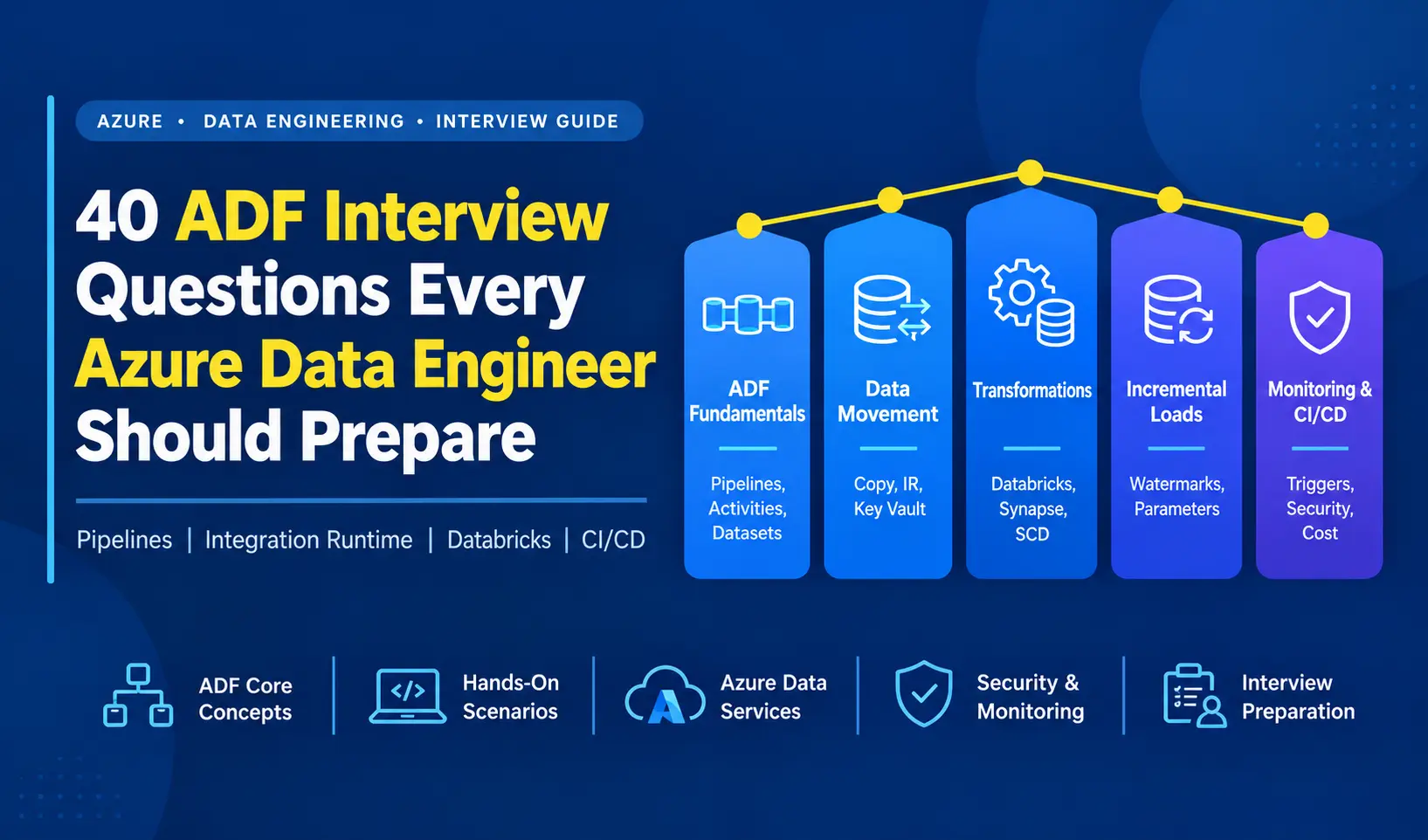
40 ADF Interview Questions Every Azure Data Engineer Should Prepare
Azure Data Factory is the first thing most hiring managers in Pune ask about when they interview for Azure Data Engineer roles. It is the orchestration backbone of nearly every enterprise Azure data platform, and interviewers use it to find out one thing quickly: have you actually built pipelines, or have you only watched tutorials?
At IntelliBI Innovations Technologies, our trainers have sat on both sides of that table. Many of the questions below are the exact ones our learners report back after interviews at IT services companies, product firms and captive centres across Hinjewadi, Kharadi and Magarpatta. They are also the scenarios we practise in mock interviews during our Azure Data Engineer Course in Pune.
We have grouped the 40 questions into six themes so you can revise in order. Read the answer, then ask yourself the follow-up every good interviewer asks: "Have you done this in a project?" If the answer is no, that is your study plan.
Section 1: ADF Fundamentals (Questions 1–8)
These are warm-up questions, but a vague answer here ends the interview early. Anyone who has completed structured Azure Data Factory Training in Pune should be able to answer them in one or two sentences.
1. What is Azure Data Factory and where does it sit in the Azure data stack? Azure Data Factory is Microsoft's cloud-based data integration and orchestration service. It moves and transforms data between on-premises and cloud sources, and it orchestrates other services such as Azure Databricks, Synapse, Azure Functions and Logic Apps. Think of it as the conductor, not the orchestra.
2. Explain pipelines, activities, datasets and linked services. A pipeline is a logical group of activities. An activity is a single task such as Copy, Lookup or Execute Notebook. A dataset describes the shape and location of data, and a linked service holds the connection information to the data store or compute. Interviewers like candidates who add: "Linked services are the connection strings; datasets are the pointers to tables or files."
3. What is the difference between ADF Version 1 and Version 2? Version 2 introduced the visual authoring UI, control-flow activities (If, ForEach, Until, Switch), parameters, triggers beyond the time-slice model, Mapping Data Flows and Git integration. Nobody builds on V1 anymore, but the question checks whether you know why.
4. What types of activities exist in ADF? Three categories: data movement (Copy activity), data transformation (Mapping Data Flows, Databricks notebook, Stored Procedure, HDInsight, Synapse Spark) and control activities (Lookup, Get Metadata, ForEach, If Condition, Execute Pipeline, Web, Set Variable, Wait, Until, Switch, Filter).
5. What is an Integration Runtime and what are its three types? The Integration Runtime (IR) is the compute infrastructure ADF uses. Azure IR runs in Microsoft's managed network for cloud-to-cloud work. Self-Hosted IR is installed on your own machine or VM to reach on-premises or private-network sources. Azure-SSIS IR lifts and shifts existing SSIS packages. Knowing when to choose each one is a core skill we drill in our Azure Cloud Training in Pune.
6. What is a Managed Virtual Network and why does it matter? A managed VNet isolates the Azure IR so that data never travels over the public internet. It is paired with managed private endpoints to connect to storage, SQL and Key Vault securely. Enterprise interviewers ask this because security reviews block pipelines without it.
7. How does ADF differ from Azure Synapse Pipelines? Synapse Pipelines are built on the same engine and share most activities, but they run inside a Synapse workspace and integrate natively with dedicated SQL pools and Spark pools. ADF is the standalone service and has a few features Synapse lacks, such as certain connectors and SSIS IR.
8. What is the difference between a Copy activity and a Mapping Data Flow? Copy moves data as-is (with light mapping and format conversion). Mapping Data Flows run transformations such as joins, aggregates, derived columns and SCD logic on a Spark cluster that ADF manages for you, without writing Spark code.
Section 2: Data Movement and Connectivity (Questions 9–15)
This is where a Microsoft Azure Data Engineering Course earns its fees. Expect scenario questions rather than definitions.
9. How do you connect ADF to an on-premises SQL Server? Install a Self-Hosted IR on a machine inside the on-premises network, register it with ADF using the authentication key, then create a linked service that uses that IR. For high availability, register a second node on another machine.
10. How do you securely store credentials in ADF? Never type secrets into linked services. Store them in Azure Key Vault, give the ADF managed identity "Get" permission on secrets, and reference the Key Vault secret from the linked service. This is a mandatory step in every project we build during Azure Training in Pune.
11. What is a Managed Identity and why is it preferred over service principals? A managed identity is an Entra ID identity that Azure creates and rotates automatically for the Data Factory resource. There is no secret to leak or expire. Grant it RBAC roles (for example, Storage Blob Data Contributor on ADLS Gen2) and ADF authenticates itself.
12. Which file formats does ADF support and which one would you choose for a data lake? Delimited text, JSON, Avro, ORC, Parquet, Delta, XML, Excel and binary. For an analytical lake, choose Parquet (or Delta when Databricks is in the picture) for columnar compression and predicate pushdown.
13. How do you copy data from multiple tables in one pipeline? Use a Lookup activity to fetch the list of tables from a control table or metadata file, pass the output to a ForEach activity, and run a parameterised Copy activity inside the loop. This metadata-driven pattern is the single most common pipeline design in Pune enterprises.
14. What is the Data Integration Unit (DIU) and how does it affect cost? A DIU is the unit of compute power for the Azure IR during a Copy activity. More DIUs give more throughput but cost more per hour. Interviewers want to hear that you tune DIUs and parallel copies per source rather than leaving defaults.
15. How do you handle schema drift? Enable "Allow schema drift" in a Mapping Data Flow and use late-binding patterns such as byName() or column patterns so new source columns flow through without breaking the pipeline. For Copy activity, use dynamic mapping or auto-create tables with caution.
Section 3: Transformation, Databricks and Synapse (Questions 16–22)
Most Azure Data Engineer roles in Pune combine ADF with Azure Databricks. Candidates who have completed Azure Databricks Training in Pune alongside ADF usually stand out here.
16. How do you call an Azure Databricks notebook from ADF and pass parameters? Create a Databricks linked service (prefer managed identity or a Key Vault-stored token), add a Notebook activity, set the notebook path, and pass base parameters. In the notebook, read them with dbutils.widgets.get(). Return values with dbutils.notebook.exit() and read them from the activity output.
17. When would you use Mapping Data Flows versus Databricks? Use Data Flows for low-code transformations handled by a small team without Spark skills. Use Databricks for complex logic, Delta Lake features, machine learning, reuse across teams, or when the job needs fine-grained cluster control and unit tests.
18. How do you implement Slowly Changing Dimension Type 2 in ADF? In a Mapping Data Flow: source the incoming rows, look up existing dimension rows, use a Conditional Split to detect new, changed and unchanged records, set end dates on changed rows with a Derived Column, and sink inserts and updates with an Alter Row transformation. We build this end-to-end in the retail data warehouse capstone of our Azure ETL Training in Pune.
19. What is the Medallion architecture and how does ADF fit in? Bronze (raw), Silver (cleaned, conformed) and Gold (business-ready) layers in the lake. ADF typically owns ingestion into Bronze and orchestration of the Silver and Gold notebooks, while Databricks or Synapse does the heavy transformation.
20. How do you load data into Azure Synapse dedicated SQL pool efficiently? Use the Copy activity with PolyBase or the COPY statement enabled, stage data in ADLS Gen2 as Parquet, and use a staging table followed by a CTAS or MERGE. Avoid row-by-row inserts.
21. What is the Stored Procedure activity used for? To run T-SQL logic such as MERGE statements, audit logging or post-load aggregations in Azure SQL or Synapse. It is also how many teams write pipeline run status back to a control table.
22. How do you handle data quality checks inside a pipeline? Add validation steps: a Lookup or Script activity that counts rows and nulls, an If Condition that compares against thresholds, and a Fail activity that stops the pipeline with a clear message. Log results to a control table for auditing.
Section 4: Parameters, Variables and Incremental Loads (Questions 23–29)
23. What is the difference between parameters and variables? Parameters are read-only inputs defined at pipeline, dataset or linked-service level and passed at run time. Variables are mutable values inside a pipeline, changed with Set Variable and Append Variable activities.
24. How do you implement incremental (delta) loading? Store a watermark (last modified timestamp or max ID) in a control table. Lookup the old watermark, Lookup the new maximum from the source, copy rows between the two values, then update the watermark with a Stored Procedure activity. Mention Change Data Capture or Change Tracking for SQL sources as the modern alternative.
25. What are global parameters? Factory-level constants such as environment name, storage account or Key Vault URL that every pipeline can reference. They make CI/CD promotion between Dev, Test and Prod far simpler.
26. How do you make a dataset dynamic? Add dataset parameters for container, folder and file name, reference them in the connection properties with expressions like @dataset().fileName, and pass values from the pipeline. One dynamic dataset replaces dozens of static ones.
27. Explain the expression language in ADF with an example. ADF uses a JSON-based expression language with functions for strings, dates, logic and collections. Example: @concat('sales_', formatDateTime(utcNow(), 'yyyyMMdd'), '.parquet') builds a dated file name.
28. How do you pass output from one activity to another? Reference it with @activity('ActivityName').output.<property>. For a Lookup, that is @activity('LookupTables').output.value; inside a ForEach, the current element is @item().
29. What is the Get Metadata activity used for? To read properties such as child items, last modified date, size or existence of files and folders. It is the standard way to list files before a ForEach loop or to check whether a source file has arrived.
Section 5: Triggers, Monitoring and Error Handling (Questions 30–35)
30. What trigger types does ADF offer? Schedule triggers (cron-like), tumbling window triggers (fixed, non-overlapping windows with dependency and retry support), storage event triggers (blob created or deleted), custom event triggers (Event Grid) and manual or on-demand runs.
31. When would you choose a tumbling window trigger over a schedule trigger? When you need backfill of historical windows, window-level retries, dependencies between windows, or guaranteed exactly-once processing per time slice. Schedule triggers simply fire at a time and know nothing about the previous run.
32. How do you implement retry and error handling? Set retry count and interval on activities, use the On Failure, On Completion and On Skip dependency paths, wrap risky steps in a child pipeline called with Execute Pipeline, and finish with a Web activity that posts to Teams or a Logic App that emails the on-call engineer.
33. How do you monitor pipelines in production? Use the ADF Monitor hub for run history, integrate with Azure Monitor and Log Analytics for alerts on failed runs or long durations, and write run metadata to a custom audit table. Senior interviewers expect you to mention diagnostic settings, not only the UI.
34. What happens if a Self-Hosted IR goes down? Pipelines that depend on it fail or queue. The fix is high availability: register multiple nodes, enable auto-update, monitor node health with alerts, and keep the IR machine patched. This is a favourite question in Azure Certification Course in Pune mock interviews because it exposes real operational experience.
35. How do you debug a pipeline without triggering a full run? Use Debug mode with breakpoints on activities, test Data Flows with Data Flow Debug sessions and data preview, and run child pipelines in isolation with sample parameters.
Section 6: CI/CD, Security and Cost Optimisation (Questions 36–40)
36. How do you set up CI/CD for Azure Data Factory? Connect the Dev factory to Git (Azure Repos or GitHub), work on feature branches, publish to generate ARM templates in the adf_publish branch (or use the npm-based automated publish), and deploy to Test and Prod with Azure DevOps or GitHub Actions pipelines that override parameters per environment. Stop triggers before deployment and restart them after.
37. What goes into the ARM template parameters file? Environment-specific values: linked service URLs, Key Vault names, integration runtime names, global parameters and trigger settings. Everything that differs between Dev and Prod should be a parameter, never a hard-coded value.
38. How do you secure data in transit and at rest with ADF? TLS for all connections, managed private endpoints and managed VNet for the IR, Key Vault for secrets, managed identity for authentication, customer-managed keys for factory encryption when compliance demands it, and RBAC with least-privilege roles for the ADF identity and for developers.
39. How do you reduce Azure Data Factory costs? Cost comes from activity runs, DIU-hours, Data Flow cluster time and IR uptime. Reduce it by batching small files, tuning DIUs and parallelism, using time-to-live on Data Flow clusters so they are reused, choosing the right cluster size, avoiding unnecessary Lookups inside loops, and scheduling heavy loads during off-peak windows. Candidates who quote real figures from a project leave the strongest impression.
40. Describe an end-to-end ADF project you have built. This is the question that decides the offer. A strong answer names the source systems, the ingestion pattern (metadata-driven, incremental), the storage layout (ADLS Gen2, Medallion), the transformation engine (Data Flows or Databricks), orchestration and triggers, monitoring, CI/CD and a measurable outcome such as "cut nightly load from 4 hours to 50 minutes." If you do not have a project like this yet, that is exactly what the capstones in the Best Azure Data Engineering Course in Pune are designed to give you.
How to Prepare Beyond the Questions
Memorising 40 answers will get you through the first screening round. Clearing the technical and managerial rounds takes three more things.
First, hands-on depth. Build at least two pipelines from scratch: a metadata-driven incremental load from SQL Server to ADLS Gen2, and a Databricks-orchestrated Medallion pipeline with SCD Type 2 in the Gold layer. Every project in our Azure Data Factory Training in Pune is built around these two patterns because they appear in almost every job description.
Second, certification alignment. Microsoft retired DP-203, and interviewers now ask about DP-700 (Fabric Data Engineer Associate) and the new DP-750 Azure Databricks Data Engineer Associate exam. A Microsoft Azure Course in Pune that still teaches to the old exam blueprint is preparing you for 2023 interviews, not 2026 ones.
Third, mock interviews with people who hire. Reading answers is passive; defending them under follow-up questions is where confidence comes from. Our learners go through technology-wise question banks, scenario rounds and HR preparation with senior engineers from TCS, Persistent and Deloitte backgrounds before they attend a single real interview.
Final Thoughts
Azure Data Factory interviews reward engineers who can explain decisions, not just definitions. Why a tumbling window instead of a schedule trigger? Why Databricks instead of a Data Flow? Why managed identity instead of a service principal? Prepare the "why" behind each of the 40 questions above and you will walk into the room as a practitioner rather than a student.
If you want to build that practitioner-level experience in a structured way, with live projects, placement support and weekend batches for working professionals, explore IntelliBI's Azure Training in Pune at our Thergaon, PCMC centre or join live online from anywhere in India. The next batch starts in October 2026. Book a free demo class, bring this list with you, and let us turn every one of these questions into something you have already done.