
30 Azure Databricks Interview Questions with Sample Answers
Quick Answer
Azure Databricks interviews in 2026 test five areas: Lakehouse and Delta Lake fundamentals (ACID, time travel, Z-ordering), PySpark performance (skew, broadcast joins, caching, AQE), governance with Unity Catalog, orchestration with Databricks Workflows and Azure Data Factory, and real project experience such as a Medallion pipeline. Learn these hands-on in IntelliBI's Azure Data Engineer Course in Pune, which includes DP-700 and DP-750 preparation, mock interviews and placement support.
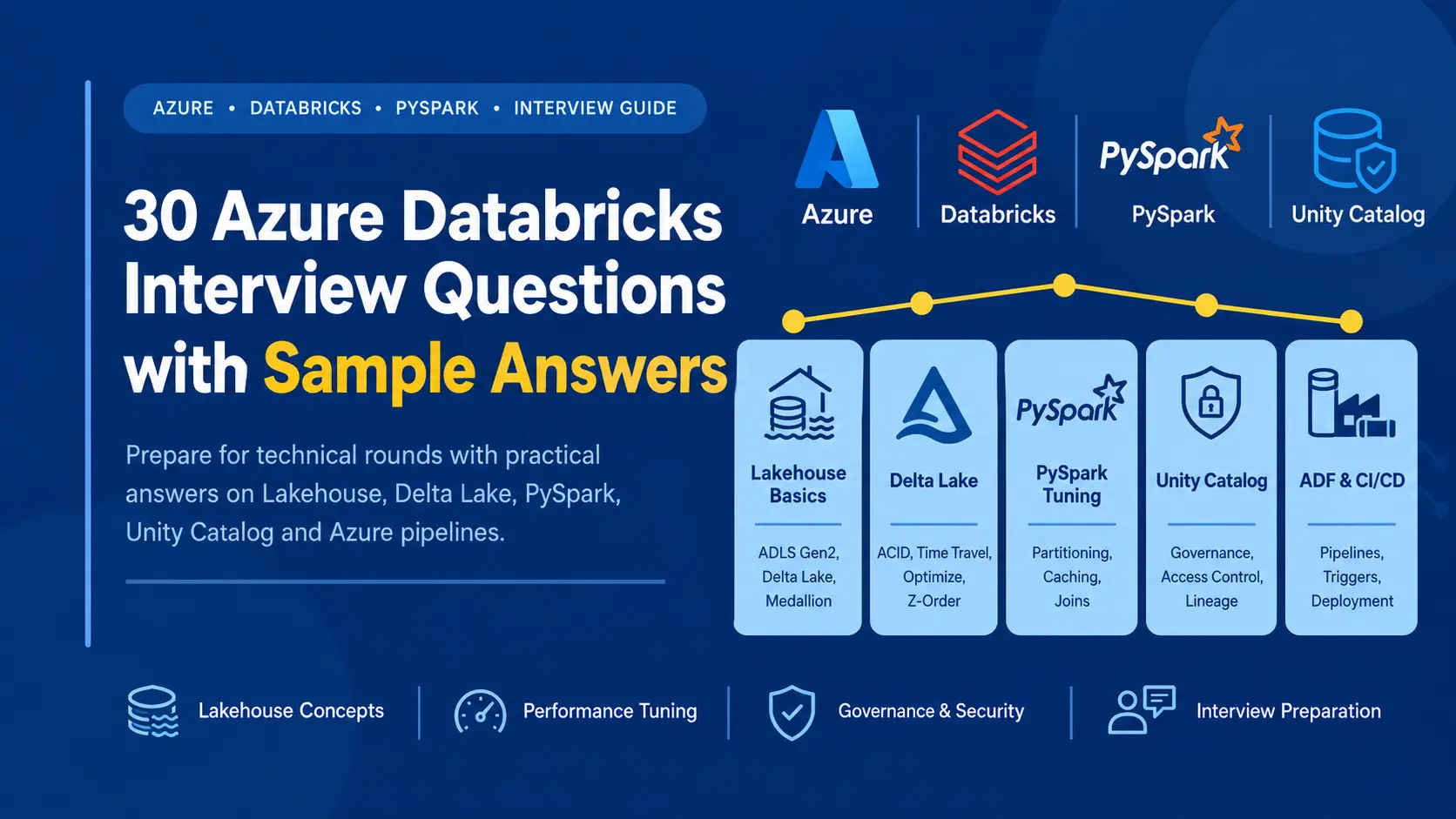
30 Azure Databricks Interview Questions with Sample Answers
If you have been searching for an Azure Data Engineer Course in Pune, you have probably noticed that almost every job description in Hinjewadi, Kharadi and Magarpatta now lists Azure Databricks as a must-have skill. Recruiters are no longer impressed by a certificate alone. They want to know whether you can explain the Lakehouse, tune a slow PySpark job, govern data with Unity Catalog and connect Databricks to Azure Data Factory in a real pipeline.
At IntelliBI Innovations Technologies, our trainers run mock interviews every week as part of the Best Azure Data Engineering Course in Pune, and we see the same questions come up again and again. This guide collects 30 of them, with sample answers written the way a confident candidate would speak. Use it as your revision sheet before your next technical round, and if you want to practise these hands-on, our Azure Data Engineer Course in Pune covers every topic below with live labs.
Section 1: Databricks Fundamentals and Lakehouse Architecture
These are warm-up questions, but they tell the panel whether your Azure Training in Pune was practical or just theory.
1. What is Azure Databricks and why do companies use it?
Sample answer: Azure Databricks is a unified analytics platform built on Apache Spark and deeply integrated with Azure. Companies use it because one workspace handles data engineering, SQL analytics, machine learning and streaming, with auto-scaling clusters, Delta Lake storage and native connections to ADLS Gen2, Azure Data Factory, Synapse and Power BI.
2. Explain the Lakehouse architecture.
Sample answer: A Lakehouse combines the low-cost, open storage of a data lake with the reliability and performance of a data warehouse. Data sits in ADLS Gen2 as Delta files, while Databricks adds ACID transactions, schema enforcement, indexing and governance on top, so the same copy of data serves BI dashboards and ML models.
3. What is the difference between the control plane and the data plane?
Sample answer: The control plane is managed by Databricks and holds the web UI, notebooks, job scheduler and cluster manager. The data plane lives in the customer's Azure subscription, where clusters run and data is processed. This separation is why your data never leaves your Azure tenant.
4. What cluster types exist and when would you use each?
Sample answer: All-purpose clusters are for interactive development and are shared by users. Job clusters spin up for a scheduled workload and terminate when it finishes, which is cheaper for production. Serverless compute removes cluster management entirely and starts in seconds, which suits SQL warehouses and short pipelines.
5. How does Databricks pricing work?
Sample answer: You pay for Azure VMs plus Databricks Units (DBUs), which measure processing capacity per hour. Job clusters consume fewer DBUs than all-purpose clusters, so moving production workloads to jobs is the first cost optimisation any Azure Data Engineering Course in Pune should teach.
Section 2: Delta Lake Questions
Delta Lake is the heart of Azure Databricks Training in Pune, and interviewers go deep here.
6. What is Delta Lake and how does it differ from Parquet?
Sample answer: Delta Lake is an open storage format that stores data as Parquet files plus a transaction log called _delta_log. The log adds ACID transactions, schema enforcement and evolution, time travel and efficient updates and deletes, none of which plain Parquet supports.
7. Explain time travel in Delta Lake.
Sample answer: Every write creates a new version in the transaction log. You can query older versions using VERSION AS OF or TIMESTAMP AS OF, which is useful for audits, rollbacks and reproducing a report exactly as it looked last month.
8. What are OPTIMIZE, Z-ORDER and VACUUM?
Sample answer: OPTIMIZE compacts many small files into larger ones to speed up reads. Z-ORDER co-locates related values in the same files so queries filtering on those columns skip more data. VACUUM removes files no longer referenced by the log after the retention period, reclaiming storage.
9. What is Change Data Feed?
Sample answer: Change Data Feed records row-level inserts, updates and deletes between table versions. Downstream pipelines read only the changes instead of reprocessing the full table, which is how we build incremental Silver and Gold layers.
10. How do you handle schema evolution in Delta?
Sample answer: With mergeSchema set to true on a write, new columns are added automatically. For stricter control, I keep schema enforcement on and fail the job when unexpected columns arrive, then review them, because silent schema drift is one of the most common data-quality incidents.
11. Describe the Medallion architecture.
Sample answer: Bronze holds raw data exactly as ingested, Silver holds cleaned, de-duplicated and conformed data, and Gold holds business-level aggregates ready for Power BI. In our capstone at IntelliBI we build an end-to-end Medallion sales Lakehouse with Auto Loader into Bronze, Delta merges into Silver and star-schema tables in Gold.
Section 3: PySpark and Performance Tuning
Performance questions separate candidates who completed a Microsoft Azure Course in Pune with real projects from those who only watched videos.
12. What is lazy evaluation in Spark?
Sample answer: Transformations such as filter or join are not executed immediately. Spark builds a logical plan and runs it only when an action like count, show or write is called. This lets the Catalyst optimiser reorder and combine operations before any data moves.
13. Explain narrow versus wide transformations.
Sample answer: Narrow transformations such as map and filter process each partition independently. Wide transformations such as groupBy and join require a shuffle, where data moves across the network between executors. Shuffles are expensive, so minimising them is the core of tuning.
14. How do you fix data skew?
Sample answer: First I confirm skew in the Spark UI by looking for one task running far longer than the rest. Then I enable Adaptive Query Execution, which splits skewed partitions automatically, or apply salting by adding a random key to spread the hot values across partitions.
15. When would you use a broadcast join?
Sample answer: When one side of the join is small enough to fit in executor memory, typically under the autoBroadcastJoinThreshold of 10 MB by default. Broadcasting sends the small table to every executor and avoids a shuffle on the large table, which can cut join time dramatically.
16. What is the difference between cache and persist?
Sample answer: cache stores a DataFrame at the default MEMORY_AND_DISK level. persist lets you choose the storage level, such as MEMORY_ONLY or DISK_ONLY. I cache only when a DataFrame is reused several times, and I unpersist it afterwards to free memory.
17. What is Adaptive Query Execution?
Sample answer: AQE re-optimises the query plan at runtime using actual statistics. It coalesces small shuffle partitions, converts sort-merge joins to broadcast joins when a side turns out to be small, and handles skewed joins. It is on by default in Databricks Runtime and I rarely turn it off.
18. Why are Python UDFs slow and what are the alternatives?
Sample answer: Standard Python UDFs serialise each row between the JVM and Python, which bypasses Catalyst optimisation. I prefer built-in Spark SQL functions first, then pandas UDFs that work on Arrow batches, and only fall back to a plain UDF when no other option exists.
19. How does Structured Streaming handle late data?
Sample answer: With watermarking. I define how late an event can arrive, for example withWatermark("event_time", "10 minutes"), and Spark keeps state only for that window. Events older than the watermark are dropped, which keeps memory bounded while still allowing reasonable delays from Azure Event Hubs.
Section 4: Governance, Security and Unity Catalog
Any serious Azure Certification Course in Pune now treats Unity Catalog as core material, because DP-750 does too.
20. What is Unity Catalog?
Sample answer: Unity Catalog is the centralised governance layer for Databricks. It gives a three-level namespace of catalog, schema and table, fine-grained access control, column and row-level security, data lineage and audit logs across all workspaces in an account.
21. How do you secure access to ADLS Gen2 from Databricks?
Sample answer: The recommended approach is a storage credential backed by a managed identity, registered in Unity Catalog as an external location. Older patterns used service principals with secrets in Azure Key Vault-backed secret scopes. I never hard-code keys in notebooks.
22. How is Azure Key Vault used with Databricks?
Sample answer: You create a secret scope that points to a Key Vault, then reference secrets with dbutils.secrets.get. The values are redacted in notebook output, and rotation happens in Key Vault without changing any code. We practise this in week six of our Azure Cloud Training in Pune, not as an afterthought.
23. What is data lineage and why does it matter?
Sample answer: Lineage shows where a column came from and which downstream tables and dashboards depend on it. Unity Catalog captures it automatically. It matters for impact analysis before a schema change and for compliance questions such as where personal data flows.
Section 5: Orchestration, CI/CD and Azure Integration
This is where your Azure Data Factory Training in Pune and your Databricks knowledge meet.
24. How does Azure Data Factory integrate with Databricks?
Sample answer: ADF has a Databricks Notebook activity, a Jar activity and a Python activity. A typical pattern is ADF handling ingestion from on-premises SQL Server through a self-hosted integration runtime, landing files in ADLS, then triggering a Databricks notebook that transforms Bronze to Silver. Parameters pass through base parameters and widgets.
25. Databricks Workflows versus Azure Data Factory: when do you use which?
Sample answer: I use Workflows when the whole pipeline lives inside Databricks, because it supports multi-task jobs, repair runs and task values natively. I use ADF when I need its 90-plus connectors, hybrid ingestion or an enterprise-wide orchestration view. In many Pune enterprises both coexist, with ADF as the outer scheduler.
26. What are Jobs versus Pipelines in Databricks?
Sample answer: A Job runs tasks such as notebooks or scripts on a schedule with dependencies. A Pipeline, formerly Delta Live Tables, is declarative: you define tables and expectations, and Databricks manages the execution order, retries and data-quality metrics. I choose Pipelines for standard ETL and Jobs for custom or mixed workloads.
27. What is Auto Loader?
Sample answer: Auto Loader incrementally ingests new files from cloud storage using the cloudFiles source. It tracks which files have been processed, infers and evolves schema, and scales to millions of files without listing the whole directory each run, making it the default choice for Bronze ingestion.
28. How do you implement CI/CD for Databricks?
Sample answer: Code lives in Git through Databricks Repos. Databricks Asset Bundles describe jobs, pipelines and clusters as YAML, and an Azure DevOps or GitHub Actions pipeline validates and deploys bundles to dev, test and prod workspaces. Unit tests run with pytest against Spark sessions before deployment.
29. How do you monitor and reduce the cost of a production pipeline?
Sample answer: I use system tables and job run metrics to see DBU consumption per job, switch long-running interactive clusters to job clusters with auto-termination, enable Photon for SQL-heavy workloads, right-size worker counts and apply OPTIMIZE to avoid small-file reads. Cost reviews are part of every sprint in our Azure ETL Training in Pune projects.
30. Which certifications should an Azure Databricks engineer target in 2026?
Sample answer: Three stand out. DP-700, Microsoft Certified: Fabric Data Engineer Associate, replaced DP-203. DP-750, Azure Databricks Data Engineer Associate, is the new Microsoft exam launched in 2026 and maps almost exactly to the topics above. Databricks Certified Data Engineer Associate validates platform skills independently of the cloud. IntelliBI's Azure Databricks Training in Pune prepares you for all three.
How to Use These Questions Before Your Interview
Reading sample answers is a start, but panels in Pune increasingly ask follow-ups such as "show me the Spark UI where you found that skew" or "walk me through your Medallion project from Bronze to the Power BI dashboard." That is why every module in our Microsoft Azure Data Engineering Course is project-driven. Learners build an enterprise retail sales warehouse, a healthcare data platform and a revenue and claims analytics Lakehouse, then defend those projects in mock interviews with senior engineers who have spent ten to fifteen years at companies like TCS, Persistent and Deloitte.
A few practical tips from our placement team:
Practise speaking answers aloud in under sixty seconds. Interviewers reward clarity over completeness.
Keep a GitHub portfolio with at least one end-to-end Azure Databricks project, including the ADF pipeline, the notebooks and a short README explaining your design decisions.
Know the trade-offs. Almost every question above has a "when would you not use this" follow-up.
Stay current. Mention DP-750, Unity Catalog and Pipelines rather than legacy terms, because that signals your Azure Training in Pune was recent and relevant.
Start Your Azure Databricks Journey with IntelliBI
Whether you are a working professional in Wakad looking for evening batches, a fresher from PCMC entering data engineering, or a SQL developer planning a career switch, the right preparation turns these 30 questions from a worry into an advantage. IntelliBI Innovations Technologies, located at Dange Chowk, Thergaon, ten minutes from Hinjewadi, has helped more than 2,200 learners transform their careers through hands-on Azure Databricks Training in Pune, with weekend and weekday batches, lifetime LMS access and placement support until you are placed.
Explore the full syllabus, upcoming batch dates and free demo class for our Azure Certification Course in Pune, and walk into your next Azure Data Engineer interview ready for anything the panel asks.