
30 AWS Glue Interview Questions Every Data Engineer Should Know
Quick Answer
AWS Glue is Amazon’s serverless data integration service for discovering, cataloging, cleaning, and transforming data. Key interview topics include Glue fundamentals, Data Catalog, crawlers, PySpark ETL jobs, DynamicFrames, workflows, triggers, bookmarks, partitioning, performance optimisation, cost management, and IAM. These 30 AWS Glue interview questions will help aspiring data engineers prepare for technical interviews in Pune.
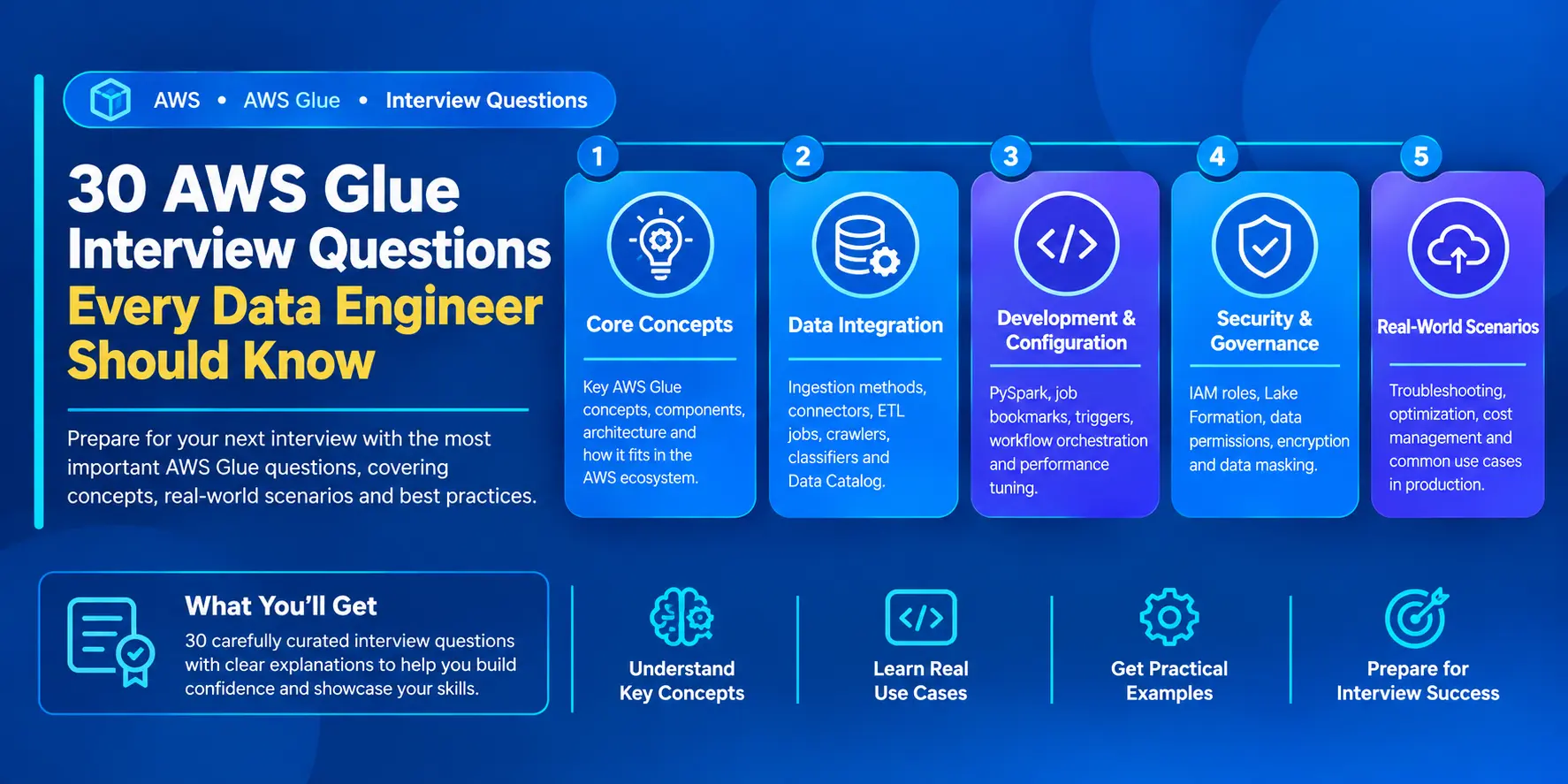
30 AWS Glue Interview Questions Every Data Engineer Should Know
If you have applied for a data engineering role in Hinjewadi, Kharadi or Magarpatta recently, you already know one thing: AWS Glue shows up in almost every technical round. It is the backbone of serverless ETL on AWS, it sits between Amazon S3, Athena and Redshift, and it is exactly the kind of tool that separates candidates who have read about the cloud from candidates who have actually built pipelines on it.
At IntelliBI Innovations Technologies, our mentors have sat on both sides of the interview table. Over the years of running our AWS Data Engineer Course in Pune, we have collected the questions that keep coming back, batch after batch, from product companies, GCCs and IT services firms alike. This post puts the 30 most important ones in one place, with answers that are short enough to remember and deep enough to impress.
Whether you are a working professional upskilling through AWS Training in Pune or a fresher searching for AWS Classes Near Me, treat this as your revision sheet. Read it twice, build one small Glue pipeline of your own, and walk into the interview with confidence.
Why AWS Glue Questions Matter in a Data Engineer Interview
Interviewers love AWS Glue because a single question can reveal a lot. Ask about crawlers and you learn whether the candidate understands schemas and partitions. Ask about DynamicFrames and you learn whether they can handle messy, semi-structured data. Ask about DPUs and job bookmarks and you learn whether they have ever watched a cloud bill. That is why every serious AWS Data Engineering Course spends real lab time on Glue rather than treating it as a slide.
The questions below are grouped into five sections: fundamentals, the Data Catalog and crawlers, ETL jobs and PySpark, orchestration and integration, and performance, cost and security.
Section 1: AWS Glue Fundamentals
1. What is AWS Glue and what problem does it solve? AWS Glue is a fully managed, serverless data integration service. It discovers data in sources such as S3, RDS and JDBC databases, stores metadata in a central Data Catalog, and runs ETL jobs on managed Apache Spark or Python without you provisioning or patching a single server. It solves the "build and babysit a Spark cluster" problem for batch and streaming pipelines.
2. What are the main components of AWS Glue? The Data Catalog (databases, tables, partitions, connections), crawlers and classifiers, ETL jobs (Spark, Spark Streaming, Python shell and Ray), triggers and workflows for orchestration, Glue Studio for visual authoring, Glue DataBrew for no-code preparation, Glue Data Quality for rule-based validation, and interactive sessions and notebooks for development.
3. What is a DPU in AWS Glue? A Data Processing Unit is Glue's unit of compute capacity: 4 vCPUs and 16 GB of memory. Glue bills Spark jobs per DPU-hour, measured by the second, so the number of workers you choose and how long the job runs decide the cost. Candidates in our AWS Course in Pune are asked to estimate the cost of a job before they run it, because interviewers do the same.
4. Explain the Glue worker types. Standard worker types for Spark jobs are G.1X (1 DPU, 4 vCPU, 16 GB), G.2X (2 DPU, 8 vCPU, 32 GB), plus larger G.4X and G.8X workers for memory-hungry transformations, and R-type memory-optimised workers for workloads like large joins and aggregations. Streaming jobs use G.025X for small, always-on pipelines. Pick the smallest worker that avoids spills to disk.
5. What is the difference between Glue 3.0, 4.0 and 5.0? Each release upgrades the underlying engines. Glue 4.0 brought Spark 3.3 and Python 3.10 with native support for open table formats such as Apache Iceberg, Hudi and Delta Lake. Glue 5.0 moved to Spark 3.5 and Python 3.11 with better performance and newer connectors. Always mention that you choose the latest version for new jobs unless a library dependency forces otherwise.
6. How does AWS Glue differ from Amazon EMR? Glue is serverless and opinionated: you write the job, Glue handles the cluster. EMR gives you a full Hadoop or Spark cluster with control over instance types, bootstrap actions and long-running services. Choose Glue for most batch ETL and catalog-driven workloads; choose EMR when you need custom frameworks, very long jobs or fine-grained cluster tuning.
7. What is Glue Flex execution? Flex is a cost-saving execution class for non-urgent jobs. Glue runs them on spare capacity at a lower DPU price, which is ideal for nightly loads, backfills and test runs where a delayed start is acceptable.
Section 2: The Data Catalog and Crawlers
8. What is the AWS Glue Data Catalog? It is a persistent, Hive-compatible metadata store for all your data assets: table definitions, schemas, partitions, locations and connection details. Athena, Redshift Spectrum, EMR and Lake Formation all read from it, which makes it the single source of truth for a data lake on AWS.
9. What does a Glue crawler do? A crawler connects to a data store, walks through the files or tables, uses classifiers to infer the format and schema, detects partitions from the folder structure, and creates or updates tables in the Data Catalog. You can schedule crawlers or trigger them after a load.
10. What are classifiers and when do you write a custom one? Classifiers tell the crawler how to recognise a format. Built-in classifiers handle CSV, JSON, Parquet, ORC, Avro and many logs. You write a custom classifier, using Grok, XML, JSON path or CSV settings, when your files do not match a built-in pattern, for example proprietary log formats or CSVs with unusual delimiters.
11. How does a crawler handle schema changes? Through its schema change policy. You decide whether to update the table definition in place, add new columns only, or log the change and leave the table untouched. For deleted objects you can delete the table, deprecate it or ignore it. Interviewers want to hear that production pipelines should not silently change schema without a review.
12. What are partition indexes and why do they matter? With thousands of partitions, Athena and Glue jobs spend time listing them. Partition indexes let the catalog filter partitions by key values before retrieval, which cuts query planning time and cost dramatically on large tables.
13. Should you always use crawlers? No. For well-known, stable schemas, defining tables with CloudFormation, Terraform or the Glue API is more predictable. Crawlers are best for discovery and for sources whose layout evolves. A thoughtful answer here is something we practise in mock interviews during AWS Training in Pune, because it shows judgement rather than memorisation.
Section 3: ETL Jobs, PySpark and DynamicFrames
14. What is a DynamicFrame and how is it different from a Spark DataFrame? A DynamicFrame is Glue's own abstraction on top of DataFrames. It does not require a fixed schema up front, so each record can carry its own structure, which is useful for semi-structured data with inconsistent fields. DataFrames are faster for standard Spark operations. In practice you convert between them with toDF() and fromDF().
15. What does ResolveChoice do? When a column holds mixed types, for example a field that is sometimes an int and sometimes a string, Glue records it as a choice type. ResolveChoice lets you cast to one type, project one type, create separate columns for each type, or convert the column to a struct so no data is lost.
16. Explain the Relationalize transform. Relationalize flattens deeply nested JSON into a set of related tables, generating keys that link parent and child records. It is the standard way to prepare nested API or event data for a relational warehouse such as Redshift.
17. What are job bookmarks? Job bookmarks let Glue track which data has already been processed so that the next run only reads new or changed data. They work on S3 object paths and modification times, and on JDBC sources with a bookmark key. Enable them for incremental loads; pause or reset them when you need a full reload.
18. How do you handle incremental loads without bookmarks? With pushdown predicates on partition columns, Glue's "bounded execution" option that limits the number of files per run, or a control table that stores the last processed watermark. Being able to compare these approaches is exactly what an AWS Data Engineering Course should teach beyond the console clicks.
19. What is a pushdown predicate? It is a filter applied at read time so Glue only loads the partitions that match. Instead of reading a year of data and filtering later, you pass a condition like year=2026 and month=10, which saves both time and DPU cost.
20. What is the difference between a Spark job, a Python shell job and a streaming job? Spark jobs run distributed PySpark or Scala for large datasets. Python shell jobs run plain Python on a single DPU or a fraction of one, which suits small files, API calls and metadata tasks. Streaming jobs consume Kinesis, Kafka or MSK streams continuously using Spark Structured Streaming with micro-batches.
21. How do you add external libraries to a Glue job? Pass pure Python wheels or eggs through the additional-python-modules job parameter, which installs from PyPI or S3, or upload JARs for Scala and JDBC drivers through the extra-jars parameter. For large or compiled dependencies you can also build a custom connector.
22. How does Glue Data Quality fit into a pipeline? It lets you define rules in DQDL, for example completeness, uniqueness or freshness checks, run them inside a job or on a catalog table, and fail or quarantine data that breaks the rules. Mentioning data quality as a first-class step is a strong signal in any AWS Certification Course in Pune mock round.
Section 4: Orchestration and Integration
23. How do triggers and workflows work in Glue? Triggers start jobs or crawlers on a schedule, on demand, or when previous jobs complete with a given status. Workflows chain triggers, jobs and crawlers into a dependency graph with shared run properties. For complex cross-service pipelines, teams often move orchestration to Step Functions or Apache Airflow with the Glue operators.
24. How does Glue work with Amazon Athena and Redshift? Athena queries S3 directly using Glue Catalog tables, so a crawler plus a Glue job is often all you need for a serverless lakehouse. For Redshift, Glue can load data through the JDBC connector or the COPY-based Redshift connector, and Redshift Spectrum can query the same catalog tables without loading them at all.
25. What is the role of AWS Lake Formation with Glue? Lake Formation adds fine-grained, column- and row-level permissions on top of the Glue Data Catalog. Glue jobs and Athena queries then respect those permissions, which is how enterprises deliver governed, multi-team data lakes.
26. How do you connect Glue to an on-premises or VPC database? Create a Glue connection with the JDBC URL, credentials from Secrets Manager, and the VPC, subnet and security group details. Glue then launches elastic network interfaces inside your VPC so the job can reach the database privately.
Section 5: Performance, Cost and Security
27. How do you tune a slow Glue job? Start with the Spark UI and job metrics. Typical fixes are enabling pushdown predicates, using Parquet instead of CSV, repartitioning to avoid small files, enabling auto scaling so idle workers are released, choosing the right worker type, and caching reused DataFrames. Converting DynamicFrames to DataFrames for heavy transformations also helps.
28. What is the small files problem and how does Glue address it? Thousands of tiny files slow down reads and inflate S3 request costs. Use groupFiles and groupSize options when reading, coalesce or repartition before writing, and compact tables periodically, especially with Iceberg or Delta tables where compaction is built in.
29. How do you keep AWS Glue costs under control? Right-size workers, enable auto scaling, set job timeouts, use Flex for non-urgent runs, process only new data with bookmarks or predicates, and prefer columnar formats. Monitor DPU hours per job in CloudWatch and tag jobs by team so finance can see who owns the spend.
30. How do you secure a Glue pipeline? Give each job a least-privilege IAM role, encrypt data at rest with KMS and in transit with TLS, enable security configurations for job bookmarks and logs, keep secrets in Secrets Manager rather than parameters, run jobs in private subnets with VPC endpoints, and use Lake Formation for data-level access control.
How to Prepare Beyond the Questions
Memorising answers gets you through the first five minutes. What gets you the offer is being able to say, "I built this." Here is the preparation path we recommend to every learner who joins our AWS Data Engineer Course in Pune:
- Build one end-to-end project: raw files landing in S3, a crawler cataloguing them, a Glue job transforming them into partitioned Parquet, Athena queries on top, and a Redshift load at the end. Add bookmarks and a Data Quality rule so you can talk about incremental loads and validation.
- Break it on purpose. Change a column type, add a nested field, drop a partition. Fixing those failures is where ResolveChoice, Relationalize and schema policies stop being theory.
- Watch the bill. Run the same job on G.1X and G.2X, with and without pushdown predicates, and note the DPU hours. Interviewers at product companies love candidates who talk about cost like an owner.
- Map the questions to the AWS Certified Data Engineer – Associate (DEA-C01) exam domains. The overlap is large, and a certification plus a working project is a powerful combination on a Pune resume.
If you prefer structured guidance, the AWS Course in Pune at IntelliBI covers all of this in a hands-on format: S3, Glue, EMR, Lambda, Athena and Redshift alongside Databricks, Airflow and an AI module, with 10+ production-grade projects, weekend batches for working professionals and placement support until you are placed. Classes run at our Thergaon centre, ten minutes from Hinjewadi, and live online for learners across India, so searching for AWS Classes Near Me finally has a practical answer.
Final Thoughts
AWS Glue is not the hardest service on AWS, but it is one of the most revealing in an interview. These 30 AWS Glue interview questions cover the ground that matters: what Glue is, how the Data Catalog and crawlers work, how to write and tune ETL jobs with DynamicFrames and PySpark, how to orchestrate and integrate with Athena and Redshift, and how to keep pipelines fast, cheap and secure.
Revise them, build the project, and if you want mentors who have shipped these pipelines in production to guide you, explore IntelliBI's AWS Training in Pune. Whether you are looking for AWS Cloud Training in Pune, an AWS Certification Course in Pune or simply the best AWS Course in Pune for a data engineering career switch, the goal is the same: walk into the room ready, and walk out with the offer.