
25 Azure Synapse Interview Questions for Data Engineers
Quick Answer
Azure Synapse interviews focus on architecture, SQL pools, table distributions, performance tuning, pipelines, security, and cost optimization. Prepare DWUs, CETAS, PolyBase/COPY, Spark pools, and Synapse vs Databricks vs Fabric comparisons with real-world project examples.
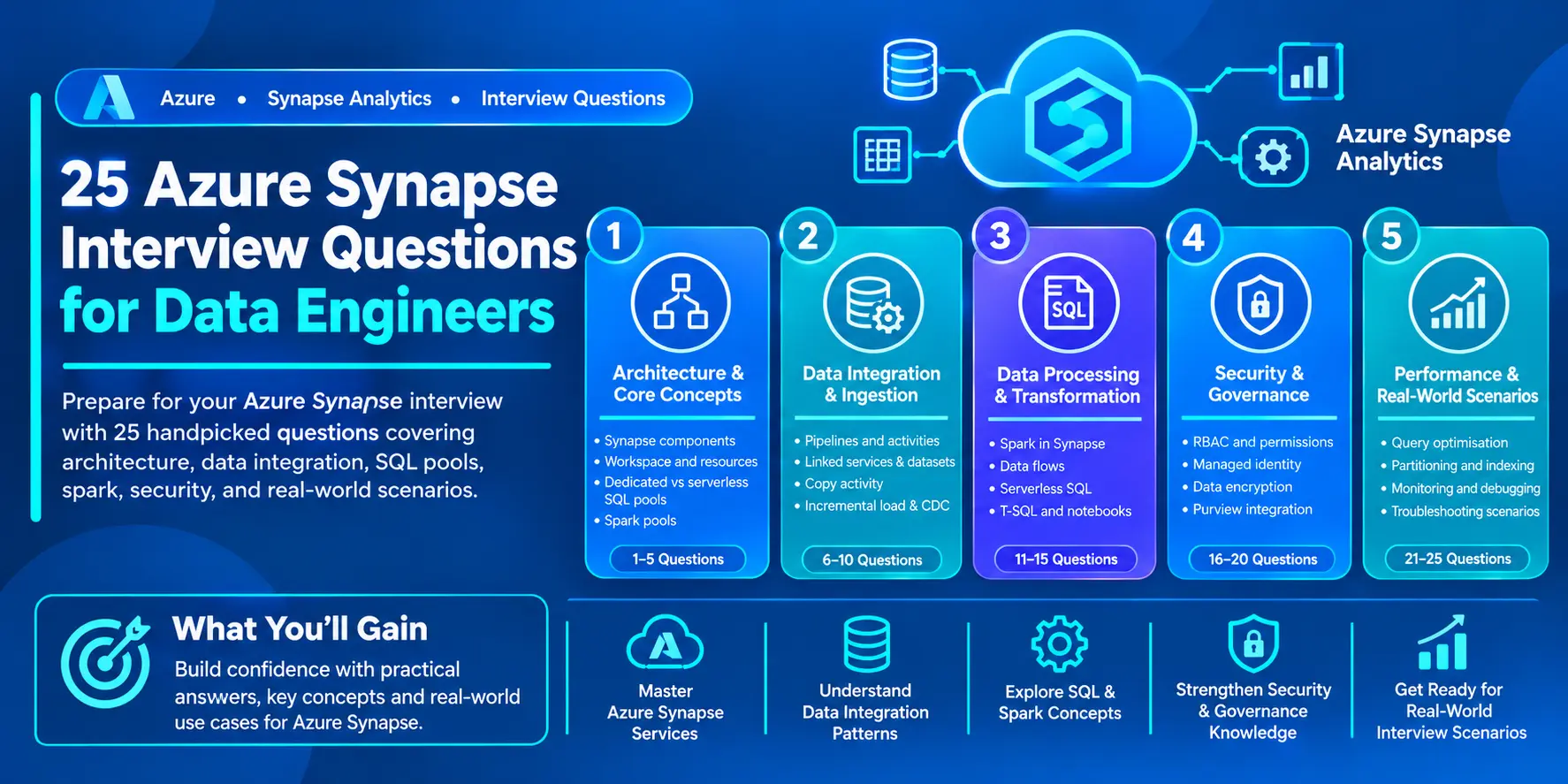
25 Azure Synapse Interview Questions for Data Engineers
If you are preparing for an Azure Data Engineer role in Pune, there is one topic you simply cannot skip: Azure Synapse Analytics. Whether the opening is at a Hinjewadi product company, a Kharadi captive centre or a Magarpatta consulting firm, Synapse questions show up in almost every technical round. Interviewers use them to test whether you understand how a modern Azure data platform really works—not just whether you can click through the portal.
At IntelliBI Innovations Technologies, our learners in the Azure Data Engineer Course in Pune go through mock interviews with senior engineers every batch. Over hundreds of these sessions, we have seen the same Synapse questions appear again and again. This guide collects the 25 most important ones, with answers written the way a working data engineer would explain them. Read it once for understanding, then once more out loud, because interviewers reward clear explanations backed by project experience.
Section 1: Azure Synapse Fundamentals
1. What is Azure Synapse Analytics, and how is it different from the old Azure SQL Data Warehouse?
Azure Synapse Analytics is Microsoft's unified analytics service that brings together enterprise data warehousing, big data processing and data integration in a single workspace. Azure SQL Data Warehouse was only the MPP (massively parallel processing) SQL engine; Synapse kept that engine as the "dedicated SQL pool" and added serverless SQL pools, Apache Spark pools, Synapse Pipelines, Synapse Link and Synapse Studio. In interviews, make this point clearly: Synapse is a platform, not just a warehouse. This is exactly why a Microsoft Azure Data Engineering Course that teaches SQL, Spark and pipelines together prepares you better than a SQL-only programme.
2. What are the main components of a Synapse workspace?
A Synapse workspace contains: a primary Azure Data Lake Storage Gen2 account; SQL pools (dedicated and serverless); Apache Spark pools; Synapse Pipelines for orchestration; Synapse Studio as the web IDE; integration runtimes; and linked services that connect to external data. Managed identities, Key Vault integration and Git configuration sit around these. Candidates from our Azure Training in Pune usually draw this as a quick diagram on the whiteboard, which interviewers appreciate.
3. What is the difference between a dedicated SQL pool and a serverless SQL pool?
A dedicated SQL pool is provisioned compute measured in Data Warehouse Units (DWUs). You pay while it is running, data is stored inside the pool in columnstore format, and you get predictable performance for large, repeated analytical workloads. A serverless SQL pool is pay-per-query: you run T-SQL directly over files in the data lake (CSV, Parquet, Delta) and pay per terabyte processed, with no infrastructure to manage. A strong answer adds when to use each: dedicated for curated enterprise warehouses with heavy concurrent BI, serverless for ad-hoc exploration, logical data warehouses and cost-sensitive teams.
4. What is a DWU and how does scaling work?
A Data Warehouse Unit combines CPU, memory and I/O into one abstract measure. DW100c is the smallest; DW30000c is the largest. Scaling up or down takes a few minutes and briefly drops connections, so production teams schedule it. You can also pause a dedicated pool to stop compute charges while storage remains. Interviewers love hearing that you have actually paused pools overnight to save cost on a real project.
5. Explain the MPP architecture of a dedicated SQL pool.
A control node receives the query, the distributed query engine creates a plan, and the work is split across up to 60 compute distributions. Each distribution holds a slice of every table. The Data Movement Service (DMS) shuffles data between distributions when joins or aggregations need it. Minimising data movement is the whole art of Synapse performance tuning, which leads directly to the next section.
Section 2: Table Design and Performance in Synapse SQL
6. What are the three table distribution types and when do you use each?
Hash distribution assigns rows to distributions based on a column value; use it for large fact tables, choosing a column with high cardinality, few nulls and frequent joins. Round-robin spreads rows evenly without a key; it is the default and is fine for staging tables. Replicated tables keep a full copy on every compute node; use them for small dimension tables under about 2 GB. This question appears in nearly every Azure Data Engineer interview, and it is covered in depth during the Azure ETL Training in Pune modules at IntelliBI.
7. How do you choose a good hash distribution column?
Pick a column that is frequently used in JOIN, GROUP BY and DISTINCT clauses, has many unique values, is not updated, and is not a date column (which causes temporal skew). Check skew after loading with DBCC PDW_SHOWSPACEUSED. If one distribution holds far more rows than the others, queries wait for the slowest distribution.
8. What is data skew and how do you fix it?
Data skew means an uneven distribution of rows across the 60 distributions, so a few do most of the work. Fixes include choosing a different hash column, creating a composite surrogate key, or switching a small table to replicated. Mentioning that you monitored skew with system views and fixed it in a real project is a strong differentiator.
9. What index types are available in a dedicated SQL pool?
Clustered columnstore index is the default and best for large fact tables because of compression and batch-mode execution. Clustered index (rowstore) suits tables with frequent single-row lookups. Heap tables load fastest and are ideal for staging. Non-clustered indexes can be layered for selective filters. Explain that columnstore works best when row groups are full, roughly one million rows, which is why batch loads beat trickle inserts.
10. What is table partitioning in Synapse and why is it used?
Partitioning splits a table by a column, usually date, so queries can skip irrelevant partitions and so you can load or archive data with fast partition switching instead of slow DELETE statements. A classic interview trap: over-partitioning on a 60-distribution pool creates tiny row groups and hurts columnstore compression. Keep partitions large enough that each one has at least a million rows per distribution.
11. What are materialized views and result-set caching?
Materialized views pre-compute and store query results inside the dedicated pool; the optimiser can automatically use them even when the user's query does not reference the view. Result-set caching stores the final output of a query so an identical repeat query returns instantly. Both are easy wins for Power BI dashboards that repeat the same aggregations, something we build in the capstone projects of our Azure Data Engineer Course in Pune.
12. How does workload management work?
Workload groups and classifiers let you allocate resources to different users or applications, for example reserving 40 percent of resources for the ETL service account during loads and giving BI users higher priority during business hours. Resource classes (smallrc, mediumrc, largerc, xlargerc) are the older mechanism. Showing you understand concurrency limits per DWU level tells the interviewer you have run a shared production warehouse.
13. Compare PolyBase, COPY INTO and bulk insert for loading data.
PolyBase uses external tables to load from the data lake in parallel and was the original fast path. COPY INTO is the newer, simpler T-SQL command that loads Parquet, CSV and ORC directly from ADLS Gen2 with fewer permissions and built-in error handling; Microsoft now recommends it. Bulk insert and SSIS row-by-row methods are slow on MPP. The right answer in 2026 is COPY INTO for most loads.
Section 3: Serverless SQL, Spark Pools and the Data Lake
14. What is OPENROWSET and how do you query the data lake with serverless SQL?
OPENROWSET lets you run a T-SQL query directly over files or folders in ADLS Gen2, specifying format (Parquet, CSV, Delta) and optionally a schema. For repeat use you create external data sources, file formats and external tables, or build a logical data warehouse with views over the lake. Interviewers often follow up with "how do you reduce cost?" The answer: use Parquet or Delta instead of CSV, partition folders by date, and select only needed columns.
15. What is CETAS and when would you use it?
CREATE EXTERNAL TABLE AS SELECT runs a query in a serverless or dedicated pool and writes the result back to the data lake as Parquet files, registering an external table. It is used to materialise transformations without a dedicated pool, to export curated datasets for Databricks or Power BI, and to build the Gold layer in a Medallion architecture.
16. How do Apache Spark pools in Synapse compare with Azure Databricks?
Synapse Spark pools give you a managed Spark runtime inside the Synapse workspace with notebooks, auto-scaling and tight integration with SQL pools and pipelines. Azure Databricks is a separate, more mature Spark platform with Delta Live Tables, Unity Catalog governance, Photon acceleration and stronger ML and streaming tooling. Many Pune enterprises use both: Synapse for the warehouse and orchestration, Databricks for heavy transformation. This is why IntelliBI combines Azure Databricks Training in Pune with Synapse in a single Microsoft Azure Course in Pune rather than teaching them separately.
17. How does Synapse Link work?
Synapse Link creates a near-real-time analytical store from operational sources such as Azure Cosmos DB, Azure SQL Database and Dataverse without ETL jobs and without affecting transactional performance. It is Microsoft's answer to the HTAP (hybrid transactional/analytical processing) requirement, and it is a frequent "modern architecture" question.
18. How do Synapse and Microsoft Fabric relate, and should a data engineer still learn Synapse?
Microsoft Fabric is the newer SaaS platform that builds on Synapse engines, bringing Lakehouse, Warehouse, Data Factory and Power BI together over OneLake. Microsoft positions Fabric as the future, and the DP-700 Fabric Data Engineer certification has replaced the retired DP-203. However, thousands of enterprise warehouses in Pune still run on Synapse dedicated pools, so hiring managers expect both. A good Azure Certification Course in Pune should prepare you for DP-700 while giving you hands-on Synapse skills for today's job descriptions.
Section 4: Synapse Pipelines, Integration and Orchestration
19. How are Synapse Pipelines different from Azure Data Factory?
Synapse Pipelines are built on the same engine as Azure Data Factory and use the same activities, triggers and integration runtimes, but they live inside the Synapse workspace and can run Synapse notebooks and SQL scripts natively. ADF is the standalone service and supports a few extra features such as SSIS integration runtime and wider connector availability. Skills transfer directly, which is why Azure Data Factory Training in Pune is a core module in every serious Azure data engineering programme.
20. What are integration runtimes and when do you use a self-hosted IR?
An integration runtime is the compute that executes pipeline activities. The Azure IR handles cloud-to-cloud movement. A self-hosted IR is installed on a machine inside your network to reach on-premises SQL Server, Oracle or file shares securely without opening inbound ports. Mention high availability by registering multiple nodes to the same self-hosted IR.
21. How do you implement incremental loading in Synapse Pipelines?
Use a watermark pattern: store the last loaded timestamp or ID in a control table, use a Lookup activity to read it, pass it as a parameter to the Copy activity's source query, and update the watermark after success. For change data capture sources, use CDC-enabled connectors or Delta change data feed. Be ready to explain how you handle late-arriving data and reruns idempotently.
22. How do you implement CI/CD for a Synapse workspace?
Connect the workspace to Azure DevOps or GitHub, develop in a feature branch, publish to generate ARM templates, and deploy to test and production workspaces with Azure DevOps release pipelines or GitHub Actions. Parameterise linked services and use Key Vault for secrets. Learners in our Azure Cloud Training in Pune build this pipeline end to end, which turns a theoretical question into a story you can tell.
Section 5: Security, Cost and Scenario Questions
23. How do you secure data in Azure Synapse?
Layer your answer: network security with managed virtual networks and private endpoints; identity with Microsoft Entra ID and managed identities instead of passwords; secrets in Azure Key Vault; data security with Transparent Data Encryption, column-level security, row-level security and dynamic data masking; and access control with workspace RBAC and Synapse roles. Interviewers test whether you can name all five layers.
24. How do you control cost in a Synapse environment?
Pause dedicated pools when idle, scale DWUs on a schedule, use serverless for exploration, store data as Parquet or Delta to cut bytes scanned, set cost control limits on serverless pools, enable result-set caching, and monitor with Azure Cost Management alerts. Cost awareness is now a hiring criterion, not a bonus, and it is something every Best Azure Data Engineering Course in Pune should cover with real billing examples.
25. Scenario: A Power BI dashboard on Synapse has become slow after a year. How do you troubleshoot?
Walk through it systematically. Check for data skew and stale statistics; verify the fact table uses clustered columnstore with healthy row groups; confirm the join columns match the hash distribution; look for data movement operations in the query plan with EXPLAIN or sys.dm_pdw_request_steps; add materialized views for repeated aggregations; enable result-set caching; and review workload management so BI users are not blocked by ETL. Finally, consider whether the dashboard should use an aggregated Gold table instead of raw fact tables. Scenario questions like this are where project experience shows, which is why IntelliBI's capstones mirror real enterprise platforms.
How to Prepare Beyond the 25 Questions
Memorising answers will get you through screening, but not through a senior round. Here is what works for our learners:
Build one end-to-end Synapse project: ingest with pipelines, land in ADLS Gen2, transform with Spark or serverless SQL, serve from a dedicated pool, and visualise in Power BI. Document it on GitHub.
Practise explaining trade-offs out loud: dedicated vs serverless, Synapse vs Databricks, Synapse vs Fabric. Interviewers at Pune MNCs care more about judgment than syntax.
Pair Synapse with certification. The DP-700 exam validates Fabric and Synapse-style data engineering, and the new DP-750 covers Azure Databricks. Our Azure Training in Pune includes guided preparation for both.
Do mock interviews with people who have actually hired data engineers. Feedback on how you structure an answer is worth more than another tutorial.
Why Learn Azure Synapse with IntelliBI in Pune
IntelliBI Innovations Technologies is based at Dange Chowk, Thergaon, ten minutes from Hinjewadi Phase 1, and runs weekday evening and weekend batches built for working professionals. Our trainers bring 10 to 15 years of enterprise data experience from companies such as TCS, Persistent and Deloitte, and every module is project-driven rather than slide-driven. In the Microsoft Azure Course in Pune, Synapse is taught alongside Azure Data Factory, Azure Databricks, ADLS Gen2, Key Vault, Entra ID and a GenAI module covering RAG, Genie and agentic tooling, so you graduate with the full stack that current job descriptions demand.
With 2,200+ career transformations, a 4.9-star Google rating and placement support that continues until you are placed, IntelliBI's Azure Certification Course in Pune is designed to take you from these 25 questions to a confident offer letter. Book a free demo class, bring your toughest Synapse question, and let our mentors show you how an interview-ready answer sounds.